Loading...
Georges Bidault vs Julius Caesar
Julius Caesar leads by 32.9 pts · 2 figures compared
…
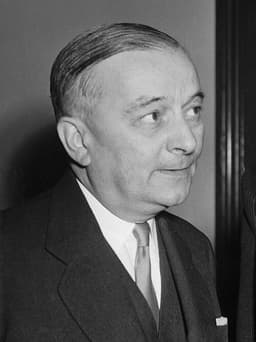
Georges Bidault
Politician · Modern
49.9Total

Julius Caesar
General · Ancient
82.8Total
Basic Information
Born
1899
-100
Died
1983
-44
Era
Modern
Ancient
Nationality
France
Roman Republic
Occupation
Politician
General
Civilization
Western
Western
Score Comparison
Military (10%)
39.9
88.0
Political (20%)
46.6
78.0
Influence (20%)
51.8
85.0
Legacy (20%)
43.3
82.0
Leadership (15%)
65.0
80.0
Strategy (15%)
54.3
85.0
TOTAL
49.9
82.8
Georges Bidault — Complete Timeline
1943 AD
Leadership of the French Resistance and CNRPolitical Action◆ Major
Bidault became president of the National Council of the Resistance (CNR) in 1943, unifying various resistance groups under de Gaulle's authority. He helped coordinate resistance activities and drafted the CNR's program for post-war social and economic reforms, which influenced the Fourth Republic.
French ResistanceWorld War IICNR
Impact: nationalconstructive
1946 AD
First Term as Prime Minister and Foreign PolicyPolitical Action
Bidault served as Prime Minister from June to December 1946, leading a tripartite government of Socialists, Communists, and MRP. He focused on foreign policy, including negotiations for the Marshall Plan and the establishment of the Fourth Republic's constitution, but faced internal coalition tensions.
Fourth RepublicGovernmentPost-War
Impact: nationalconstructive
1949 AD
Second Term as Prime Minister and the Indochina WarPolitical Action◆ Major
Bidault became Prime Minister again in 1949, overseeing France's involvement in the First Indochina War. He supported the creation of the Associated State of Vietnam under Emperor Bao Dai, but the war continued without resolution, and his government fell in 1950 due to economic and colonial issues.
Indochina WarColonial PolicyFourth Republic
Impact: globaldestructive
1958 AD
Opposition to de Gaulle and the Algerian WarPolitical Action◆ Major
Bidault opposed de Gaulle's return to power in 1958 and his policy of Algerian self-determination. He became a leader of the Organisation de l'arm
Algerian WarOASFifth Republic
Impact: nationaldestructive
Julius Caesar — Complete Timeline
58 BC
Gallic WarsWar◆ Major
Caesar, as proconsul of Gaul, launched a series of campaigns that conquered all of Gaul (modern France, Belgium, and parts of Switzerland). He fought numerous battles, including against the Helvetii, the Belgae, and the Gallic chieftain Vercingetorix. The wars brought immense wealth and a loyal army to Caesar.
Gallic WarsConquestRoman Expansion
Impact: regional
49 BC
Crossing the RubiconPolitical Action◆ Major
Caesar led Legio XIII across the Rubicon River into Italy, defying the Roman Senate's order to disband his army. This act triggered a civil war against Pompey and the Optimates, ultimately leading to Caesar's dictatorship and the end of the Roman Republic.
Roman Civil WarEnd of RepublicPower Struggle
Impact: global
48 BC
Battle of PharsalusWar◆ Major
Caesar's outnumbered army defeated the larger forces of Pompey the Great at Pharsalus in Greece. Caesar's tactical use of a reserve line to counter Pompey's cavalry charge proved decisive. Pompey fled to Egypt, where he was assassinated, leaving Caesar as the undisputed master of the Roman world.
Roman Civil WarBattleDecisive Victory
Impact: regional
44 BC
Appointment as Dictator for LifePolitical Action◆ Major
The Roman Senate appointed Caesar dictator perpetuo (dictator for life), granting him unprecedented personal power. This move concentrated military, legislative, and judicial authority in one person, effectively ending the Roman Republic's traditional system of checks and balances and alarming many senators.
DictatorshipEnd of RepublicPower Consolidation
Impact: regionaldestructive
Assassination on the Ides of MarchPolitical Action◆ Major
A group of Roman senators, led by Marcus Junius Brutus and Gaius Cassius Longinus, stabbed Caesar to death at a meeting of the Senate in the Theatre of Pompey. The assassination was intended to restore the Republic, but instead triggered another civil war that led to the rise of the Roman Empire.
AssassinationRoman PoliticsEnd of Republic
Impact: globaldestructive
Expert Analysis
georges-bidault-vs-julius-caesar
### The Crosser and the Resister: Caesar and Bidault on the Stage of History
In the chill of a January dawn in 49 BCE, a single general stood on the bank of a small, muddy river in northern Italy. The Rubicon was a boundary, a line in the sand that no Roman commander could cross with an army. On the other side lay civil war, proscription, and the death of a five-hundred-year-old republic. Julius Caesar hesitated, then plunged. Nearly two thousand years later, in the summer of 1943, a history professor with a false identity and a price on his head slipped through a Gestapo checkpoint in Lyon. Georges Bidault, a man of words and underground meetings, took the chair of the National Council of the Resistance, uniting a fractured, hunted nation against an occupying empire. One man crossed a river to seize power; the other crossed a shadow world to resist it. Their lives, separated by millennia, ask the same question: what does it mean to act when history is a knife’s edge?
### Origins
Caesar was born into a patrician family that had fallen from grace. The Rome of his youth was a violent, competitive arena where senatorial factions murdered rivals in the streets. His father died when he was sixteen, leaving him to navigate the treacherous waters of Roman politics alone. He learned early that survival meant audacity. He borrowed fortunes he could not repay to fund spectacles, seduced the wives of powerful men, and fled Rome to avoid Sulla’s proscriptions. His era was one of collapse—the old Republic, built on tradition and law, was rotting from within. For a man of ambition, this was not a tragedy; it was an opportunity.
Bidault was born in 1899 in Moulins, central France, into a solidly bourgeois Catholic family. He was a scholar, not a soldier—a history teacher who became a journalist. His France was the Third Republic, a regime of parliamentary squabbles and colonial pride. The Great War had bled his generation white, and the interwar years were a fog of economic crisis and creeping fascism. When the Germans marched into Paris in 1940, Bidault was forty-one, too old to fight, too stubborn to submit. His era was one of occupation, where the state itself became the enemy. For a man of conscience, this was not an opportunity; it was a duty.
### Rise to Power
Caesar’s ascent was a masterpiece of calibrated risk. He won the consulship in 59 BCE by forming the First Triumvirate with Pompey and Crassus—an illegal private alliance that controlled Rome. As governor of Gaul, he spent eight years in brutal campaigns, conquering a territory larger than Italy itself. He wrote his own dispatches, *Commentaries on the Gallic War*, a propaganda masterpiece that turned a provincial war into a heroic saga. When the Senate ordered him to disband his army, he refused. The Rubicon crossing in 49 BCE was not a rebellion; it was a coup dressed as a defense of his honor.
Bidault’s rise was slower, quieter, and far more dangerous. He joined the Resistance in 1941 after the fall of France, writing for underground newspapers under pseudonyms. In 1943, the Gestapo arrested Jean Moulin, de Gaulle’s envoy to unify the Resistance. Bidault was chosen to replace him as president of the CNR. He had no army, no treasury, no public platform—only a network of couriers, safe houses, and a radio link to London. His power was the power of trust. While Caesar conquered Gaul with legions, Bidault unified the French Resistance with handshakes and coded messages.
### Leadership & Governance
Caesar governed like a storm. As dictator, he reformed the calendar, gave land to veterans, extended citizenship to Gauls, and centralized the debt system. He ruled by personal authority, bypassing the Senate entirely. His military genius was unmatched: at Alesia (52 BCE) he besieged a Gallic army while simultaneously building defenses against a relief force, winning a double victory that ended the Gallic Wars. But his governance was brittle. He packed the Senate with his supporters, issued coins with his own image, and accepted the title “dictator for life.” He treated the Republic as a stage for his own drama.
Bidault governed in the wreckage of war. As Prime Minister in 1946 and again in 1949–1950, he presided over a France struggling to rebuild. He was a staunch Atlanticist, pushing for NATO and European cooperation, but his governments were coalitions of Socialists, Communists, and Christian Democrats—an alliance that could not last. His political wisdom was real but limited: he understood the need for a strong France in a divided Europe, but he was blind to the tides of decolonization. He supported the First Indochina War, committing French troops to a conflict that would bleed the nation dry. Where Caesar expanded Rome’s borders, Bidault tried to hold France’s empire together with tape and treaties.
### Triumph & Tragedy
Caesar’s greatest triumph was the conquest of Gaul—a feat that added a vast, wealthy province to Rome and made him the richest man in the Republic. His greatest tragedy was the Ides of March, 44 BCE, when sixty senators stabbed him to death in the Senate chamber. He died not because he was weak, but because he was too powerful. The Republic he had bent to his will could not survive him. His assassination did not restore liberty; it unleashed another civil war, which ended with his adopted son Octavian becoming the first emperor.
Bidault’s triumph was the Liberation. In 1944, when Paris rose against the Germans, the CNR under his leadership coordinated the uprising. He stood beside de Gaulle at the Arc de Triomphe, a symbol of a nation that had refused to die. His tragedy was Algeria. In the 1950s, as the Algerian War of Independence raged, Bidault became a hardliner, opposing any negotiation with the FLN. When de Gaulle returned to power in 1958 and moved toward Algerian self-determination, Bidault broke with him entirely. He joined the Organisation armée secrète (OAS), a terrorist group that bombed and assassinated to keep Algeria French. The resister became a renegade, a man who had fought for France’s freedom now fighting to deny it to others.
### Character & Destiny
Caesar was driven by an insatiable need for glory. He was charming, ruthless, and endlessly calculating. He forgave his enemies—until it was convenient to kill them. His character was a paradox: a man who could weep at the death of a friend and order the massacre of a Gallic tribe without flinching. His destiny was to destroy what he could not fix. The Republic needed reform; he gave it revolution. He died because he believed his own myth, that he was above the rules.
Bidault was driven by a different fire: a sense of duty shaped by Catholic moralism and French patriotism. He was stubborn, principled, and tragically inflexible. He could unite the Resistance because he believed in a single, indivisible France. But that same conviction made him unable to accept that France itself was changing. His character was also a paradox: a man who risked death to liberate his country, then risked his reputation to suppress another’s liberation. His destiny was to be left behind by history, a hero of one war and a villain of the next.
### Legacy
Caesar’s legacy is the Roman Empire. His name became a title—Kaiser, Tsar—and his reforms shaped Western governance for two millennia. He is remembered as a genius, a tyrant, and a martyr, all at once. Every leader who ever crossed a line and called it destiny walks in his shadow.
Bidault’s legacy is thinner, more ambiguous. He is remembered as a Resistance hero, a founder of the Fourth Republic, and a symbol of French intransigence in Algeria. His name does not echo through the ages; it sits in the footnotes of history books. He belonged to a moment, not an epoch.
### Conclusion
One man crossed a river and changed the world. The other crossed a shadow and saved a nation. Caesar’s ambition broke the world he knew; Bidault’s loyalty broke the world he loved. They remind us that the same qualities—courage, conviction, the willingness to act alone—can produce both empire and exile, triumph and tragedy. History does not judge by intention alone. It judges by what remains.
Rankings
🥇
Julius CaesarLeader
Mil: 88.0Pol: 78.0Inf: 85.0
82.8
🥈
Georges Bidault
Mil: 39.9Pol: 46.6Inf: 51.8
49.9
+32.9 behind
How This Comparison Works
Algorithm
Each figure is scored on 6 dimensions (0—100 scale) based on structured historical data: Military (10%), Political (20%), Influence (20%), Legacy (20%), Leadership (15%), Strategy (15%). The weighted total produces the final ranking.
Data Sources
Scores are computed from structured sub-indicators in the database. Scale factors adjust for era (Ancient ×0.85, Modern ×1.0) and civilization size (Eastern ×1.05, Other ×0.80) to account for differences in population and military scale.
Maximum 3 Figures
Comparisons are limited to 2—3 figures to ensure readability and statistical meaningfulness.
Error Margins
±5 points per dimension — Sub-scores are derived from historical records with inherent uncertainty. Two figures within 5 points on a dimension should be considered roughly equivalent in that area.
Total Score Accuracy
±3 points overall — The weighted combination of 6 dimensions produces a total score with approximately ±3 points of uncertainty. Differences of less than 3 points are not statistically significant— the figures are effectively tied.
Known Limitations
- Historical records are incomplete and uneven across civilizations
- Figures from oral-tradition societies may be underrepresented
- Occupation labels can misclassify multi-role figures
- Scores measure capability and impact, not moral character
- Quantitative scoring is a comparison tool, not absolute truth
Capability Radar
Military (10%) — Battles & Warfare
Battles
10
95
Win Rate
10
92
Expansion
5
97
Political (20%) — Governance & Reform
Reform
40
90
Diplomacy
45
85
Economy
30
82
Influence (20%) — Cultural & Global Reach
Cultural
20
88
Global
30
94
Legacy (20%) — Historical Impact
Historical
40
95
Longevity
20
96
Leadership (15%) — Power & Stability
Tenure
55
75
Stability
25
60
Strategy (15%) — Tactics & Innovation
Strategy
20
94
Tactics
20
96
Reform
5
88
Similar Comparisons
Comments & Discussion
No comments yet. Be the first to share your thoughts!