Loading...
George Washington vs Theodosius I
George Washington leads by 0.8 pts · 2 figures compared
…
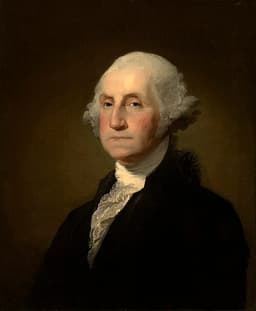
George Washington
Politician · Modern
76.8Total

Theodosius I
Emperor · Ancient
76.0Total
Basic Information
Born
1732
347
Died
1799
395
Era
Modern
Ancient
Nationality
United States
Roman Empire
Occupation
Politician
Emperor
Civilization
Western
Western
Score Comparison
Military (10%)
75.0
72.5
Political (20%)
82.0
65.0
Influence (20%)
75.0
85.0
Legacy (20%)
80.0
90.0
Leadership (15%)
85.0
68.0
Strategy (15%)
55.0
50.0
TOTAL
76.8
76.0
George Washington — Complete Timeline
1775 AD
Appointed Commander-in-Chief of the Continental ArmyOther◆ Major
The Second Continental Congress appointed Washington as commander-in-chief of the Continental Army on June 15, 1775. He accepted the position without pay, taking command of the forces besieging Boston at the start of the American Revolutionary War.
American RevolutionMilitary Leadership
Impact: national
1776 AD
Crossed the Delaware RiverOther◆ Major
On the night of December 25-26, 1776, Washington led 2,400 troops across the ice-choked Delaware River. The surprise attack on Hessian forces at Trenton resulted in a decisive American victory, capturing nearly 1,000 prisoners and reviving Patriot morale after a series of defeats.
American RevolutionBattleTurning Point
Impact: nationalconstructive
1787 AD
Presided over the Constitutional ConventionPolitical Action◆ Major
Washington served as president of the Constitutional Convention in Philadelphia from May to September 1787. His presence lent legitimacy to the proceedings, and he formally signed the final draft of the U.S. Constitution, though he contributed little to the debates.
ConstitutionFounding Father
Impact: national
1789 AD
Inaugurated as First President of the United StatesPolitical Action◆ Major
Washington was unanimously elected by the Electoral College and inaugurated on April 30, 1789, at Federal Hall in New York City. He established numerous executive branch precedents, including the cabinet system, the inaugural address, and the title 'Mr. President'.
PresidencyFounding Father
Impact: national
1793 AD
Issued the Proclamation of NeutralityOther◆ Major
Washington issued the Proclamation of Neutrality on April 22, 1793, declaring the United States neutral in the conflict between France and Great Britain. This decision established the precedent of American isolationism and avoided entanglement in European wars.
Foreign PolicyNeutrality
Impact: national
1796 AD
Delivered the Farewell AddressOther◆ Major
Washington published his Farewell Address on September 19, 1796, announcing his decision not to seek a third term. The address warned against political factionalism, permanent foreign alliances, and the influence of the military in government, shaping American political culture.
PresidencyLegacy
Impact: national
Theodosius I — Complete Timeline
380 AD
Edict of ThessalonicaPolitical Action
Theodosius I issued the Edict of Thessalonica, declaring Nicene Christianity the official state religion of the Roman Empire. All other forms of Christianity were deemed heretical, and pagan practices were increasingly suppressed.
ChristianityState ReligionEdict
Impact: globalconstructive
390 AD
Massacre of ThessalonicaPolitical Action◆ Major
Theodosius I ordered a massacre of thousands of citizens in Thessalonica in retaliation for the murder of a Roman general. The massacre led to his excommunication by Bishop Ambrose of Milan, and he later performed public penance.
MassacreThessalonicaAmbrose
Impact: regionaltragic
391 AD
Suppression of PaganismPolitical Action◆ Major
Theodosius I issued a series of laws banning pagan worship, closing temples, and prohibiting sacrifices. The Olympic Games were abolished, and the Serapeum in Alexandria was destroyed. These actions accelerated the decline of paganism in the empire.
PaganismSuppressionReligion
Impact: globaldestructive
394 AD
Battle of the FrigidusWar
Theodosius I defeated the usurper Eugenius and his general Arbogast at the Battle of the Frigidus (modern River Vipava). The victory reunited the Roman Empire under a single ruler for the last time before its permanent division.
Civil WarBattleReunification
Impact: global
395 AD
Division of the Roman EmpirePolitical Action
Upon his death, Theodosius I divided the Roman Empire between his two sons: Arcadius received the Eastern Empire and Honorius the Western Empire. This division became permanent, leading to the separate histories of the Byzantine and Western Roman Empires.
DivisionSuccessionEast-West
Impact: global
Expert Analysis
Origins
George Washington was born into a Virginia planter family in 1732, gaining early military experience during the French and Indian War. His management of Mount Vernon and involvement in colonial politics shaped his pragmatic leadership style. Theodosius I, born in Hispania around 347 AD, was the son of a Roman general. He rose through military ranks, becoming emperor in 379 AD after a period of civil war. His upbringing in a Christian family and military background influenced his authoritarian and religious policies.
Rise to Power
Washington's rise came through his role as a delegate to the Continental Congress and his appointment as Commander-in-Chief of the Continental Army in 1775. His leadership during the Revolutionary War, including the crossing of the Delaware River and the winter at Valley Forge, solidified his reputation. Theodosius I was proclaimed emperor by Gratian after the Battle of Adrianople. He consolidated power by defeating rivals like Maximus and Eugenius, and through the Edict of Thessalonica (380 AD) made Nicene Christianity the state religion.
Leadership & Governance
Washington's leadership emphasized republican virtue, civilian control of the military, and constitutional governance. As president, he established precedents like the cabinet system and neutrality in foreign affairs (Proclamation of Neutrality, 1793). Theodosius I ruled as an autocrat, enforcing religious uniformity through laws against paganism and heresy. He divided the Roman Empire between his sons after his death, a move that weakened the empire. Both leaders faced crises: Washington the Whiskey Rebellion, Theodosius the Massacre of Thessalonica (390 AD) for which he did penance.
Triumph & Tragedy
Washington's triumphs include leading the Continental Army to victory at Yorktown, presiding over the Constitutional Convention, and establishing a stable federal government. His tragedy lies in his ownership of slaves, which contradicted his ideals of liberty. Theodosius I triumphed in making Christianity dominant and defeating usurpers, but his division of the empire and suppression of paganism contributed to the empire's decline. His penance after the Thessalonica massacre shows a blend of imperial power and church authority.
Character & Destiny
Washington was reserved, disciplined, and focused on duty. His Farewell Address warned against factionalism and foreign entanglements, shaping American foreign policy for a century. Theodosius I was zealous, sometimes ruthless, but also capable of humility. His destiny was to cement Christian orthodoxy, but at the cost of religious diversity and imperial unity. Washington's character earned him the title "Father of His Country," while Theodosius's legacy is tied to the Christianization of Rome.
Legacy
Washington's legacy is foundational: the peaceful transfer of power, the two-term tradition, and the ideal of republican leadership. He is consistently ranked among the greatest U.S. presidents. Theodosius I is remembered for making Christianity the state religion, which shaped Western civilization. However, his division of the empire and persecution of pagans are criticized. Both are monumental figures, but Washington's influence on democratic governance and global revolutions is more enduring and positive.
Conclusion
George Washington and Theodosius I represent different models of leadership: one a republican founding father, the other an imperial religious reformer. Washington's scores (M=75, P=82, I=75, L=80, D=85, S=55, T=77) reflect his balanced achievements and moral complexities. Theodosius's scores (M=72, P=65, I=85, L=90, D=68, S=50, T=76) show high influence and leadership but lower durability and strategy due to the empire's eventual fall. Overall, Washington's contributions to modern democracy give him an edge in historical impact.
Rankings
🥇
George WashingtonLeader
Mil: 75.0Pol: 82.0Inf: 75.0
76.8
🥈
Theodosius I
Mil: 72.5Pol: 65.0Inf: 85.0
76.0
+0.8 behind
How This Comparison Works
Algorithm
Each figure is scored on 6 dimensions (0—100 scale) based on structured historical data: Military (10%), Political (20%), Influence (20%), Legacy (20%), Leadership (15%), Strategy (15%). The weighted total produces the final ranking.
Data Sources
Scores are computed from structured sub-indicators in the database. Scale factors adjust for era (Ancient ×0.85, Modern ×1.0) and civilization size (Eastern ×1.05, Other ×0.80) to account for differences in population and military scale.
Maximum 3 Figures
Comparisons are limited to 2—3 figures to ensure readability and statistical meaningfulness.
Error Margins
±5 points per dimension — Sub-scores are derived from historical records with inherent uncertainty. Two figures within 5 points on a dimension should be considered roughly equivalent in that area.
Total Score Accuracy
±3 points overall — The weighted combination of 6 dimensions produces a total score with approximately ±3 points of uncertainty. Differences of less than 3 points are not statistically significant— the figures are effectively tied.
Known Limitations
- Historical records are incomplete and uneven across civilizations
- Figures from oral-tradition societies may be underrepresented
- Occupation labels can misclassify multi-role figures
- Scores measure capability and impact, not moral character
- Quantitative scoring is a comparison tool, not absolute truth
Capability Radar
Military (10%) — Battles & Warfare
Battles
75
65
Win Rate
70
60
Expansion
60
45
Political (20%) — Governance & Reform
Reform
90
85
Diplomacy
85
75
Economy
65
60
Influence (20%) — Cultural & Global Reach
Cultural
85
90
Global
85
90
Legacy (20%) — Historical Impact
Historical
95
95
Longevity
90
95
Leadership (15%) — Power & Stability
Tenure
70
70
Stability
85
55
Strategy (15%) — Tactics & Innovation
Strategy
80
60
Tactics
65
55
Reform
85
50
Similar Comparisons
Comments & Discussion
No comments yet. Be the first to share your thoughts!