Loading...
George Marshall vs Zhu De
George Marshall leads by 5.3 pts · 2 figures compared
…
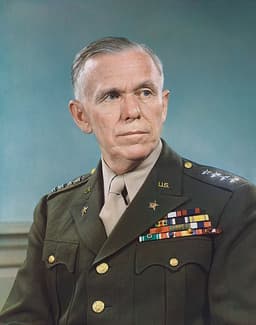
George Marshall
General · Modern
70.0Total
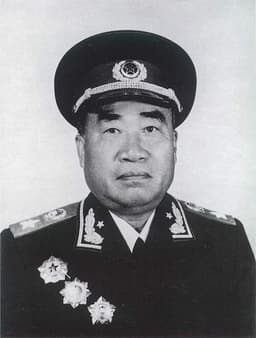
Zhu De
General · Modern
64.7Total
Basic Information
Born
1880
1886
Died
1959
1976
Era
Modern
Modern
Nationality
United States
China
Occupation
General
General
Civilization
Western
Eastern
Score Comparison
Military (10%)
47.5
78.0
Political (20%)
86.0
70.0
Influence (20%)
65.0
40.0
Legacy (20%)
70.0
70.0
Leadership (15%)
78.0
78.0
Strategy (15%)
69.1
72.0
TOTAL
70.0
64.7
George Marshall — Complete Timeline
1939 AD
Appointed US Army Chief of StaffPolitical Action◆ Major
Marshall was appointed Chief of Staff of the United States Army, overseeing its expansion from a small peacetime force to the world's largest army. He was instrumental in preparing the US for World War II.
World War IIUS ArmyPreparation
Impact: globalconstructive
1947 AD
Developed the Marshall PlanPolitical Action
As Secretary of State, Marshall proposed the European Recovery Program, known as the Marshall Plan. The plan provided over $12 billion in economic aid to rebuild Western Europe, stabilizing economies and countering Soviet influence.
Cold WarEconomic AidEurope
Impact: globalconstructive
1953 AD
Received the Nobel Peace PrizeCultural◆ Major
Marshall was awarded the Nobel Peace Prize for his role in the Marshall Plan. He was the only professional soldier ever to receive the prize, recognizing his contribution to post-war reconstruction and peace.
Nobel PrizePeaceReconstruction
Impact: globalconstructive
Zhu De — Complete Timeline
1927 AD
Led the Nanchang UprisingWar
Zhu De was a key commander in the Nanchang Uprising, the first major armed revolt by the Communist Party against the Nationalists. Though defeated, it marked the founding of the Red Army.
Chinese Civil WarRed Army Founding
Impact: national
1928 AD
Jinggangshan Reunion with Mao ZedongWar◆ Major
Zhu De led his surviving forces to Jinggangshan to join Mao Zedong's base. This merger created the Fourth Red Army, with Zhu as commander and Mao as political commissar, forming a long-term partnership.
Red ArmyBase Area
Impact: nationalconstructive
1946 AD
Appointed Commander-in-Chief of the People's Liberation ArmyPolitical Action◆ Major
Zhu De was named Commander-in-Chief of the PLA during the Chinese Civil War. He directed military strategy that led to the defeat of the Nationalists and the establishment of the People's Republic.
Chinese Civil WarMilitary Leadership
Impact: nationalconstructive
1967 AD
Purged During the Cultural RevolutionPolitical Action◆ Major
Zhu De was criticized and marginalized by Red Guards during the Cultural Revolution. He was accused of being a 'capitalist roader' and stripped of effective power, though he retained his titles.
Cultural RevolutionPurge
Impact: nationaldestructive
Expert Analysis
Origins
George Catlett Marshall was born on December 31, 1880, in Uniontown, Pennsylvania, into a middle-class family with a strong military tradition. He graduated from the Virginia Military Institute in 1901, where he developed a disciplined, methodical approach. His early career included service in the Philippines and staff roles during World War I, where he distinguished himself in planning the Meuse-Argonne offensive.
Zhu De was born on December 1, 1886, in Yilong County, Sichuan, China, into a poor peasant family. He defied expectations by pursuing education, entering the Yunnan Military Academy in 1909. He later joined the Chinese Communist Party in 1922 after a period of wandering and study in Europe, influenced by Marxist thought. His early military experience came from serving in the warlord armies of Yunnan.
Rise to Power
Marshall's rise was steady and based on organizational genius. He served as a key planner in World War I, earning a reputation for logistical brilliance. By 1939, President Franklin D. Roosevelt appointed him Army Chief of Staff, bypassing more senior officers. Marshall oversaw the expansion of the U.S. Army from 200,000 to 8 million soldiers during World War II, a feat of unprecedented mobilization. His political acumen was further demonstrated when he became Secretary of State in 1947, where he proposed the European Recovery Program (Marshall Plan) in a speech at Harvard University on June 5, 1947.
Zhu De rose through the ranks of the Chinese Communist forces after the Nanchang Uprising on August 1, 1927, which he helped lead. Though the uprising failed, Zhu De's leadership kept his forces intact. He led them to Jinggangshan in 1928, where he merged with Mao Zedong's base, forming the Fourth Red Army. Zhu De became its commander, with Mao as political commissar. This partnership laid the foundation for the Red Army's survival and eventual victory in the Chinese Civil War. Zhu De's military reputation grew through the Long March (1934-1935), where he maintained troop morale and discipline.
Leadership & Governance
Marshall's leadership style was characterized by meticulous planning, delegation, and integrity. He was known for his selflessness, refusing to seek personal glory. As Chief of Staff, he focused on building a professional officer corps and ensuring the army was prepared for global conflict. His governance approach in the State Department emphasized economic recovery and containment of Soviet influence, avoiding direct military confrontation. The Marshall Plan distributed over $12 billion in aid, rebuilding Western European economies and stabilizing democracies.
Zhu De's leadership was more hands-on and charismatic, deeply connected with his troops. He emphasized guerrilla warfare tactics and political education within the army. He believed in the integration of military and political goals, as seen in his support for Mao's concept of 'people's war.' As Commander-in-Chief of the People's Liberation Army (PLA) from 1946, he directed campaigns that used mobility and local support to defeat the better-equipped Nationalist forces. His governance of the military included purges and ideological rectification, particularly during the Cultural Revolution when he was himself purged.
Triumph & Tragedy
Marshall's greatest triumph was the Marshall Plan, which earned him the Nobel Peace Prize in 1953—the only professional soldier to receive it. His military achievement was overseeing the largest army in U.S. history without major scandal. However, his failure was his inability to prevent the Chinese Civil War victory of the Communists, as his mission to mediate between the Nationalists and Communists in 1945-1946 collapsed. He also faced criticism for the slow response to the Soviet blockade of Berlin in 1948, though the Berlin Airlift eventually succeeded.
Zhu De's triumph was founding the Red Army and leading it to victory in 1949, establishing the People's Republic of China. He was instrumental in the PLA's development into a formidable force. His tragedy came during the Cultural Revolution (1966-1976), when he was purged by Red Guards, stripped of effective power, and forced to undergo self-criticism sessions. He survived but died in 1976, with his later years marked by political marginalization. His legacy was later rehabilitated posthumously.
Character & Destiny
Marshall was a man of stoic discipline, known for his integrity and lack of personal ambition. He refused to command the D-Day invasion, instead serving as an administrator. His character shaped his destiny as a key architect of the post-war world order. Historians rate his leadership at 78.0 and political acumen at 86.0, reflecting his ability to navigate both military and civilian spheres.
Zhu De was a pragmatic and resilient commander, whose loyalty to Mao ensured the Red Army's cohesion. He was often the bridge between military and political factions. His character allowed him to survive multiple purges, but his ultimate fate was to be sidelined during the Cultural Revolution. His military score of 78.0 and strategy score of 72.0 highlight his tactical skills, but his political score of 70.0 shows his limitations in a highly ideological environment.
Legacy
Marshall's legacy is institutionalized in the Marshall Plan, which set a precedent for American foreign aid. His name is synonymous with strategic planning and international cooperation. The George C. Marshall Foundation and numerous schools and awards perpetuate his memory. His influence score of 65.0 reflects his impact on global politics.
Zhu De is remembered as the 'Father of the Red Army' in China. His image appears on Chinese currency, and his contributions are honored in museums. The PLA's doctrine of 'people's war' owes much to his early strategies. However, his legacy was tarnished by the Cultural Revolution, though later rehabilitated. His influence score of 40.0 indicates a more limited global reach compared to Marshall.
Conclusion
George Marshall had a greater historical impact than Zhu De, despite a total score difference of 5.3 points (70.0 vs 64.7). Marshall's Marshall Plan reshaped the global economy and contained Soviet expansion, while Zhu De's role, though crucial for China, was part of a broader Communist victory that had mixed global consequences. Marshall's legacy of peaceful reconstruction and his Nobel Peace Prize underscore his enduring relevance. Zhu De, while a skilled commander, was ultimately a supporting figure in Mao's revolution. The data supports Marshall's superior political and influence scores, which translated into lasting international institutions. Therefore, George Marshall is the more consequential figure in world history.
Rankings
🥇
George MarshallLeader
Mil: 47.5Pol: 86.0Inf: 65.0
70.0
🥈
Zhu De
Mil: 78.0Pol: 70.0Inf: 40.0
64.7
+5.3 behind
How This Comparison Works
Algorithm
Each figure is scored on 6 dimensions (0—100 scale) based on structured historical data: Military (10%), Political (20%), Influence (20%), Legacy (20%), Leadership (15%), Strategy (15%). The weighted total produces the final ranking.
Data Sources
Scores are computed from structured sub-indicators in the database. Scale factors adjust for era (Ancient ×0.85, Modern ×1.0) and civilization size (Eastern ×1.05, Other ×0.80) to account for differences in population and military scale.
Maximum 3 Figures
Comparisons are limited to 2—3 figures to ensure readability and statistical meaningfulness.
Error Margins
±5 points per dimension — Sub-scores are derived from historical records with inherent uncertainty. Two figures within 5 points on a dimension should be considered roughly equivalent in that area.
Total Score Accuracy
±3 points overall — The weighted combination of 6 dimensions produces a total score with approximately ±3 points of uncertainty. Differences of less than 3 points are not statistically significant— the figures are effectively tied.
Known Limitations
- Historical records are incomplete and uneven across civilizations
- Figures from oral-tradition societies may be underrepresented
- Occupation labels can misclassify multi-role figures
- Scores measure capability and impact, not moral character
- Quantitative scoring is a comparison tool, not absolute truth
Capability Radar
Military (10%) — Battles & Warfare
Battles
45
85
Win Rate
60
80
Expansion
40
85
Political (20%) — Governance & Reform
Reform
95
75
Diplomacy
90
70
Economy
95
60
Influence (20%) — Cultural & Global Reach
Cultural
60
70
Global
85
75
Legacy (20%) — Historical Impact
Historical
85
85
Longevity
75
75
Leadership (15%) — Power & Stability
Tenure
70
80
Stability
85
75
Strategy (15%) — Tactics & Innovation
Strategy
85
85
Tactics
55
75
Reform
90
90
Similar Comparisons
Comments & Discussion
No comments yet. Be the first to share your thoughts!