Loading...
George Marshall vs Julius Caesar
Julius Caesar leads by 12.8 pts · 2 figures compared
…
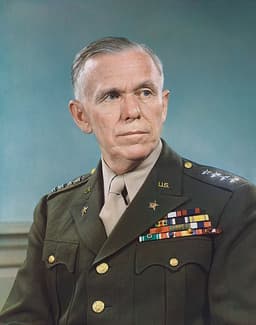
George Marshall
General · Modern
70.0Total

Julius Caesar
General · Ancient
82.8Total
Basic Information
Born
1880
-100
Died
1959
-44
Era
Modern
Ancient
Nationality
United States
Roman Republic
Occupation
General
General
Civilization
Western
Western
Score Comparison
Military (10%)
47.5
88.0
Political (20%)
86.0
78.0
Influence (20%)
65.0
85.0
Legacy (20%)
70.0
82.0
Leadership (15%)
78.0
80.0
Strategy (15%)
69.1
85.0
TOTAL
70.0
82.8
George Marshall — Complete Timeline
1939 AD
Appointed US Army Chief of StaffPolitical Action◆ Major
Marshall was appointed Chief of Staff of the United States Army, overseeing its expansion from a small peacetime force to the world's largest army. He was instrumental in preparing the US for World War II.
World War IIUS ArmyPreparation
Impact: globalconstructive
1947 AD
Developed the Marshall PlanPolitical Action
As Secretary of State, Marshall proposed the European Recovery Program, known as the Marshall Plan. The plan provided over $12 billion in economic aid to rebuild Western Europe, stabilizing economies and countering Soviet influence.
Cold WarEconomic AidEurope
Impact: globalconstructive
1953 AD
Received the Nobel Peace PrizeCultural◆ Major
Marshall was awarded the Nobel Peace Prize for his role in the Marshall Plan. He was the only professional soldier ever to receive the prize, recognizing his contribution to post-war reconstruction and peace.
Nobel PrizePeaceReconstruction
Impact: globalconstructive
Julius Caesar — Complete Timeline
58 BC
Gallic WarsWar◆ Major
Caesar, as proconsul of Gaul, launched a series of campaigns that conquered all of Gaul (modern France, Belgium, and parts of Switzerland). He fought numerous battles, including against the Helvetii, the Belgae, and the Gallic chieftain Vercingetorix. The wars brought immense wealth and a loyal army to Caesar.
Gallic WarsConquestRoman Expansion
Impact: regional
49 BC
Crossing the RubiconPolitical Action◆ Major
Caesar led Legio XIII across the Rubicon River into Italy, defying the Roman Senate's order to disband his army. This act triggered a civil war against Pompey and the Optimates, ultimately leading to Caesar's dictatorship and the end of the Roman Republic.
Roman Civil WarEnd of RepublicPower Struggle
Impact: global
48 BC
Battle of PharsalusWar◆ Major
Caesar's outnumbered army defeated the larger forces of Pompey the Great at Pharsalus in Greece. Caesar's tactical use of a reserve line to counter Pompey's cavalry charge proved decisive. Pompey fled to Egypt, where he was assassinated, leaving Caesar as the undisputed master of the Roman world.
Roman Civil WarBattleDecisive Victory
Impact: regional
44 BC
Appointment as Dictator for LifePolitical Action◆ Major
The Roman Senate appointed Caesar dictator perpetuo (dictator for life), granting him unprecedented personal power. This move concentrated military, legislative, and judicial authority in one person, effectively ending the Roman Republic's traditional system of checks and balances and alarming many senators.
DictatorshipEnd of RepublicPower Consolidation
Impact: regionaldestructive
Assassination on the Ides of MarchPolitical Action◆ Major
A group of Roman senators, led by Marcus Junius Brutus and Gaius Cassius Longinus, stabbed Caesar to death at a meeting of the Senate in the Theatre of Pompey. The assassination was intended to restore the Republic, but instead triggered another civil war that led to the rise of the Roman Empire.
AssassinationRoman PoliticsEnd of Republic
Impact: globaldestructive
Expert Analysis
george-marshall-vs-julius-caesar
# The General and the Statesman
On a raw January morning in 49 BCE, Julius Caesar stood at the banks of the Rubicon River, a small stream separating his province of Gaul from Italy proper. He knew that crossing meant civil war, the end of the Republic he professed to serve, and a destiny that would echo through millennia. Two thousand years later, in the spring of 1947, George Marshall stood before Harvard University’s commencement audience and announced a plan that would rebuild a shattered continent—not with legions, but with loans, grain, and vision. One man crossed a river to seize power; the other crossed an ocean to restore it. What separates these two generals, both masters of war and peace, is not merely time but the very nature of their ambition and the worlds they sought to shape.
Origins
Julius Caesar was born into the chaos of the late Roman Republic, a world of aristocratic feuds, slave revolts, and the dying gasps of a constitutional order. His family, the Julii, claimed descent from the goddess Venus, but they were politically marginal. Caesar’s childhood was marked by the Social War and the rise of Sulla’s dictatorship—brutal lessons in how quickly law could yield to the sword. He learned early that in Rome, survival meant either crushing your enemies or being crushed.
George Marshall, by contrast, came of age in a unified, expanding America. Born in Uniontown, Pennsylvania, in 1880, he was the son of a coal merchant who had fought for the Union in the Civil War. Marshall’s world was one of industrial growth, westward expansion, and a professional military that had just begun to emerge from the shadows of the Civil War. Where Caesar inherited a republic tearing itself apart, Marshall inherited a nation that, for all its flaws, believed in progress through institutions.
Rise to Power
Caesar’s path was forged through debt, bribery, and military glory. He served as a young officer in Asia Minor, then returned to Rome to climb the political ladder—quaestor, aedile, pontifex maximus. But his true breakthrough came when he secured command in Gaul. Over eight years, from 58 to 50 BCE, he conquered a territory larger than Italy itself, amassing a loyal army and immense wealth. His Commentaries on the Gallic Wars were not just history—they were propaganda, crafted to make a provincial campaign seem like the salvation of Rome.
Marshall’s rise was quieter but no less determined. He graduated from the Virginia Military Institute in 1901, then served in the Philippines and France during World War I, where he earned a reputation for meticulous planning. By 1939, when President Franklin Roosevelt appointed him Army Chief of Staff, Marshall was known as a man who could organize chaos. He expanded the U.S. Army from 200,000 to over 8 million soldiers during World War II—a feat of logistics that Caesar could not have imagined. Marshall never commanded troops in battle, but he commanded the system that won the war.
Leadership and Governance
Caesar led from the front. At the Battle of Alesia in 52 BCE, he personally rallied his troops against a Gallic relief force, his presence turning a potential rout into a decisive victory. His military genius lay in speed, audacity, and the ability to inspire men who would follow him to the edge of the known world. As dictator, he reformed the calendar, extended citizenship to provincials, and launched public works. Yet his governance was autocratic—he centralized power, packed the Senate with his supporters, and accepted the title "dictator for life." He believed that only one man could save Rome, and that man was himself.
Marshall’s leadership was institutional. As Secretary of State after the war, he did not seek personal power but the reconstruction of Europe. The Marshall Plan, announced in 1947, provided over $13 billion in aid—roughly $150 billion today—to rebuild economies and prevent the spread of communism. Marshall understood that lasting peace required not conquest but cooperation. Where Caesar demanded loyalty to his person, Marshall demanded loyalty to a vision of shared prosperity. His military strategy had been about winning battles; his political strategy was about winning the peace.
Triumph and Tragedy
Caesar’s greatest triumph was the conquest of Gaul, which made him the richest and most powerful man in the Roman world. His greatest tragedy was the civil war that followed—a war he won, only to be stabbed to death on the Ides of March, 44 BCE, by men he had pardoned and promoted. His assassination plunged Rome into another generation of bloodshed, proving that even genius could not escape the cycles of violence he had helped unleash.
Marshall’s triumph was the Marshall Plan itself, which revived Western Europe and earned him the Nobel Peace Prize in 1953—the only professional soldier ever to receive it. His tragedy was more subtle: he saw the Cold War coming, and he spent his final years warning against militarization and the arms race. He died in 1959, watching the world he had helped save divide again, this time behind walls and nuclear deterrents.
Character and Destiny
Caesar was driven by an insatiable hunger for glory. He once said, "It is better to be the first in a village than second in Rome." His character was a blend of charm, ruthlessness, and intellectual brilliance—he was a writer, a seducer, and a killer. His destiny was to destroy the Republic he claimed to love, because he could not imagine a world where his ambition did not define the age.
Marshall was driven by duty. He turned down the command of the D-Day invasion because he felt it was wrong to leave Washington. He refused to write his memoirs for years, believing that history should judge his work, not his words. His character was stoic, self-effacing, and profoundly institutional. "I have no feeling of bitterness," he once said after being attacked in the press, "because I have no feeling of personal importance." His destiny was to build structures that outlasted him.
Legacy
Caesar’s legacy is the Roman Empire itself. His name became a title—Kaiser, Tsar—and his reforms laid the foundation for centuries of imperial rule. Yet he also bequeathed a template for dictatorship: the general who overthrows the republic, the strongman who promises order and delivers tyranny. His memory is a warning.
Marshall’s legacy is the architecture of the postwar world: NATO, the European Union, the culture of international cooperation that, however imperfect, prevented a third world war. His name adorns a plan, not a throne. He is remembered as a man who used power not to elevate himself but to lift others.
Conclusion
Standing at the Rubicon, Caesar chose himself. Standing at Harvard, Marshall chose Europe. One leapt into the river of history; the other built a bridge. Their differences reveal a profound truth about leadership: that the same skills—strategy, organization, vision—can serve tyranny or democracy, depending on the soul of the person wielding them. Caesar gave the world a legend. Marshall gave it a lesson. And in the end, it is the lesson that lasts.
Rankings
🥇
Julius CaesarLeader
Mil: 88.0Pol: 78.0Inf: 85.0
82.8
🥈
George Marshall
Mil: 47.5Pol: 86.0Inf: 65.0
70.0
+12.8 behind
How This Comparison Works
Algorithm
Each figure is scored on 6 dimensions (0—100 scale) based on structured historical data: Military (10%), Political (20%), Influence (20%), Legacy (20%), Leadership (15%), Strategy (15%). The weighted total produces the final ranking.
Data Sources
Scores are computed from structured sub-indicators in the database. Scale factors adjust for era (Ancient ×0.85, Modern ×1.0) and civilization size (Eastern ×1.05, Other ×0.80) to account for differences in population and military scale.
Maximum 3 Figures
Comparisons are limited to 2—3 figures to ensure readability and statistical meaningfulness.
Error Margins
±5 points per dimension — Sub-scores are derived from historical records with inherent uncertainty. Two figures within 5 points on a dimension should be considered roughly equivalent in that area.
Total Score Accuracy
±3 points overall — The weighted combination of 6 dimensions produces a total score with approximately ±3 points of uncertainty. Differences of less than 3 points are not statistically significant— the figures are effectively tied.
Known Limitations
- Historical records are incomplete and uneven across civilizations
- Figures from oral-tradition societies may be underrepresented
- Occupation labels can misclassify multi-role figures
- Scores measure capability and impact, not moral character
- Quantitative scoring is a comparison tool, not absolute truth
Capability Radar
Military (10%) — Battles & Warfare
Battles
45
95
Win Rate
60
92
Expansion
40
97
Political (20%) — Governance & Reform
Reform
95
90
Diplomacy
90
85
Economy
95
82
Influence (20%) — Cultural & Global Reach
Cultural
60
88
Global
85
94
Legacy (20%) — Historical Impact
Historical
85
95
Longevity
75
96
Leadership (15%) — Power & Stability
Tenure
70
75
Stability
85
60
Strategy (15%) — Tactics & Innovation
Strategy
85
94
Tactics
55
96
Reform
90
88
Similar Comparisons
Comments & Discussion
No comments yet. Be the first to share your thoughts!