Loading...
George Marshall vs Napoleon Bonaparte
Napoleon Bonaparte leads by 0.9 pts · 2 figures compared
…
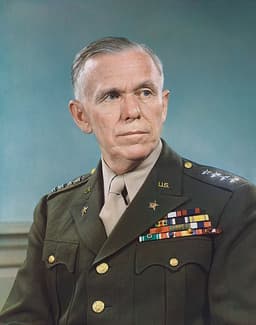
George Marshall
General · Modern
70.0Total

Napoleon Bonaparte
General · Modern
70.9Total
Basic Information
Born
1880
1769
Died
1959
1821
Era
Modern
Modern
Nationality
United States
France
Occupation
General
General
Civilization
Western
Western
Score Comparison
Military (10%)
47.5
94.0
Political (20%)
86.0
72.0
Influence (20%)
65.0
40.0
Legacy (20%)
70.0
80.0
Leadership (15%)
78.0
78.0
Strategy (15%)
69.1
90.0
TOTAL
70.0
70.9
George Marshall — Complete Timeline
1939 AD
Appointed US Army Chief of StaffPolitical Action◆ Major
Marshall was appointed Chief of Staff of the United States Army, overseeing its expansion from a small peacetime force to the world's largest army. He was instrumental in preparing the US for World War II.
World War IIUS ArmyPreparation
Impact: globalconstructive
1947 AD
Developed the Marshall PlanPolitical Action
As Secretary of State, Marshall proposed the European Recovery Program, known as the Marshall Plan. The plan provided over $12 billion in economic aid to rebuild Western Europe, stabilizing economies and countering Soviet influence.
Cold WarEconomic AidEurope
Impact: globalconstructive
1953 AD
Received the Nobel Peace PrizeCultural◆ Major
Marshall was awarded the Nobel Peace Prize for his role in the Marshall Plan. He was the only professional soldier ever to receive the prize, recognizing his contribution to post-war reconstruction and peace.
Nobel PrizePeaceReconstruction
Impact: globalconstructive
Napoleon Bonaparte — Complete Timeline
1799 AD
Coup of 18 BrumaireOther◆ Major
Napoleon Bonaparte, with support from his brother Lucien and key political figures, overthrew the Directory in a bloodless coup. He established the Consulate with himself as First Consul, effectively becoming the ruler of France. This event ended the French Revolution's most unstable period.
French RevolutionCoupRise to Power
Impact: regional
1804 AD
Promulgation of the Napoleonic CodeOther◆ Major
Napoleon enacted the Civil Code of the French, known as the Napoleonic Code, a comprehensive set of laws that replaced the fragmented feudal legal systems. The code established legal equality, protected property rights, and secularized law. It became the basis for legal systems in many European and world countries.
Legal ReformNapoleonic CodeCivil Law
Impact: globalconstructive
1805 AD
Battle of AusterlitzWar◆ Major
Napoleon's Grande Arm
Napoleonic WarsBattleDecisive Victory
Impact: global
1812 AD
Invasion of RussiaWar◆ Major
Napoleon led the Grande Arm
Napoleonic WarsInvasionDisaster
Impact: globaldestructive
1815 AD
Battle of WaterlooWar◆ Major
Napoleon's French army was defeated by the combined forces of the Duke of Wellington's Anglo-Allied army and Gebhard Leberecht von Bl
Napoleonic WarsBattleFinal Defeat
Impact: globaldestructive
Expert Analysis
george-marshall-vs-napoleon-bonaparte
# The General Who Conquered, and the General Who Rebuilt
In the winter of 1947, a tall, silver-haired American stood before a graduating class at Harvard University and spoke not of battlefields or sieges, but of hunger, poverty, and chaos. He proposed something unprecedented: that the United States should spend billions of dollars to rebuild its defeated enemies and devastated allies. Across the Atlantic, a century and a quarter earlier, another general had stood on the deck of a ship in the Mediterranean, watching the pyramids of Egypt recede into the distance, his mind already racing toward the next conquest. One man sought to dominate Europe through force of arms; the other sought to save it through force of generosity. Why did Napoleon Bonaparte and George Marshall—two men who wore the same uniform, faced the same continent, and commanded the same kind of loyalty—produce such opposite outcomes?
Origins
Napoleon was born in 1769 on the island of Corsica, a place that had only recently become French. His family was minor nobility, but poor. He spoke French with an Italian accent and was mocked at military school for his small stature and provincial origins. This humiliation forged something in him: a burning need to prove himself, to rise above every slight. The French Revolution had shattered the old order, and for a young artillery officer of talent, the path to glory lay wide open.
George Marshall was born in 1880 in Uniontown, Pennsylvania, into a comfortable but not wealthy family. His father was a coal merchant who had failed in business. Marshall graduated from the Virginia Military Institute—not West Point—and spent years in the slow, grinding climb of a peacetime army. He was patient, meticulous, and invisible. While Napoleon’s era was one of revolution and chaos, Marshall’s was one of industrial consolidation and global war. The difference in their times shaped the difference in their temperaments: Napoleon was forged in fire, Marshall in stone.
Rise to Power
Napoleon’s rise was meteoric. At 24, he drove the British out of Toulon. At 26, he crushed a royalist uprising in Paris with a “whiff of grapeshot.” At 27, he was given command of the Army of Italy, where he won six battles in a single month. By 30, he was First Consul of France. His path was one of sheer velocity—he did not wait for opportunity; he seized it by the throat.
Marshall’s rise was the opposite. He spent 15 years as a lieutenant. He served in the Philippines, in France during World War I, and then in obscurity during the 1920s and 1930s. His breakthrough came in 1939, when President Franklin Roosevelt appointed him Army Chief of Staff. Marshall was 59 years old—nearly twice Napoleon’s age when he became emperor. Where Napoleon climbed by brilliance and audacity, Marshall climbed by competence and character. He was so trusted that Roosevelt once said, “I feel I could not sleep at night with you out of the country.”
Leadership & Governance
Napoleon governed as he fought: with speed, centralization, and overwhelming force. His Napoleonic Code reformed French law and spread ideas of meritocracy and civil rights across Europe, but his rule was also a military dictatorship. He crowned himself emperor, placed his brothers on thrones, and treated nations as chess pieces. His military genius was undeniable—his campaign at Austerlitz in 1805 remains a masterpiece of strategy and deception. But he never learned to share power or to build institutions that could outlast him.
Marshall governed with a radically different philosophy. As Chief of Staff, he expanded the U.S. Army from 200,000 to over 8 million soldiers, but he did so by delegating authority and trusting his subordinates. He promoted Eisenhower, Bradley, and Patton—men who would later outshine him—because he believed the mission mattered more than his own glory. As Secretary of State in 1947, he proposed the European Recovery Program, which provided over $12 billion (roughly $150 billion today) to rebuild Western Europe. The Marshall Plan was not charity; it was strategy. Marshall understood that poverty bred communism, and that the best way to defeat an enemy was to make him prosperous.
Triumph & Tragedy
Napoleon’s greatest triumph was the Empire at its height in 1810, when he controlled most of Europe and had married the daughter of the Austrian emperor. His greatest tragedy was the invasion of Russia in 1812. He marched 600,000 men into the vastness of the east; fewer than 40,000 returned. His refusal to compromise, his inability to stop, drove him to exile on Elba, then to Waterloo, then to a lonely death on Saint Helena in 1821.
Marshall’s greatest triumph was not a battle but a speech. The Harvard address of 1947 set in motion the economic recovery of a continent. His greatest tragedy was perhaps never commanding troops in combat—a soldier’s deepest wish. He was too valuable as a planner and organizer. When asked what he wanted on his tombstone, he said simply: “He did his duty.”
Character & Destiny
Napoleon was a man of infinite ambition and boundless energy. “Impossible is a word to be found only in the dictionary of fools,” he said. His personality drove him to conquer, but also to overreach. He could not stop because stopping meant admitting limits. His destiny was to rise higher than any man of his age—and to fall further.
Marshall was a man of self-effacing discipline. He refused to seek the presidency, though many urged him. He refused to write memoirs. He said, “I have no desire to be a public figure.” His personality drove him to serve, not to dominate. His destiny was to be the architect of a new world order, not its emperor.
Legacy
Napoleon left a Europe reshaped by war and law. His Code still influences legal systems from France to Louisiana to Japan. But he also left a trail of destruction that cost a million lives. He is remembered as a genius and a tyrant, a liberator and a conqueror.
Marshall left a Europe rebuilt by peace. The Marshall Plan revived economies, stabilized democracies, and created the foundation for the European Union. He is remembered as a statesman in uniform, the only professional soldier ever to win the Nobel Peace Prize, in 1953.
Conclusion
Standing at the end of their lives, one on a windswept Atlantic island, the other in a quiet Washington hospital, both men might have reflected on the same question: What does it mean to lead? Napoleon answered with conquest; Marshall with construction. The one who conquered is remembered in statues and stories of glory. The one who rebuilt is remembered in the prosperity of nations that no longer need to fight. Perhaps the deepest lesson is this: it is harder to build than to destroy, and the greatest generals are not those who win wars, but those who make them unnecessary.
Rankings
🥇
Napoleon BonaparteLeader
Mil: 94.0Pol: 72.0Inf: 40.0
70.9
🥈
George Marshall
Mil: 47.5Pol: 86.0Inf: 65.0
70.0
+0.9 behind
How This Comparison Works
Algorithm
Each figure is scored on 6 dimensions (0—100 scale) based on structured historical data: Military (10%), Political (20%), Influence (20%), Legacy (20%), Leadership (15%), Strategy (15%). The weighted total produces the final ranking.
Data Sources
Scores are computed from structured sub-indicators in the database. Scale factors adjust for era (Ancient ×0.85, Modern ×1.0) and civilization size (Eastern ×1.05, Other ×0.80) to account for differences in population and military scale.
Maximum 3 Figures
Comparisons are limited to 2—3 figures to ensure readability and statistical meaningfulness.
Error Margins
±5 points per dimension — Sub-scores are derived from historical records with inherent uncertainty. Two figures within 5 points on a dimension should be considered roughly equivalent in that area.
Total Score Accuracy
±3 points overall — The weighted combination of 6 dimensions produces a total score with approximately ±3 points of uncertainty. Differences of less than 3 points are not statistically significant— the figures are effectively tied.
Known Limitations
- Historical records are incomplete and uneven across civilizations
- Figures from oral-tradition societies may be underrepresented
- Occupation labels can misclassify multi-role figures
- Scores measure capability and impact, not moral character
- Quantitative scoring is a comparison tool, not absolute truth
Capability Radar
Military (10%) — Battles & Warfare
Battles
45
95
Win Rate
60
90
Expansion
40
95
Political (20%) — Governance & Reform
Reform
95
95
Diplomacy
90
80
Economy
95
85
Influence (20%) — Cultural & Global Reach
Cultural
60
85
Global
85
90
Legacy (20%) — Historical Impact
Historical
85
95
Longevity
75
90
Leadership (15%) — Power & Stability
Tenure
70
85
Stability
85
70
Strategy (15%) — Tactics & Innovation
Strategy
85
95
Tactics
55
98
Reform
90
92
Similar Comparisons
Comments & Discussion
EmperorOfBureaucracy6/17/2026
Marshall’s real victory wasn’t on any battlefield but in Congress. He convinced a war-weary, isolationist America to spend $13 billion—roughly $180 billion today—on rebuilding Europe, including Germany. Napoleon could never have done that. He conquered by fear, not persuasion. Marshall’s greatest weapon was a Harvard speech, not a bayonet. That’s the difference between a tactician and a statesman.
数据铁骑6/17/2026
数据不会撒谎:拿破仑打了60场战役,赢了绝大多数,但他的帝国只撑了11年。马歇尔从未在欧洲指挥过进攻,却在一战后永久重塑了欧洲权力格局。如果胜利是看长期影响,那马歇尔秒杀拿破仑。史诗战役固然精彩,但重建一个大陆才是真本事。
ClassicsSkeptic6/17/2026
Calling Marshall a “general who rebuilt” sanitizes the Cold War reality. The Marshall Plan was a containment policy dressed as charity. Sure, it rebuilt Europe—but it also locked Western Europe into American hegemony and divided the continent further. Napoleon at least aimed for a unified Europe under one legal code, however flawed. Marshall’s “generosity” came with strings attached, painted red, white, and blue.
历史侦探6/17/2026
拿破仑输在了战略膨胀。1812年入侵俄国,60万大军只剩不到10万回来,原因不是敌人太强,而是补给线拉得太长。马歇尔相反,1940年他拒绝陆军扩大规模直到计划完备,宁可被骂“慢”。打仗和治国一样,耐心比勇猛难。拿破仑冲锋一时爽,马歇尔从容写存折。
CenturionOfContrast6/17/2026
Both men understood logistics, but one used it for destruction, the other for construction. Napoleon’s Grande Armée lived off the land because he couldn’t sustain supply lines. Marshall coordinated the largest logistical feat in history—D-Day—and then applied that same skill to civilian aid. One man turned Europe into a graveyard; the other turned it into a rebuilding site. I know which legacy I’d prefer.