Loading...
George I of Great Britain vs George VI
George VI leads by 4.1 pts · 2 figures compared
…
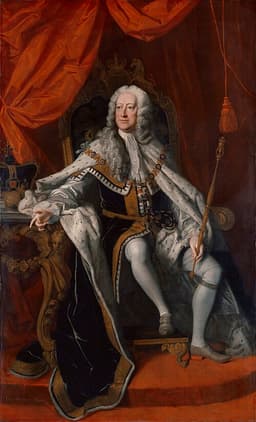
George I of Great Britain
Emperor · Modern
52.2Total

George VI
Emperor · Modern
56.3Total
Basic Information
Born
1660
1895
Died
1727
1952
Era
Modern
Modern
Nationality
United Kingdom
United Kingdom
Occupation
Emperor
Emperor
Civilization
Western
Western
Score Comparison
Military (10%)
21.2
10.0
Political (20%)
68.0
72.0
Influence (20%)
53.3
56.7
Legacy (20%)
45.0
54.0
Leadership (15%)
72.0
72.0
Strategy (15%)
45.0
60.0
TOTAL
52.2
56.3
George I of Great Britain — Complete Timeline
1714 AD
Accession to the British ThronePolitical Action◆ Major
George I became king of Great Britain and Ireland following the death of Queen Anne. He was the first Hanoverian monarch, succeeding under the Act of Settlement 1701. His accession established the House of Hanover on the British throne.
AccessionHanoverian DynastySuccession
Impact: national
1715 AD
Jacobite Rising of 1715War◆ Major
George I faced a Jacobite rebellion aimed at restoring the Stuart claimant James Francis Edward Stuart. The rebellion was suppressed by government forces at the Battle of Preston and the Battle of Sheriffmuir. This defeat secured George's throne.
Jacobite RebellionCivil WarStuart Claimant
Impact: national
1717 AD
Development of Cabinet GovernmentPolitical Action
George I ceased attending Cabinet meetings due to his limited English and lack of interest. This led to the development of the cabinet system under a chief minister, Sir Robert Walpole, who became the first de facto Prime Minister. This shift strengthened parliamentary governance.
Cabinet GovernmentPrime MinisterConstitutional Evolution
Impact: nationalconstructive
1727 AD
Death in HanoverOther
George I died of a stroke while traveling to Hanover. He was buried in the Leineschloss church in Hanover. His death passed the throne to his son George II. His reign established the Hanoverian dynasty in Britain.
DeathHanoverSuccession
Impact: national
George VI — Complete Timeline
1936 AD
Accession to the ThronePolitical Action
George VI became king on December 11, 1936, following the abdication of his brother Edward VIII. He was crowned on May 12, 1937. His reign began under the shadow of constitutional crisis and the looming threat of war in Europe.
CoronationMonarchySuccession
Impact: national
1939 AD
King's Speech BroadcastCultural◆ Major
George VI delivered a radio broadcast to the British Empire on September 3, 1939, announcing the declaration of war against Germany. His speech, delivered despite a stammer, became a symbol of national resolve and unity during World War II.
World War IIBroadcastNational Unity
Impact: global
1940 AD
Remained in London During BlitzPolitical Action◆ Major
George VI and Queen Elizabeth refused to leave London or send their children to safety during the Blitz. They remained at Buckingham Palace, which was bombed on September 13, 1940. Their decision to stay boosted public morale and symbolized shared sacrifice.
World War IIBlitzRoyal Family
Impact: nationalconstructive
1944 AD
Visited Battlefronts in EuropeWar
George VI visited Allied troops in Normandy, France, on June 16, 1944, just ten days after D-Day. He also toured other battlefronts in North Africa and Italy during the war, becoming the first British monarch to visit active combat zones since George II.
World War IIRoyal VisitMilitary
Impact: regionalconstructive
1947 AD
End of British Raj in IndiaPolitical Action◆ Major
George VI relinquished the title of Emperor of India on June 22, 1948, following Indian independence on August 15, 1947. This marked the formal end of British imperial rule in India and the transformation of the monarchy's role in the Commonwealth.
DecolonizationIndiaCommonwealth
Impact: global
Expert Analysis
Origins
**George I** (1660-1727) was born in Hanover, Germany, as the son of Ernest Augustus, Elector of Hanover, and Sophia of the Palatinate. He was raised in the Lutheran faith and educated in German, French, and Latin, but never learned English. His early life was marked by military service against France and involvement in the politics of the Holy Roman Empire. He became Elector of Hanover in 1698 and inherited the British throne in 1714 under the Act of Settlement, which excluded Catholics.
**George VI** (1895-1952) was born at Sandringham House in Norfolk, England, as the second son of King George V and Queen Mary. He was educated at naval colleges and served in the Royal Navy and Royal Air Force during World War I. Unlike his elder brother Edward VIII, he was shy and suffered from a stammer, which he worked to overcome with speech therapist Lionel Logue. His early life was overshadowed by his brother's charisma and his own perceived inadequacies.
Rise to Power
George I became King of Great Britain and Ireland on August 1, 1714, upon the death of Queen Anne, as the closest Protestant heir. His accession was contested by the Jacobites, who supported the Catholic Stuart claimant James Francis Edward Stuart. The Jacobite Rising of 1715 was a major early challenge, but it was suppressed by government forces. George I relied on the Whig party, as the Tories were suspected of Jacobite sympathies. His lack of English and frequent absences in Hanover led him to delegate governance to his ministers, particularly Sir Robert Walpole, who is often considered the first Prime Minister (1721-1742).
George VI became king unexpectedly on December 11, 1936, after his brother Edward VIII abdicated to marry Wallis Simpson. He was crowned on May 12, 1937. His reign began under the shadow of the abdication crisis and the looming threat of Nazi Germany. He adopted the regnal name George VI to emphasize continuity with his father and restore confidence in the monarchy. His leadership was tested by the outbreak of World War II in 1939.
Leadership & Governance
George I's leadership style was hands-off, as he rarely attended Cabinet meetings due to his limited English and lack of interest. This led to the development of the cabinet system under a chief minister, with the monarch's role becoming more ceremonial. Politically, George I scored 68.0, reflecting his effective management of the transition to Hanoverian rule and suppression of Jacobite threats. However, his governance was often criticized for favoring Hanoverian interests over British ones. For example, he involved Britain in the Great Northern War (1700-1721) to secure Hanoverian territories, which was unpopular.
George VI's leadership was characterized by duty and resilience. He scored 72.0 in leadership, matching George I, but his political score of 72.0 was higher, reflecting his role as a unifying figure during WWII. He remained in London during the Blitz, visiting bombed areas and boosting morale. He also delivered radio broadcasts, most notably on September 3, 1939, announcing the declaration of war. His governance was constitutional, but he exercised influence behind the scenes, such as advocating for Winston Churchill as Prime Minister in 1940. He also supported the Labour government after 1945, accepting the end of the British Raj in India in 1947.
Triumph & Tragedy
George I's greatest triumph was establishing the Hanoverian dynasty on the British throne and defeating the Jacobite Rising of 1715. His reign also saw the South Sea Bubble (1720), a financial crisis that caused widespread ruin, though he was not directly responsible. His failure to learn English and frequent absences damaged his popularity and contributed to the perception of a detached monarchy. He died in Hanover in 1727, leaving a legacy of constitutional change.
George VI's triumph was leading Britain through WWII, with his refusal to leave London during the Blitz earning him widespread respect. His speech therapy success was a personal victory. However, his reign also saw the decline of the British Empire, with Indian independence in 1947 marking the end of the British Raj. He also suffered from health problems, including lung cancer, and died in 1952 at age 56. His legacy is tied to the war and the modernisation of the monarchy.
Character & Destiny
George I was reserved, pragmatic, and focused on his Hanoverian interests. His lack of English and disinterest in British politics shaped his destiny, as he inadvertently strengthened parliamentary government. Historians often view him as a transitional figure, scoring 45.0 in legacy. His character was seen as cold and aloof, which contrasted with the more accessible image later monarchs cultivated.
George VI was shy, dutiful, and determined. His struggle with his stammer and his unexpected accession shaped his reign. He embodied the 'reluctant king' who rose to the occasion, earning a legacy score of 54.0. His character was warm and family-oriented, which helped restore the monarchy's image after the abdication crisis. He was deeply religious and saw his role as a service to the nation.
Legacy
George I's legacy is primarily constitutional: his absence from Cabinet meetings led to the development of the cabinet system and the role of Prime Minister. This fundamentally changed British governance, making the monarch a figurehead. His dynasty ruled until 1901. However, his personal legacy is mixed, with many viewing him as a foreign king who prioritized Hanover.
George VI's legacy is defined by his leadership during WWII and the modernisation of the monarchy. He made the monarchy more accessible and symbolic of national unity. His daughter, Elizabeth II, succeeded him and reigned for 70 years, building on his example. The end of the British Raj marked a shift to a Commonwealth role. He scored 54.0 in legacy, slightly higher than George I's 45.0.
Conclusion
While both kings had significant impacts, George VI had a greater overall impact due to his role during a global conflict and his modernisation of the monarchy. His leadership score (72.0) matches George I's, but his political score (72.0) and legacy (54.0) are higher. George I's contribution to cabinet government was crucial, but it was an unintended consequence of his disinterest. George VI actively shaped his reign, facing greater challenges and leaving a more enduring legacy of duty and service. Therefore, George VI is the more impactful monarch.
Rankings
🥇
George VILeader
Mil: 10.0Pol: 72.0Inf: 56.7
56.3
🥈
George I of Great Britain
Mil: 21.2Pol: 68.0Inf: 53.3
52.2
+4.1 behind
How This Comparison Works
Algorithm
Each figure is scored on 6 dimensions (0—100 scale) based on structured historical data: Military (10%), Political (20%), Influence (20%), Legacy (20%), Leadership (15%), Strategy (15%). The weighted total produces the final ranking.
Data Sources
Scores are computed from structured sub-indicators in the database. Scale factors adjust for era (Ancient ×0.85, Modern ×1.0) and civilization size (Eastern ×1.05, Other ×0.80) to account for differences in population and military scale.
Maximum 3 Figures
Comparisons are limited to 2—3 figures to ensure readability and statistical meaningfulness.
Error Margins
±5 points per dimension — Sub-scores are derived from historical records with inherent uncertainty. Two figures within 5 points on a dimension should be considered roughly equivalent in that area.
Total Score Accuracy
±3 points overall — The weighted combination of 6 dimensions produces a total score with approximately ±3 points of uncertainty. Differences of less than 3 points are not statistically significant— the figures are effectively tied.
Known Limitations
- Historical records are incomplete and uneven across civilizations
- Figures from oral-tradition societies may be underrepresented
- Occupation labels can misclassify multi-role figures
- Scores measure capability and impact, not moral character
- Quantitative scoring is a comparison tool, not absolute truth
Capability Radar
Military (10%) — Battles & Warfare
Battles
10
38
Win Rate
10
38
Expansion
10
44
Political (20%) — Governance & Reform
Reform
40
55
Diplomacy
50
70
Economy
40
50
Influence (20%) — Cultural & Global Reach
Cultural
20
55
Global
30
60
Legacy (20%) — Historical Impact
Historical
40
65
Longevity
30
50
Leadership (15%) — Power & Stability
Tenure
60
60
Stability
50
65
Strategy (15%) — Tactics & Innovation
Strategy
10
44
Tactics
10
51
Reform
10
49
Similar Comparisons
Comments & Discussion
No comments yet. Be the first to share your thoughts!