Loading...
George I of Great Britain vs Napoleon Bonaparte
Napoleon Bonaparte leads by 18.7 pts · 2 figures compared
…
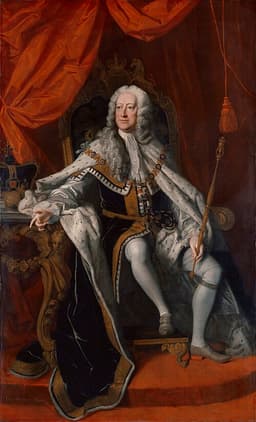
George I of Great Britain
Emperor · Modern
52.2Total

Napoleon Bonaparte
General · Modern
70.9Total
Basic Information
Born
1660
1769
Died
1727
1821
Era
Modern
Modern
Nationality
United Kingdom
France
Occupation
Emperor
General
Civilization
Western
Western
Score Comparison
Military (10%)
21.2
94.0
Political (20%)
68.0
72.0
Influence (20%)
53.3
40.0
Legacy (20%)
45.0
80.0
Leadership (15%)
72.0
78.0
Strategy (15%)
45.0
90.0
TOTAL
52.2
70.9
George I of Great Britain — Complete Timeline
1714 AD
Accession to the British ThronePolitical Action◆ Major
George I became king of Great Britain and Ireland following the death of Queen Anne. He was the first Hanoverian monarch, succeeding under the Act of Settlement 1701. His accession established the House of Hanover on the British throne.
AccessionHanoverian DynastySuccession
Impact: national
1715 AD
Jacobite Rising of 1715War◆ Major
George I faced a Jacobite rebellion aimed at restoring the Stuart claimant James Francis Edward Stuart. The rebellion was suppressed by government forces at the Battle of Preston and the Battle of Sheriffmuir. This defeat secured George's throne.
Jacobite RebellionCivil WarStuart Claimant
Impact: national
1717 AD
Development of Cabinet GovernmentPolitical Action
George I ceased attending Cabinet meetings due to his limited English and lack of interest. This led to the development of the cabinet system under a chief minister, Sir Robert Walpole, who became the first de facto Prime Minister. This shift strengthened parliamentary governance.
Cabinet GovernmentPrime MinisterConstitutional Evolution
Impact: nationalconstructive
1727 AD
Death in HanoverOther
George I died of a stroke while traveling to Hanover. He was buried in the Leineschloss church in Hanover. His death passed the throne to his son George II. His reign established the Hanoverian dynasty in Britain.
DeathHanoverSuccession
Impact: national
Napoleon Bonaparte — Complete Timeline
1799 AD
Coup of 18 BrumaireOther◆ Major
Napoleon Bonaparte, with support from his brother Lucien and key political figures, overthrew the Directory in a bloodless coup. He established the Consulate with himself as First Consul, effectively becoming the ruler of France. This event ended the French Revolution's most unstable period.
French RevolutionCoupRise to Power
Impact: regional
1804 AD
Promulgation of the Napoleonic CodeOther◆ Major
Napoleon enacted the Civil Code of the French, known as the Napoleonic Code, a comprehensive set of laws that replaced the fragmented feudal legal systems. The code established legal equality, protected property rights, and secularized law. It became the basis for legal systems in many European and world countries.
Legal ReformNapoleonic CodeCivil Law
Impact: globalconstructive
1805 AD
Battle of AusterlitzWar◆ Major
Napoleon's Grande Arm
Napoleonic WarsBattleDecisive Victory
Impact: global
1812 AD
Invasion of RussiaWar◆ Major
Napoleon led the Grande Arm
Napoleonic WarsInvasionDisaster
Impact: globaldestructive
1815 AD
Battle of WaterlooWar◆ Major
Napoleon's French army was defeated by the combined forces of the Duke of Wellington's Anglo-Allied army and Gebhard Leberecht von Bl
Napoleonic WarsBattleFinal Defeat
Impact: globaldestructive
Expert Analysis
george-i-of-great-britain-vs-napoleon-bonaparte
### The Emperor and the King: Napoleon’s Conquests, George’s Patience
On a rain-soaked June evening in 1815, Napoleon Bonaparte watched his dreams of empire dissolve into the mud of Waterloo. Half a continent away, a century earlier, another ruler—George I of Great Britain—sat in a carriage rattling toward Hanover, a man who had never quite learned the language of his own kingdom. One died in exile on a volcanic island; the other passed in his sleep, his legacy woven into the fabric of a constitutional monarchy. What drove these two men—both monarchs, both Western, both products of the modern age—to such opposite fates? The answer lies not in their crowns, but in the fires that forged them.
**Origins**
Napoleon was born in 1769 on Corsica, an island that had only recently become French. His family was minor nobility, but their world was one of Mediterranean ambition and vendetta. Young Napoleon devoured military history and the works of Rousseau, dreaming not of a throne, but of glory. The French Revolution, which erupted when he was twenty, demolished the old order and opened a path for talent over birth. He was a child of chaos, shaped by the belief that a man could remake the world with will and cannon fire.
George I, born in 1660, was a German prince of the House of Hanover. His world was a web of dynastic marriages and Protestant alliances. The Thirty Years’ War had ended only a decade before his birth, and the Holy Roman Empire remained a patchwork of competing states. George learned statecraft as a young elector, commanding armies against the French and managing the delicate balance of power. Where Napoleon’s world was a volcano, George’s was a chessboard.
**Rise to Power**
Napoleon’s ascent was a lightning strike. In 1793, at the age of twenty-four, he drove the British out of Toulon. By 1796, he commanded the Army of Italy and carved a kingdom out of Austrian territory. His 1798 Egyptian campaign was a disaster of strategy but a masterpiece of propaganda. In 1799, he returned to a France desperate for order, overthrew the Directory in a coup, and made himself First Consul. By 1804, he crowned himself Emperor in Notre-Dame. Every step was a gamble, every victory a platform for the next.
George I’s rise was a slow inheritance. He became King of Great Britain and Ireland in 1714 at the age of fifty-four, not because he sought the throne, but because the Act of Settlement of 1701 barred Catholics, and Queen Anne died without a Protestant heir. George was the fifty-seventh in line, a German prince who spoke French better than English. He arrived in London to a country suspicious of foreigners and Jacobites—supporters of the exiled Stuart claimant. His power was not seized; it was handed to him, wrapped in parliamentary statutes.
**Leadership & Governance**
Napoleon ruled as a military autocrat. His Napoleonic Code, enacted in 1804, standardized French law, abolished feudalism, and enshrined meritocracy. He built roads, reformed education, and centralized the state. But his governance was inseparable from conquest. He fought over sixty battles, from Austerlitz in 1805—his masterpiece—to the disastrous invasion of Russia in 1812. His political score of 75.0 reflects a ruler who could reform but could not compromise. “Power is my mistress,” he once said, and he meant it.
George I governed through absence. He ceased attending Cabinet meetings around 1717, not out of laziness but because his limited English made him a bystander. This withdrawal became a turning point: the Cabinet system, led by a prime minister, evolved into the engine of British government. George’s political score of 85.8 is high, but it was a passive achievement. He faced the Jacobite Rising of 1715, a rebellion that failed largely because its leader, James Stuart, lacked George’s patience. George let his ministers govern, and they let him reign. His strategy score of 30.0 is not a mark of incompetence but of a different kind of wisdom—knowing when not to act.
**Triumph & Tragedy**
Napoleon’s greatest moment was Austerlitz, where he crushed the combined armies of Russia and Austria in a single day. His empire stretched from Spain to Poland. But his tragedy was hubris: the Russian winter of 1812 destroyed his Grand Army, and the Battle of Leipzig in 1813 shattered his hold on Germany. Exiled to Elba, he returned in 1815 for a final, desperate campaign. Waterloo was his last roll of the dice, and it came up empty. He died in 1821 on Saint Helena, a prisoner of the British.
George I’s triumph was survival. He weathered the Jacobite rebellion, stabilized the Hanoverian succession, and presided over the rise of a new political order. His tragedy was personal: he was estranged from his wife, Sophia Dorothea, whom he imprisoned for adultery for thirty-two years. He died of a stroke in 1727 while traveling to Hanover, his heart buried in Germany, his body in England—a man split between two worlds.
**Character & Destiny**
Napoleon was a creature of fire: brilliant, restless, and consumed by ambition. His personality drove every decision. He could not stop conquering because conquest defined him. “I am not a man, but a thing,” he said—a force of nature that eventually burned out. George I was a creature of ice: reserved, pragmatic, and emotionally distant. He accepted his limitations and worked within them. Where Napoleon shaped his destiny with a sword, George let history shape his.
**Legacy**
Napoleon’s legacy is a paradox. The Napoleonic Code remains the foundation of civil law across Europe and beyond. He democratized merit and centralized administration. But his wars killed millions and left France exhausted. His score of 78.0 for legacy reflects a man who changed the world but left it scarred. George I’s legacy is quieter but no less profound. By stepping back, he allowed the cabinet system to flower, paving the way for modern parliamentary democracy. His score of 61.8 is modest, but the system he enabled—where a monarch reigns but does not rule—shaped the United Kingdom and its Commonwealth.
**Conclusion**
Napoleon and George I stand as two poles of modern leadership. One conquered nations; the other surrendered power. One built an empire with blood and iron; the other built a constitution with silence and patience. The emperor’s glory is louder, but the king’s legacy may be more lasting. In the end, both men taught the same lesson: that power, whether seized or received, always outlives the one who holds it.
Rankings
🥇
Napoleon BonaparteLeader
Mil: 94.0Pol: 72.0Inf: 40.0
70.9
🥈
George I of Great Britain
Mil: 21.2Pol: 68.0Inf: 53.3
52.2
+18.7 behind
How This Comparison Works
Algorithm
Each figure is scored on 6 dimensions (0—100 scale) based on structured historical data: Military (10%), Political (20%), Influence (20%), Legacy (20%), Leadership (15%), Strategy (15%). The weighted total produces the final ranking.
Data Sources
Scores are computed from structured sub-indicators in the database. Scale factors adjust for era (Ancient ×0.85, Modern ×1.0) and civilization size (Eastern ×1.05, Other ×0.80) to account for differences in population and military scale.
Maximum 3 Figures
Comparisons are limited to 2—3 figures to ensure readability and statistical meaningfulness.
Error Margins
±5 points per dimension — Sub-scores are derived from historical records with inherent uncertainty. Two figures within 5 points on a dimension should be considered roughly equivalent in that area.
Total Score Accuracy
±3 points overall — The weighted combination of 6 dimensions produces a total score with approximately ±3 points of uncertainty. Differences of less than 3 points are not statistically significant— the figures are effectively tied.
Known Limitations
- Historical records are incomplete and uneven across civilizations
- Figures from oral-tradition societies may be underrepresented
- Occupation labels can misclassify multi-role figures
- Scores measure capability and impact, not moral character
- Quantitative scoring is a comparison tool, not absolute truth
Capability Radar
Military (10%) — Battles & Warfare
Battles
10
95
Win Rate
10
90
Expansion
10
95
Political (20%) — Governance & Reform
Reform
40
95
Diplomacy
50
80
Economy
40
85
Influence (20%) — Cultural & Global Reach
Cultural
20
85
Global
30
90
Legacy (20%) — Historical Impact
Historical
40
95
Longevity
30
90
Leadership (15%) — Power & Stability
Tenure
60
85
Stability
50
70
Strategy (15%) — Tactics & Innovation
Strategy
10
95
Tactics
10
98
Reform
10
92
Similar Comparisons
Comments & Discussion
汉诺威笨熊6/17/2026
这个拿拿破仑跟乔治一世比较简直搞笑。一个连英语都不会说的德国小领主,除了打猎和睡情妇啥也不会,就靠他妈是斯图亚特王朝远亲捡了个王位。拿破仑可是白手起家的军事天才,从科西嘉小贵族一路打到巴黎,搞现代法典,重组欧洲版图。乔治一世治国八百年都没搞明白英国议会怎么运作,配跟拿破仑放在一起?
The Corsican Ghost6/17/2026
You revisionists always romanticize Napoleon, but let's talk facts: he lost 500,000 men in Russia alone, nearly 100,000 horses froze to death in a single retreat. His "genius" was gambling with human lives, and when the dice stopped rolling, he ended up on St. Helena. George I, by contrast, was shrewd enough to let Robert Walpole run things while he quietly collected tax revenues from his German holdings. Napoleon burned bright and fast. George burned slow and steady. Which legacy would you rath
凯撒的鞋匠6/17/2026
数据不会说谎。拿破仑在位14年发动了7场大战役,法国人口损失约100万,外加60亿法郎战争债务。乔治一世在位13年,英国国债只增加了300万英镑,而且他成功避免了卷入西班牙王位继承战争的后续冲突。拿破仑的"伟大"是用同胞的尸骨堆出来的数学奇迹,而乔治一世的不作为反而让英国工业革命得以和平起步。你要是法国纳税人,选哪个?
The Tea-Sipping Skeptic6/17/2026
Let's be clear: George I's greatest achievement was literally not messing things up. He presided over the South Sea Bubble that ruined thousands of investors, spoke no English, had two ugly mistresses his wife called "the elephant" and "the maypole." Napoleon? He unified Italy, codified laws still used across Europe, and inspired a meritocratic ethos that ended aristocratic privilege in France. Comparing them is like comparing a chess master to a man who accidentally sat on the board.
托克维尔的门徒6/17/2026
真正该问的是制度差异。拿破仑是法兰西第一帝国皇帝,权力集中到连新闻都要亲自审查——他颁布《新闻出版法》就多达6部。乔治一世是立宪君主,哪怕他讨厌议会也得乖乖点头签署法案。两人身处不同的政治生态系统:一个在法国大革命的火山口上跳舞,一个在汉诺威的安逸庄园里钓鲈鱼。把他们的命运归因于个人才华,那是文化史的廉价骗局。