Loading...
Gaston Eyskens vs Julius Caesar
Julius Caesar leads by 29.7 pts · 2 figures compared
…
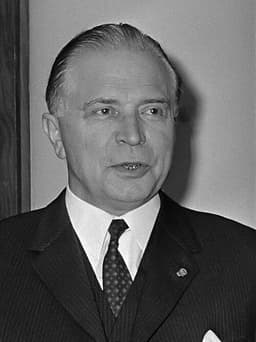
Gaston Eyskens
Politician · Modern
53.1Total

Julius Caesar
General · Ancient
82.8Total
Basic Information
Born
1905
-100
Died
1988
-44
Era
Modern
Ancient
Nationality
Belgium
Roman Republic
Occupation
Politician
General
Civilization
Western
Western
Score Comparison
Military (10%)
50.0
88.0
Political (20%)
55.0
78.0
Influence (20%)
54.1
85.0
Legacy (20%)
45.0
82.0
Leadership (15%)
72.0
80.0
Strategy (15%)
42.9
85.0
TOTAL
53.1
82.8
Gaston Eyskens — Complete Timeline
1968 AD
Prime Minister of Belgium (first term)Political Action◆ Major
Gaston Eyskens became Prime Minister of Belgium for the first time, leading a coalition government. His tenure focused on economic policy and the ongoing linguistic conflict between Flemish and French-speaking communities.
Prime MinisterBelgian Politics
Impact: national
1970 AD
State reform of 1970Reform
Under Prime Minister Gaston Eyskens, Belgium enacted a major state reform that created three cultural communities (Flemish, French, German) and three regions (Flanders, Wallonia, Brussels). This was the first step in the federalization of Belgium.
State ReformFederalizationBelgium
Impact: nationalconstructive
1972 AD
Prime Minister of Belgium (second term)Political Action
Gaston Eyskens served a second term as Prime Minister, continuing to manage the linguistic tensions and economic challenges. His government fell over the issue of the Fourons commune, a symbol of the Flemish-Walloon conflict.
Prime MinisterBelgian Politics
Impact: national
Julius Caesar — Complete Timeline
58 BC
Gallic WarsWar◆ Major
Caesar, as proconsul of Gaul, launched a series of campaigns that conquered all of Gaul (modern France, Belgium, and parts of Switzerland). He fought numerous battles, including against the Helvetii, the Belgae, and the Gallic chieftain Vercingetorix. The wars brought immense wealth and a loyal army to Caesar.
Gallic WarsConquestRoman Expansion
Impact: regional
49 BC
Crossing the RubiconPolitical Action◆ Major
Caesar led Legio XIII across the Rubicon River into Italy, defying the Roman Senate's order to disband his army. This act triggered a civil war against Pompey and the Optimates, ultimately leading to Caesar's dictatorship and the end of the Roman Republic.
Roman Civil WarEnd of RepublicPower Struggle
Impact: global
48 BC
Battle of PharsalusWar◆ Major
Caesar's outnumbered army defeated the larger forces of Pompey the Great at Pharsalus in Greece. Caesar's tactical use of a reserve line to counter Pompey's cavalry charge proved decisive. Pompey fled to Egypt, where he was assassinated, leaving Caesar as the undisputed master of the Roman world.
Roman Civil WarBattleDecisive Victory
Impact: regional
44 BC
Appointment as Dictator for LifePolitical Action◆ Major
The Roman Senate appointed Caesar dictator perpetuo (dictator for life), granting him unprecedented personal power. This move concentrated military, legislative, and judicial authority in one person, effectively ending the Roman Republic's traditional system of checks and balances and alarming many senators.
DictatorshipEnd of RepublicPower Consolidation
Impact: regionaldestructive
Assassination on the Ides of MarchPolitical Action◆ Major
A group of Roman senators, led by Marcus Junius Brutus and Gaius Cassius Longinus, stabbed Caesar to death at a meeting of the Senate in the Theatre of Pompey. The assassination was intended to restore the Republic, but instead triggered another civil war that led to the rise of the Roman Empire.
AssassinationRoman PoliticsEnd of Republic
Impact: globaldestructive
Expert Analysis
gaston-eyskens-vs-julius-caesar
# The Dictator and the Democrat
On the Ides of March in 44 BCE, Julius Caesar fell bleeding at the feet of a statue of his rival Pompey, stabbed twenty-three times by senators who feared he would destroy the Roman Republic. Nearly two thousand years later, in 1970, Gaston Eyskens stood before the Belgian parliament and calmly secured passage of a state reform that peacefully dismantled the unitary Belgian state into cultural communities—a quiet revolution achieved not with daggers, but with votes. These two Western leaders, separated by millennia, both faced the same fundamental challenge: how to govern a fractured society. One chose the path of absolute power and died for it. The other chose compromise and lived to see his nation transform.
Origins
Julius Caesar was born into the patrician Julian clan, a family of ancient prestige but modest wealth in a Rome dominated by the optimates—the conservative aristocracy. His uncle by marriage, Gaius Marius, had been a populist reformer, and the young Caesar absorbed the lesson that power in Rome flowed from the people, not the Senate. The Republic of his youth was already rotting: civil wars, slave revolts, and the corrosion of traditional institutions by ambitious generals. Caesar learned early that survival meant audacity.
Gaston Eyskens came of age in a very different world. Born in 1905 in Lier, Belgium, he grew up in a small, prosperous nation still recovering from the wounds of World War I. Belgium was a constitutional monarchy, a modern European democracy—but one deeply divided between Dutch-speaking Flemings and French-speaking Walloons. Eyskens studied economics and law, becoming a professor at the Catholic University of Leuven. Where Caesar learned rhetoric and warfare, Eyskens learned budgets and coalition-building.
Rise to Power
Caesar’s ascent was a masterpiece of calculated risk. He fled Rome to avoid Sulla’s proscriptions, then returned to climb the political ladder: military tribune, quaestor, aedile, pontifex maximus. His genius lay in borrowing enormous sums to fund public spectacles that made him beloved by the mob. In 60 BCE, he formed the First Triumvirate with Pompey and Crassus, an alliance that gave him command of Gaul. There, over eight years, he fought more than forty battles, conquered a territory larger than Italy, and built an army fanatically loyal to him, not the Republic. When the Senate ordered him to disband his legions, he crossed the Rubicon River in 49 BCE, igniting a civil war that ended with him as dictator.
Eyskens’ rise was quiet by comparison. He entered politics as a member of the Christian Social Party, serving as minister of finance before becoming Prime Minister in 1949. His first term focused on postwar reconstruction, stabilizing a currency, and integrating Belgium into the new European cooperation that would become the European Union. His path depended not on legions, but on parliamentary majorities and coalition agreements. The turning point came in 1968, when linguistic tensions between Flemings and Walloons brought the government to crisis. Eyskens returned as Prime Minister with a mandate to reform the state itself.
Leadership & Governance
Caesar governed as a military autocrat who understood the art of mercy. After defeating his enemies, he pardoned many and appointed them to office—a calculated clemency that disarmed opposition. He reformed the calendar, granted citizenship to provincials, and launched massive infrastructure projects. But his concentration of power was absolute: he was made dictator for ten years, then dictator for life, and his image appeared on coins alongside the goddess Venus. He centralized authority because he believed only a strong hand could save Rome from its own corruption.
Eyskens governed as a consensus-builder in a system designed to prevent any single hand from becoming too strong. Belgium’s linguistic divide was not a problem that could be solved by conquest or decree. The 1970 state reform created three cultural communities—Flemish, French, and German—each with autonomy over language and culture, while the central government retained economic and foreign policy. It was a messy, imperfect compromise, but it held. Eyskens’ strategy score of 35.3 reflects that he was no military tactician; his genius was political patience.
Triumph & Tragedy
Caesar’s triumph was the conquest of Gaul and the defeat of Pompey. He stood as master of the Mediterranean world, and his military score of 88.0 marks him among history’s greatest commanders. But his tragedy was that his success made him a target. The Ides of March assassination ended his life at fifty-five, and the Republic he had tried to save—or replace—collapsed into another civil war before becoming the Empire.
Eyskens’ triumph was the 1970 reform, a peaceful renegotiation of the national contract. His tragedy is that it was only the beginning. Belgium’s federalization would continue for decades, and linguistic tensions persist today. Yet he died in 1988 at the age of eighty-three, a respected elder statesman, not a corpse on the Senate floor.
Character & Destiny
Caesar was driven by an insatiable ambition. He wrote his own commentaries, controlled his own narrative, and believed his destiny was to reshape the world. His leadership score of 82.0 captures a man who inspired fierce loyalty but also fierce hatred. He could not compromise because compromise meant sharing power, and sharing power was not in his nature.
Eyskens was a man of institutions. His political score of 69.4 and leadership of 79.2 reflect a leader who understood that in a democracy, power is borrowed, not owned. He was not a conqueror but a negotiator, and his destiny was not to be remembered in epic poems but in constitutional articles.
Legacy
Caesar’s legacy is overwhelming. His name became synonymous with emperor—Kaiser, Tsar, Caesar. His reforms laid the foundation for the Roman Empire, which shaped Western civilization for fifteen centuries. He is remembered as a genius and a tyrant, a man who destroyed a republic and built an empire.
Eyskens’ legacy is quieter but no less significant. The 1970 reform preserved Belgium’s unity by accommodating its diversity. In an era when nationalism and ethnic conflict tore apart Yugoslavia and other states, Belgium’s peaceful devolution stands as a model—imperfect, but functional.
Conclusion
Standing in the Roman Forum where Caesar fell, one feels the weight of ambition and blood. Standing in the Belgian parliament where Eyskens’ reform passed, one feels the weight of compromise and patience. Both men faced division. Caesar tried to master it through force; Eyskens tried to manage it through law. The dictator died in a pool of blood. The democrat died in his bed. Perhaps the difference between them is not just two thousand years of history, but two answers to the oldest question of politics: how much power should one person hold? Caesar’s answer was everything. Eyskens’ answer was just enough.
Rankings
🥇
Julius CaesarLeader
Mil: 88.0Pol: 78.0Inf: 85.0
82.8
🥈
Gaston Eyskens
Mil: 50.0Pol: 55.0Inf: 54.1
53.1
+29.7 behind
How This Comparison Works
Algorithm
Each figure is scored on 6 dimensions (0—100 scale) based on structured historical data: Military (10%), Political (20%), Influence (20%), Legacy (20%), Leadership (15%), Strategy (15%). The weighted total produces the final ranking.
Data Sources
Scores are computed from structured sub-indicators in the database. Scale factors adjust for era (Ancient ×0.85, Modern ×1.0) and civilization size (Eastern ×1.05, Other ×0.80) to account for differences in population and military scale.
Maximum 3 Figures
Comparisons are limited to 2—3 figures to ensure readability and statistical meaningfulness.
Error Margins
±5 points per dimension — Sub-scores are derived from historical records with inherent uncertainty. Two figures within 5 points on a dimension should be considered roughly equivalent in that area.
Total Score Accuracy
±3 points overall — The weighted combination of 6 dimensions produces a total score with approximately ±3 points of uncertainty. Differences of less than 3 points are not statistically significant— the figures are effectively tied.
Known Limitations
- Historical records are incomplete and uneven across civilizations
- Figures from oral-tradition societies may be underrepresented
- Occupation labels can misclassify multi-role figures
- Scores measure capability and impact, not moral character
- Quantitative scoring is a comparison tool, not absolute truth
Capability Radar
Military (10%) — Battles & Warfare
Battles
31
95
Win Rate
32
92
Expansion
33
97
Political (20%) — Governance & Reform
Reform
65
90
Diplomacy
60
85
Economy
75
82
Influence (20%) — Cultural & Global Reach
Cultural
30
88
Global
35
94
Legacy (20%) — Historical Impact
Historical
40
95
Longevity
30
96
Leadership (15%) — Power & Stability
Tenure
70
75
Stability
55
60
Strategy (15%) — Tactics & Innovation
Strategy
40
94
Tactics
40
96
Reform
45
88
Similar Comparisons
Comments & Discussion
No comments yet. Be the first to share your thoughts!