Loading...
Gaspard de Coligny vs Zia-ul-Haq
Gaspard de Coligny leads by 5.5 pts · 2 figures compared
…
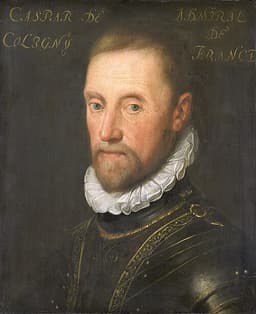
Gaspard de Coligny
General · Modern
58.3Total

Zia-ul-Haq
General · Modern
52.8Total
Basic Information
Born
1519
1924
Died
1572
—
Era
Modern
Modern
Nationality
France
Pakistan
Occupation
General
General
Civilization
Western
Indian
Score Comparison
Military (10%)
47.5
25.9
Political (20%)
68.0
68.0
Influence (20%)
62.0
55.0
Legacy (20%)
52.0
49.2
Leadership (15%)
65.7
64.0
Strategy (15%)
50.0
43.3
TOTAL
58.3
52.8
Gaspard de Coligny — Complete Timeline
1567 AD
Battle of Saint-DenisWar◆ Major
Gaspard de Coligny commanded Huguenot forces at the Battle of Saint-Denis against the royal army. The battle was indecisive, but the Huguenots failed to capture Paris. Coligny's leadership solidified his position as a key Huguenot military commander.
BattleWars of ReligionHuguenots
Impact: national
1570 AD
Peace of Saint-Germain-en-LayePolitical Action◆ Major
Coligny negotiated the Peace of Saint-Germain-en-Laye, which granted Huguenots limited religious freedom and control of several fortified towns. The peace allowed Coligny to return to court and gain influence over King Charles IX.
Peace TreatyReligious TolerationHuguenots
Impact: nationalconstructive
1572 AD
Assassination attempt on ColignyOther◆ Major
An assassination attempt was made on Gaspard de Coligny in Paris, allegedly ordered by Catherine de Medici and the Guise family. He was shot but survived. This attack set the stage for the St. Bartholomew's Day Massacre two days later.
Assassination AttemptSt. Bartholomew's DayHuguenots
Impact: nationaldestructive
St. Bartholomew's Day MassacreOther
Gaspard de Coligny was killed during the St. Bartholomew's Day Massacre, when Catholic mobs murdered Huguenots in Paris. His body was mutilated and thrown from a window. His death marked a turning point in the Wars of Religion.
MassacreDeathWars of Religion
Impact: nationaltragic
Zia-ul-Haq — Complete Timeline
1977 AD
Seized Power in a Military CoupPolitical Action
General Zia-ul-Haq led a military coup that overthrew Prime Minister Zulfikar Ali Bhutto. Zia imposed martial law, suspended the constitution, and arrested Bhutto. The coup ended Pakistan's democratic experiment and began over a decade of military rule.
CoupMartial Law
Impact: nationaldestructive
1979 AD
Supported the Afghan Mujahideen Against the Soviet UnionWar◆ Major
Zia's government became a key ally of the U.S. in supporting Afghan mujahideen fighters against the Soviet invasion of Afghanistan. Pakistan provided training, arms, and sanctuary. This policy strengthened the military's role and later contributed to the rise of militant groups.
Afghan WarProxy War
Impact: regional
Introduced Islamization PoliciesReform◆ Major
Zia implemented a series of Islamization measures, including the introduction of Hudood Ordinances, Islamic courts, and compulsory zakat. He also enforced strict Islamic dress codes and media censorship. These policies reshaped Pakistan's legal and social fabric, increasing sectarian tensions.
IslamizationLegal Reform
Impact: nationaldestructive
Executed Zulfikar Ali BhuttoPolitical Action◆ Major
Zia ordered the execution of former Prime Minister Zulfikar Ali Bhutto after a controversial murder trial. Bhutto was hanged despite international appeals for clemency. The execution deepened political polarization and created a lasting legacy of enmity between the military and the PPP.
ExecutionPolitical Repression
Impact: nationaltragic
1984 AD
Held a Referendum on His PresidencyPolitical Action
Zia held a controversial referendum asking voters to endorse his Islamization policies and his continuation as president. The referendum was widely criticized as a sham, with official results claiming over 97% approval. It allowed Zia to extend his rule without elections.
ReferendumAuthoritarianism
Impact: nationaldestructive
1988 AD
Died in a Plane CrashOther
Zia-ul-Haq died in a mysterious plane crash near Bahawalpur along with several senior generals and the U.S. ambassador. The cause of the crash remains disputed, with theories ranging from sabotage to mechanical failure. His death ended military rule and led to democratic elections.
DeathMystery
Impact: nationaltragic
Expert Analysis
Origins
Gaspard de Coligny (1519–1572) was born into the French nobility, the son of Gaspard I de Coligny, Marshal of France. He received a military education and became a close ally of the French crown, serving under King Henry II. His early career was marked by military campaigns in Italy and France, but his conversion to Calvinism in the 1550s set him on a path of religious conflict.
Zia-ul-Haq (1924–1988) was born in Jalandhar, Punjab, British India, into a modest Arain family. He joined the British Indian Army in 1943 and later fought in the Indo-Pakistani wars. His military career was steady but unspectacular, reaching the rank of Major General before being appointed Chief of Army Staff in 1976 by Prime Minister Zulfikar Ali Bhutto.
Rise to Power
Coligny rose to prominence as a military commander during the Italian Wars but became a key leader of the Huguenot (French Protestant) movement after his conversion. By 1569, he was the de facto military leader of the Huguenots. His political influence peaked with the Peace of Saint-Germain-en-Laye (1570), which granted Huguenots limited religious freedom and control of several fortified towns. This treaty, negotiated by Coligny, was a major turning point.
Zia-ul-Haq seized power in a military coup on July 5, 1977, overthrowing Prime Minister Zulfikar Ali Bhutto after widespread protests against alleged rigged elections. Zia imposed martial law, suspended the constitution, and became Chief Martial Law Administrator. He later consolidated power by executing Bhutto in 1979 after a controversial murder trial, despite international appeals for clemency.
Leadership & Governance
Coligny was a moderate leader who sought to balance religious tolerance with political stability. He advocated for a peaceful coexistence between Catholics and Huguenots, but his influence at court was undermined by the Catholic Guise family. His governance style was consultative, relying on negotiation and alliance-building.
Zia-ul-Haq ruled with an iron fist, imposing strict martial law and later Islamizing Pakistan. His regime introduced the Hudood Ordinances (1979), which enforced harsh Islamic punishments, and established Islamic courts. He also mandated compulsory zakat (religious tax) and promoted Islamic education. Politically, he held a referendum in 1984 to legitimize his rule, winning 97.7% approval, though critics called it a farce.
Triumph & Tragedy
Coligny's greatest triumph was negotiating the Peace of Saint-Germain-en-Laye, which temporarily protected Huguenot rights. However, his tragedy was his assassination during the St. Bartholomew's Day Massacre (August 24, 1572). His body was mutilated and thrown into the Seine. The massacre killed thousands of Huguenots and sparked the Fourth War of Religion. Coligny's death was a catastrophic failure for the Huguenot cause.
Zia-ul-Haq's greatest success was his support for the Afghan Mujahideen against the Soviet invasion (1979–1989). With U.S. aid, Pakistan became a frontline state, and the war eventually led to the Soviet withdrawal. However, his Islamization policies deepened sectarian divides and marginalized minorities. His tragic end came in a mysterious plane crash on August 17, 1988, near Bahawalpur, killing him and several senior generals. The cause remains unknown.
Character & Destiny
Coligny was courageous and principled, but his trust in the royal court proved fatal. Despite warnings, he remained in Paris after the wedding of Henry of Navarre, believing the king's assurances of safety. His character—optimistic about reconciliation—led him to ignore the growing Catholic hostility.
Zia was calculating and ruthless. He used Islam as a political tool to legitimize his rule and suppress dissent. His decision to execute Bhutto eliminated a rival but also created a lasting political rift. His authoritarian style centralized power but left Pakistan without democratic institutions. Historian Ayesha Jalal notes that Zia's "Islamization was a top-down process that weakened civil society."
Legacy
Coligny's legacy is tied to the French Wars of Religion and the struggle for religious tolerance. His death made him a martyr for Protestantism. The Peace of Saint-Germain-en-Laye, though short-lived, set a precedent for religious coexistence. His scores: Leadership 65.7, Influence 62.0, Legacy 52.0.
Zia-ul-Haq's legacy is transformative for Pakistan. His Islamization policies reshaped the legal and social fabric, creating a more conservative society. The Hudood Ordinances and Islamic courts remain influential. His support for the Mujahideen contributed to the rise of global jihadism. His scores: Leadership 64.0, Influence 55.0, Legacy 49.2.
Conclusion
While both figures were pivotal in their contexts, Coligny scored higher overall (58.3 vs 52.8) and had a more enduring impact on the concept of religious tolerance. Zia's Islamization was profound but primarily within one nation, while Coligny's struggle influenced broader European debates on freedom of conscience. Therefore, Gaspard de Coligny had a greater historical impact.
Rankings
🥇
Gaspard de ColignyLeader
Mil: 47.5Pol: 68.0Inf: 62.0
58.3
🥈
Zia-ul-Haq
Mil: 25.9Pol: 68.0Inf: 55.0
52.8
+5.5 behind
How This Comparison Works
Algorithm
Each figure is scored on 6 dimensions (0—100 scale) based on structured historical data: Military (10%), Political (20%), Influence (20%), Legacy (20%), Leadership (15%), Strategy (15%). The weighted total produces the final ranking.
Data Sources
Scores are computed from structured sub-indicators in the database. Scale factors adjust for era (Ancient ×0.85, Modern ×1.0) and civilization size (Eastern ×1.05, Other ×0.80) to account for differences in population and military scale.
Maximum 3 Figures
Comparisons are limited to 2—3 figures to ensure readability and statistical meaningfulness.
Error Margins
±5 points per dimension — Sub-scores are derived from historical records with inherent uncertainty. Two figures within 5 points on a dimension should be considered roughly equivalent in that area.
Total Score Accuracy
±3 points overall — The weighted combination of 6 dimensions produces a total score with approximately ±3 points of uncertainty. Differences of less than 3 points are not statistically significant— the figures are effectively tied.
Known Limitations
- Historical records are incomplete and uneven across civilizations
- Figures from oral-tradition societies may be underrepresented
- Occupation labels can misclassify multi-role figures
- Scores measure capability and impact, not moral character
- Quantitative scoring is a comparison tool, not absolute truth
Capability Radar
Military (10%) — Battles & Warfare
Battles
55
10
Win Rate
50
15
Expansion
30
5
Political (20%) — Governance & Reform
Reform
50
70
Diplomacy
55
50
Economy
30
30
Influence (20%) — Cultural & Global Reach
Cultural
45
60
Global
55
45
Legacy (20%) — Historical Impact
Historical
70
55
Longevity
60
40
Leadership (15%) — Power & Stability
Tenure
45
55
Stability
20
20
Strategy (15%) — Tactics & Innovation
Strategy
65
25
Tactics
60
20
Reform
40
60
Similar Comparisons
Comments & Discussion
No comments yet. Be the first to share your thoughts!