Loading...
Anastasio Somoza Garcia vs Gaspard de Coligny
Gaspard de Coligny leads by 11.6 pts · 2 figures compared
…

Anastasio Somoza Garcia
General · Modern
46.7Total
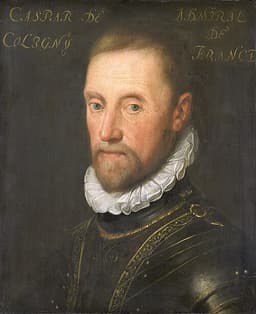
Gaspard de Coligny
General · Modern
58.3Total
Basic Information
Born
1896
1519
Died
1956
1572
Era
Modern
Modern
Nationality
Nicaragua
France
Occupation
General
General
Civilization
Western
Western
Score Comparison
Military (10%)
50.0
47.5
Political (20%)
46.6
68.0
Influence (20%)
56.4
62.0
Legacy (20%)
48.3
52.0
Leadership (15%)
40.0
65.7
Strategy (15%)
25.0
50.0
TOTAL
46.7
58.3
Anastasio Somoza Garcia — Complete Timeline
1934 AD
Assassination of Sandino (1934)Political Action◆ Major
Anastasio Somoza Garc
AssassinationSandinoNational Guard
Impact: nationaldestructive
1937 AD
Presidency and Consolidation of Power (1937-1956)Political Action◆ Major
Somoza Garc
DictatorshipSomoza DynastyCorruption
Impact: nationaldestructive
1956 AD
Assassination (1956)Other◆ Major
Somoza Garc
AssassinationRigoberto López PérezDynasty
Impact: nationaltragic
Gaspard de Coligny — Complete Timeline
1567 AD
Battle of Saint-DenisWar◆ Major
Gaspard de Coligny commanded Huguenot forces at the Battle of Saint-Denis against the royal army. The battle was indecisive, but the Huguenots failed to capture Paris. Coligny's leadership solidified his position as a key Huguenot military commander.
BattleWars of ReligionHuguenots
Impact: national
1570 AD
Peace of Saint-Germain-en-LayePolitical Action◆ Major
Coligny negotiated the Peace of Saint-Germain-en-Laye, which granted Huguenots limited religious freedom and control of several fortified towns. The peace allowed Coligny to return to court and gain influence over King Charles IX.
Peace TreatyReligious TolerationHuguenots
Impact: nationalconstructive
1572 AD
Assassination attempt on ColignyOther◆ Major
An assassination attempt was made on Gaspard de Coligny in Paris, allegedly ordered by Catherine de Medici and the Guise family. He was shot but survived. This attack set the stage for the St. Bartholomew's Day Massacre two days later.
Assassination AttemptSt. Bartholomew's DayHuguenots
Impact: nationaldestructive
St. Bartholomew's Day MassacreOther
Gaspard de Coligny was killed during the St. Bartholomew's Day Massacre, when Catholic mobs murdered Huguenots in Paris. His body was mutilated and thrown from a window. His death marked a turning point in the Wars of Religion.
MassacreDeathWars of Religion
Impact: nationaltragic
Expert Analysis
Origins
Anastasio Somoza García was born on February 1, 1896, in San Marcos, Nicaragua, to a wealthy coffee-growing family. His father was a senator, and Somoza received education in the United States, attending the Pierce School of Business Administration in Philadelphia. He returned to Nicaragua and entered politics through marriage to Salvadora Debayle, a member of a prominent liberal family. His early career included stints as a deputy and as a diplomat in Costa Rica.
Gaspard de Coligny was born on February 16, 1519, in Châtillon-sur-Loing, France, into a noble family. His father, Gaspard I de Coligny, was Marshal of France. Coligny received a military education and served in the Italian Wars. He was appointed Admiral of France in 1552, a position that gave him command of the navy and coastal defenses. His early life was marked by loyalty to the French crown and conversion to Protestantism around 1558.
Rise to Power
Somoza's rise began when he became the head of the National Guard in 1933, a position given by President Juan Bautista Sacasa (his wife's uncle). He used the Guard to eliminate rivals, most notably ordering the assassination of rebel leader Augusto C. Sandino on February 21, 1934. This act removed the main obstacle to his power. In 1936, he forced Sacasa to resign and assumed the presidency in 1937, consolidating control through the National Guard and electoral manipulation.
Coligny rose to prominence as a military commander and political leader of the Huguenots (French Protestants). After the death of King Henry II, he became a key advisor to the young King Charles IX, but his influence waned due to Catholic opposition led by the Guise family. He survived an assassination attempt in August 1572, which was blamed on the Guises. The attempt triggered the St. Bartholomew's Day Massacre on August 24, 1572, during which Coligny was killed.
Leadership & Governance
Somoza ruled Nicaragua as a personal dictatorship. He centralized power in the National Guard, which served as his private army. He amassed enormous wealth through corruption, owning vast estates and monopolies. His governance was marked by repression of political opponents, censorship, and rigged elections. He modernized infrastructure (roads, hospitals) but only to benefit his regime. His political score of 46.6 reflects his authoritarian control but limited institutional legacy.
Coligny was a military leader and statesman. As Admiral, he organized Huguenot forces and negotiated the Peace of Saint-Germain-en-Laye (1570), which granted religious freedoms to Protestants. He advocated for toleration and sought to strengthen royal authority against ultra-Catholic factions. His leadership score of 65.7 indicates his ability to command loyalty and navigate complex politics. However, his governance was constrained by the monarchy and civil war.
Triumph & Tragedy
Somoza's greatest triumph was establishing the Somoza dynasty, which ruled Nicaragua from 1937 to 1979. He maintained stability through force and U.S. support. His tragedy was his assassination in 1956 by poet Rigoberto López Pérez, which exposed the regime's fragility. The dynasty continued but eventually fell to the Sandinista revolution in 1979. His military score of 50.0 reflects his reliance on the National Guard rather than personal battlefield command.
Coligny's triumph was the Peace of Saint-Germain-en-Laye, which temporarily ended religious conflict and granted Huguenot rights. His tragedy was his brutal murder during the St. Bartholomew's Day Massacre, which escalated the French Wars of Religion. His body was mutilated and thrown from a window. The massacre killed thousands and deepened divisions. His military score of 47.5 reflects mixed battlefield results, such as the indecisive Battle of Saint-Denis (1567).
Character & Destiny
Somoza was cunning and ruthless. He cultivated a persona of a jovial, American-friendly leader while eliminating enemies. His character shaped his fate: his dictatorial methods created enemies, leading to his assassination. He scored 40.0 in leadership, indicating limited strategic vision beyond personal power.
Coligny was principled and courageous, but politically inflexible. His faith and advocacy for toleration made him a target. His character led him to stay in Paris after the assassination attempt, trusting royal promises of safety, which proved fatal. His strategy score of 50.0 reflects a balanced but not exceptional tactical mind.
Legacy
Somoza's legacy is the Somoza dynasty, which impoverished Nicaragua and left a culture of corruption. The Sandinistas later used his memory as a symbol of oppression. His influence score of 56.4 is tempered by the negative association. Nicaragua still bears scars from his regime.
Coligny's legacy is as a martyr for religious freedom. The St. Bartholomew's Day Massacre galvanized Huguenot resistance and influenced political thought on toleration. He is remembered as a principled leader who fought for minority rights. His legacy score of 52.0 reflects his impact on French history and Protestant identity.
Conclusion
Gaspard de Coligny had greater historical impact. His total score of 58.3 exceeds Somoza's 46.7. Coligny's actions shaped the French Wars of Religion and the development of religious toleration in Europe. Somoza's dynasty, while lasting decades, was a local phenomenon that ultimately failed. Coligny's principles and martyrdom resonated beyond his lifetime, influencing Enlightenment ideas. Therefore, Coligny is the more significant figure.
Rankings
🥇
Gaspard de ColignyLeader
Mil: 47.5Pol: 68.0Inf: 62.0
58.3
🥈
Anastasio Somoza Garcia
Mil: 50.0Pol: 46.6Inf: 56.4
46.7
+11.6 behind
How This Comparison Works
Algorithm
Each figure is scored on 6 dimensions (0—100 scale) based on structured historical data: Military (10%), Political (20%), Influence (20%), Legacy (20%), Leadership (15%), Strategy (15%). The weighted total produces the final ranking.
Data Sources
Scores are computed from structured sub-indicators in the database. Scale factors adjust for era (Ancient ×0.85, Modern ×1.0) and civilization size (Eastern ×1.05, Other ×0.80) to account for differences in population and military scale.
Maximum 3 Figures
Comparisons are limited to 2—3 figures to ensure readability and statistical meaningfulness.
Error Margins
±5 points per dimension — Sub-scores are derived from historical records with inherent uncertainty. Two figures within 5 points on a dimension should be considered roughly equivalent in that area.
Total Score Accuracy
±3 points overall — The weighted combination of 6 dimensions produces a total score with approximately ±3 points of uncertainty. Differences of less than 3 points are not statistically significant— the figures are effectively tied.
Known Limitations
- Historical records are incomplete and uneven across civilizations
- Figures from oral-tradition societies may be underrepresented
- Occupation labels can misclassify multi-role figures
- Scores measure capability and impact, not moral character
- Quantitative scoring is a comparison tool, not absolute truth
Capability Radar
Military (10%) — Battles & Warfare
Battles
15
55
Win Rate
20
50
Expansion
10
30
Political (20%) — Governance & Reform
Reform
20
50
Diplomacy
50
55
Economy
30
30
Influence (20%) — Cultural & Global Reach
Cultural
20
45
Global
30
55
Legacy (20%) — Historical Impact
Historical
40
70
Longevity
40
60
Leadership (15%) — Power & Stability
Tenure
70
45
Stability
25
20
Strategy (15%) — Tactics & Innovation
Strategy
15
65
Tactics
10
60
Reform
10
40
Similar Comparisons
Comments & Discussion
No comments yet. Be the first to share your thoughts!