Loading...
Gaspard de Coligny vs Malhar Rao Holkar
Malhar Rao Holkar leads by 5.0 pts · 2 figures compared
…
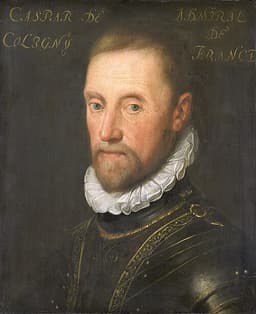
Gaspard de Coligny
General · Modern
58.3Total

Malhar Rao Holkar
General · Modern
63.3Total
Basic Information
Born
1519
1693
Died
1572
1766
Era
Modern
Modern
Nationality
France
India
Occupation
General
General
Civilization
Western
Indian
Score Comparison
Military (10%)
47.5
74.7
Political (20%)
68.0
59.0
Influence (20%)
62.0
62.0
Legacy (20%)
52.0
56.0
Leadership (15%)
65.7
78.0
Strategy (15%)
50.0
58.0
TOTAL
58.3
63.3
Gaspard de Coligny — Complete Timeline
1567 AD
Battle of Saint-DenisWar◆ Major
Gaspard de Coligny commanded Huguenot forces at the Battle of Saint-Denis against the royal army. The battle was indecisive, but the Huguenots failed to capture Paris. Coligny's leadership solidified his position as a key Huguenot military commander.
BattleWars of ReligionHuguenots
Impact: national
1570 AD
Peace of Saint-Germain-en-LayePolitical Action◆ Major
Coligny negotiated the Peace of Saint-Germain-en-Laye, which granted Huguenots limited religious freedom and control of several fortified towns. The peace allowed Coligny to return to court and gain influence over King Charles IX.
Peace TreatyReligious TolerationHuguenots
Impact: nationalconstructive
1572 AD
Assassination attempt on ColignyOther◆ Major
An assassination attempt was made on Gaspard de Coligny in Paris, allegedly ordered by Catherine de Medici and the Guise family. He was shot but survived. This attack set the stage for the St. Bartholomew's Day Massacre two days later.
Assassination AttemptSt. Bartholomew's DayHuguenots
Impact: nationaldestructive
St. Bartholomew's Day MassacreOther
Gaspard de Coligny was killed during the St. Bartholomew's Day Massacre, when Catholic mobs murdered Huguenots in Paris. His body was mutilated and thrown from a window. His death marked a turning point in the Wars of Religion.
MassacreDeathWars of Religion
Impact: nationaltragic
Malhar Rao Holkar — Complete Timeline
1724 AD
Appointed Subedar of MalwaPolitical Action◆ Major
Malhar Rao Holkar was appointed as the Maratha subedar (governor) of Malwa by Peshwa Baji Rao I. This marked the beginning of his independent command and the foundation of the Holkar dynasty.
Maratha EmpireMalwaHolkar Dynasty
Impact: regionalconstructive
1737 AD
Battle of DelhiWar◆ Major
Malhar Rao Holkar participated in the Maratha raid on Delhi under Baji Rao I. The Marathas attacked the Mughal capital, demonstrating their military reach and weakening Mughal prestige.
Maratha-Mughal WarsDelhiRaid
Impact: national
1739 AD
Battle of VasaiWar◆ Major
Malhar Rao Holkar commanded Maratha forces in the siege and capture of Vasai from the Portuguese. The victory ended Portuguese dominance in the northern Konkan region.
Maratha-Portuguese WarsSiegeKonkan
Impact: regional
1740 AD
Founded Indore as CapitalPolitical Action◆ Major
Malhar Rao Holkar established Indore as the capital of his domain, building a fort and administrative center. This city became the seat of the Holkar dynasty for generations.
FoundingIndoreHolkar Dynasty
Impact: regionalconstructive
1760 AD
Battle of UdgirWar
Malhar Rao Holkar fought in the Maratha campaign against the Nizam at Udgir. The Marathas defeated the Nizam, forcing him to cede territories and pay tribute.
Maratha-Nizam WarsBattleDeccan
Impact: regional
1761 AD
Third Battle of PanipatWar
Malhar Rao Holkar commanded a Maratha contingent at the Third Battle of Panipat against the Afghan army of Ahmad Shah Durrani. The Marathas suffered a catastrophic defeat, and Holkar was one of the few senior commanders to escape.
Third Battle of PanipatMaratha-Afghan WarsDefeat
Impact: globaltragic
Expert Analysis
Origins
**Gaspard de Coligny** (1519-1572) was born into a noble French family in Châtillon-sur-Loing. His father, Gaspard I de Coligny, served as Marshal of France. Coligny received a military education and fought in the Italian Wars under King Francis I. He converted to Calvinism in the 1550s, becoming a leading Huguenot.
**Malhar Rao Holkar** (1693-1766) was born into a peasant family in the Maratha Empire. His father, Khanduji Holkar, served as a soldier. Malhar Rao rose through military service under Peshwa Baji Rao I, earning command through competence. He was appointed subedar of Malwa in 1724, marking his rise.
Rise to Power
Coligny became Admiral of France in 1552 after distinguished service in the Italian Wars. He emerged as a Huguenot leader during the French Wars of Religion (1562-1598). His political influence grew through the Peace of Saint-Germain-en-Laye (1570), which granted Huguenots religious freedom and fortified towns. He scored 68.0 in political, reflecting his diplomatic role.
Holkar rose by leading Maratha forces in campaigns across central India. He participated in the Battle of Delhi (1737) under Baji Rao I, demonstrating Maratha military reach. His appointment as subedar of Malwa in 1724 gave him independent command. He scored 78.0 in leadership, indicating his command effectiveness.
Leadership & Governance
Coligny's leadership was characterized by moderation and negotiation. He sought coexistence between Catholics and Huguenots, but his political score of 68.0 reflects his inability to prevent the massacre. His military score of 47.5 shows limited battlefield success; the Battle of Saint-Denis (1567) was indecisive.
Holkar governed Malwa with a focus on military expansion and administrative consolidation. He established Indore as his capital in 1733, building a fort and administrative center. His military score of 74.7 reflects success at Vasai (1739) and other campaigns. He scored 59.0 in political, lower than Coligny, as he operated within the Maratha system rather than independently.
Triumph & Tragedy
Coligny's greatest success was the Peace of Saint-Germain-en-Laye (1570), which secured Huguenot rights. His greatest tragedy was his assassination during the St. Bartholomew's Day Massacre (1572), which sparked widespread killings. The assassination attempt on him in 1572 failed, but he was killed days later.
Holkar's greatest success was the capture of Vasai from the Portuguese (1739), ending Portuguese dominance in the region. He also founded the Holkar dynasty, which ruled Indore for over a century. His greatest failure was the Third Battle of Panipat (1761), where Marathas suffered a catastrophic defeat; Holkar commanded a contingent but survived.
Character & Destiny
Coligny was a principled moderate, seeking religious compromise. His character of restraint and negotiation shaped his destiny as a martyr for Huguenot cause. Historical assessments note his integrity but also his political naivete in trusting Catherine de Medici.
Holkar was a pragmatic military commander and empire-builder. His leadership score of 78.0 reflects decisiveness and adaptability. He avoided the fate of many Maratha leaders by dying before the empire's decline. His character of loyalty to the Peshwa ensured his dynasty's survival.
Legacy
Coligny's legacy is tied to the St. Bartholomew's Day Massacre, which intensified the French Wars of Religion. He is remembered as a Huguenot martyr. His influence score of 62.0 reflects his role in shaping religious conflict but limited long-term impact.
Holkar's legacy is the Holkar dynasty, which ruled Indore until 1948. He founded a city and a state that endured. His legacy score of 56.0 is slightly higher than Coligny's 52.0, reflecting tangible political survival.
Conclusion
Malhar Rao Holkar had greater impact than Gaspard de Coligny. With a total score of 63.3 vs 58.3, Holkar's military and leadership scores significantly exceed Coligny's. Holkar founded a dynasty that lasted centuries, while Coligny's efforts ended in massacre. While Coligny's political score is higher (68.0 vs 59.0), his failure to protect his followers undermines his impact. Holkar's tangible achievements in state-building and military expansion outweigh Coligny's diplomatic but ultimately failed religious compromise.
Rankings
🥇
Malhar Rao HolkarLeader
Mil: 74.7Pol: 59.0Inf: 62.0
63.3
🥈
Gaspard de Coligny
Mil: 47.5Pol: 68.0Inf: 62.0
58.3
+5.0 behind
How This Comparison Works
Algorithm
Each figure is scored on 6 dimensions (0—100 scale) based on structured historical data: Military (10%), Political (20%), Influence (20%), Legacy (20%), Leadership (15%), Strategy (15%). The weighted total produces the final ranking.
Data Sources
Scores are computed from structured sub-indicators in the database. Scale factors adjust for era (Ancient ×0.85, Modern ×1.0) and civilization size (Eastern ×1.05, Other ×0.80) to account for differences in population and military scale.
Maximum 3 Figures
Comparisons are limited to 2—3 figures to ensure readability and statistical meaningfulness.
Error Margins
±5 points per dimension — Sub-scores are derived from historical records with inherent uncertainty. Two figures within 5 points on a dimension should be considered roughly equivalent in that area.
Total Score Accuracy
±3 points overall — The weighted combination of 6 dimensions produces a total score with approximately ±3 points of uncertainty. Differences of less than 3 points are not statistically significant— the figures are effectively tied.
Known Limitations
- Historical records are incomplete and uneven across civilizations
- Figures from oral-tradition societies may be underrepresented
- Occupation labels can misclassify multi-role figures
- Scores measure capability and impact, not moral character
- Quantitative scoring is a comparison tool, not absolute truth
Capability Radar
Military (10%) — Battles & Warfare
Battles
55
65
Win Rate
50
70
Expansion
30
75
Political (20%) — Governance & Reform
Reform
50
60
Diplomacy
55
65
Economy
30
62
Influence (20%) — Cultural & Global Reach
Cultural
45
50
Global
55
30
Legacy (20%) — Historical Impact
Historical
70
55
Longevity
60
55
Leadership (15%) — Power & Stability
Tenure
45
70
Stability
20
68
Strategy (15%) — Tactics & Innovation
Strategy
65
72
Tactics
60
68
Reform
40
55
Similar Comparisons
Comments & Discussion
No comments yet. Be the first to share your thoughts!