Loading...
Gaspard de Coligny vs Oboi
Oboi leads by 1.2 pts · 2 figures compared
…
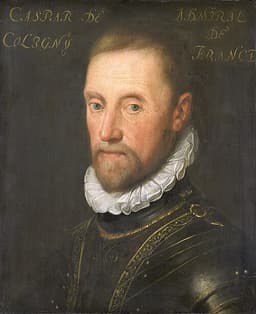
Gaspard de Coligny
General · Modern
58.3Total

Oboi
General · Modern
59.5Total
Basic Information
Born
1519
1610
Died
1572
1669
Era
Modern
Modern
Nationality
France
China
Occupation
General
General
Civilization
Western
Eastern
Score Comparison
Military (10%)
47.5
61.7
Political (20%)
68.0
68.0
Influence (20%)
62.0
54.9
Legacy (20%)
52.0
50.0
Leadership (15%)
65.7
72.0
Strategy (15%)
50.0
60.7
TOTAL
58.3
59.5
Gaspard de Coligny — Complete Timeline
1567 AD
Battle of Saint-DenisWar◆ Major
Gaspard de Coligny commanded Huguenot forces at the Battle of Saint-Denis against the royal army. The battle was indecisive, but the Huguenots failed to capture Paris. Coligny's leadership solidified his position as a key Huguenot military commander.
BattleWars of ReligionHuguenots
Impact: national
1570 AD
Peace of Saint-Germain-en-LayePolitical Action◆ Major
Coligny negotiated the Peace of Saint-Germain-en-Laye, which granted Huguenots limited religious freedom and control of several fortified towns. The peace allowed Coligny to return to court and gain influence over King Charles IX.
Peace TreatyReligious TolerationHuguenots
Impact: nationalconstructive
1572 AD
Assassination attempt on ColignyOther◆ Major
An assassination attempt was made on Gaspard de Coligny in Paris, allegedly ordered by Catherine de Medici and the Guise family. He was shot but survived. This attack set the stage for the St. Bartholomew's Day Massacre two days later.
Assassination AttemptSt. Bartholomew's DayHuguenots
Impact: nationaldestructive
St. Bartholomew's Day MassacreOther
Gaspard de Coligny was killed during the St. Bartholomew's Day Massacre, when Catholic mobs murdered Huguenots in Paris. His body was mutilated and thrown from a window. His death marked a turning point in the Wars of Religion.
MassacreDeathWars of Religion
Impact: nationaltragic
Oboi — Complete Timeline
1661 AD
Appointed as one of four regents for Kangxi EmperorPolitical Action◆ Major
Upon the death of the Shunzhi Emperor, Oboi was appointed as one of four regents for the young Kangxi Emperor. This positioned him as a key power holder in the Qing court during the emperor's minority.
RegencyQing DynastyPower Transition
Impact: national
1667 AD
Consolidated power and purged rival regentsPolitical Action◆ Major
Oboi eliminated his co-regent Suksaha and marginalized others, concentrating authority in his own hands. This power grab created factional strife and weakened the regency council's collective governance.
Power StrugglePurgeFactionalism
Impact: nationaldestructive
1669 AD
Arrested and imprisoned by Kangxi EmperorPolitical Action
The Kangxi Emperor, having reached adulthood, ordered Oboi's arrest on charges of corruption and abuse of power. Oboi was stripped of his titles and imprisoned, ending his regency and restoring imperial authority.
ArrestImperial AuthorityEnd of Regency
Impact: national
Expert Analysis
Origins
Gaspard de Coligny was born in 1519 into a noble French family. His father, Gaspard I de Coligny, served as Marshal of France. Coligny received a military education and became a close associate of the future King Henry II. He converted to Calvinism in the 1550s, becoming a leader of the Huguenot (French Protestant) movement.
Oboi was born around 1610 into the Manchu Guwalgiya clan, a prominent military family. He served under the Qing dynasty's founding emperors, distinguishing himself in campaigns against the Ming and other rivals. His military prowess earned him the title of 'Baturu' (warrior) and a place among the elite.
Rise to Power
Coligny rose to prominence as a military commander during the Italian Wars, fighting for France. Under King Henry II, he became Admiral of France in 1552. After Henry's death, the French Wars of Religion erupted (1562). Coligny emerged as the political and military leader of the Huguenots, negotiating the Peace of Saint-Germain-en-Laye in 1570, which granted limited religious freedoms and control of fortified towns.
Oboi rose through the ranks in the Manchu military, participating in the conquest of China. After the death of the Shunzhi Emperor in 1661, Oboi was appointed one of four regents for the young Kangxi Emperor. He quickly consolidated power, purging co-regent Suksaha in 1667 and marginalizing others. By 1669, he was the de facto ruler of the Qing Empire.
Leadership & Governance
Coligny's leadership was defined by his dual role as a military commander and a political negotiator. He scored 65.7 in leadership, reflecting his ability to unite Huguenot factions and negotiate with the crown. However, his military strategy scored 50.0, as his battlefield record was mixed. For example, at the Battle of Saint-Denis in 1567, he led Huguenot forces against the royal army, but the battle was indecisive and the Huguenots failed to achieve their objectives.
Oboi's leadership score was 72.0, higher than Coligny's. He ruled the Qing Empire with an iron fist, centralizing authority and suppressing dissent. He implemented policies that strengthened the central government but also engaged in corruption and nepotism. His governance style was autocratic, leading to factional strife within the court. His military score of 61.7 reflects his successful campaigns, though his political maneuvering was his primary tool.
Triumph & Tragedy
Coligny's greatest triumph was the Peace of Saint-Germain-en-Laye (1570), which temporarily ended hostilities and granted Huguenots significant rights. His tragedy was his assassination during the St. Bartholomew's Day Massacre in 1572, which sparked a wave of violence that killed thousands of Huguenots. His body was mutilated and thrown from a window.
Oboi's triumph was his rise to supreme power as regent, effectively ruling the Qing Empire for several years. His tragedy was his downfall: after Kangxi came of age, the emperor arrested Oboi in 1669 on charges of corruption and abuse of power. He was stripped of his titles and imprisoned, dying in captivity.
Character & Destiny
Coligny was a devout Calvinist whose religious convictions drove his political actions. He was seen as a principled leader, but his faith made him a target in a Catholic-dominated France. His character—steadfast and idealistic—ultimately led to his martyrdom. Historians note that his assassination was a turning point in the French Wars of Religion, escalating the conflict.
Oboi was ambitious and ruthless, willing to eliminate rivals to secure his position. His character—pragmatic and power-hungry—led to his downfall when he underestimated the young Kangxi. The emperor, aged 15, orchestrated Oboi's arrest, demonstrating that Oboi's grip on power was not absolute. His legacy is that of a usurper who overreached.
Legacy
Coligny's legacy is deeply tied to the Huguenot cause. His death galvanized Protestant resistance and contributed to the eventual Edict of Nantes (1598), which granted religious toleration. He scored 52.0 in legacy, reflecting his enduring symbolic importance. His political influence (62.0) and overall impact (58.3 total) are modest compared to Oboi's.
Oboi's legacy is more complex. He is remembered as a powerful but corrupt regent whose actions weakened the Qing court temporarily. However, Kangxi's subsequent reforms strengthened the empire. Oboi's total score is 59.5, slightly higher than Coligny. His military and leadership scores are higher, but his legacy score is 50.0, as his negative reputation limits his long-term impact.
Conclusion
While Coligny's assassination had profound consequences for France, his direct impact was limited by his early death. Oboi, with a higher total score (59.5 vs. 58.3), exercised greater power as regent. His actions shaped Qing politics during a critical period, and his downfall demonstrated the resilience of the imperial system. Thus, Oboi had a greater impact, as his rule affected the governance of a vast empire, whereas Coligny's influence was confined to a religious faction within a single kingdom.
Rankings
🥇
OboiLeader
Mil: 61.7Pol: 68.0Inf: 54.9
59.5
🥈
Gaspard de Coligny
Mil: 47.5Pol: 68.0Inf: 62.0
58.3
+1.2 behind
How This Comparison Works
Algorithm
Each figure is scored on 6 dimensions (0—100 scale) based on structured historical data: Military (10%), Political (20%), Influence (20%), Legacy (20%), Leadership (15%), Strategy (15%). The weighted total produces the final ranking.
Data Sources
Scores are computed from structured sub-indicators in the database. Scale factors adjust for era (Ancient ×0.85, Modern ×1.0) and civilization size (Eastern ×1.05, Other ×0.80) to account for differences in population and military scale.
Maximum 3 Figures
Comparisons are limited to 2—3 figures to ensure readability and statistical meaningfulness.
Error Margins
±5 points per dimension — Sub-scores are derived from historical records with inherent uncertainty. Two figures within 5 points on a dimension should be considered roughly equivalent in that area.
Total Score Accuracy
±3 points overall — The weighted combination of 6 dimensions produces a total score with approximately ±3 points of uncertainty. Differences of less than 3 points are not statistically significant— the figures are effectively tied.
Known Limitations
- Historical records are incomplete and uneven across civilizations
- Figures from oral-tradition societies may be underrepresented
- Occupation labels can misclassify multi-role figures
- Scores measure capability and impact, not moral character
- Quantitative scoring is a comparison tool, not absolute truth
Capability Radar
Military (10%) — Battles & Warfare
Battles
55
65
Win Rate
50
70
Expansion
30
60
Political (20%) — Governance & Reform
Reform
50
50
Diplomacy
55
55
Economy
30
45
Influence (20%) — Cultural & Global Reach
Cultural
45
30
Global
55
30
Legacy (20%) — Historical Impact
Historical
70
55
Longevity
60
40
Leadership (15%) — Power & Stability
Tenure
45
70
Stability
20
40
Strategy (15%) — Tactics & Innovation
Strategy
65
65
Tactics
60
60
Reform
40
55
Similar Comparisons
Comments & Discussion
No comments yet. Be the first to share your thoughts!