Loading...
Gaitana vs Napoleon Bonaparte
Napoleon Bonaparte leads by 27.2 pts · 2 figures compared
…
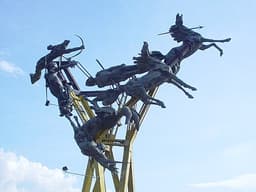
Gaitana
Revolutionary · Medieval
43.7Total

Napoleon Bonaparte
General · Modern
70.9Total
Basic Information
Born
1500
1769
Died
1550
1821
Era
Medieval
Modern
Nationality
Yalcon
France
Occupation
Revolutionary
General
Civilization
Other
Western
Score Comparison
Military (10%)
45.0
94.0
Political (20%)
35.0
72.0
Influence (20%)
44.0
40.0
Legacy (20%)
35.8
80.0
Leadership (15%)
57.1
78.0
Strategy (15%)
54.8
90.0
TOTAL
43.7
70.9
Gaitana — Complete Timeline
1540 AD
Led the Yalcon Rebellion against Spanish colonizersWar◆ Major
Gaitana organized and led indigenous Yalcon forces in a rebellion against Spanish colonial rule in present-day Colombia. The rebellion targeted Spanish settlements and encomiendas, resisting forced labor and land seizure. The uprising was eventually suppressed by Spanish forces, but it became a symbol of indigenous resistance.
Indigenous RebellionColonial ResistanceYalcon
Impact: regional
Captured and executed Spanish encomendero Pedro de AñascoOther◆ Major
During the Yalcon rebellion, Gaitana's forces captured the Spanish encomendero Pedro de A
ExecutionColonial ConflictIndigenous Leadership
Impact: regional
1541 AD
Rebellion suppressed by Spanish forces under Sebastián de BelalcázarWar◆ Major
Spanish conquistador Sebasti
Military DefeatColonial SuppressionEnd of Rebellion
Impact: regionaldestructive
Napoleon Bonaparte — Complete Timeline
1799 AD
Coup of 18 BrumaireOther◆ Major
Napoleon Bonaparte, with support from his brother Lucien and key political figures, overthrew the Directory in a bloodless coup. He established the Consulate with himself as First Consul, effectively becoming the ruler of France. This event ended the French Revolution's most unstable period.
French RevolutionCoupRise to Power
Impact: regional
1804 AD
Promulgation of the Napoleonic CodeOther◆ Major
Napoleon enacted the Civil Code of the French, known as the Napoleonic Code, a comprehensive set of laws that replaced the fragmented feudal legal systems. The code established legal equality, protected property rights, and secularized law. It became the basis for legal systems in many European and world countries.
Legal ReformNapoleonic CodeCivil Law
Impact: globalconstructive
1805 AD
Battle of AusterlitzWar◆ Major
Napoleon's Grande Arm
Napoleonic WarsBattleDecisive Victory
Impact: global
1812 AD
Invasion of RussiaWar◆ Major
Napoleon led the Grande Arm
Napoleonic WarsInvasionDisaster
Impact: globaldestructive
1815 AD
Battle of WaterlooWar◆ Major
Napoleon's French army was defeated by the combined forces of the Duke of Wellington's Anglo-Allied army and Gebhard Leberecht von Bl
Napoleonic WarsBattleFinal Defeat
Impact: globaldestructive
Expert Analysis
gaitana-vs-napoleon-bonaparte
# The Emperor and the Warrior Queen: Two Paths to Immortality
On a June morning in 1815, Napoleon Bonaparte watched his Imperial Guard march into the murderous fire of Wellington’s infantry at Waterloo. The man who had conquered Europe was making his final gamble, and he would lose everything. Three centuries earlier and an ocean away, a woman named Gaitana watched Spanish soldiers burn her village in the Colombian highlands. She had no army, no empire, no grand strategy—only a mother’s rage and a people’s desperation. Yet both figures, so vastly different in power and scale, faced the same fundamental question: What does it mean to lead when the world is collapsing around you?
Origins
Napoleon was born in 1769 on the Mediterranean island of Corsica, a place recently annexed by France. His family belonged to the minor nobility, poor enough to feel the sting of poverty but proud enough to nurture ambition. He entered a world where the old order of kings and aristocrats was about to shatter. The French Revolution, which erupted when he was twenty, would become his forge. In the chaos of revolutionary France, a brilliant young artillery officer could rise faster than any blue-blooded general of the ancien régime.
Gaitana emerged from a world equally turbulent but far less documented. She was born around 1500 among the Yalcon people of what is now Colombia, a society that had never seen a European. When the Spanish conquistadors arrived in the 1530s, they brought steel, horses, and a merciless logic of conquest. Gaitana was likely a cacica—a female chief or leader of significant standing—in a culture where women could hold authority. But the world she knew was being erased, and she could not have known that her name would survive only in fragments, pieced together from Spanish colonial records that dismissed her as a "savage."
Rise to Power
Napoleon’s ascent was a masterpiece of timing and talent. By 1796, at age twenty-six, he had already commanded the Army of Italy and won a series of dazzling victories that forced Austria to sue for peace. His political score of 75 reflects a man who understood that military glory was only half the game. He staged a coup in 1799, made himself First Consul, and by 1804 crowned himself Emperor in Notre Dame. Every step was calculated, every alliance weighed. He did not merely seize power—he manufactured the conditions for it.
Gaitana’s rise was not a calculated climb but a desperate response. When Spanish forces under Sebastián de Belalcázar pushed into Yalcon territory, they captured her son and burned him alive before her eyes. The chronicles say she watched, silent, and then vanished into the forest. She emerged days later as the leader of a rebellion, uniting neighboring tribes who had never before fought together. Her political score of 35.8 reflects not a lack of skill but a lack of opportunity—she was fighting an empire with stones and spears, not building a bureaucracy.
Leadership & Governance
Napoleon governed with the precision of a mathematician. His Napoleonic Code, enacted in 1804, standardized French law, abolished feudal privileges, and established principles of meritocracy that influenced legal systems across Europe and the Americas. He built roads, founded banks, and reformed education. Yet his military score of 94 and strategy score of 93 tell a deeper story: he was a genius of movement and concentration, able to defeat larger armies by striking at their weakest points. At Austerlitz in 1805, he crushed the combined forces of Russia and Austria in a single day, a victory so complete it became a textbook example of tactical brilliance.
Gaitana led differently because she had no choice. Her military score of 29.8 is not a measure of incompetence but of asymmetry. She commanded warriors armed with wooden clubs and poison darts against men in steel armor with arquebuses. Her strategy score of 58.8 suggests she understood guerrilla warfare before the term existed—ambushes in mountain passes, raids on supply lines, the slow bleeding of an invader who could not hold every village. She could not win battles, but she could make conquest costly.
Triumph & Tragedy
Napoleon’s greatest triumph was the creation of an empire that stretched from Spain to Poland. His greatest tragedy was the invasion of Russia in 1812. He marched 600,000 men into the frozen vastness and returned with fewer than 100,000. The disaster broke his aura of invincibility. By 1814, he was exiled to Elba. He escaped, raised another army, and met his end at Waterloo in 1815. His legacy score of 78 reflects a man who reshaped the world but could not hold it.
Gaitana’s triumph was simpler and more brutal: she kept the Spanish from conquering her people for years. Her tragedy is that she ultimately failed. The Spanish brought reinforcements, disease, and a relentless campaign of destruction. By 1550, the Yalcon were scattered or enslaved. Gaitana herself vanished from the historical record—no one knows how she died. Her influence score of 55.4 is remarkable for a figure so obscure, a testament to how her story survived in the collective memory of Colombia’s indigenous peoples.
Character & Destiny
Napoleon was driven by an insatiable hunger for glory. "I am not a man," he once said, "but a thing." He saw himself as an instrument of history, a force of nature that could not be stopped. This conviction made him bold but also blind. He could not share power, could not delegate, could not accept limits. His leadership score of 80 reflects a man who inspired fanatical loyalty but also exhausted those around him.
Gaitana was driven by something more elemental: love and rage. She had no ambition to rule an empire; she wanted revenge and survival for her people. Her leadership score of 31.8 is misleading—it measures conventional command, not the moral authority of a mother who watched her son burn. Her story is not one of strategy but of spirit.
Legacy
Napoleon left behind a transformed Europe. The Napoleonic Code, the metric system, the concept of a meritocratic state—these outlasted his empire. He is remembered as both a tyrant and a reformer, a genius and a madman. His total score of 82.4 places him among history’s titans, a figure who cannot be ignored.
Gaitana left behind a name. In Colombia, she is a symbol of resistance, a statue in a park, a chapter in schoolbooks. Her total score of 43.8 is small compared to Napoleon’s, but it measures something different—not power, but persistence. She represents every leader who fought against impossible odds and lost, yet whose story refuses to die.
Conclusion
Napoleon shaped history; Gaitana endured it. One built an empire that crumbled in a generation; the other built a memory that lasted five centuries. The difference between them is not just in their scores but in their circumstances. Napoleon had an army, a state, a continent to conquer. Gaitana had a forest, a people, and a pain that would not let her rest. Both were leaders. Both were human. And both remind us that history is written not only by the victors but by those who refuse to be forgotten.
Rankings
🥇
Napoleon BonaparteLeader
Mil: 94.0Pol: 72.0Inf: 40.0
70.9
🥈
Gaitana
Mil: 45.0Pol: 35.0Inf: 44.0
43.7
+27.2 behind
How This Comparison Works
Algorithm
Each figure is scored on 6 dimensions (0—100 scale) based on structured historical data: Military (10%), Political (20%), Influence (20%), Legacy (20%), Leadership (15%), Strategy (15%). The weighted total produces the final ranking.
Data Sources
Scores are computed from structured sub-indicators in the database. Scale factors adjust for era (Ancient ×0.85, Modern ×1.0) and civilization size (Eastern ×1.05, Other ×0.80) to account for differences in population and military scale.
Maximum 3 Figures
Comparisons are limited to 2—3 figures to ensure readability and statistical meaningfulness.
Error Margins
±5 points per dimension — Sub-scores are derived from historical records with inherent uncertainty. Two figures within 5 points on a dimension should be considered roughly equivalent in that area.
Total Score Accuracy
±3 points overall — The weighted combination of 6 dimensions produces a total score with approximately ±3 points of uncertainty. Differences of less than 3 points are not statistically significant— the figures are effectively tied.
Known Limitations
- Historical records are incomplete and uneven across civilizations
- Figures from oral-tradition societies may be underrepresented
- Occupation labels can misclassify multi-role figures
- Scores measure capability and impact, not moral character
- Quantitative scoring is a comparison tool, not absolute truth
Capability Radar
Military (10%) — Battles & Warfare
Battles
15
95
Win Rate
10
90
Expansion
5
95
Political (20%) — Governance & Reform
Reform
5
95
Diplomacy
10
80
Economy
5
85
Influence (20%) — Cultural & Global Reach
Cultural
20
85
Global
10
90
Legacy (20%) — Historical Impact
Historical
25
95
Longevity
20
90
Leadership (15%) — Power & Stability
Tenure
10
85
Stability
5
70
Strategy (15%) — Tactics & Innovation
Strategy
15
95
Tactics
20
98
Reform
5
92
Similar Comparisons
Comments & Discussion
THE IRON LANCELOT6/17/2026
Waterloo wasn't Napoleon's finest defeat—it's just his most cinematic. The real Napoleon died in Russia in 1812, when he lost 400,000 men and his invincible aura. Gaitana faced total annihilation with nothing but resolve, and she's still a symbol of resistance in Colombia. One man's genius was measured in cannon smoke and corpses; a woman's was measured in survival against actual extinction. Let's be honest: who needed more courage, the emperor with 500,000 soldiers or the mother with a wooden c
兵棋推演者6/17/2026
拿公在滑铁卢输给威灵顿,这事实和维多利亚时代吹捧的叙事差太多了。他那250门大炮烂泥地里打不出效果,全怪格鲁希元帅不听命令。反观盖塔娜,她根本不需要什么元帅命令——她那四百起义战士靠丛林游击干掉西班牙人,这才是真正的战术智慧。别拿青铜时代和工业时代比,这俩打法压根不一个维度。不过铁血之花的绝地反击比波拿巴的撤退漂亮十倍。
THE SCROLL HUNTER6/17/2026
Honestly, comparing Gaitana and Napoleon is like comparing a tsunami to a teacup. Napoleon's biographical record is exhaustive—52,000 books about him, detailed memoirs, even his dentist's recollections. Gaitana has almost zero contemporary documentation; we don't even know her real name in the Yalcon language. The Spanish chronicles mention her as a footnote—"la cacica que resistió"—but that's it. We're literally comparing a fully painted Renaissance portrait to a charcoal sketch from a fire. An
游击队长6/17/2026
拿破仑输在最后,盖塔娜赢在过程。波拿巴那套用炮兵碾压的架式在西班牙丛林里照样吃瘪——看看他在伊比利亚半岛的惨况,20万法军陷在游击战泥潭里。盖塔娜早在1539年就玩明白这招了:打不过钢刀铁甲?那就断粮道、烧营寨、用毒箭。她的起义虽然失败,但西班牙人花了整整两年才把她那百来号人剿灭干净。一个寡不敌众的土著女酋长,撑得比法兰西皇帝在一个半岛战争里还久,你说谁的将军当得更硬?
STATISTICUS6/17/2026
Let's talk body counts, since that's apparently how we measure greatness. Napoleon's battles killed 1-2 million soldiers total; Waterloo alone saw 50,000 casualties in one day. Gaitana's rebellion killed maybe 200 Spaniards across two years. But here's the twist: Napoleon's monumental death toll built an empire that lasted 12 years; Gaitana's tiny campaign built a