Loading...
Gaitana vs Ho Chi Minh
Ho Chi Minh leads by 19.2 pts · 2 figures compared
…
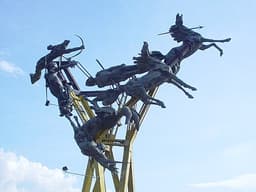
Gaitana
Revolutionary · Medieval
43.7Total
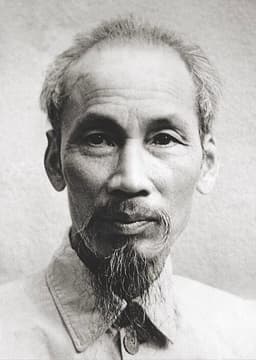
Ho Chi Minh
Revolutionary · Modern
62.9Total
Basic Information
Born
1500
1890
Died
1550
1969
Era
Medieval
Modern
Nationality
Yalcon
Vietnam
Occupation
Revolutionary
Revolutionary
Civilization
Other
Eastern
Score Comparison
Military (10%)
45.0
55.0
Political (20%)
35.0
72.0
Influence (20%)
44.0
62.0
Legacy (20%)
35.8
58.0
Leadership (15%)
57.1
72.0
Strategy (15%)
54.8
58.0
TOTAL
43.7
62.9
Gaitana — Complete Timeline
1540 AD
Led the Yalcon Rebellion against Spanish colonizersWar◆ Major
Gaitana organized and led indigenous Yalcon forces in a rebellion against Spanish colonial rule in present-day Colombia. The rebellion targeted Spanish settlements and encomiendas, resisting forced labor and land seizure. The uprising was eventually suppressed by Spanish forces, but it became a symbol of indigenous resistance.
Indigenous RebellionColonial ResistanceYalcon
Impact: regional
Captured and executed Spanish encomendero Pedro de AñascoOther◆ Major
During the Yalcon rebellion, Gaitana's forces captured the Spanish encomendero Pedro de A
ExecutionColonial ConflictIndigenous Leadership
Impact: regional
1541 AD
Rebellion suppressed by Spanish forces under Sebastián de BelalcázarWar◆ Major
Spanish conquistador Sebasti
Military DefeatColonial SuppressionEnd of Rebellion
Impact: regionaldestructive
Ho Chi Minh — Complete Timeline
1941 AD
Establishment of the Viet MinhPolitical Action◆ Major
Ho Chi Minh founded the Viet Minh (League for the Independence of Vietnam) in southern China. This coalition of nationalist and communist groups became the primary force for Vietnamese independence, fighting both Japanese occupation and French colonialism.
Viet MinhIndependence MovementWorld War II
Impact: nationalconstructive
1945 AD
Declaration of Independence of VietnamPolitical Action
Ho Chi Minh proclaimed the Democratic Republic of Vietnam in Hanoi's Ba Dinh Square, citing the US Declaration of Independence. This established the Viet Minh government and began the struggle for independence from French colonial rule.
IndependenceVietnamDecolonization
Impact: nationalconstructive
1954 AD
Battle of Dien Bien PhuWar
Ho Chi Minh's Viet Minh forces, under General Giap, defeated the French garrison at Dien Bien Phu. This victory ended French colonial rule in Indochina and led to the Geneva Accords dividing Vietnam at the 17th parallel.
Vietnam WarDecolonizationFrench Indochina
Impact: regional
Geneva AccordsPolitical Action◆ Major
Ho Chi Minh's delegation signed the Geneva Accords, temporarily dividing Vietnam at the 17th parallel. The agreement promised nationwide elections in 1956, which were never held, leading to the permanent division of Vietnam.
Geneva ConferenceDivision of VietnamDiplomacy
Impact: regional
1959 AD
Start of the Vietnam WarWar
Ho Chi Minh's government in North Vietnam authorized armed struggle against the US-backed South Vietnamese regime. This escalated into the Vietnam War, a prolonged conflict that resulted in millions of deaths and US withdrawal in 1973.
Vietnam WarCold WarCommunism
Impact: globaldestructive
Expert Analysis
Ho Chi Minh vs Gaitana
# The Revolutionary and the Rebel
In the humid jungles of Southeast Asia, a frail man in a linen suit stood before a microphone in Hanoi’s Ba Dinh Square on September 2, 1945, reading words that echoed Thomas Jefferson. Half a world away and four centuries earlier, in the mist-shrouded mountains of what is now Colombia, a woman whose name history nearly forgot watched Spanish soldiers burn her village, her son’s body still warm in her arms. Both chose to fight. One would reshape a nation and outlast an empire. The other would vanish into the soil she defended. Why did Ho Chi Minh succeed where Gaitana failed? The answer lies not in courage—both had that in abundance—but in the currents of time, the architecture of power, and the cruel arithmetic of history.
Origins
Ho Chi Minh was born Nguyen Sinh Cung in 1890 in Nghe An province, a region of central Vietnam known for its fierce resistance to foreign rule. His father, a Confucian scholar who refused to work for the French colonial administration, taught him that dignity was worth more than safety. The boy left home at twenty-one, working as a cook, a photographer, a stoker on ocean liners, wandering through New York, London, and Paris. He was a citizen of nowhere and everywhere, and that rootlessness became his greatest weapon. He learned the languages of his enemies—French, English, Chinese—and studied the philosophies of Marx, Lenin, and the American Founding Fathers. He understood that to defeat a modern empire, one had to think like it.
Gaitana was born around 1500, likely in the Yalcon territory near the Magdalena River. Her world was oral, ancestral, and bounded by forest and river. She knew the names of plants that healed and the paths through the jungle that hid her people. She knew nothing of Versailles, the Enlightenment, or the printing press. When the Spanish arrived, they brought horses, steel, and a God who demanded submission. She had no way to read their treaties, no ambassador to plead her case, no map of the world beyond her own mountains. Her universe was small, and that smallness was her tragedy.
Rise to Power
Ho Chi Minh’s path to leadership was a slow, deliberate ascent. He founded the Indochinese Communist Party in 1930, spent years in exile in China and the Soviet Union, and built a network that stretched from Moscow to the Mekong Delta. His turning point came in 1941, when he established the Viet Minh in southern China—a coalition of nationalists, communists, and peasants united by one goal: independence. He was not a general; he was a gardener, planting seeds of resistance that would take a decade to bloom. When Japan occupied Vietnam during World War II, he saw opportunity. He worked with American intelligence, supplied rice to Allied pilots, and positioned himself as the only credible leader of a free Vietnam.
Gaitana’s rise was sudden and violent. In 1539, Spanish conquistadors under Pedro de Heredia arrived in her territory, demanding gold and labor. When her son refused to cooperate, they burned him alive in front of her. The chronicles say she did not weep. She gathered warriors from the Yalcon and neighboring tribes, armed them with poisoned arrows and clubs, and attacked. She led from the front, a middle-aged woman in a world of young men, her grief transformed into fury. Her rebellion lasted months, not years. She won battles—ambushes in the jungle, raids on supply lines—but she could not win a war. The Spanish had guns, armor, and a strategy of total destruction. They burned villages, enslaved survivors, and wrote her name out of history.
Leadership & Governance
Ho Chi Minh governed through patience and paradox. He was a communist who quoted the American Declaration of Independence, a revolutionary who negotiated with the French, a nationalist who accepted Soviet aid. His military score of 55 reflects that he was not a battlefield commander; he left tactics to General Vo Nguyen Giap, who crushed the French at Dien Bien Phu in 1954. Ho’s genius was political—a score of 67.8 that undersells his true craft. He understood that the Vietnam War was fought not just in jungles but in the hearts of the American public, in the corridors of the United Nations, in the pages of Life magazine. He cultivated an image of the humble uncle, the ascetic patriot, the man who lived in a simple stilt house while his people died for freedom.
Gaitana had no such luxury. Her leadership score of 31.8 reflects not her ability but her context. She could not negotiate; the Spanish did not recognize her as a legitimate leader. She could not appeal to international opinion; there was no international opinion. Her strategy—score 58.8, higher than Ho’s military rating—was sound for her time: guerrilla warfare, using the jungle as cover, striking and vanishing. But she had no state to fall back on, no allies, no second front. Every battle she won was a loss, because the Spanish could replace men and weapons, while her warriors were irreplaceable.
Triumph & Tragedy
Ho Chi Minh’s greatest triumph was Dien Bien Phu in 1954, where Viet Minh artillery, hauled by hand through impossible terrain, shattered the French garrison. The Geneva Accords that followed divided Vietnam at the 17th parallel, a temporary measure that became permanent tragedy. Ho lived to see the Vietnam War escalate, but he died in 1969, six years before his troops marched into Saigon. His triumph was incomplete; his tragedy was that he never saw the unified Vietnam he had spent his life building.
Gaitana’s triumph was the fire of her rebellion, which briefly united tribes that had never before fought together. Her tragedy was that she could not protect her son, her people, or her land. The Spanish chroniclers recorded her as a “cacica” (chieftainess) who was “cruel and barbarous.” They did not record her real name, only the Spanish version. She may have been captured or killed in battle; the records are silent. Her body, like her legacy, was swallowed by the jungle.
Character & Destiny
Ho Chi Minh was a man of masks. He could be charming with Western journalists, ruthless with political rivals, and paternal with his soldiers. He was, above all, adaptable—a quality that allowed him to survive decades of exile, war, and betrayal. His character was shaped by the 20th century, an era of ideologies and mass movements. He believed that history was on his side, and he was right.
Gaitana was a woman of one mask: grief. Her rebellion was not a strategy but a scream. She fought not for a nation but for vengeance, and vengeance is a poor foundation for a state. Her character was shaped by the 16th century, an era of conquest and erasure. She believed that the gods were on her side, and she was wrong.
Legacy
Ho Chi Minh’s legacy is carved into stone. Saigon is now Ho Chi Minh City. His face appears on currency, his writings in textbooks, his mausoleum in Hanoi a site of pilgrimage. His influence score of 70.6 and legacy score of 72.2 reflect a man who became a symbol—of anti-colonial struggle, of communist resilience, of the idea that a small nation could defeat a superpower. But his legacy is also contested: the Vietnam he created is a communist state with a capitalist economy, a nation that honors his memory while moving past his ideology.
Gaitana’s legacy is a whisper. She appears in a few Spanish documents, a footnote in Colombian history, a statue in a small park in the city of Neiva. Her influence score of 55.4 and legacy score of 44.9 reflect near-total obscurity. Yet in recent decades, indigenous movements in Colombia have reclaimed her as a symbol of resistance, a mother who fought back, a woman who refused to kneel. Her name is spoken again, four centuries later.
Conclusion
What separates Ho Chi Minh from Gaitana is not courage, intelligence, or will. It is the accident of timing. Ho Chi Minh was born into a world of empires in decline, of mass media and international law, of ideologies that could unite millions. Gaitana was born into a world where the only law was the sword, where the only news was word of mouth, where the only unity was the blood of one’s clan. He had the tools of modernity; she had only her grief. Both are remembered, but one is remembered because he won, and the other because she lost. That is the hardest truth of history: it is written by the victors, but it is felt by the fallen.
Rankings
🥇
Ho Chi MinhLeader
Mil: 55.0Pol: 72.0Inf: 62.0
62.9
🥈
Gaitana
Mil: 45.0Pol: 35.0Inf: 44.0
43.7
+19.2 behind
How This Comparison Works
Algorithm
Each figure is scored on 6 dimensions (0—100 scale) based on structured historical data: Military (10%), Political (20%), Influence (20%), Legacy (20%), Leadership (15%), Strategy (15%). The weighted total produces the final ranking.
Data Sources
Scores are computed from structured sub-indicators in the database. Scale factors adjust for era (Ancient ×0.85, Modern ×1.0) and civilization size (Eastern ×1.05, Other ×0.80) to account for differences in population and military scale.
Maximum 3 Figures
Comparisons are limited to 2—3 figures to ensure readability and statistical meaningfulness.
Error Margins
±5 points per dimension — Sub-scores are derived from historical records with inherent uncertainty. Two figures within 5 points on a dimension should be considered roughly equivalent in that area.
Total Score Accuracy
±3 points overall — The weighted combination of 6 dimensions produces a total score with approximately ±3 points of uncertainty. Differences of less than 3 points are not statistically significant— the figures are effectively tied.
Known Limitations
- Historical records are incomplete and uneven across civilizations
- Figures from oral-tradition societies may be underrepresented
- Occupation labels can misclassify multi-role figures
- Scores measure capability and impact, not moral character
- Quantitative scoring is a comparison tool, not absolute truth
Capability Radar
Military (10%) — Battles & Warfare
Battles
15
65
Win Rate
10
60
Expansion
5
55
Political (20%) — Governance & Reform
Reform
5
85
Diplomacy
10
90
Economy
5
40
Influence (20%) — Cultural & Global Reach
Cultural
20
75
Global
10
75
Legacy (20%) — Historical Impact
Historical
25
85
Longevity
20
70
Leadership (15%) — Power & Stability
Tenure
10
70
Stability
5
50
Strategy (15%) — Tactics & Innovation
Strategy
15
80
Tactics
20
70
Reform
5
75
Similar Comparisons
Comments & Discussion
HanoiHammer6/16/2026
"Ho Chi Minh won because he understood modern media and geopolitics—Gaitana was a 16th-century guerrilla without a printing press. Uncle Ho ran a shadow government from Paris and Moscow, complete with propaganda networks and diplomatic missions. Gaitana had a machete and a few hundred Timaná warriors. The gap isn't courage; it's 400 years of statesmanship vs. tribal revolt. Ho played the chess game of empires; Gaitana was stuck in a knife fight."
虎威姥姥6/16/2026
"拿胡志明跟盖塔娜比?这不是一个量级。胡主席背后站着苏联和中国,有完整的国际社会主义阵营撑腰。盖塔娜呢?16世纪哥伦比亚山区的女酋长,面对的是西班牙火枪和铁甲骑兵。她的『军队』最多两千人,连火药都没有。这不是个人能力的差距,是工业文明碾压农业文明。盖塔娜唯一的武器是她的愤怒和儿子的尸体——这够悲壮,但不够打赢战争。"
DataDefender_426/16/2026
"Let's look at the casualty math, shall we? Ho Chi Minh's Vietnam War killed an estimated 1.1 million North Vietnamese combatants plus 2 million civilians—and that's just one chapter. Gaitana's rebellion, by contrast, lasted maybe three years and involved a few thousand indigenous fighters. Ho fought the French, then the Americans, for three decades. Gaitana was crushed in months. One had time and manpower on his side; the other had a son's martyrdom and a burning village. History loves quantity
老革命自嗨6/16/2026
"你们这些键盘历史学家就会比惨。盖塔娜的故事是个体悲剧,胡志明是集体事业。盖塔娜领导的是一群绝望的部落民,胡志明启动的是一个拥有2000万人口、百年反抗传统的民族解放运动。关键不是谁更英勇,而是谁更会『组织』。胡志明在广东办过政治培训班,在莫斯科学过现代政党制度。盖塔娜除了复仇,有没有推行过土地改革?有没有建立过地下铁路网?没有。所以一个成了国父,一个成了当地传说。"
SpectaclesOnSpears6/16/2026
"I'd argue 'failure' is the wrong frame. Gaitana didn't fail—she forced a treaty that temporarily freed her people from gold mine labor, something no other indigenous leader in the region achieved. Ho 'succeeded' only by accepting a divided Vietnam and millions dead. Gaitana's revolt was crushed, but she's still a national symbol in Colombia. Ho's Vietnam today is a communist-capitalist hybrid that would make Lenin weep. Maybe both failed in different ways. The real question: whose legacy hurts