Loading...
Gaitana vs Julius Caesar
Julius Caesar leads by 39.1 pts · 2 figures compared
…
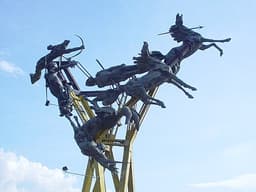
Gaitana
Revolutionary · Medieval
43.7Total

Julius Caesar
General · Ancient
82.8Total
Basic Information
Born
1500
-100
Died
1550
-44
Era
Medieval
Ancient
Nationality
Yalcon
Roman Republic
Occupation
Revolutionary
General
Civilization
Other
Western
Score Comparison
Military (10%)
45.0
88.0
Political (20%)
35.0
78.0
Influence (20%)
44.0
85.0
Legacy (20%)
35.8
82.0
Leadership (15%)
57.1
80.0
Strategy (15%)
54.8
85.0
TOTAL
43.7
82.8
Gaitana — Complete Timeline
1540 AD
Led the Yalcon Rebellion against Spanish colonizersWar◆ Major
Gaitana organized and led indigenous Yalcon forces in a rebellion against Spanish colonial rule in present-day Colombia. The rebellion targeted Spanish settlements and encomiendas, resisting forced labor and land seizure. The uprising was eventually suppressed by Spanish forces, but it became a symbol of indigenous resistance.
Indigenous RebellionColonial ResistanceYalcon
Impact: regional
Captured and executed Spanish encomendero Pedro de AñascoOther◆ Major
During the Yalcon rebellion, Gaitana's forces captured the Spanish encomendero Pedro de A
ExecutionColonial ConflictIndigenous Leadership
Impact: regional
1541 AD
Rebellion suppressed by Spanish forces under Sebastián de BelalcázarWar◆ Major
Spanish conquistador Sebasti
Military DefeatColonial SuppressionEnd of Rebellion
Impact: regionaldestructive
Julius Caesar — Complete Timeline
58 BC
Gallic WarsWar◆ Major
Caesar, as proconsul of Gaul, launched a series of campaigns that conquered all of Gaul (modern France, Belgium, and parts of Switzerland). He fought numerous battles, including against the Helvetii, the Belgae, and the Gallic chieftain Vercingetorix. The wars brought immense wealth and a loyal army to Caesar.
Gallic WarsConquestRoman Expansion
Impact: regional
49 BC
Crossing the RubiconPolitical Action◆ Major
Caesar led Legio XIII across the Rubicon River into Italy, defying the Roman Senate's order to disband his army. This act triggered a civil war against Pompey and the Optimates, ultimately leading to Caesar's dictatorship and the end of the Roman Republic.
Roman Civil WarEnd of RepublicPower Struggle
Impact: global
48 BC
Battle of PharsalusWar◆ Major
Caesar's outnumbered army defeated the larger forces of Pompey the Great at Pharsalus in Greece. Caesar's tactical use of a reserve line to counter Pompey's cavalry charge proved decisive. Pompey fled to Egypt, where he was assassinated, leaving Caesar as the undisputed master of the Roman world.
Roman Civil WarBattleDecisive Victory
Impact: regional
44 BC
Appointment as Dictator for LifePolitical Action◆ Major
The Roman Senate appointed Caesar dictator perpetuo (dictator for life), granting him unprecedented personal power. This move concentrated military, legislative, and judicial authority in one person, effectively ending the Roman Republic's traditional system of checks and balances and alarming many senators.
DictatorshipEnd of RepublicPower Consolidation
Impact: regionaldestructive
Assassination on the Ides of MarchPolitical Action◆ Major
A group of Roman senators, led by Marcus Junius Brutus and Gaius Cassius Longinus, stabbed Caesar to death at a meeting of the Senate in the Theatre of Pompey. The assassination was intended to restore the Republic, but instead triggered another civil war that led to the rise of the Roman Empire.
AssassinationRoman PoliticsEnd of Republic
Impact: globaldestructive
Expert Analysis
gaitana-vs-julius-caesar
# The Conqueror and the Rebel
On a March morning in 44 BCE, Julius Caesar walked into the Senate chamber in Rome, ignoring warnings of danger. Hours later, his body lay bleeding beneath the statue of his rival Pompey, stabbed twenty-three times by men he had trusted. Fourteen centuries later and an ocean away, a woman named Gaitana watched Spanish soldiers burn her son alive in a village square in what is now Colombia. She did not die that day. Instead, she rose.
What drives a person to risk everything against overwhelming power? Caesar and Gaitana both faced that question, but their answers could not have been more different. One was a master of a vast military machine; the other, a mother leading a desperate uprising with little more than fury and sticks. Their stories, separated by time, geography, and civilization, reveal how two individuals—one at the pinnacle of Western power, the other at the sharp end of its expansion—responded to the same fundamental challenge: how to act when the world demands submission.
Origins
Caesar was born into the patrician class of the Roman Republic in 100 BCE, but his family was neither wealthy nor politically dominant. His uncle by marriage was Gaius Marius, the great general and populist reformer, and from his youth Caesar breathed the air of civil conflict. The Republic was tearing itself apart—senatorial oligarchs versus popular generals, tradition versus ambition. Caesar learned early that in Rome, power flowed from military glory and political cunning.
Gaitana’s origins are murkier, as is true for most indigenous leaders whose stories were recorded only by their enemies. She was likely born around 1500 in the Yalcon territory, a region of dense jungles and steep mountains in present-day Colombia. Her people lived in small, fortified villages, governed by chieftains and shamans. The Spanish had arrived only decades earlier, bringing steel, horses, and a brutal logic of conquest. For Gaitana, the world she knew was already ending before she chose to fight.
Rise to Power
Caesar’s path was long and strategic. He served as a military tribune, then quaestor in Spain, where he allegedly wept before a statue of Alexander the Great, lamenting that he had done nothing notable by the same age. He climbed the cursus honorum—the ladder of Roman offices—through loans, alliances, and calculated risks. His election as pontifex maximus in 63 BCE and his command in Gaul from 58 BCE gave him the army and the prestige he needed. When the Senate ordered him to disband his legions, he crossed the Rubicon River in 49 BCE, igniting a civil war that would make him master of Rome.
Gaitana’s rise was instantaneous and tragic. In 1539 or 1540, Spanish conquistadors under the command of Pedro de Heredia arrived in Yalcon territory demanding tribute and labor. When Gaitana’s son refused to comply—or perhaps simply could not—the Spanish tied him to a stake and burned him alive before the eyes of his people. Gaitana did not negotiate. She did not petition. She gathered warriors from neighboring tribes and launched an assault that stunned the invaders.
Leadership & Governance
Caesar governed as a reformer and a dictator. He centralized tax collection, reformed the calendar, extended Roman citizenship to allies, and initiated massive public works. His military genius was undeniable: at the Siege of Alesia in 52 BCE, he defeated a Gallic coalition by building fortifications around both the besieged city and the relief army, a double envelopment that remains a classic of military strategy. His political score of 78 reflects a man who understood power but alienated the aristocracy. His leadership score of 82 shows a commander who inspired fierce loyalty—his soldiers adored him—but who also made enemies as easily as allies.
Gaitana led differently. She had no bureaucracy, no standing army, no written laws. Her military score of 29.8 and strategy score of 58.8 reflect the reality of her situation: she commanded warriors armed with spears and blowpipes against men with crossbows and steel swords. Yet her influence score of 55.4 and legacy score of 44.9 suggest that her rebellion mattered beyond its immediate outcome. She did not reform institutions; she tried to destroy the ones crushing her people. Her leadership was personal, rooted in grief and rage, not in strategic calculation.
Triumph & Tragedy
Caesar’s greatest triumph was his conquest of Gaul, which added a vast territory to the Roman world and made him fabulously wealthy. His greatest tragedy was his own success: by accumulating too much power, he made assassination inevitable. On the Ides of March, 44 BCE, he fell to the daggers of senators who feared he would crown himself king. His last words, according to tradition, were “Et tu, Brute?”—a recognition that even friendship had been consumed by ambition.
Gaitana’s triumph was brief. She led a rebellion that killed several Spanish soldiers and forced the conquistadors to retreat temporarily. But the Spanish returned with reinforcements, and the Yalcon were no match for European weaponry and diseases. Gaitana was captured and executed, likely in 1550. Her tragedy was not personal failure but the impossibility of her cause: she fought to preserve a world that was already being erased.
Character & Destiny
Caesar was calculating, ambitious, and ruthlessly pragmatic. He pardoned former enemies to win allies, but he also destroyed those who stood in his way. His character drove him to take risks that paid off—crossing the Rubicon, fighting in Gaul against impossible odds—but also to ignore warnings that might have saved his life. He believed in his own destiny, and that belief became a self-fulfilling prophecy.
Gaitana was driven by something simpler and more universal: a mother’s love and a people’s rage. She did not seek power for its own sake; she sought vengeance and survival. Her character was forged in fire, not in forum debates. She had no grand strategy, only the desperate hope that resistance might buy time or inspire others.
Legacy
Caesar’s legacy is monumental. His name became synonymous with imperial rule—Kaiser in German, Tsar in Russian. His writings, especially the *Commentaries on the Gallic War*, remain classics of military literature. He transformed the Roman Republic into an empire, for better and worse. His total score of 83.3 reflects a figure who shaped Western civilization.
Gaitana’s legacy is quieter but no less real. She is remembered in Colombia as a symbol of indigenous resistance, a name given to streets and schools, a story told to remind Colombians that their land was not conquered without a fight. Her total score of 43.8 reflects the asymmetry of historical memory: the victors write the textbooks, but the defeated write the songs.
Conclusion
Caesar and Gaitana never met, but their lives are bound together by the same brutal logic of empire. One built it; the other burned under its wheels. Caesar’s story is about the intoxicating power of ambition, the seduction of glory, and the tragedy of reaching too high. Gaitana’s story is about the cost of that ambition for those who are merely in the way. Both faced impossible odds—Caesar against the Senate, Gaitana against the Spanish—and both acted with courage. But one died in a marble chamber, surrounded by peers who had once been friends. The other died in a jungle, surrounded by enemies who had taken everything. Their fates remind us that history is written not only by the victors, but also by those who refused to surrender.
Rankings
🥇
Julius CaesarLeader
Mil: 88.0Pol: 78.0Inf: 85.0
82.8
🥈
Gaitana
Mil: 45.0Pol: 35.0Inf: 44.0
43.7
+39.1 behind
How This Comparison Works
Algorithm
Each figure is scored on 6 dimensions (0—100 scale) based on structured historical data: Military (10%), Political (20%), Influence (20%), Legacy (20%), Leadership (15%), Strategy (15%). The weighted total produces the final ranking.
Data Sources
Scores are computed from structured sub-indicators in the database. Scale factors adjust for era (Ancient ×0.85, Modern ×1.0) and civilization size (Eastern ×1.05, Other ×0.80) to account for differences in population and military scale.
Maximum 3 Figures
Comparisons are limited to 2—3 figures to ensure readability and statistical meaningfulness.
Error Margins
±5 points per dimension — Sub-scores are derived from historical records with inherent uncertainty. Two figures within 5 points on a dimension should be considered roughly equivalent in that area.
Total Score Accuracy
±3 points overall — The weighted combination of 6 dimensions produces a total score with approximately ±3 points of uncertainty. Differences of less than 3 points are not statistically significant— the figures are effectively tied.
Known Limitations
- Historical records are incomplete and uneven across civilizations
- Figures from oral-tradition societies may be underrepresented
- Occupation labels can misclassify multi-role figures
- Scores measure capability and impact, not moral character
- Quantitative scoring is a comparison tool, not absolute truth
Capability Radar
Military (10%) — Battles & Warfare
Battles
15
95
Win Rate
10
92
Expansion
5
97
Political (20%) — Governance & Reform
Reform
5
90
Diplomacy
10
85
Economy
5
82
Influence (20%) — Cultural & Global Reach
Cultural
20
88
Global
10
94
Legacy (20%) — Historical Impact
Historical
25
95
Longevity
20
96
Leadership (15%) — Power & Stability
Tenure
10
75
Stability
5
60
Strategy (15%) — Tactics & Innovation
Strategy
15
94
Tactics
20
96
Reform
5
88
Similar Comparisons
Comments & Discussion
LegionnaireSkeptic6/17/2026
Comparing Caesar to a tribal leader with sticks is like comparing a Ferrari to a oxcart. Caesar conquered Gaul with professional legions, siege engines, and a supply chain that could cross the Alps in winter. Gaitana rallied villagers with stones and wooden spears. The only thing they share is that both faced overwhelming odds—Caesar against a million Gauls, Gaitana against Spanish steel. She lost. He won. That’s not a comparison, that’s a tragedy dressed as a metaphor.
数据老兵6/17/2026
你们忽略了一个核心差异:资源密度。凯撒控制的是地中海最集中的军事工业复合体,而盖塔纳的起义连个像样的铁匠铺都没有。这不是勇气或战略的问题,是后勤碾压。历史书爱讲英雄领导起义,但要我说,把一帮用木棍的农民对抗火绳枪和板甲叫“起义”,不如叫集体送死。
AlexandriaScribe6/17/2026
The symmetry is poetic but flawed. Caesar’s ambition was for power, glory, and the state—he wrote his own story in Commentarii de Bello Gallico, controlling the narrative. Gaitana’s story is oral, fragmented, passed down through indigenous memory and Spanish colonial records that treat her as a footnote. Caesar dies as a tyrant in marble and bronze; Gaitana lives as a legend in smoke and grief. One shapes history with quills, the other with scars.
史学拆台王6/17/2026
你们是不是忘了凯撒被杀这事儿?他掌握了罗马军队,跨过卢比孔河,把元老院踩在脚下,最后被自己提拔的人捅死在广场上。盖塔纳呢?她儿子被烧死,她愤怒起义,最后西班牙人赢了。这两个故事的核心教训完全相反:凯撒证明了权力巅峰的脆弱,盖塔纳证明了愤怒的极限。非要类比的话,一个是《权力的游戏》前传,一个是被删除的悲剧配角。