Loading...
Gabriel Garcia Moreno vs Julius Caesar
Julius Caesar leads by 33.5 pts · 2 figures compared
…
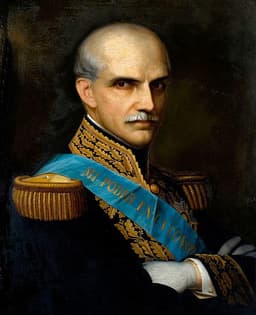
Gabriel Garcia Moreno
Politician · Modern
49.3Total

Julius Caesar
General · Ancient
82.8Total
Basic Information
Born
1821
-100
Died
1875
-44
Era
Modern
Ancient
Nationality
Ecuador
Roman Republic
Occupation
Politician
General
Civilization
Western
Western
Score Comparison
Military (10%)
21.2
88.0
Political (20%)
62.7
78.0
Influence (20%)
54.9
85.0
Legacy (20%)
47.5
82.0
Leadership (15%)
53.2
80.0
Strategy (15%)
42.3
85.0
TOTAL
49.3
82.8
Gabriel Garcia Moreno — Complete Timeline
1861 AD
Modernization of InfrastructureReform
García Moreno initiated major infrastructure projects, including the construction of roads, bridges, and the Quito-Guayaquil railway. These projects aimed to integrate Ecuador's regions and boost economic development, though they were financed through heavy borrowing.
InfrastructureRailwayDevelopment
Impact: nationalconstructive
Presidency of EcuadorPolitical Action◆ Major
García Moreno was elected President of Ecuador in 1861, serving until 1865 and again from 1869 to 1875. His administrations were characterized by authoritarian rule, centralization of power, and a strong alliance with the Catholic Church.
PresidencyAuthoritarianismCatholicism
Impact: national
1862 AD
Concordat with the VaticanPolitical Action◆ Major
García Moreno signed a concordat with the Vatican in 1862, granting the Catholic Church control over education and religious affairs in Ecuador. This agreement strengthened church-state ties and made Ecuador a confessional state, aligning with his conservative ideology.
Church-State RelationsConcordatCatholicism
Impact: national
1869 AD
Suppression of Liberal OppositionPolitical Action◆ Major
After returning to power in 1869, Garc
RepressionAuthoritarianismConstitution
Impact: nationaldestructive
1875 AD
Assassination of Gabriel García MorenoPolitical Action
García Moreno was assassinated on August 6, 1875, on the steps of the presidential palace in Quito. His death was carried out by liberal opponents, ending his conservative regime and plunging Ecuador into a period of political instability.
AssassinationPolitical ViolenceEnd of Regime
Impact: nationaltragic
Julius Caesar — Complete Timeline
58 BC
Gallic WarsWar◆ Major
Caesar, as proconsul of Gaul, launched a series of campaigns that conquered all of Gaul (modern France, Belgium, and parts of Switzerland). He fought numerous battles, including against the Helvetii, the Belgae, and the Gallic chieftain Vercingetorix. The wars brought immense wealth and a loyal army to Caesar.
Gallic WarsConquestRoman Expansion
Impact: regional
49 BC
Crossing the RubiconPolitical Action◆ Major
Caesar led Legio XIII across the Rubicon River into Italy, defying the Roman Senate's order to disband his army. This act triggered a civil war against Pompey and the Optimates, ultimately leading to Caesar's dictatorship and the end of the Roman Republic.
Roman Civil WarEnd of RepublicPower Struggle
Impact: global
48 BC
Battle of PharsalusWar◆ Major
Caesar's outnumbered army defeated the larger forces of Pompey the Great at Pharsalus in Greece. Caesar's tactical use of a reserve line to counter Pompey's cavalry charge proved decisive. Pompey fled to Egypt, where he was assassinated, leaving Caesar as the undisputed master of the Roman world.
Roman Civil WarBattleDecisive Victory
Impact: regional
44 BC
Appointment as Dictator for LifePolitical Action◆ Major
The Roman Senate appointed Caesar dictator perpetuo (dictator for life), granting him unprecedented personal power. This move concentrated military, legislative, and judicial authority in one person, effectively ending the Roman Republic's traditional system of checks and balances and alarming many senators.
DictatorshipEnd of RepublicPower Consolidation
Impact: regionaldestructive
Assassination on the Ides of MarchPolitical Action◆ Major
A group of Roman senators, led by Marcus Junius Brutus and Gaius Cassius Longinus, stabbed Caesar to death at a meeting of the Senate in the Theatre of Pompey. The assassination was intended to restore the Republic, but instead triggered another civil war that led to the rise of the Roman Empire.
AssassinationRoman PoliticsEnd of Republic
Impact: globaldestructive
Expert Analysis
gabriel-garcia-moreno-vs-julius-caesar
# The Dictator and the Theocrat: Caesar and García Moreno
On the Ides of March, 44 BCE, Julius Caesar fell beneath twenty-three dagger blows in the Pompeian Senate chamber, his blood pooling on the marble floor. Eighteen centuries later, on August 6, 1875, Gabriel García Moreno stumbled on the steps of his presidential palace in Quito, hacked down by machetes wielded by liberal assassins. Both men died violently, both ruled with iron hands, and both left nations transformed. Yet one built an empire that would define Western civilization for millennia, while the other built a conservative Catholic republic that remains a footnote in world history. What separates the conqueror of Gaul from the president of Ecuador? The answer lies not in their ambition—both had that in abundance—but in the worlds they inhabited and the tools history placed in their hands.
Origins
Caesar was born into the patrician Julian clan, an ancient but impoverished noble family in a Roman Republic already creaking under the weight of its own conquests. His world was one of civil wars, senatorial intrigue, and the relentless expansion of a Mediterranean superpower. He learned Greek philosophy, studied rhetoric, and watched his uncle Marius and rival Sulla tear the Republic apart. From childhood, Caesar understood that power in Rome was a game of alliances, debts, and military glory.
García Moreno entered the world in 1821, the same year Ecuador won independence from Spain. He was born into a creole elite that had just inherited a shattered colony—a land of vast Andean mountains, dense jungles, and a deeply Catholic indigenous population. Where Caesar's Rome was a pagan superstate hungry for more territory, García Moreno's Ecuador was a fragile new nation bleeding from wars of independence, deeply divided between liberals who wanted secular progress and conservatives who clung to the Church. His education in Quito and later in Europe exposed him to the intellectual currents of the day, but unlike Caesar, who absorbed the cynical pragmatism of Roman politics, García Moreno emerged as a militant Catholic, convinced that only the Church could hold his fractured country together.
Rise to Power
Caesar’s path to dominance was a masterclass in calculated risk. He climbed the Roman political ladder—quaestor, aedile, praetor—but his true springboard came when he secured the governorship of Gaul in 58 BCE. Over eight years, he conquered a territory larger than Italy, built a loyal army that worshipped him, and amassed enough wealth to buy the loyalty of Rome’s elites. When the Senate ordered him to disband his legions, he crossed the Rubicon River in 49 BCE, igniting a civil war that ended with him as dictator.
García Moreno’s rise was quieter, more provincial, but no less determined. He first became president of Ecuador in 1861 after years of political chaos, with the country teetering between liberal revolutions and conservative coups. Unlike Caesar, who seized power through military force, García Moreno won elections—though in a system where the Catholic Church and landed elites controlled the votes. His key turning point came in 1862, when he signed a concordat with the Vatican, handing control of education and religious life to the Church. This pact defined his rule: Caesar conquered nations; García Moreno conquered souls.
Leadership & Governance
Caesar governed as a military genius and political reformer. He reorganized the Roman calendar (giving us the Julian calendar), extended citizenship to provincial elites, initiated massive public works, and centralized power in his own hands while maintaining the facade of the Republic. His military strategy was audacious—crossing the English Channel, besieging Alesia, and defeating Pompey at Pharsalus. He understood that power required both the sword and the law, and he wielded both with cold precision.
García Moreno governed as a Catholic autocrat. He built roads and bridges linking Quito to Guayaquil, modernized the postal system, and balanced Ecuador’s budget—achievements that earned him genuine admiration. But his rule was also marked by the suppression of liberal opposition after 1869, using censorship, exile, and police force to silence secular voices. Where Caesar’s reforms expanded the Roman state, García Moreno’s contracted Ecuador into a confessional fortress. He had no military genius to speak of—his strategy score of 41.4 reflects a man who relied on political maneuvering, not battlefield brilliance. His strength lay in political will: a leadership score of 79.6, high for a small-state president.
Triumph & Tragedy
Caesar’s greatest triumph was the conquest of Gaul, which doubled Rome’s territory and filled its treasury. His greatest tragedy was his assassination—a failure to understand that the Republic’s elite would never accept a king in all but name. He died at the height of his power, his reforms unfinished, his adopted heir Octavian left to clean up the mess.
García Moreno’s triumph was stabilizing Ecuador after decades of chaos, giving it a decade of peace and infrastructure that outlasted him. His tragedy was his assassination—a brutal machete attack on the palace steps, carried out by liberal radicals who saw him as a theocratic tyrant. Unlike Caesar, who died surrounded by senators, García Moreno died alone, his body hacked apart in the Andean twilight. Both men were victims of the very forces they had tried to control: Caesar of republican resentment, García Moreno of liberal fury.
Character & Destiny
Caesar was a gambler—charming, ruthless, and endlessly calculating. His personality drove him to take risks that would have destroyed lesser men: crossing the Rubicon, pardoning enemies, trusting his luck. This gambler’s instinct made him great, but it also blinded him to the daggers of his friends. He believed his charisma could overcome any conspiracy.
García Moreno was a zealot—pious, disciplined, and unyielding. He saw politics as a holy war, and his Catholic faith was both his strength and his blind spot. He could not compromise with liberals because he believed they were agents of Satan. This rigidity earned him devoted followers and implacable enemies, but it also limited his vision. Caesar dreamed of an empire; García Moreno dreamed of a theocracy. One ambition expanded the world; the other contracted it.
Legacy
Caesar’s legacy is immeasurable. His name became a title—Kaiser, Tsar—and his reforms laid the foundation for the Roman Empire that would shape Western law, language, and government for two thousand years. He is remembered as a military genius, a political revolutionary, and a cautionary tale about ambition.
García Moreno’s legacy is smaller but sharper. In Ecuador, he is revered by conservatives as a martyr for Catholic civilization, reviled by liberals as a theocratic dictator. His concordat with the Vatican lasted until the 20th century, and his infrastructure projects still serve the country. But his vision of a Catholic republic died with him. Ecuador eventually secularized, and García Moreno became a symbol of a road not taken—a path of faith and order that modern history has largely abandoned.
Conclusion
What ultimately separates Caesar from García Moreno is not ambition or ability, but scale and context. Caesar lived in a world of empires, where one man could reshape the Mediterranean. García Moreno lived in a world of nation-states, where even a determined leader could only reshape a small Andean republic. Both died by violence, both left lasting marks, but one changed the course of Western history, while the other changed only his corner of it. In the end, history’s judgment depends not just on what a leader does, but on the stage on which he acts. Caesar had the Roman world; García Moreno had Ecuador. Both played their parts with ferocious conviction—but only one played for the highest stakes.
Rankings
🥇
Julius CaesarLeader
Mil: 88.0Pol: 78.0Inf: 85.0
82.8
🥈
Gabriel Garcia Moreno
Mil: 21.2Pol: 62.7Inf: 54.9
49.3
+33.5 behind
How This Comparison Works
Algorithm
Each figure is scored on 6 dimensions (0—100 scale) based on structured historical data: Military (10%), Political (20%), Influence (20%), Legacy (20%), Leadership (15%), Strategy (15%). The weighted total produces the final ranking.
Data Sources
Scores are computed from structured sub-indicators in the database. Scale factors adjust for era (Ancient ×0.85, Modern ×1.0) and civilization size (Eastern ×1.05, Other ×0.80) to account for differences in population and military scale.
Maximum 3 Figures
Comparisons are limited to 2—3 figures to ensure readability and statistical meaningfulness.
Error Margins
±5 points per dimension — Sub-scores are derived from historical records with inherent uncertainty. Two figures within 5 points on a dimension should be considered roughly equivalent in that area.
Total Score Accuracy
±3 points overall — The weighted combination of 6 dimensions produces a total score with approximately ±3 points of uncertainty. Differences of less than 3 points are not statistically significant— the figures are effectively tied.
Known Limitations
- Historical records are incomplete and uneven across civilizations
- Figures from oral-tradition societies may be underrepresented
- Occupation labels can misclassify multi-role figures
- Scores measure capability and impact, not moral character
- Quantitative scoring is a comparison tool, not absolute truth
Capability Radar
Military (10%) — Battles & Warfare
Battles
20
95
Win Rate
25
92
Expansion
15
97
Political (20%) — Governance & Reform
Reform
70
90
Diplomacy
40
85
Economy
60
82
Influence (20%) — Cultural & Global Reach
Cultural
40
88
Global
30
94
Legacy (20%) — Historical Impact
Historical
50
95
Longevity
35
96
Leadership (15%) — Power & Stability
Tenure
55
75
Stability
45
60
Strategy (15%) — Tactics & Innovation
Strategy
20
94
Tactics
15
96
Reform
30
88
Similar Comparisons
Comments & Discussion
SenatusPopulus6/17/2026
Comparing Caesar to García Moreno is like comparing a hurricane to a garden hose. Caesar’s reforms—land redistribution, calendar overhaul, citizenship extension—reshaped the Mediterranean world for centuries. García Moreno built railroads and a theocracy. One expanded the boundaries of civilization; the other tightened the screws on a small Andean backwater. Caesar’s death sparked a civil war that birthed an empire; García Moreno’s just reaffirmed Ecuador’s cycle of coups. The scale alone makes
数据篾匠6/17/2026
拿历史统计来比?罗马帝国GDP占全球四分之一强,凯撒活着的35年打下高卢让罗马人口翻倍。加西亚·莫雷诺统治厄瓜多尔16年,铁路多修了200公里,天主教徒比例从99%升到99.5%。要论“铁腕治国效率”,凯撒一个跨海作战决策就能调动三万人,莫雷诺查个税收都得和教会商量。数据不会撒谎:一个是地球棋盘上的棋手,一个是棋盘角落的兵卒。
ClassicsCompendium6/17/2026
The structural irony is delicious: Caesar, the pagan monarchist, laid the groundwork for empire through conquest and law, while García Moreno, the self-styled Catholic crusader, built a confessional state that crumbled within decades. Caesar’s dictatorship was a pragmatic synthesis of military power and liberal reforms—he pardoned rivals, reformed debt, and centralized authority without abolishing republican forms entirely. García Moreno’s rule was a sectarian fortress: the Concordat of 1862 han
旧书虫6/17/2026
我翻过厄瓜多尔档案馆的原始文件——莫雷诺1869年宪法第七条写着“国家信仰为罗马天主教,排斥一切其他崇拜”。凯撒呢?《卢卡条约》后他让埃及祭司继续供奉伊西斯,自己还在罗马广场建了维纳斯神庙,但从未禁止犹太教在罗马的礼拜。这才是古今之别:凯撒用权力整合异教世界,莫雷诺用权力冻结时间。一个往前看,一个往后看,结局自然天壤之别。
RevisionistDagger6/17/2026
Spare me the Civilizing Mission worship. Caesar’s Gaul was a genocide: one million dead, another million enslaved, all to pay off his debts and secure a triumph. García Moreno’s Ecuador was brutally repressive to liberals, but his public works and debt repayment actually improved life for the rural poor. The difference isn’t greatness—it’s that Caesar’s bloodletting got rebranded as history, while Moreno’s brutality remains provincial nastiness. If we’re judging by human cost, Moreno’s machetes