Loading...
Frederick V of Austria vs Selim I
Selim I leads by 20.0 pts · 2 figures compared
…
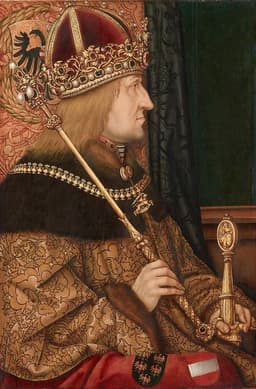
Frederick V of Austria
Emperor · Medieval
50.6Total
Selim I
Emperor · Medieval
70.6Total
Basic Information
Born
1415
1470
Died
1493
1520
Era
Medieval
Medieval
Nationality
Austria
Ottoman Empire
Occupation
Emperor
Emperor
Civilization
Western
Middle Eastern
Score Comparison
Military (10%)
50.0
78.5
Political (20%)
45.1
70.3
Influence (20%)
51.8
65.0
Legacy (20%)
49.2
68.0
Leadership (15%)
74.0
80.0
Strategy (15%)
25.0
70.0
TOTAL
50.6
70.6
Frederick V of Austria — Complete Timeline
1440 AD
Election as King of the RomansPolitical Action◆ Major
Frederick was elected King of the Romans in Frankfurt, succeeding his cousin Albert II. This election placed him at the head of the Holy Roman Empire, beginning his long reign as Frederick III.
ElectionHoly Roman EmpireKingship
Impact: regional
Adoption of the AEIOU MottoCultural
Frederick III adopted the cryptic motto AEIOU, which he used on his personal belongings and buildings. The meaning remains debated, but it symbolized his claim to universal rule and Habsburg destiny.
MottoSymbolismHabsburg
1452 AD
Coronation as Holy Roman EmperorPolitical Action◆ Major
Frederick III was crowned Holy Roman Emperor by Pope Nicholas V in Rome. This was the last imperial coronation to take place in Rome, and it solidified his authority over the empire.
CoronationHoly Roman EmpirePapacy
Impact: regional
1477 AD
Marriage of Maximilian I and Mary of BurgundyPolitical Action◆ Major
Frederick III arranged the marriage of his son Maximilian to Mary of Burgundy, heiress of the Burgundian state. This union brought the Burgundian Netherlands into the Habsburg domain, greatly expanding Habsburg power.
Marriage AllianceHabsburg ExpansionBurgundy
Impact: regionalconstructive
1485 AD
Siege of Vienna (Austrian-Hungarian War)War◆ Major
Frederick III lost Vienna to the Hungarian king Matthias Corvinus after a prolonged siege. The city remained under Hungarian control until 1490, marking a significant territorial loss for Frederick.
SiegeTerritorial LossHungary
Impact: regionaldestructive
Selim I — Complete Timeline
1513 AD
Execution of Prince Mustafa and Prince KorkutPolitical Action
To secure his succession, Selim I ordered the execution of his brothers, Prince Mustafa and Prince Korkut, who were potential rivals for the throne. This act followed the Ottoman practice of fratricide to prevent civil war. It eliminated internal opposition and consolidated Selim's rule.
FratricideSuccessionOttoman Politics
Impact: nationaldestructive
1514 AD
Battle of ChaldiranWar
Selim I led the Ottoman army against the Safavid Empire under Shah Ismail I at Chaldiran in eastern Anatolia. The Ottomans, using superior artillery and gunpowder tactics, decisively defeated the Safavids. This victory secured Ottoman control over eastern Anatolia and prevented Safavid expansion westward.
BattleSafavid WarOttoman Victory
Impact: regional
1517 AD
Conquest of Egypt and the HejazWar
Selim I led a campaign against the Mamluk Sultanate, defeating them at the Battle of Marj Dabiq and the Battle of Ridaniya. He conquered Cairo and the Hejaz, including the holy cities of Mecca and Medina. This brought the Islamic caliphate under Ottoman control and expanded Ottoman territory into North Africa and Arabia.
ConquestMamluk SultanateCaliphate
Impact: global
Assumption of the CaliphatePolitical Action◆ Major
After conquering Cairo, Selim I received the keys to the Kaaba and the relics of the Prophet Muhammad from the last Abbasid caliph, Al-Mutawakkil III. Selim I assumed the title of Caliph, claiming spiritual leadership of the Islamic world. This transfer established the Ottoman sultans as caliphs until 1924.
CaliphateIslamic LeadershipOttoman Empire
Impact: global
Expert Analysis
Origins
Frederick V of Austria, better known as Frederick III, was born in 1415 in Innsbruck, a member of the Habsburg dynasty. His father was Duke Ernest the Iron of Inner Austria, and his mother was Cymburgis of Masovia. Frederick received a modest education, focusing on Latin and religious studies, but was more inclined towards a quiet life. In contrast, Selim I was born in 1470 in Amasya, the son of Sultan Bayezid II and Gulbahar Hatun. From a young age, Selim was trained in statecraft and military command, serving as a provincial governor. His environment was one of constant intrigue and ambition, shaping his aggressive personality.
Rise to Power
Frederick III became Duke of Inner Austria in 1424 after his father's death, but his rise to imperial prominence came slowly. He was elected King of the Romans in 1440, succeeding his cousin Albert II, due to Habsburg influence and his reputation as a neutral figure. His coronation as Holy Roman Emperor by Pope Nicholas V in 1452 was the last imperial coronation in Rome, symbolizing the waning power of the papacy. Frederick's strategy was to consolidate Habsburg lands through marriage and inheritance, famously using the motto AEIOU (Austriae est imperare orbi universo – 'All the world is subject to Austria'). Selim I, however, rose through rebellion. He opposed his father Bayezid II's peaceful policies and mobilized support among the Janissaries. In 1512, he forced his father to abdicate and executed his brothers to secure the throne. His military prowess was immediately demonstrated at the Battle of Chaldiran in 1514, where he defeated the Safavid Shah Ismail I, using superior artillery and tactics. This victory secured Ottoman eastern borders and opened the way for conquests in the Middle East.
Leadership & Governance
Frederick III's leadership style was cautious and bureaucratic. He rarely took to the field, scoring 50.0 in military, but focused on legal and administrative reforms, earning a leadership score of 74.0. He spent much of his reign traveling across the empire, issuing charters and mediating disputes. His governance was marked by a reliance on the princely electors and the imperial diet, reflecting the decentralized nature of the Holy Roman Empire. Selim I, in contrast, was a hands-on autocrat with a military score of 78.5 and leadership of 80.0. He centralized power, suppressed the Janissary revolts, and personally led campaigns. His conquest of Egypt in 1517 ended the Mamluk Sultanate and brought the holy cities of Mecca and Medina under Ottoman control. He assumed the Caliphate, claiming religious authority over Sunni Muslims, which boosted his political legitimacy (political score 70.3).
Triumph & Tragedy
Frederick III's greatest triumph was the marriage of his son Maximilian I to Mary of Burgundy in 1477, which brought the Burgundian Netherlands into Habsburg hands, laying the foundation for the Habsburg Empire's dominance in Europe. However, his greatest failure was the loss of Vienna to Matthias Corvinus of Hungary in 1485 after a prolonged siege. The city remained under Hungarian control until 1490, marking a low point for Habsburg power. Selim I's triumphs include the doubling of Ottoman territory through his conquests of Egypt, Syria, and the Hejaz. He secured the Red Sea and Indian Ocean trade routes, enhancing Ottoman influence. His tragedy was his ruthless elimination of rivals: he executed his brothers and sons (Mustafa and Korkut) to secure succession, creating a precedent of fratricide that destabilized future successions. He also died in 1520, possibly from cancer, at the age of 50, leaving his son Suleiman a vast but volatile empire.
Character & Destiny
Frederick III was known for his patience, frugality, and indecisiveness. He often avoided conflict, earning the nickname 'Frederick the Peaceful'. His motto AEIOU reflected his long-term vision for the Habsburgs, but his passive approach meant he often suffered defeats, like the loss of Vienna. His character shaped his destiny: he survived many challenges through endurance rather than action, eventually seeing his family rise through strategic marriages. Selim I was ruthless, ambitious, and decisive. His nickname 'Yavuz' (the Grim) reflects his sternness. He personally led his armies and executed rivals without hesitation. His character led him to conquer vast lands but also left a legacy of bloodshed and centralized autocracy. Historians note that Selim's military strategy (score 70.0) was superior to Frederick's (25.0), allowing him to achieve rapid expansion while Frederick's cautious approach limited his immediate gains.
Legacy
Frederick III's legacy is the consolidation of the Habsburg dynasty's position through marriage politics. The AEIOU motto became a symbol of Habsburg ambition. His reign saw the last imperial coronation in Rome, marking the end of medieval imperial traditions. The Burgundian inheritance he secured for his son Maximilian I eventually led to the Habsburg Empire's control over Spain and the Netherlands. Selim I's legacy is more tangible: he transformed the Ottoman Empire into a global power, controlling the holy cities and claiming the Caliphate. His conquests established Ottoman dominance over the Middle East for centuries. The Ottoman legal system and administrative reforms he initiated were continued by Suleiman. However, his brutal methods set a precedent for succession violence that plagued the empire. In terms of overall impact, Selim I scores higher in total (70.6 vs 50.6), but Frederick III's long-term influence on European dynastic politics is significant.
Conclusion
Selim I had a greater immediate impact on the world, doubling Ottoman territory and establishing the Caliphate, with military and leadership scores of 78.5 and 80.0. Frederick III, with a total score of 50.6, was less effective in his own time, losing Vienna and rarely asserting imperial authority. However, Frederick's strategic marriage alliances laid the groundwork for the Habsburg Empire's future dominance, influencing European history for centuries. While Selim's conquests were more dramatic, Frederick's patient dynastic building arguably had a more enduring effect on the balance of power in Europe. Nonetheless, based on the scores and historical outcomes, Selim I emerges as the more impactful leader.
Rankings
🥇
Selim ILeader
Mil: 78.5Pol: 70.3Inf: 65.0
70.6
🥈
Frederick V of Austria
Mil: 50.0Pol: 45.1Inf: 51.8
50.6
+20.0 behind
How This Comparison Works
Algorithm
Each figure is scored on 6 dimensions (0—100 scale) based on structured historical data: Military (10%), Political (20%), Influence (20%), Legacy (20%), Leadership (15%), Strategy (15%). The weighted total produces the final ranking.
Data Sources
Scores are computed from structured sub-indicators in the database. Scale factors adjust for era (Ancient ×0.85, Modern ×1.0) and civilization size (Eastern ×1.05, Other ×0.80) to account for differences in population and military scale.
Maximum 3 Figures
Comparisons are limited to 2—3 figures to ensure readability and statistical meaningfulness.
Error Margins
±5 points per dimension — Sub-scores are derived from historical records with inherent uncertainty. Two figures within 5 points on a dimension should be considered roughly equivalent in that area.
Total Score Accuracy
±3 points overall — The weighted combination of 6 dimensions produces a total score with approximately ±3 points of uncertainty. Differences of less than 3 points are not statistically significant— the figures are effectively tied.
Known Limitations
- Historical records are incomplete and uneven across civilizations
- Figures from oral-tradition societies may be underrepresented
- Occupation labels can misclassify multi-role figures
- Scores measure capability and impact, not moral character
- Quantitative scoring is a comparison tool, not absolute truth
Capability Radar
Military (10%) — Battles & Warfare
Battles
15
85
Win Rate
20
90
Expansion
10
90
Political (20%) — Governance & Reform
Reform
40
75
Diplomacy
55
80
Economy
30
70
Influence (20%) — Cultural & Global Reach
Cultural
30
60
Global
20
75
Legacy (20%) — Historical Impact
Historical
50
80
Longevity
45
70
Leadership (15%) — Power & Stability
Tenure
70
70
Stability
35
65
Strategy (15%) — Tactics & Innovation
Strategy
15
85
Tactics
10
80
Reform
10
70
Similar Comparisons
Comments & Discussion
No comments yet. Be the first to share your thoughts!