Loading...
Frederick V of Austria vs Julius Caesar
Julius Caesar leads by 32.2 pts · 2 figures compared
…
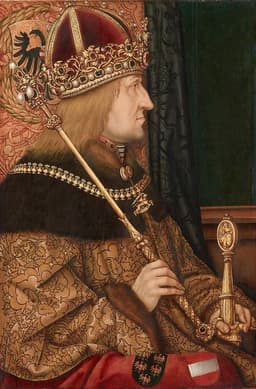
Frederick V of Austria
Emperor · Medieval
50.6Total

Julius Caesar
General · Ancient
82.8Total
Basic Information
Born
1415
-100
Died
1493
-44
Era
Medieval
Ancient
Nationality
Austria
Roman Republic
Occupation
Emperor
General
Civilization
Western
Western
Score Comparison
Military (10%)
50.0
88.0
Political (20%)
45.1
78.0
Influence (20%)
51.8
85.0
Legacy (20%)
49.2
82.0
Leadership (15%)
74.0
80.0
Strategy (15%)
25.0
85.0
TOTAL
50.6
82.8
Frederick V of Austria — Complete Timeline
1440 AD
Election as King of the RomansPolitical Action◆ Major
Frederick was elected King of the Romans in Frankfurt, succeeding his cousin Albert II. This election placed him at the head of the Holy Roman Empire, beginning his long reign as Frederick III.
ElectionHoly Roman EmpireKingship
Impact: regional
Adoption of the AEIOU MottoCultural
Frederick III adopted the cryptic motto AEIOU, which he used on his personal belongings and buildings. The meaning remains debated, but it symbolized his claim to universal rule and Habsburg destiny.
MottoSymbolismHabsburg
1452 AD
Coronation as Holy Roman EmperorPolitical Action◆ Major
Frederick III was crowned Holy Roman Emperor by Pope Nicholas V in Rome. This was the last imperial coronation to take place in Rome, and it solidified his authority over the empire.
CoronationHoly Roman EmpirePapacy
Impact: regional
1477 AD
Marriage of Maximilian I and Mary of BurgundyPolitical Action◆ Major
Frederick III arranged the marriage of his son Maximilian to Mary of Burgundy, heiress of the Burgundian state. This union brought the Burgundian Netherlands into the Habsburg domain, greatly expanding Habsburg power.
Marriage AllianceHabsburg ExpansionBurgundy
Impact: regionalconstructive
1485 AD
Siege of Vienna (Austrian-Hungarian War)War◆ Major
Frederick III lost Vienna to the Hungarian king Matthias Corvinus after a prolonged siege. The city remained under Hungarian control until 1490, marking a significant territorial loss for Frederick.
SiegeTerritorial LossHungary
Impact: regionaldestructive
Julius Caesar — Complete Timeline
58 BC
Gallic WarsWar◆ Major
Caesar, as proconsul of Gaul, launched a series of campaigns that conquered all of Gaul (modern France, Belgium, and parts of Switzerland). He fought numerous battles, including against the Helvetii, the Belgae, and the Gallic chieftain Vercingetorix. The wars brought immense wealth and a loyal army to Caesar.
Gallic WarsConquestRoman Expansion
Impact: regional
49 BC
Crossing the RubiconPolitical Action◆ Major
Caesar led Legio XIII across the Rubicon River into Italy, defying the Roman Senate's order to disband his army. This act triggered a civil war against Pompey and the Optimates, ultimately leading to Caesar's dictatorship and the end of the Roman Republic.
Roman Civil WarEnd of RepublicPower Struggle
Impact: global
48 BC
Battle of PharsalusWar◆ Major
Caesar's outnumbered army defeated the larger forces of Pompey the Great at Pharsalus in Greece. Caesar's tactical use of a reserve line to counter Pompey's cavalry charge proved decisive. Pompey fled to Egypt, where he was assassinated, leaving Caesar as the undisputed master of the Roman world.
Roman Civil WarBattleDecisive Victory
Impact: regional
44 BC
Appointment as Dictator for LifePolitical Action◆ Major
The Roman Senate appointed Caesar dictator perpetuo (dictator for life), granting him unprecedented personal power. This move concentrated military, legislative, and judicial authority in one person, effectively ending the Roman Republic's traditional system of checks and balances and alarming many senators.
DictatorshipEnd of RepublicPower Consolidation
Impact: regionaldestructive
Assassination on the Ides of MarchPolitical Action◆ Major
A group of Roman senators, led by Marcus Junius Brutus and Gaius Cassius Longinus, stabbed Caesar to death at a meeting of the Senate in the Theatre of Pompey. The assassination was intended to restore the Republic, but instead triggered another civil war that led to the rise of the Roman Empire.
AssassinationRoman PoliticsEnd of Republic
Impact: globaldestructive
Expert Analysis
frederick-v-of-austria-vs-julius-caesar
# The Dictator and the Dreamer: Two Paths to Power in Ancient and Medieval Europe
On the Ides of March in 44 BCE, Julius Caesar fell beneath the daggers of sixty senators, his blood pooling at the base of Pompey’s statue. The man who had conquered Gaul, crossed the Rubicon, and declared himself dictator for life lay dead, his final breath a testament to ambition’s price. Fourteen centuries later, another ruler—Frederick V of Austria, better known as Holy Roman Emperor Frederick III—sat in his Vienna palace, stitching the cryptic letters AEIOU onto his garments, dreaming of Habsburg dominion over the world. One died in a blaze of political violence; the other reigned for fifty-three years and died in his bed. Both sought to reshape history, but their paths—and their fates—could not have diverged more sharply.
Origins
Gaius Julius Caesar was born into the patrician Julian clan in 100 BCE, a family that traced its lineage to the goddess Venus. Yet the Rome of his youth was a republic in convulsion: patricians and plebeians clashed, generals raised private armies, and the old aristocratic order was crumbling. Caesar’s father died when he was sixteen, leaving him to navigate a world of debt, rivalry, and survival. He learned early that in Rome, glory was currency and risk was the only road to greatness.
Frederick V of Austria entered the world in 1415, the same year Henry V won Agincourt. His family, the Habsburgs, were neither the wealthiest nor the most powerful house in the Holy Roman Empire—not yet. The empire itself was a patchwork of hundreds of states, electors, and free cities, held together by little more than tradition and the fragile authority of an elected emperor. Frederick’s childhood was shaped by the relentless politics of dynastic survival, where marriages mattered more than battles and patience was the greatest weapon.
Rise to Power
Caesar’s ascent was a story of audacity and timing. He fled Rome to avoid Sulla’s proscriptions, then returned as a rising military tribune. He borrowed fortunes to fund public spectacles, won election as pontifex maximus, and forged the First Triumvirate with Pompey and Crassus. But his true springboard was Gaul: from 58 to 50 BCE, he conquered a territory that doubled the size of the Republic, built a loyal army, and amassed enough wealth to make the Senate tremble. When ordered to disband, he crossed the Rubicon River in 49 BCE with a single legion, uttering the words *alea iacta est*—the die is cast. Civil war followed, and within four years, Caesar was master of Rome.
Frederick’s rise was glacial by comparison. In 1440, at age twenty-five, he was elected King of the Romans in Frankfurt, succeeding his cousin Albert II. It was not a conquest but a compromise: the electors chose him because he seemed weak and malleable. Twelve years passed before he was crowned Holy Roman Emperor by Pope Nicholas V in Rome in 1452—the last imperial coronation ever held in the Eternal City. Where Caesar seized power in a lightning campaign, Frederick accumulated it through sheer endurance.
Leadership & Governance
Caesar governed as a revolutionary. He reformed the calendar, granted citizenship to provincials, launched public works, and centralized authority in his own hands. He pardoned former enemies—a calculated mercy that would ultimately fail to save him. His military genius was unmatched: at Alesia in 52 BCE, his double siege lines trapped both the Gallic army and its relief force, a feat of engineering and tactical brilliance that still stuns historians. Yet his political wisdom was undermined by his impatience. He accepted a dictatorship for life, flaunted his power, and treated the Senate as a rubber stamp.
Frederick III governed as a survivor. His military record was disastrous: in 1485, the Hungarian king Matthias Corvinus besieged Vienna and took it, forcing Frederick to flee his own capital. He never won a major battle. But his political genius lay in marriage and inheritance. In 1477, he arranged the marriage of his son Maximilian to Mary of Burgundy, heiress to the richest state in Europe. This single act transformed the Habsburgs from a middling dynasty into a continental power. Frederick’s motto, AEIOU—*Austriae est imperare orbi universo* (Austria is destined to rule the whole world)—was not a boast of conquest but a prophecy of patience. He outlived his enemies, waited for opportunities, and let time do the work of empire.
Triumph & Tragedy
Caesar’s greatest triumph was the conquest of Gaul, a campaign he himself chronicled in elegant Latin prose that remains a masterpiece of military literature. His tragedy was the Ides of March: the assassination that ended his life and plunged Rome into another civil war. He had centralized power but failed to build institutions to sustain it. His adopted heir, Octavian, would learn from his mistakes and create the Empire that Caesar had only glimpsed.
Frederick’s triumph was the Burgundian marriage, a diplomatic masterstroke that laid the foundation for Habsburg dominance for centuries. His tragedy was the loss of Vienna, the humiliation of fleeing his own city as Hungarian troops occupied it. Yet even that defeat was temporary. Matthias Corvinus died in 1490, and Frederick returned. He died three years later, in 1493, at age seventy-eight, having reigned longer than almost any European monarch.
Character & Destiny
Caesar was driven by *ambitio*—the Roman craving for glory and honor. He could not stop. He pardoned his enemies because he believed he was above their petty resentments. He refused a bodyguard because he considered himself invincible. His personality was his destiny: he dared everything, won everything, and then lost everything because he could not imagine losing.
Frederick was driven by endurance. He was slow, cautious, and unglamorous—contemporaries called him “the Arch-Sleepyhead.” But he understood that in the medieval empire, power was not seized but inherited, not won in a day but built over generations. His motto AEIOU was not a plan but a prayer. He played the long game, and the long game won.
Legacy
Caesar’s legacy is the Roman Empire, the Latin language, the calendar we still use, and the title “Caesar” that became synonymous with emperor. His name became a byword for ambition and tyranny, but also for genius. He changed the course of Western civilization in a single decade.
Frederick III’s legacy is the Habsburg dynasty that dominated Europe for four centuries, from Spain to Hungary to the New World. His son Maximilian, his grandson Charles V, his great-grandson Philip II—all inherited the empire he had quietly assembled through marriages and patience. He is not remembered as a conqueror, but as a founder.
Conclusion
Two men, fourteen centuries apart, both seeking to rule the world. Caesar crossed a river and changed history in a flash of steel. Frederick stitched a motto on his sleeve and changed it in a whisper. One died at fifty-five, betrayed by those he spared; the other died at seventy-eight, mourned by a dynasty he had built. The dictator and the dreamer remind us that power takes many forms—and that in the end, the most lasting conquests are not always the loudest.
Rankings
🥇
Julius CaesarLeader
Mil: 88.0Pol: 78.0Inf: 85.0
82.8
🥈
Frederick V of Austria
Mil: 50.0Pol: 45.1Inf: 51.8
50.6
+32.2 behind
How This Comparison Works
Algorithm
Each figure is scored on 6 dimensions (0—100 scale) based on structured historical data: Military (10%), Political (20%), Influence (20%), Legacy (20%), Leadership (15%), Strategy (15%). The weighted total produces the final ranking.
Data Sources
Scores are computed from structured sub-indicators in the database. Scale factors adjust for era (Ancient ×0.85, Modern ×1.0) and civilization size (Eastern ×1.05, Other ×0.80) to account for differences in population and military scale.
Maximum 3 Figures
Comparisons are limited to 2—3 figures to ensure readability and statistical meaningfulness.
Error Margins
±5 points per dimension — Sub-scores are derived from historical records with inherent uncertainty. Two figures within 5 points on a dimension should be considered roughly equivalent in that area.
Total Score Accuracy
±3 points overall — The weighted combination of 6 dimensions produces a total score with approximately ±3 points of uncertainty. Differences of less than 3 points are not statistically significant— the figures are effectively tied.
Known Limitations
- Historical records are incomplete and uneven across civilizations
- Figures from oral-tradition societies may be underrepresented
- Occupation labels can misclassify multi-role figures
- Scores measure capability and impact, not moral character
- Quantitative scoring is a comparison tool, not absolute truth
Capability Radar
Military (10%) — Battles & Warfare
Battles
15
95
Win Rate
20
92
Expansion
10
97
Political (20%) — Governance & Reform
Reform
40
90
Diplomacy
55
85
Economy
30
82
Influence (20%) — Cultural & Global Reach
Cultural
30
88
Global
20
94
Legacy (20%) — Historical Impact
Historical
50
95
Longevity
45
96
Leadership (15%) — Power & Stability
Tenure
70
75
Stability
35
60
Strategy (15%) — Tactics & Innovation
Strategy
15
94
Tactics
10
96
Reform
10
88
Similar Comparisons
Comments & Discussion
No comments yet. Be the first to share your thoughts!