Loading...
Frederick the Great vs William III of England
William III of England leads by 2.2 pts · 2 figures compared
…
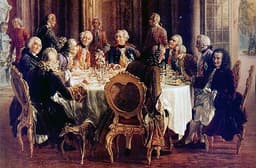
Frederick the Great
Emperor · Modern
68.1Total

William III of England
Emperor · Modern
70.3Total
Basic Information
Born
1712
1650
Died
1786
1702
Era
Modern
Modern
Nationality
Prussia
England
Occupation
Emperor
Emperor
Civilization
Western
Western
Score Comparison
Military (10%)
90.0
61.7
Political (20%)
75.0
75.0
Influence (20%)
55.0
82.0
Legacy (20%)
52.0
55.0
Leadership (15%)
82.0
80.0
Strategy (15%)
88.0
66.3
TOTAL
68.1
70.3
Frederick the Great — Complete Timeline
1723 AD
General Directory EstablishedReform◆ Major
Frederick the Great reorganized the Prussian government by establishing the General Directory, a centralized administrative body. This reform improved tax collection, military logistics, and state efficiency, strengthening Prussia's fiscal and military capacity.
AdministrationReformState Building
Impact: nationalconstructive
1757 AD
Battle of RossbachWar◆ Major
Frederick the Great's Prussian army defeated a larger Franco-Imperial force at Rossbach during the Seven Years' War. The victory showcased Prussian military discipline and Frederick's tactical genius, securing his reputation as a leading commander.
Seven Years' WarBattleMilitary Tactics
Impact: regional
Battle of LeuthenWar◆ Major
Frederick the Great led Prussian forces to a decisive victory over the Austrian army at Leuthen. The battle, fought in Silesia, demonstrated Frederick's use of oblique order tactics and helped Prussia retain control of Silesia during the Seven Years' War.
Seven Years' WarBattleSilesia
Impact: regional
1763 AD
Treaty of Hubertusburg SignedPolitical Action
Frederick the Great signed the Treaty of Hubertusburg with Austria, ending the Seven Years' War. The treaty confirmed Prussian possession of Silesia and established Prussia as a major European power, despite near-defeat earlier in the war.
TreatySeven Years' WarPrussia
Impact: regionalconstructive
1772 AD
First Partition of PolandPolitical Action◆ Major
Frederick the Great orchestrated the First Partition of Poland alongside Russia and Austria. Prussia gained West Prussia, connecting its territories and gaining control of the Vistula River trade, at the expense of Polish sovereignty.
PartitionPolandTerritorial Expansion
Impact: regionaldestructive
William III of England — Complete Timeline
1688 AD
Invasion of England (Glorious Revolution)War
William III landed at Torbay with a Dutch army of 15,000 men. He marched on London as James II's army disintegrated. James fled to France, and William was invited by Parliament to take the throne. This invasion established Protestant succession and parliamentary supremacy.
Glorious RevolutionInvasionConstitutional Change
Impact: nationalconstructive
Nine Years' War (War of the Grand Alliance)War◆ Major
William III led England into the Nine Years' War against France under Louis XIV. He fought campaigns in the Spanish Netherlands and Ireland. The war ended with the Treaty of Ryswick in 1697, which recognized William as king of England.
WarFranceEuropean Conflict
Impact: global
1689 AD
Signing of the Bill of RightsPolitical Action
William III accepted the Bill of Rights, which prohibited the monarch from suspending laws, levying taxes without Parliament, or maintaining a standing army in peacetime. This document established constitutional monarchy in England and limited royal prerogative.
Bill of RightsConstitutional MonarchyParliamentary Supremacy
Impact: nationalconstructive
1690 AD
Battle of the BoyneWar◆ Major
William III personally led his army to victory over James II's forces at the River Boyne in Ireland. This battle secured Protestant control of Ireland and solidified William's throne. It remains a key event in Irish Protestant history.
BattleIrelandProtestant-Catholic Conflict
Impact: regional
1702 AD
Death from PneumoniaOther◆ Major
William III died of pneumonia following a fall from his horse. He was buried in Westminster Abbey. His death ended the Stuart line and passed the throne to Mary's sister Anne, as William had no surviving children.
DeathSuccessionMonarchy
Impact: nationaltragic
Expert Analysis
Origins
Frederick the Great (1712-1786) was born in Berlin to King Frederick William I of Prussia and Sophia Dorothea of Hanover. His father, the 'Soldier King', imposed a harsh military education, but Frederick preferred French literature and music. He attempted to flee to England with his friend Hans Hermann von Katte in 1730, leading to Katte's execution and Frederick's imprisonment. This traumatic event hardened him. He later reconciled with his father and took up military duties. Frederick inherited the throne in 1740 at age 28.
William III (1650-1702) was born in The Hague to William II, Prince of Orange, and Mary Stuart, daughter of Charles I of England. His father died weeks before his birth, leaving him as sovereign prince from infancy. He was raised in a Dutch Republic torn by factional strife between Orangists and republican regents. His education emphasized Calvinist piety and military leadership. He became stadtholder in 1672 at age 22 when the Dutch Republic faced invasion from France and England.
Rise to Power
Frederick's rise began with the death of Charles VI of Austria in 1740. Ignoring the Pragmatic Sanction, Frederick invaded Silesia, a wealthy Habsburg province, launching the War of Austrian Succession. His victory at Mollwitz (1741) established his reputation. Through the Treaty of Breslau (1742), he secured Silesia. The Second Silesian War (1744-1745) confirmed his gains. By 1745, Frederick had doubled Prussia's territory and population, shocking Europe.
William's rise came during the 'Year of Disaster' 1672 when France and England attacked the Dutch Republic. With the Orangist party seizing power, William was appointed captain-general and stadtholder. He saved the Republic by opening dikes to flood the Dutch Water Line, stopping the French army. He then forged an anti-French coalition and by 1678 secured a favorable peace. In 1688, he invaded England at the invitation of English nobles, landing with 15,000 men. James II fled, and William and his wife Mary were crowned joint sovereigns in 1689.
Leadership & Governance
Frederick was an enlightened despot: he centralized administration through the General Directory (1723, expanded by him), codified laws (the Prussian Code of 1749), promoted religious tolerance, and reformed education. He abolished torture and censorship, and invited French intellectuals like Voltaire to his court. However, his reforms were top-down; he maintained serfdom and a rigid social hierarchy. He personally led his armies in battle, sharing hardships with soldiers. His governance score of 75.0 reflects efficiency but limited popular participation.
William III was a constitutional monarch. He accepted the Bill of Rights (1689), which limited royal power, guaranteed free elections, and prohibited a standing army without Parliament. He also signed the Toleration Act, granting religious freedom to dissenters. In foreign policy, he prioritized containing French expansion, leading the Grand Alliance in the Nine Years' War (1688-1697). He was an effective diplomat, uniting European powers against Louis XIV. His leadership score of 80.0 reflects his collaborative style, but he often frustrated Parliament by prioritizing Dutch interests.
Triumph & Tragedy
Frederick's greatest triumph was surviving the Seven Years' War (1756-1763) against a coalition of Austria, France, Russia, and Sweden. Outnumbered, he won spectacular victories at Rossbach (1757) and Leuthen (1757). The Miracle of the House of Brandenburg (1762) when Tsarina Elizabeth died saved him. The Treaty of Hubertusburg confirmed Prussian possession of Silesia, establishing Prussia as a great power. His tragedy was his later isolation; he became cynical and misanthropic after the war, and his reforms stalled. In military terms he scored 90.0, but his political and legacy scores are lower (75.0 and 52.0).
William's triumph was the Glorious Revolution and the Bill of Rights, which established parliamentary sovereignty and influenced democratic development. His victory at the Battle of the Boyne (1690) secured Protestant rule in Ireland. His tragedy was his failure to defeat Louis XIV decisively; the Nine Years' War ended in a stalemate. He also faced domestic opposition, including a Jacobite assassination plot in 1696. He died childless, and the Stuart line ended. His military score of 61.7 reflects mixed success in continental campaigns.
Character & Destiny
Frederick was brilliant, disciplined, and ruthless. He wrote philosophical treatises, composed music, and spoke multiple languages. Yet he was deeply insecure, driven by a desire to prove himself after his father's abuse. He never married and had no children; his heir was his nephew Frederick William II. His character shaped his fate: his audacity won Silesia but his aggression provoked coalitions that nearly destroyed Prussia. Historians rank him as a military genius but a flawed ruler.
William was stoic, persistent, and politically astute. He suffered from asthma and was often ill, but he worked tirelessly. His Calvinist faith gave him a sense of mission against Catholic France. He married Mary, but their marriage was childless. His destiny was to be a transitional figure: he united Dutch and British resources against French hegemony, but his achievements were built on the foundations laid by others. His influence score of 82.0 reflects his pivotal role in European politics.
Legacy
Frederick's legacy is mixed. He transformed Prussia into a great power, laying the groundwork for German unification. His military system influenced Napoleon and later German strategists. His patronage of the arts made Berlin a cultural center. However, his militarism and absolutism set a precedent for Prussian authoritarianism. He scored 52.0 in legacy, indicating that his immediate impact was profound but his long-term influence diminished as Prussia's rise led to two world wars.
William's legacy is more enduring in constitutional terms. The Bill of Rights is a cornerstone of British and American liberties. His concept of a balanced constitution influenced the Enlightenment. His foreign policy strategy of containing France shaped European alliances for centuries. He scored 55.0 in legacy, slightly higher than Frederick, reflecting the lasting impact of his political reforms.
Conclusion
While Frederick the Great was a military genius (90.0) and transformed Prussia into a major power, William III's political achievements had broader and more lasting effects on governance and international relations. William's acceptance of the Bill of Rights established a constitutional monarchy that influenced democratic development globally. Frederick's Prussia, for all its strength, eventually led to authoritarianism and war. William's overall score of 70.3 exceeds Frederick's 68.1, and his influence (82.0) and political (75.0) scores are higher. On balance, William III had a greater impact on the modern world by advancing parliamentary democracy and creating a durable framework for European power balancing.
Rankings
🥇
William III of EnglandLeader
Mil: 61.7Pol: 75.0Inf: 82.0
70.3
🥈
Frederick the Great
Mil: 90.0Pol: 75.0Inf: 55.0
68.1
+2.2 behind
How This Comparison Works
Algorithm
Each figure is scored on 6 dimensions (0—100 scale) based on structured historical data: Military (10%), Political (20%), Influence (20%), Legacy (20%), Leadership (15%), Strategy (15%). The weighted total produces the final ranking.
Data Sources
Scores are computed from structured sub-indicators in the database. Scale factors adjust for era (Ancient ×0.85, Modern ×1.0) and civilization size (Eastern ×1.05, Other ×0.80) to account for differences in population and military scale.
Maximum 3 Figures
Comparisons are limited to 2—3 figures to ensure readability and statistical meaningfulness.
Error Margins
±5 points per dimension — Sub-scores are derived from historical records with inherent uncertainty. Two figures within 5 points on a dimension should be considered roughly equivalent in that area.
Total Score Accuracy
±3 points overall — The weighted combination of 6 dimensions produces a total score with approximately ±3 points of uncertainty. Differences of less than 3 points are not statistically significant— the figures are effectively tied.
Known Limitations
- Historical records are incomplete and uneven across civilizations
- Figures from oral-tradition societies may be underrepresented
- Occupation labels can misclassify multi-role figures
- Scores measure capability and impact, not moral character
- Quantitative scoring is a comparison tool, not absolute truth
Capability Radar
Military (10%) — Battles & Warfare
Battles
85
75
Win Rate
80
70
Expansion
85
60
Political (20%) — Governance & Reform
Reform
90
80
Diplomacy
80
85
Economy
85
75
Influence (20%) — Cultural & Global Reach
Cultural
80
60
Global
75
70
Legacy (20%) — Historical Impact
Historical
85
75
Longevity
80
70
Leadership (15%) — Power & Stability
Tenure
85
70
Stability
75
65
Strategy (15%) — Tactics & Innovation
Strategy
90
78
Tactics
95
72
Reform
90
65
Similar Comparisons
Comments & Discussion
No comments yet. Be the first to share your thoughts!