Loading...
Frederick the Great vs Napoleon Bonaparte
Napoleon Bonaparte leads by 2.8 pts · 2 figures compared
…
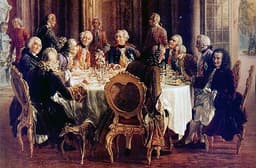
Frederick the Great
Emperor · Modern
68.1Total

Napoleon Bonaparte
General · Modern
70.9Total
Basic Information
Born
1712
1769
Died
1786
1821
Era
Modern
Modern
Nationality
Prussia
France
Occupation
Emperor
General
Civilization
Western
Western
Score Comparison
Military (10%)
90.0
94.0
Political (20%)
75.0
72.0
Influence (20%)
55.0
40.0
Legacy (20%)
52.0
80.0
Leadership (15%)
82.0
78.0
Strategy (15%)
88.0
90.0
TOTAL
68.1
70.9
Frederick the Great — Complete Timeline
1723 AD
General Directory EstablishedReform◆ Major
Frederick the Great reorganized the Prussian government by establishing the General Directory, a centralized administrative body. This reform improved tax collection, military logistics, and state efficiency, strengthening Prussia's fiscal and military capacity.
AdministrationReformState Building
Impact: nationalconstructive
1757 AD
Battle of RossbachWar◆ Major
Frederick the Great's Prussian army defeated a larger Franco-Imperial force at Rossbach during the Seven Years' War. The victory showcased Prussian military discipline and Frederick's tactical genius, securing his reputation as a leading commander.
Seven Years' WarBattleMilitary Tactics
Impact: regional
Battle of LeuthenWar◆ Major
Frederick the Great led Prussian forces to a decisive victory over the Austrian army at Leuthen. The battle, fought in Silesia, demonstrated Frederick's use of oblique order tactics and helped Prussia retain control of Silesia during the Seven Years' War.
Seven Years' WarBattleSilesia
Impact: regional
1763 AD
Treaty of Hubertusburg SignedPolitical Action
Frederick the Great signed the Treaty of Hubertusburg with Austria, ending the Seven Years' War. The treaty confirmed Prussian possession of Silesia and established Prussia as a major European power, despite near-defeat earlier in the war.
TreatySeven Years' WarPrussia
Impact: regionalconstructive
1772 AD
First Partition of PolandPolitical Action◆ Major
Frederick the Great orchestrated the First Partition of Poland alongside Russia and Austria. Prussia gained West Prussia, connecting its territories and gaining control of the Vistula River trade, at the expense of Polish sovereignty.
PartitionPolandTerritorial Expansion
Impact: regionaldestructive
Napoleon Bonaparte — Complete Timeline
1799 AD
Coup of 18 BrumaireOther◆ Major
Napoleon Bonaparte, with support from his brother Lucien and key political figures, overthrew the Directory in a bloodless coup. He established the Consulate with himself as First Consul, effectively becoming the ruler of France. This event ended the French Revolution's most unstable period.
French RevolutionCoupRise to Power
Impact: regional
1804 AD
Promulgation of the Napoleonic CodeOther◆ Major
Napoleon enacted the Civil Code of the French, known as the Napoleonic Code, a comprehensive set of laws that replaced the fragmented feudal legal systems. The code established legal equality, protected property rights, and secularized law. It became the basis for legal systems in many European and world countries.
Legal ReformNapoleonic CodeCivil Law
Impact: globalconstructive
1805 AD
Battle of AusterlitzWar◆ Major
Napoleon's Grande Arm
Napoleonic WarsBattleDecisive Victory
Impact: global
1812 AD
Invasion of RussiaWar◆ Major
Napoleon led the Grande Arm
Napoleonic WarsInvasionDisaster
Impact: globaldestructive
1815 AD
Battle of WaterlooWar◆ Major
Napoleon's French army was defeated by the combined forces of the Duke of Wellington's Anglo-Allied army and Gebhard Leberecht von Bl
Napoleonic WarsBattleFinal Defeat
Impact: globaldestructive
Expert Analysis
frederick-the-great-vs-napoleon-bonaparte
# The Philosopher King and the Emperor of Will
On a bitter December morning in 1805, Napoleon Bonaparte stood atop a hill in Austerlitz, watching his Grand Army crush the combined forces of Russia and Austria. The sun broke through the fog, and his soldiers hailed it as "the sun of Austerlitz." Forty-eight years earlier, on a December day equally cold, Frederick the Great had watched his Prussians shatter the Austrian line at Leuthen, his troops singing a hymn as they marched into battle. Both men were masters of war, yet they ruled worlds apart. Napoleon conquered Europe and lost it all; Frederick transformed a scrap of a kingdom into a great power and kept it. Why did one burn out and the other endure?
Origins
Frederick was born in 1712 into a Prussian court that felt more like a barracks. His father, the "Soldier King" Frederick William I, despised weakness, music, and books—three things his son adored. Young Frederick loved French poetry and played the flute. His father beat him, humiliated him, and once forced him to watch his best friend be executed for attempting to desert with him. Frederick learned early that power was not about being loved; it was about being obeyed. He buried his feelings, wrote philosophical essays, and waited.
Napoleon, born in 1769 on the island of Corsica, grew up in a poor noble family surrounded by Italian vendettas and French occupation. He spoke French with a thick accent that aristocrats mocked. He devoured history and military treatises, dreaming not of poetry but of Alexander and Caesar. Where Frederick learned to survive a tyrant father, Napoleon learned to survive a world that sneered at him. One became a king who hated kingship; the other became an emperor who could not imagine being anything else.
Rise to Power
Frederick's path was inherited. In 1740, at age twenty-eight, his father died, and he became king. Within six months, he invaded Silesia, a rich Austrian province, launching the War of Austrian Succession. He won not through brute force but through audacity and speed—invading in winter when no one expected it. His rise was a legal transfer of power, but his legitimacy came from conquest.
Napoleon rose from nothing. A Corsican outsider in the French army, he seized his moment in 1795 when he crushed a royalist uprising in Paris with a "whiff of grapeshot." He was twenty-six. By 1799, he had conquered Italy, fought in Egypt, and staged a coup to become First Consul. In 1804, he crowned himself Emperor in Notre Dame, taking the crown from the Pope's hands and placing it on his own head. Frederick inherited a crown; Napoleon grabbed one.
Leadership & Governance
Frederick ruled as a philosopher king—but a practical one. He established the General Directory in 1723, centralizing Prussia's chaotic bureaucracy. He reformed the legal system, abolished torture, and allowed religious freedom. "I am the first servant of the state," he wrote, and he meant it. He slept on a camp bed, wore a stained uniform, and worked eighteen-hour days. His military genius was defensive and opportunistic. At Rossbach in 1757, with 22,000 Prussians, he defeated 54,000 Franco-Imperial troops by using the terrain to neutralize their numbers. At Leuthen, he marched his army in a flanking maneuver that remains a textbook example of oblique order. He fought the Seven Years' War against Austria, Russia, France, and Sweden simultaneously—and survived.
Napoleon governed as a titan of will. He created the Napoleonic Code, a legal system that influenced much of Europe and still shapes modern law. He centralized education, established the Bank of France, and made peace with the Catholic Church. But his rule was personal, not institutional. The code was his code; the bank was his bank. His military strategy was aggressive and overwhelming. He used speed, massed artillery, and the corps system to defeat armies twice his size. At Austerlitz in 1805, he lured the allies into attacking his exposed right flank, then crushed their center. He was the greatest general of his age—until he wasn't.
Triumph & Tragedy
Frederick's greatest moment came during his darkest hour. In 1760, after five years of war, his army was shattered, his treasury empty, and Berlin occupied by Russians. He considered suicide. Then the Russian Empress Elizabeth died, and her successor, Peter III, a Prussian admirer, pulled Russia out of the war. Frederick survived by luck and stubbornness. The Treaty of Hubertusburg in 1763 confirmed Prussia as a great power. His tragedy was internal: he never trusted anyone, never married for love, and died alone in his palace at Sanssouci, surrounded by books and dogs.
Napoleon's triumph was total. In 1812, he ruled from Spain to Poland. His tragedy was the invasion of Russia. He marched 600,000 men into the snow; fewer than 100,000 returned. He was exiled to Elba, escaped, raised another army, and lost at Waterloo in 1815. He died on Saint Helena, a British prisoner, at age fifty-one. His tragedy was not bad luck but overreach. Frederick knew when to stop; Napoleon did not.
Character & Destiny
Frederick was a cynic who believed in nothing but duty. "The more I see of men," he wrote, "the more I like dogs." He played the flute to soothe his soul, but his soul was never soothed. His caution came from trauma: he had seen what power could destroy. He fought wars not to conquer the world but to keep what he had.
Napoleon was a romantic who believed in destiny. "Impossible is a word to be found only in the dictionary of fools," he said. He trusted his star until it fell. His ambition was boundless, and so was his fall. Frederick's caution kept Prussia alive; Napoleon's ambition killed his empire.
Legacy
Frederick left a machine. Prussia became a state built on efficiency, discipline, and military readiness. His reforms inspired German unification and, later, Bismarck. Today, he is remembered as the "Old Fritz"—a wily, brilliant king who made a small country great.
Napoleon left a myth. His code, his battles, his ambition shaped the modern world. He ended feudalism in Europe, spread nationalism, and inspired dictators from Hitler to Mussolini. Today, he is remembered as a genius who aimed too high.
Conclusion
Standing at Austerlitz, Napoleon saw the sun rise on his greatest victory. Standing at Leuthen, Frederick heard his soldiers sing hymns as they marched to certain death. Both men knew war intimately. But Frederick fought to preserve; Napoleon fought to possess. One was a king who never wanted to be king; the other was a soldier who could not stop being emperor. In the end, the difference between them is not talent—both were supreme. It is the difference between knowing when to stop and never being able to stop at all.
Rankings
🥇
Napoleon BonaparteLeader
Mil: 94.0Pol: 72.0Inf: 40.0
70.9
🥈
Frederick the Great
Mil: 90.0Pol: 75.0Inf: 55.0
68.1
+2.8 behind
How This Comparison Works
Algorithm
Each figure is scored on 6 dimensions (0—100 scale) based on structured historical data: Military (10%), Political (20%), Influence (20%), Legacy (20%), Leadership (15%), Strategy (15%). The weighted total produces the final ranking.
Data Sources
Scores are computed from structured sub-indicators in the database. Scale factors adjust for era (Ancient ×0.85, Modern ×1.0) and civilization size (Eastern ×1.05, Other ×0.80) to account for differences in population and military scale.
Maximum 3 Figures
Comparisons are limited to 2—3 figures to ensure readability and statistical meaningfulness.
Error Margins
±5 points per dimension — Sub-scores are derived from historical records with inherent uncertainty. Two figures within 5 points on a dimension should be considered roughly equivalent in that area.
Total Score Accuracy
±3 points overall — The weighted combination of 6 dimensions produces a total score with approximately ±3 points of uncertainty. Differences of less than 3 points are not statistically significant— the figures are effectively tied.
Known Limitations
- Historical records are incomplete and uneven across civilizations
- Figures from oral-tradition societies may be underrepresented
- Occupation labels can misclassify multi-role figures
- Scores measure capability and impact, not moral character
- Quantitative scoring is a comparison tool, not absolute truth
Capability Radar
Military (10%) — Battles & Warfare
Battles
85
95
Win Rate
80
90
Expansion
85
95
Political (20%) — Governance & Reform
Reform
90
95
Diplomacy
80
80
Economy
85
85
Influence (20%) — Cultural & Global Reach
Cultural
80
85
Global
75
90
Legacy (20%) — Historical Impact
Historical
85
95
Longevity
80
90
Leadership (15%) — Power & Stability
Tenure
85
85
Stability
75
70
Strategy (15%) — Tactics & Innovation
Strategy
90
95
Tactics
95
98
Reform
90
92
Similar Comparisons
Comments & Discussion
No comments yet. Be the first to share your thoughts!