Loading...
Frederick the Great vs Quang Trung
Frederick the Great leads by 5.2 pts · 2 figures compared
…
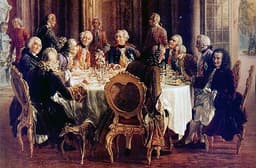
Frederick the Great
Emperor · Modern
68.1Total

Quang Trung
Emperor · Modern
62.9Total
Basic Information
Born
1712
1753
Died
1786
1792
Era
Modern
Modern
Nationality
Prussia
Vietnam
Occupation
Emperor
Emperor
Civilization
Western
Eastern
Score Comparison
Military (10%)
90.0
82.0
Political (20%)
75.0
45.0
Influence (20%)
55.0
62.0
Legacy (20%)
52.0
58.0
Leadership (15%)
82.0
74.0
Strategy (15%)
88.0
68.0
TOTAL
68.1
62.9
Frederick the Great — Complete Timeline
1723 AD
General Directory EstablishedReform◆ Major
Frederick the Great reorganized the Prussian government by establishing the General Directory, a centralized administrative body. This reform improved tax collection, military logistics, and state efficiency, strengthening Prussia's fiscal and military capacity.
AdministrationReformState Building
Impact: nationalconstructive
1757 AD
Battle of RossbachWar◆ Major
Frederick the Great's Prussian army defeated a larger Franco-Imperial force at Rossbach during the Seven Years' War. The victory showcased Prussian military discipline and Frederick's tactical genius, securing his reputation as a leading commander.
Seven Years' WarBattleMilitary Tactics
Impact: regional
Battle of LeuthenWar◆ Major
Frederick the Great led Prussian forces to a decisive victory over the Austrian army at Leuthen. The battle, fought in Silesia, demonstrated Frederick's use of oblique order tactics and helped Prussia retain control of Silesia during the Seven Years' War.
Seven Years' WarBattleSilesia
Impact: regional
1763 AD
Treaty of Hubertusburg SignedPolitical Action
Frederick the Great signed the Treaty of Hubertusburg with Austria, ending the Seven Years' War. The treaty confirmed Prussian possession of Silesia and established Prussia as a major European power, despite near-defeat earlier in the war.
TreatySeven Years' WarPrussia
Impact: regionalconstructive
1772 AD
First Partition of PolandPolitical Action◆ Major
Frederick the Great orchestrated the First Partition of Poland alongside Russia and Austria. Prussia gained West Prussia, connecting its territories and gaining control of the Vistula River trade, at the expense of Polish sovereignty.
PartitionPolandTerritorial Expansion
Impact: regionaldestructive
Quang Trung — Complete Timeline
1785 AD
Battle of Rach Gam-Xoai MutWar◆ Major
Nguyen Hue defeated a Siamese naval force at Rach Gam-Xoai Mut in the Mekong Delta. This victory eliminated the Siamese threat to the Nguyen lords in the south and consolidated his power.
Siamese WarNaval BattleNguyen Lords
Impact: regional
1788 AD
Coronation as Emperor Quang TrungPolitical Action◆ Major
Nguyen Hue proclaimed himself Emperor Quang Trung, establishing the Tay Son dynasty's rule over all of Dai Viet. He implemented land reforms, promoted education, and strengthened the military.
Tay Son DynastyCoronationReforms
Impact: nationalconstructive
1789 AD
Battle of Ngoc Hoi-Dong DaWar
Nguyen Hue (Quang Trung) led a surprise attack on Qing Chinese forces occupying Thang Long (Hanoi) during the Tet holiday. His army defeated the Qing forces, forcing them to retreat and ending the Chinese invasion.
Qing InvasionTet OffensiveVietnamese Independence
Impact: regional
Land Reform and Tax ReductionReform
Emperor Quang Trung implemented land reforms that redistributed land to peasants and reduced taxes. These policies aimed to alleviate rural poverty and rebuild the economy after years of war.
Land ReformEconomic PolicyPeasant Welfare
Impact: nationalconstructive
Expert Analysis
Origins
Frederick the Great was born in 1712 in Berlin, Prussia, to King Frederick William I and Sophia Dorothea of Hanover. His father, known as the 'Soldier King,' imposed a harsh military education, but Frederick preferred French literature and music. Their conflict culminated in Frederick's failed escape attempt in 1730 and the execution of his friend Hans Hermann von Katte. After submitting to his father, Frederick studied statecraft and military science, eventually inheriting the throne in 1740.
Quang Trung, born Nguyễn Huệ in 1753 in Bình Định, Vietnam, was the second of three Tây Sơn brothers. His family were peasants, and he received little formal education. However, he learned martial arts and military tactics from his brother Nguyễn Nhạc, who led a rebellion against the corrupt Nguyễn lords in the south. Nguyễn Huệ's early life was shaped by poverty, rebellion, and a desire to unify Vietnam.
Rise to Power
Frederick ascended the throne in 1740 and immediately launched the First Silesian War (1740-1742), seizing Silesia from Austria after the death of Emperor Charles VI. He capitalized on the Pragmatic Sanction controversy and allied with France. The victory at Mollwitz (1741) solidified his reputation, but he later lost battles. Through the Treaty of Berlin (1742) and the Second Silesian War (1744-1745), he retained Silesia. The Seven Years' War (1756-1763) tested his survival against Austria, Russia, France, and Sweden. His military triumphs at Rossbach (1757) and Leuthen (1757) saved Prussia, and the Treaty of Hubertusburg (1763) confirmed his gains.
Quang Trung rose as a military leader in the Tây Sơn rebellion (1771). In 1777, he defeated the Nguyễn lords, capturing Saigon. He then fought the Siamese at Rach Gầm-Xoài Mút (1785), annihilating a Siamese fleet with 30,000 troops. In 1786, he marched north and overthrew the Trịnh lords, unifying Vietnam. He proclaimed himself Emperor Quang Trung in 1788, establishing the Tây Sơn dynasty. Facing a Qing invasion to restore the Lê dynasty, he assembled an army and launched a surprise attack during Tết (Lunar New Year) in 1789, crushing the Qing forces at Ngọc Hồi-Đống Đa. This victory forced Qing Emperor Qianlong to recognize him as king.
Leadership & Governance
Frederick ruled as an enlightened despot, implementing reforms in law, education, and economy. He established the General Directory (1723) to centralize administration, abolished torture, and promoted religious tolerance. He invited French intellectuals like Voltaire to his court, though they later clashed. His economic policies encouraged agriculture, mining, and manufacturing. However, he maintained a rigid social hierarchy, keeping the nobility in control of the army and bureaucracy. He personally led his troops in battle, earning respect but also micromanaging campaigns.
Quang Trung focused on land reform and tax reduction to aid peasants. He redistributed land from landlords to cultivators and lowered taxes. He promoted education by adopting Chữ Nôm (Vietnamese script) over Chinese characters to increase literacy. He attempted to build a strong central government but faced resistance from local elites. His military leadership was charismatic; he inspired loyalty among his soldiers, who were often peasants. He used innovative tactics, such as surprise attacks and psychological warfare, as seen in the Tết offensive of 1789.
Triumph & Tragedy
Frederick's greatest triumph was surviving the Seven Years' War and establishing Prussia as a great power. His military scores (90.0 military, 88.0 strategy) reflect his tactical brilliance. However, his greatest failure was the near-collapse of Prussia in 1760 after defeats at Kunersdorf and Landeshut. He also failed to secure a lasting alliance system, leaving Prussia diplomatically isolated after his death. His legacy includes militarism that later contributed to German unification.
Quang Trung's triumph was defeating the Qing invasion and unifying Vietnam. His military score (82.0) and leadership (74.0) demonstrate his effectiveness. However, his reign was cut short by his sudden death in 1792 at age 39, likely from illness. His failure was the inability to consolidate the Tây Sơn dynasty; after his death, internal strife allowed Nguyễn Ánh to reunite Vietnam under the Nguyễn dynasty. His reforms did not endure, as the Nguyễns reversed them.
Character & Destiny
Frederick was disciplined, cynical, and pragmatic. He valued reason over emotion, often manipulating allies and enemies. His personality was shaped by his abusive father, leading to a secretive nature. He was a prolific writer and flutist, earning the title 'Old Fritz.' His destiny was to transform Prussia from a minor state into a European power, but his militarism left a fragile state.
Quang Trung was bold, decisive, and empathetic to peasants. He was a natural orator and strategist, capable of inspiring mass mobilization. His character reflected his peasant origins, but his ambition led him to imperial power. His early death sealed the fate of the Tây Sơn dynasty, as no successor matched his abilities.
Legacy
Frederick's legacy is immense: he made Prussia a leading military state, influenced German unification, and embodied enlightened absolutism. His military reforms were studied by Napoleon and Clausewitz. However, his legacy is contested due to his role in the partitions of Poland and the militarization of German society. His score of 55.0 in influence and 52.0 in legacy reflect his moderate global impact compared to other figures.
Quang Trung is celebrated as a national hero in Vietnam for defeating the Qing and unifying the country. His Tết offensive is a symbol of Vietnamese resistance. However, his dynasty collapsed, and his reforms were undone. His influence score (62.0) and legacy (58.0) reflect his enduring symbolic importance but limited institutional impact.
Conclusion
Frederick the Great had a greater historical impact than Quang Trung. With a total score of 68.1 compared to 62.9, Frederick's military and political achievements reshaped European geopolitics for centuries. While Quang Trung's victories were remarkable, his short reign and the collapse of his dynasty limit his lasting influence. Frederick's Prussia became the nucleus of the German Empire, whereas Quang Trung's Vietnam reverted to civil war. The data supports Frederick as the more consequential figure, though Quang Trung's legacy as a national liberator endures in Vietnamese memory.
Rankings
🥇
Frederick the GreatLeader
Mil: 90.0Pol: 75.0Inf: 55.0
68.1
🥈
Quang Trung
Mil: 82.0Pol: 45.0Inf: 62.0
62.9
+5.2 behind
How This Comparison Works
Algorithm
Each figure is scored on 6 dimensions (0—100 scale) based on structured historical data: Military (10%), Political (20%), Influence (20%), Legacy (20%), Leadership (15%), Strategy (15%). The weighted total produces the final ranking.
Data Sources
Scores are computed from structured sub-indicators in the database. Scale factors adjust for era (Ancient ×0.85, Modern ×1.0) and civilization size (Eastern ×1.05, Other ×0.80) to account for differences in population and military scale.
Maximum 3 Figures
Comparisons are limited to 2—3 figures to ensure readability and statistical meaningfulness.
Error Margins
±5 points per dimension — Sub-scores are derived from historical records with inherent uncertainty. Two figures within 5 points on a dimension should be considered roughly equivalent in that area.
Total Score Accuracy
±3 points overall — The weighted combination of 6 dimensions produces a total score with approximately ±3 points of uncertainty. Differences of less than 3 points are not statistically significant— the figures are effectively tied.
Known Limitations
- Historical records are incomplete and uneven across civilizations
- Figures from oral-tradition societies may be underrepresented
- Occupation labels can misclassify multi-role figures
- Scores measure capability and impact, not moral character
- Quantitative scoring is a comparison tool, not absolute truth
Capability Radar
Military (10%) — Battles & Warfare
Battles
85
75
Win Rate
80
85
Expansion
85
65
Political (20%) — Governance & Reform
Reform
90
60
Diplomacy
80
55
Economy
85
50
Influence (20%) — Cultural & Global Reach
Cultural
80
60
Global
75
40
Legacy (20%) — Historical Impact
Historical
85
70
Longevity
80
55
Leadership (15%) — Power & Stability
Tenure
85
40
Stability
75
45
Strategy (15%) — Tactics & Innovation
Strategy
90
80
Tactics
95
90
Reform
90
70
Similar Comparisons
Comments & Discussion
No comments yet. Be the first to share your thoughts!