Loading...
Frederick II of Hohenstaufen vs Li Yan
Frederick II of Hohenstaufen leads by 11.6 pts · 2 figures compared
…
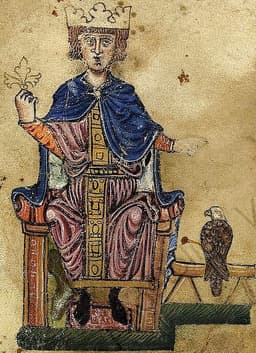
Frederick II of Hohenstaufen
Emperor · Medieval
59.3Total

Li Yan
Emperor · Medieval
47.7Total
Basic Information
Born
1194
814
Died
1250
846
Era
Medieval
Medieval
Nationality
Holy Roman Empire
China
Occupation
Emperor
Emperor
Civilization
Western
Eastern
Score Comparison
Military (10%)
40.0
35.0
Political (20%)
72.0
46.6
Influence (20%)
72.0
53.3
Legacy (20%)
52.0
45.0
Leadership (15%)
53.2
55.3
Strategy (15%)
55.0
43.3
TOTAL
59.3
47.7
Frederick II of Hohenstaufen — Complete Timeline
1220 AD
Coronation as Holy Roman EmperorPolitical Action◆ Major
Frederick II was crowned Holy Roman Emperor by Pope Honorius III in Rome. This coronation confirmed his authority over Germany and Italy, but also set the stage for a long conflict with the papacy over imperial power in Italy.
CoronationHoly Roman EmpirePapacy
Impact: global
1229 AD
Sixth Crusade and Treaty of JaffaWar◆ Major
Frederick II led the Sixth Crusade, negotiating the Treaty of Jaffa with Sultan al-Kamil. Through diplomacy, he regained control of Jerusalem, Bethlehem, and Nazareth without battle, but was excommunicated by the Pope for negotiating with Muslims.
CrusadeDiplomacyJerusalemExcommunication
Impact: globalconstructive
1231 AD
Promulgation of the Constitutions of MelfiReform◆ Major
Frederick II issued the Constitutions of Melfi, a comprehensive legal code for the Kingdom of Sicily. This code centralized royal authority, reformed the administration, and established a modern state based on Roman law.
LawReformSicily
Impact: regionalconstructive
1237 AD
Conflict with the Lombard LeagueWar◆ Major
Frederick II defeated the Lombard League at the Battle of Cortenuova, aiming to assert imperial control over northern Italy. His victory was followed by harsh reprisals, which alienated many Italian cities and strengthened papal opposition.
BattleItalyLombard League
Impact: regionaldestructive
1245 AD
Excommunication by Pope Innocent IV at the Council of LyonPolitical Action◆ Major
Pope Innocent IV declared Frederick II deposed at the First Council of Lyon, accusing him of heresy, sacrilege, and tyranny. This excommunication intensified the conflict between the Empire and the Papacy, leading to a war of propaganda.
ExcommunicationPapacyConflict
Impact: globaldestructive
1250 AD
Death and end of the Hohenstaufen dynastyOther◆ Major
Frederick II died of dysentery at Castel Fiorentino. His death marked the beginning of the end for the Hohenstaufen dynasty, as his sons were unable to maintain control, leading to the Great Interregnum in the Holy Roman Empire.
DeathHohenstaufenInterregnum
Impact: globaltragic
Li Yan — Complete Timeline
843 AD
Military Campaigns against the UyghursWar◆ Major
Li Yan's forces attacked the remnants of the Uyghur Khaganate, which had been weakened by internal strife and Kyrgyz attacks. Tang armies defeated the Uyghurs and secured the northern border, but the campaigns drained resources.
Uyghur KhaganateBorder WarMilitary Campaign
Impact: regional
845 AD
Great Anti-Buddhist PersecutionReform◆ Major
Li Yan issued edicts ordering the destruction of thousands of Buddhist monasteries and temples. Over 260,000 monks and nuns were forced to return to lay life. Buddhist property was confiscated, and the religion's influence was severely curtailed.
Buddhist PersecutionReligious PolicySecularization
Impact: nationaldestructive
Suppression of Manichaeism and NestorianismReform◆ Major
As part of his anti-religious campaign, Li Yan also suppressed Manichaeism, Zoroastrianism, and Nestorian Christianity. Foreign religions were banned, and their clergy were forced to laicize. This was part of a broader effort to assert Confucian orthodoxy.
Religious PersecutionForeign ReligionsConfucian Orthodoxy
Impact: nationaldestructive
846 AD
Death of Li YanOther
Li Yan died in 846 after consuming alchemical elixirs in pursuit of immortality. His death was likely due to heavy metal poisoning. His successor reversed many of his anti-Buddhist policies.
DeathAlchemyPolicy Reversal
Impact: nationaltragic
Expert Analysis
Origins
Frederick II of Hohenstaufen was born in 1194 in Jesi, Italy, to Emperor Henry VI and Constance of Sicily. Orphaned young, he was raised under papal guardianship in Sicily, a multicultural crossroads of Norman, Arab, Byzantine, and Latin influences. This environment fostered his polymathic interests—he spoke six languages, wrote poetry, and patronized science. His education was informal but broad, shaped by Muslim scholars at his court.
Li Yan (Emperor Wuzong of Tang) was born in 814 in Chang'an, China, as the fifth son of Emperor Muzong. His early life was dominated by eunuch power struggles at court. He received a Confucian education and was deeply influenced by Daoist advisors. His path to the throne was improbable: he was not the designated heir but rose after a series of palace coups and the sudden death of his brother Emperor Jingzong in 826.
Rise to Power
Frederick was elected King of the Romans in 1196 at age two, but his early reign was contested. After his father's death, he was crowned King of Sicily in 1198 under papal regency. He came of age during the chaos of the German throne dispute between the Hohenstaufen and Welf factions. In 1211, he was elected King of Germany and marched north, securing his position by 1215. His coronation as Holy Roman Emperor by Pope Honorius III in 1220 marked his full authority, but it also bound him to crusade promises he would later struggle to fulfill.
Li Yan's rise was swift and ruthless. In 826, eunuchs murdered his brother Emperor Jingzong and installed another brother, Emperor Wenzong. After Wenzong's failed coup against eunuchs in 835, Li Yan was placed on the throne in 840 by the powerful eunuch Qiu Shiliang. He ruled as a puppet initially but gradually asserted control by playing eunuch factions against each other. By 843, he had consolidated power and purged rival eunuchs, becoming an autocrat.
Leadership & Governance
Frederick II's governance was innovative. In 1231, he promulgated the Constitutions of Melfi for Sicily, a centralized legal code that reformed administration, abolished feudal privileges, and promoted trade. He established the University of Naples in 1224 to train officials loyal to the crown. His court in Palermo was a hub of multicultural exchange, with Muslim astronomers, Jewish translators, and Christian scholars. However, his rule in Germany was largely absentee, delegating authority to princes, which weakened imperial power. His conflict with the Papacy consumed his later years; he was excommunicated multiple times and declared deposed at the Council of Lyon in 1245.
Li Yan's governance was marked by aggressive centralization and religious persecution. His Great Anti-Buddhist Persecution (842-845) destroyed 4,600 monasteries and 40,000 temples, forcing 260,000 monks and nuns back into lay life. He also suppressed Manichaeism, Zoroastrianism, and Nestorian Christianity, confiscating their property. Economically, he seized monastic lands to boost state revenues, but the destruction of cultural heritage was immense. His military campaigns against the Uyghur Khaganate (843) were successful, crushing their remnants and securing the northern frontier. Domestically, he relied on Daoist alchemists for immortality elixirs, which ultimately led to his death.
Triumph & Tragedy
Frederick's greatest triumph was the Sixth Crusade (1228-1229). Through diplomacy with Sultan al-Kamil, he negotiated the Treaty of Jaffa, regaining Jerusalem, Bethlehem, and Nazareth without battle. He crowned himself King of Jerusalem in the Church of the Holy Sepulchre. This was a unique achievement: a crusade won by negotiation. His tragedy was his relentless conflict with the Papacy. Excommunicated and vilified, his empire fractured after his death. The Hohenstaufen dynasty was extinguished, and Italy fell into chaos. His dream of a unified imperial state failed.
Li Yan's triumph was the suppression of Buddhism, which temporarily increased state revenue and broke monastic power. His military victory over the Uyghurs secured Tang borders. However, his persecution destroyed centuries of art, literature, and scholarship. The cultural loss was incalculable. His downfall came from his own superstition: he died in 846 from ingesting alchemical elixirs, likely mercury poisoning. His successor, Emperor Xuānzong, reversed his policies, restoring Buddhism. Li Yan's legacy is thus one of fanaticism and folly.
Character & Destiny
Frederick II was a rationalist and skeptic, nicknamed "Stupor Mundi" (Wonder of the World). He was tolerant of different faiths, curious about science, and pragmatic in politics. Yet his arrogance and refusal to compromise with the Papacy doomed him. He believed in imperial supremacy over the Church, a stance that made him a target. His character—brilliant but inflexible—shaped his destiny: a visionary whose reach exceeded his grasp.
Li Yan was paranoid and superstitious. He trusted Daoist alchemists and eunuchs, and his persecution of Buddhism stemmed from a desire to eliminate political rivals and secure divine favor. His short reign (840-846) was driven by a manic quest for immortality. His death by his own elixirs is a poetic irony. Historically, he is remembered as a destroyer, not a builder.
Legacy
Frederick II's legal reforms influenced later European governance. The Constitutions of Melfi were a precursor to modern state administration. His patronage of science and translation preserved classical knowledge. However, his political legacy was negative: his conflict with the Papacy weakened the Holy Roman Empire and contributed to Italian fragmentation.
Li Yan's persecution was a cultural catastrophe. The destruction of Buddhist art and texts was irreversible. However, his suppression of Buddhism had long-term effects: it broke the economic power of monasteries and shifted state ideology toward Neo-Confucianism. His military successes temporarily revived Tang prestige, but his religious policies were reversed. He is largely condemned by Chinese historians.
Conclusion
Frederick II had greater impact overall. His political score of 72.0 and influence score of 72.0 far exceed Li Yan's 46.6 and 53.3. While Li Yan's persecution was dramatic, its effects were reversed. Frederick's legal, cultural, and diplomatic achievements—though flawed—shaped European history. He scored 59.3 total, while Li Yan scored 47.7. Frederick's legacy in state-building and cross-cultural exchange outweighs Li Yan's destructiveness. The data supports Frederick II as the more consequential ruler.
Rankings
🥇
Frederick II of HohenstaufenLeader
Mil: 40.0Pol: 72.0Inf: 72.0
59.3
🥈
Li Yan
Mil: 35.0Pol: 46.6Inf: 53.3
47.7
+11.6 behind
How This Comparison Works
Algorithm
Each figure is scored on 6 dimensions (0—100 scale) based on structured historical data: Military (10%), Political (20%), Influence (20%), Legacy (20%), Leadership (15%), Strategy (15%). The weighted total produces the final ranking.
Data Sources
Scores are computed from structured sub-indicators in the database. Scale factors adjust for era (Ancient ×0.85, Modern ×1.0) and civilization size (Eastern ×1.05, Other ×0.80) to account for differences in population and military scale.
Maximum 3 Figures
Comparisons are limited to 2—3 figures to ensure readability and statistical meaningfulness.
Error Margins
±5 points per dimension — Sub-scores are derived from historical records with inherent uncertainty. Two figures within 5 points on a dimension should be considered roughly equivalent in that area.
Total Score Accuracy
±3 points overall — The weighted combination of 6 dimensions produces a total score with approximately ±3 points of uncertainty. Differences of less than 3 points are not statistically significant— the figures are effectively tied.
Known Limitations
- Historical records are incomplete and uneven across civilizations
- Figures from oral-tradition societies may be underrepresented
- Occupation labels can misclassify multi-role figures
- Scores measure capability and impact, not moral character
- Quantitative scoring is a comparison tool, not absolute truth
Capability Radar
Military (10%) — Battles & Warfare
Battles
45
30
Win Rate
40
30
Expansion
50
20
Political (20%) — Governance & Reform
Reform
85
50
Diplomacy
80
40
Economy
75
40
Influence (20%) — Cultural & Global Reach
Cultural
75
30
Global
60
30
Legacy (20%) — Historical Impact
Historical
70
40
Longevity
65
30
Leadership (15%) — Power & Stability
Tenure
65
40
Stability
55
30
Strategy (15%) — Tactics & Innovation
Strategy
55
30
Tactics
60
30
Reform
70
20
Similar Comparisons
Comments & Discussion
No comments yet. Be the first to share your thoughts!