Loading...
Frederick II of Hohenstaufen vs Julius Caesar
Julius Caesar leads by 23.5 pts · 2 figures compared
…
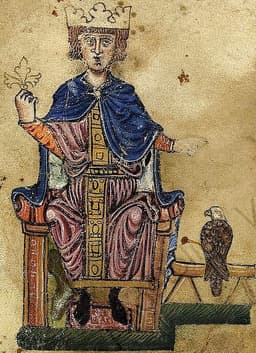
Frederick II of Hohenstaufen
Emperor · Medieval
59.3Total

Julius Caesar
General · Ancient
82.8Total
Basic Information
Born
1194
-100
Died
1250
-44
Era
Medieval
Ancient
Nationality
Holy Roman Empire
Roman Republic
Occupation
Emperor
General
Civilization
Western
Western
Score Comparison
Military (10%)
40.0
88.0
Political (20%)
72.0
78.0
Influence (20%)
72.0
85.0
Legacy (20%)
52.0
82.0
Leadership (15%)
53.2
80.0
Strategy (15%)
55.0
85.0
TOTAL
59.3
82.8
Frederick II of Hohenstaufen — Complete Timeline
1220 AD
Coronation as Holy Roman EmperorPolitical Action◆ Major
Frederick II was crowned Holy Roman Emperor by Pope Honorius III in Rome. This coronation confirmed his authority over Germany and Italy, but also set the stage for a long conflict with the papacy over imperial power in Italy.
CoronationHoly Roman EmpirePapacy
Impact: global
1229 AD
Sixth Crusade and Treaty of JaffaWar◆ Major
Frederick II led the Sixth Crusade, negotiating the Treaty of Jaffa with Sultan al-Kamil. Through diplomacy, he regained control of Jerusalem, Bethlehem, and Nazareth without battle, but was excommunicated by the Pope for negotiating with Muslims.
CrusadeDiplomacyJerusalemExcommunication
Impact: globalconstructive
1231 AD
Promulgation of the Constitutions of MelfiReform◆ Major
Frederick II issued the Constitutions of Melfi, a comprehensive legal code for the Kingdom of Sicily. This code centralized royal authority, reformed the administration, and established a modern state based on Roman law.
LawReformSicily
Impact: regionalconstructive
1237 AD
Conflict with the Lombard LeagueWar◆ Major
Frederick II defeated the Lombard League at the Battle of Cortenuova, aiming to assert imperial control over northern Italy. His victory was followed by harsh reprisals, which alienated many Italian cities and strengthened papal opposition.
BattleItalyLombard League
Impact: regionaldestructive
1245 AD
Excommunication by Pope Innocent IV at the Council of LyonPolitical Action◆ Major
Pope Innocent IV declared Frederick II deposed at the First Council of Lyon, accusing him of heresy, sacrilege, and tyranny. This excommunication intensified the conflict between the Empire and the Papacy, leading to a war of propaganda.
ExcommunicationPapacyConflict
Impact: globaldestructive
1250 AD
Death and end of the Hohenstaufen dynastyOther◆ Major
Frederick II died of dysentery at Castel Fiorentino. His death marked the beginning of the end for the Hohenstaufen dynasty, as his sons were unable to maintain control, leading to the Great Interregnum in the Holy Roman Empire.
DeathHohenstaufenInterregnum
Impact: globaltragic
Julius Caesar — Complete Timeline
58 BC
Gallic WarsWar◆ Major
Caesar, as proconsul of Gaul, launched a series of campaigns that conquered all of Gaul (modern France, Belgium, and parts of Switzerland). He fought numerous battles, including against the Helvetii, the Belgae, and the Gallic chieftain Vercingetorix. The wars brought immense wealth and a loyal army to Caesar.
Gallic WarsConquestRoman Expansion
Impact: regional
49 BC
Crossing the RubiconPolitical Action◆ Major
Caesar led Legio XIII across the Rubicon River into Italy, defying the Roman Senate's order to disband his army. This act triggered a civil war against Pompey and the Optimates, ultimately leading to Caesar's dictatorship and the end of the Roman Republic.
Roman Civil WarEnd of RepublicPower Struggle
Impact: global
48 BC
Battle of PharsalusWar◆ Major
Caesar's outnumbered army defeated the larger forces of Pompey the Great at Pharsalus in Greece. Caesar's tactical use of a reserve line to counter Pompey's cavalry charge proved decisive. Pompey fled to Egypt, where he was assassinated, leaving Caesar as the undisputed master of the Roman world.
Roman Civil WarBattleDecisive Victory
Impact: regional
44 BC
Appointment as Dictator for LifePolitical Action◆ Major
The Roman Senate appointed Caesar dictator perpetuo (dictator for life), granting him unprecedented personal power. This move concentrated military, legislative, and judicial authority in one person, effectively ending the Roman Republic's traditional system of checks and balances and alarming many senators.
DictatorshipEnd of RepublicPower Consolidation
Impact: regionaldestructive
Assassination on the Ides of MarchPolitical Action◆ Major
A group of Roman senators, led by Marcus Junius Brutus and Gaius Cassius Longinus, stabbed Caesar to death at a meeting of the Senate in the Theatre of Pompey. The assassination was intended to restore the Republic, but instead triggered another civil war that led to the rise of the Roman Empire.
AssassinationRoman PoliticsEnd of Republic
Impact: globaldestructive
Expert Analysis
Origins
Frederick II of Hohenstaufen was born in 1194 in Jesi, Italy, to Holy Roman Emperor Henry VI and Constance of Sicily. Orphaned by age four, he was raised under the guardianship of Pope Innocent III, who used him as a pawn in papal politics. Frederick grew up in Palermo, a multicultural crossroads of Norman, Byzantine, Arab, and Jewish influences. He received a broad education, learning multiple languages (Latin, Greek, Arabic) and developing interests in science, philosophy, and law. This unique upbringing shaped his cosmopolitan worldview and often put him at odds with the papacy.
Julius Caesar was born in 100 BCE into a patrician family in Rome, though his family was not politically powerful. His father died when Caesar was 16, leaving him under the protection of his uncle, Gaius Marius, a populist leader. Caesar received a typical Roman education in rhetoric, law, and military tactics. He fled Rome during Sulla's proscriptions and served in the military in Asia, where he won the Civic Crown for courage. His early life was marked by ambition and a desire to restore his family's prestige.
Rise to Power
Frederick II's rise began with his election as King of Germany in 1212, supported by Pope Innocent III against Otto IV. After Otto's defeat, Frederick was crowned Holy Roman Emperor by Pope Honorius III in 1220. To secure papal support, he promised to go on crusade, but repeatedly delayed. His power base was the Kingdom of Sicily, where he consolidated control. In 1228, he launched the Sixth Crusade, achieving through diplomacy what others failed through war: the Treaty of Jaffa (1229) returned Jerusalem, Bethlehem, and a corridor to the coast to Christian control. This diplomatic triumph enhanced his prestige but also deepened papal hostility.
Caesar's rise was meteoric. He formed the First Triumvirate with Pompey and Crassus in 60 BCE, securing the consulship in 59 BCE. As proconsul of Gaul from 58 BCE, he launched the Gallic Wars, conquering all of Gaul (modern France, Belgium, and parts of Switzerland). His Commentaries on the Gallic Wars publicized his victories. After Crassus's death and Pompey's alignment with the Senate, Caesar defied the Senate's order to disband his army. On January 10, 49 BCE, he crossed the Rubicon River, triggering a civil war. He defeated Pompey at Pharsalus in 48 BCE and later overcame other rivals, becoming dictator first for ten years, then for life in 44 BCE.
Leadership & Governance
Frederick II ruled with a centralized, autocratic style, especially in Sicily. The Constitutions of Melfi (1231) codified Roman law, curbed feudal barons, and established a centralized bureaucracy. He created the University of Naples (1224) to train administrators independent of papal influence. His court was a center of learning, attracting scholars from diverse backgrounds. However, his neglect of Germany (he spent only a few years there) weakened imperial authority north of the Alps. His conflict with the Lombard League in Italy was a strategic mistake: after winning the Battle of Cortenuova (1237), his harsh terms united the cities against him, leading to a prolonged war that drained resources.
Caesar was a reformer and populist. As dictator, he implemented land reforms for veterans, reorganized local government, reformed the calendar (introducing the Julian calendar), and granted citizenship to many provincials. He centralized power but maintained the Senate's facade. His military leadership was decisive: at Pharsalus, he used a reserve line to counter Pompey's cavalry, a tactical innovation scoring 85.0 in Strategy. He also showed clemency to former enemies, a policy that won him some support but also bred resentment among those who saw it as weakness. His governance was efficient but autocratic, leading to fears that he would restore monarchy.
Triumph & Tragedy
Frederick II's greatest triumph was the diplomatic recovery of Jerusalem without significant bloodshed. The Treaty of Jaffa (1229) gave Christians control of holy sites for ten years. His Constitutions of Melfi were a landmark in legal history, influencing later European law. However, his excommunication by Pope Gregory IX (1227, 1239) and later by Pope Innocent IV at the Council of Lyon (1245) isolated him. The papal propaganda depicted him as the Antichrist, undermining his authority. His death in 1250 left his sons to face a papacy determined to destroy the Hohenstaufen dynasty.
Caesar's triumphs are legion: the conquest of Gaul (58-50 BCE) added a vast, wealthy province to Rome. His victory in the civil war made him supreme ruler. He initiated reforms that lasted centuries, including the Julian calendar used for 1,600 years. His tragedy was his assassination on the Ides of March (March 15, 44 BCE) by a group of senators led by Brutus and Cassius. The assassination plunged Rome into another civil war, ultimately ending the Republic and ushering in the Empire. Caesar's ambition and concentration of power provoked a violent backlash that undid his work.
Character & Destiny
Frederick II was intellectually curious, cynical, and pragmatic. He was known as "Stupor Mundi" (Wonder of the World) for his learning and tolerance. He debated with Muslim scholars and wrote a book on falconry. His character led him to trust diplomacy over force, scoring 40.0 in Military but 72.0 in Political. His disdain for papal authority was a fatal flaw; he underestimated the power of ideological opposition. His excommunication made him a pariah, and his death in 1250 left his dynasty vulnerable.
Caesar was ambitious, charismatic, and ruthless when necessary. He was a master of propaganda and self-promotion. His clemency after victories was calculated to win loyalty, but his desire for absolute power alienated the republican elite. His crossing of the Rubicon was a gamble that paid off, but his appointment as dictator for life was a step too far. His character combined strategic brilliance with political naivety about the resentment he provoked. His assassination was a direct result of his concentration of power.
Legacy
Frederick II's legacy is mixed. His legal reforms influenced later European law, but his political project failed. The Hohenstaufen dynasty was extinguished, and the Holy Roman Empire fragmented. He is remembered as an enlightened despot ahead of his time, but his impact on Europe was limited. His scores: Influence 72.0, Legacy 52.0.
Caesar's legacy is monumental. His conquests expanded Rome's territory and brought wealth. His reforms laid the foundation for the Roman Empire. The title "Caesar" became synonymous with emperor (Kaiser, Tsar). His military tactics are studied to this day. His assassination marked the end of the Republic, but his name and achievements shaped Western history. His scores: Influence 85.0, Legacy 82.0.
Conclusion
Julius Caesar had a greater impact than Frederick II. Caesar's military and political achievements transformed the Roman world and set a pattern for future empires. His total score of 82.8 compared to Frederick's 59.3 reflects this. While Frederick was a remarkable figure for his era, his influence was largely confined to the medieval Mediterranean. Caesar's actions ended the Roman Republic and created the imperial system that dominated Europe for centuries. The gap of 23.5 points is justified by the scale and duration of Caesar's legacy.
Rankings
🥇
Julius CaesarLeader
Mil: 88.0Pol: 78.0Inf: 85.0
82.8
🥈
Frederick II of Hohenstaufen
Mil: 40.0Pol: 72.0Inf: 72.0
59.3
+23.5 behind
How This Comparison Works
Algorithm
Each figure is scored on 6 dimensions (0—100 scale) based on structured historical data: Military (10%), Political (20%), Influence (20%), Legacy (20%), Leadership (15%), Strategy (15%). The weighted total produces the final ranking.
Data Sources
Scores are computed from structured sub-indicators in the database. Scale factors adjust for era (Ancient ×0.85, Modern ×1.0) and civilization size (Eastern ×1.05, Other ×0.80) to account for differences in population and military scale.
Maximum 3 Figures
Comparisons are limited to 2—3 figures to ensure readability and statistical meaningfulness.
Error Margins
±5 points per dimension — Sub-scores are derived from historical records with inherent uncertainty. Two figures within 5 points on a dimension should be considered roughly equivalent in that area.
Total Score Accuracy
±3 points overall — The weighted combination of 6 dimensions produces a total score with approximately ±3 points of uncertainty. Differences of less than 3 points are not statistically significant— the figures are effectively tied.
Known Limitations
- Historical records are incomplete and uneven across civilizations
- Figures from oral-tradition societies may be underrepresented
- Occupation labels can misclassify multi-role figures
- Scores measure capability and impact, not moral character
- Quantitative scoring is a comparison tool, not absolute truth
Capability Radar
Military (10%) — Battles & Warfare
Battles
45
95
Win Rate
40
92
Expansion
50
97
Political (20%) — Governance & Reform
Reform
85
90
Diplomacy
80
85
Economy
75
82
Influence (20%) — Cultural & Global Reach
Cultural
75
88
Global
60
94
Legacy (20%) — Historical Impact
Historical
70
95
Longevity
65
96
Leadership (15%) — Power & Stability
Tenure
65
75
Stability
55
60
Strategy (15%) — Tactics & Innovation
Strategy
55
94
Tactics
60
96
Reform
70
88
Similar Comparisons
Comments & Discussion
No comments yet. Be the first to share your thoughts!