Loading...
Frank Forde vs Julius Caesar
Julius Caesar leads by 44.8 pts · 2 figures compared
…
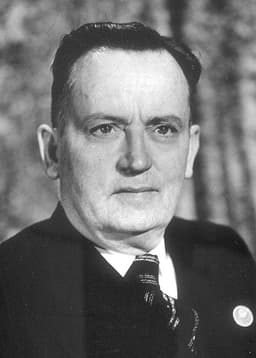
Frank Forde
Politician · Modern
38.0Total

Julius Caesar
General · Ancient
82.8Total
Basic Information
Born
1890
-100
Died
1983
-44
Era
Modern
Ancient
Nationality
Australia
Roman Republic
Occupation
Politician
General
Civilization
Western
Western
Score Comparison
Military (10%)
50.0
88.0
Political (20%)
26.4
78.0
Influence (20%)
45.5
85.0
Legacy (20%)
35.8
82.0
Leadership (15%)
31.2
80.0
Strategy (15%)
40.5
85.0
TOTAL
38.0
82.8
Frank Forde — Complete Timeline
1941 AD
Appointed Minister for the ArmyPolitical Action◆ Major
Forde was appointed Minister for the Army in John Curtin's Labor government. He oversaw Australia's military operations during World War II, including the defense against Japanese advances in the Pacific.
World War IIMilitary Administration
Impact: national
1945 AD
Became Prime Minister of AustraliaPolitical Action◆ Major
Forde became Prime Minister on 6 July 1945 following the death of John Curtin. He served for only 8 days until Ben Chifley was elected as Labor leader and succeeded him.
Prime MinisterShortest Tenure
Impact: national
1946 AD
Australian Ambassador to CanadaPolitical Action
After leaving politics, Forde was appointed as Australia's first High Commissioner to Canada. He served in this diplomatic role until 1953, representing Australian interests in North America.
DiplomacyPost-Political Career
Impact: nationalconstructive
Julius Caesar — Complete Timeline
58 BC
Gallic WarsWar◆ Major
Caesar, as proconsul of Gaul, launched a series of campaigns that conquered all of Gaul (modern France, Belgium, and parts of Switzerland). He fought numerous battles, including against the Helvetii, the Belgae, and the Gallic chieftain Vercingetorix. The wars brought immense wealth and a loyal army to Caesar.
Gallic WarsConquestRoman Expansion
Impact: regional
49 BC
Crossing the RubiconPolitical Action◆ Major
Caesar led Legio XIII across the Rubicon River into Italy, defying the Roman Senate's order to disband his army. This act triggered a civil war against Pompey and the Optimates, ultimately leading to Caesar's dictatorship and the end of the Roman Republic.
Roman Civil WarEnd of RepublicPower Struggle
Impact: global
48 BC
Battle of PharsalusWar◆ Major
Caesar's outnumbered army defeated the larger forces of Pompey the Great at Pharsalus in Greece. Caesar's tactical use of a reserve line to counter Pompey's cavalry charge proved decisive. Pompey fled to Egypt, where he was assassinated, leaving Caesar as the undisputed master of the Roman world.
Roman Civil WarBattleDecisive Victory
Impact: regional
44 BC
Appointment as Dictator for LifePolitical Action◆ Major
The Roman Senate appointed Caesar dictator perpetuo (dictator for life), granting him unprecedented personal power. This move concentrated military, legislative, and judicial authority in one person, effectively ending the Roman Republic's traditional system of checks and balances and alarming many senators.
DictatorshipEnd of RepublicPower Consolidation
Impact: regionaldestructive
Assassination on the Ides of MarchPolitical Action◆ Major
A group of Roman senators, led by Marcus Junius Brutus and Gaius Cassius Longinus, stabbed Caesar to death at a meeting of the Senate in the Theatre of Pompey. The assassination was intended to restore the Republic, but instead triggered another civil war that led to the rise of the Roman Empire.
AssassinationRoman PoliticsEnd of Republic
Impact: globaldestructive
Expert Analysis
frank-forde-vs-julius-caesar
# The Measure of a Life: Julius Caesar and Frank Forde
On a summer morning in July 1945, Frank Forde walked into Parliament House in Canberra, a man who had spent four grueling years as Australia’s Minister for the Army, overseeing the nation’s war effort from the jungles of New Guinea to the deserts of North Africa. He was about to become Prime Minister—a position he had worked toward for decades. Eight days later, he was gone, replaced by a rival, his name all but forgotten. Two thousand years earlier, another man crossed a small river in northern Italy, a decision that would end the Roman Republic and launch an empire. Julius Caesar’s name still echoes through classrooms and battlefields. The question is not simply why one succeeded and the other failed—it is whether such different lives can even be compared.
Origins
Julius Caesar was born into the chaos of the late Roman Republic, a world of civil wars, crumbling traditions, and men who measured their worth in legions and gold. His family, the Julii, claimed descent from the goddess Venus, but they were patricians in name only—politically marginalized, financially stretched. Caesar grew up watching his uncle Gaius Marius fight for power against the dictator Sulla, learning early that survival required cunning, alliances, and a willingness to bend the rules. The Rome of his youth was a crucible of ambition, where a man could rise from debt-ridden obscurity to master of the Mediterranean—if he dared.
Frank Forde was born in 1890 in Mitchell, Queensland, a small town on the edge of the Australian outback. His Ireland-born father was a laborer, his mother a homemaker. The Australia of Forde’s childhood was a young dominion, still finding its voice within the British Empire. There were no gods in his lineage, no civil wars in his backyard—only the quiet dignity of working-class life and the steady rise of the Australian Labor Party, which promised ordinary men a seat at the table. Forde’s ambition was not to conquer the world, but to serve his community. He became a schoolteacher, then a union organizer, then a politician. The path was narrow, but it was clear.
Rise to Power
Caesar’s ascent was a masterclass in audacity. He borrowed fortunes to fund public games, bribed his way to the office of Pontifex Maximus, and formed the First Triumvirate with Pompey and Crassus—men far richer and more powerful than himself. His conquest of Gaul (58–50 BCE) was not merely a military campaign; it was a political machine. He wrote his own dispatches, crafting a narrative of heroism that reached every corner of Rome. When the Senate ordered him to disband his army, he refused. The Rubicon was crossed in 49 BCE, and within four years, Caesar was dictator for life. His rise was built on war, debt, and the calculated manipulation of a republic that could no longer contain him.
Forde’s rise was quieter, but no less determined. He entered Parliament in 1917, a loyal Labor man through decades of opposition, depression, and war. His key moment came in 1941, when Prime Minister John Curtin appointed him Minister for the Army. Australia was under direct threat from Japan; its soldiers were fighting in the Middle East and the Pacific. Forde managed logistics, recruitment, and the brutal politics of coalition warfare. He was competent, steady, and utterly loyal—qualities that made him invaluable but not unforgettable. When Curtin died in 1945, Forde was the natural successor, but only for eight days. The party caucus voted for Ben Chifley, a man with stronger support and sharper political instincts. Forde’s prime ministership was a handover, not a coronation.
Leadership & Governance
Caesar governed as a revolutionary. He reformed the calendar, granted citizenship to provincials, launched public works projects, and centralized power in his own hands. His military genius was undeniable—the siege of Alesia, the lightning campaign at Pharsalus—but his political wisdom was more fragile. He pardoned his enemies, only to be stabbed by them. He sought to heal the Republic by destroying its institutions, a contradiction that ended in blood. His leadership was a blend of vision and hubris, generosity and tyranny.
Forde’s governance was the opposite: institutional, cautious, and collective. As Army Minister, he worked within the system, coordinating with generals and allies, never seeking personal glory. His eight days as Prime Minister were spent attending the San Francisco conference that founded the United Nations—a fitting symbol of his belief in diplomacy and cooperation. He had no military campaigns to his name, no reforms to remember. His leadership score of 74.6 reflects competence, not brilliance.
Triumph & Tragedy
Caesar’s greatest triumph was the conquest of Gaul, which added a vast territory to the Roman world and made him the most powerful man in the Mediterranean. His tragedy was the Ides of March—44 BCE—when sixty senators, many of them men he had spared, cut him down in the Senate chamber. He died believing his work was unfinished, his empire stillborn.
Forde’s triumph was serving his country in its darkest hour, helping to ensure that Australia survived the war intact. His tragedy was not assassination, but obscurity. He lived to 93, long enough to see his eight-day premiership become a footnote, a trivia question. He died in 1983, a man who had done his duty and been forgotten for it.
Character & Destiny
Caesar’s character was forged in the furnace of ambition. He was charming, ruthless, and intellectually voracious—a man who could dictate a letter while riding a horse, who wrote Latin prose that is still studied today. His decisions were driven by a hunger for glory that no amount of power could satisfy. Destiny, for him, was something to be seized.
Forde’s character was shaped by service. He was loyal, patient, and unassuming—qualities that made him a good minister but a forgettable leader. His destiny was to be a bridge between greater men, a caretaker in a moment of transition. He did not seize history; history passed him by.
Legacy
Caesar’s legacy is the Roman Empire itself. His name became a title—Kaiser, Tsar—and his reforms shaped Western civilization for two millennia. He is remembered as a genius, a tyrant, and a martyr, a figure of endless fascination.
Forde’s legacy is more modest. He is remembered, if at all, as Australia’s shortest-serving Prime Minister. His name appears in lists and footnotes, a reminder that not all who serve are celebrated. But his scores—Political 62.2, Influence 62.6, Legacy 48.9—tell a different story: that of a man who played his part in a larger drama, without needing to be its star.
Conclusion
What drives a man to cross the Rubicon, and another to step aside after eight days? The answer lies not in ambition alone, but in the worlds that shaped them. Caesar lived in a time when a single man could remake civilization, when the rules were written in blood and gold. Forde lived in a time of committees and coalitions, when power was dispersed and glory was shared. One changed the world; the other served it. Both, in their way, were necessary. And both remind us that history is not only the story of those who seize the moment, but also of those who hold the door.
Rankings
🥇
Julius CaesarLeader
Mil: 88.0Pol: 78.0Inf: 85.0
82.8
🥈
Frank Forde
Mil: 50.0Pol: 26.4Inf: 45.5
38.0
+44.8 behind
How This Comparison Works
Algorithm
Each figure is scored on 6 dimensions (0—100 scale) based on structured historical data: Military (10%), Political (20%), Influence (20%), Legacy (20%), Leadership (15%), Strategy (15%). The weighted total produces the final ranking.
Data Sources
Scores are computed from structured sub-indicators in the database. Scale factors adjust for era (Ancient ×0.85, Modern ×1.0) and civilization size (Eastern ×1.05, Other ×0.80) to account for differences in population and military scale.
Maximum 3 Figures
Comparisons are limited to 2—3 figures to ensure readability and statistical meaningfulness.
Error Margins
±5 points per dimension — Sub-scores are derived from historical records with inherent uncertainty. Two figures within 5 points on a dimension should be considered roughly equivalent in that area.
Total Score Accuracy
±3 points overall — The weighted combination of 6 dimensions produces a total score with approximately ±3 points of uncertainty. Differences of less than 3 points are not statistically significant— the figures are effectively tied.
Known Limitations
- Historical records are incomplete and uneven across civilizations
- Figures from oral-tradition societies may be underrepresented
- Occupation labels can misclassify multi-role figures
- Scores measure capability and impact, not moral character
- Quantitative scoring is a comparison tool, not absolute truth
Capability Radar
Military (10%) — Battles & Warfare
Battles
27
95
Win Rate
32
92
Expansion
35
97
Political (20%) — Governance & Reform
Reform
10
90
Diplomacy
15
85
Economy
10
82
Influence (20%) — Cultural & Global Reach
Cultural
5
88
Global
5
94
Legacy (20%) — Historical Impact
Historical
10
95
Longevity
5
96
Leadership (15%) — Power & Stability
Tenure
5
75
Stability
10
60
Strategy (15%) — Tactics & Innovation
Strategy
35
94
Tactics
40
96
Reform
42
88
Similar Comparisons
Comments & Discussion
No comments yet. Be the first to share your thoughts!