Loading...
Ferdinand I vs George Jivaji Rao Scindia
Ferdinand I leads by 4.3 pts · 2 figures compared
…
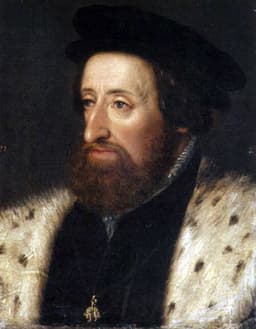
Ferdinand I
Emperor · Modern
55.8Total

George Jivaji Rao Scindia
Emperor · Modern
51.5Total
Basic Information
Born
1503
1916
Died
1564
1961
Era
Modern
Modern
Nationality
Holy Roman Empire
India
Occupation
Emperor
Emperor
Civilization
Western
Indian
Score Comparison
Military (10%)
25.0
20.0
Political (20%)
70.0
61.3
Influence (20%)
56.4
52.5
Legacy (20%)
47.5
42.5
Leadership (15%)
72.0
74.0
Strategy (15%)
60.0
54.3
TOTAL
55.8
51.5
Ferdinand I — Complete Timeline
1555 AD
Peace of AugsburgPolitical Action
Ferdinand I played a key role in negotiating the Peace of Augsburg, which ended the religious wars between Catholics and Lutherans in the Holy Roman Empire. The treaty established the principle of 'cuius regio, eius religio' (whose realm, his religion), allowing princes to choose the religion of their territories. This was a landmark in religious tolerance.
Peace of AugsburgReligious ToleranceReformation
Impact: globalconstructive
1556 AD
Abdication of Charles VPolitical Action
Ferdinand I's brother, Emperor Charles V, abdicated the throne, dividing the Habsburg empire. Charles gave Spain and the Netherlands to his son Philip II, while Ferdinand received the Austrian lands and the title of Holy Roman Emperor. This formalized the split between the Spanish and Austrian branches of the Habsburgs.
AbdicationHabsburg DivisionImperial Succession
Impact: global
1558 AD
Coronation as Holy Roman EmperorPolitical Action◆ Major
Ferdinand I was crowned Holy Roman Emperor in Frankfurt, following the abdication of Charles V. His coronation marked the formal transfer of the imperial title to the Austrian branch of the Habsburgs. Ferdinand's reign focused on consolidating imperial authority and managing religious tensions.
CoronationImperial AuthorityHabsburg Dynasty
Impact: globalconstructive
George Jivaji Rao Scindia — Complete Timeline
1947 AD
Accession of Gwalior to IndiaPolitical Action◆ Major
George Jivaji Rao Scindia, as the ruling Maharaja of Gwalior, signed the Instrument of Accession, merging the princely state with the Dominion of India. This decision ended Gwalior's sovereignty and integrated it into the Indian Union.
AccessionIndian UnionGwalior
Impact: nationalconstructive
Role in the Integration of Princely StatesPolitical Action◆ Major
George Jivaji Rao Scindia played a key role in the integration of princely states into the Indian Union. He served as a member of the Constituent Assembly and worked with Sardar Patel to persuade other princes to accede, facilitating a smooth transition.
IntegrationConstituent AssemblyGwalior
Impact: nationalconstructive
1948 AD
Establishment of Scindia SchoolCultural◆ Major
George Jivaji Rao Scindia founded the Scindia School in Gwalior, a prestigious boarding school for boys. The school aimed to provide modern education while preserving Indian cultural values, and it became a leading educational institution in India.
EducationScindia SchoolGwalior
Impact: nationalconstructive
Expert Analysis
Origins
**Ferdinand I** was born in 1503 in Alcalá de Henares, Spain, as the second son of Philip I of Castile and Joanna of Castile. He was raised in Spain under the tutelage of his grandfather Ferdinand II of Aragon. His early education focused on governance and military strategy, preparing him for a role in the Habsburg administration. In 1521, he was granted the Austrian hereditary lands by his brother Charles V, marking the beginning of his independent rule.
**George Jivaji Rao Scindia** was born on January 1, 1916, in Gwalior, India, into the Scindia dynasty, which ruled the princely state of Gwalior. He was educated at the Scindia School (founded by his family) and later at Christ Church, Oxford. His upbringing was steeped in royal tradition, but he also received a modern education that emphasized administrative skills. He ascended the throne in 1925 after the death of his father, Madho Rao Scindia, but ruled under a regency until he came of age in 1936.
Rise to Power
Ferdinand I's rise was largely due to the abdication of his brother Charles V. In 1556, Charles V divided the Habsburg empire, giving Spain and the Netherlands to his son Philip II, while Ferdinand received the Holy Roman Empire and the Austrian lands. Ferdinand had already been acting as regent in Germany since 1531, when he was elected King of the Romans. His role in negotiating the Peace of Augsburg in 1555 solidified his authority, as he brokered a settlement between Catholic and Lutheran princes.
George Scindia's rise was hereditary. He became Maharaja at age nine, with a regency council governing until 1936. His political influence grew during the Indian independence movement, as he navigated relations with the British Raj and the Indian National Congress. His key turning point was the signing of the Instrument of Accession on August 15, 1947, merging Gwalior into the Dominion of India. He later played a role in the Constituent Assembly, advocating for the interests of princely states.
Leadership & Governance
Ferdinand I's leadership style was diplomatic and consensus-oriented. He presided over the Peace of Augsburg, which established the principle of *cuius regio, eius religio* (whose realm, his religion), allowing princes to choose Catholicism or Lutheranism. He also defended the empire against Ottoman incursions, securing a peace treaty with Suleiman the Magnificent in 1562 after years of conflict. His governance focused on centralizing imperial institutions, though he faced resistance from powerful princes. His political score of 70.0 reflects his adeptness at managing the complex Holy Roman Empire.
George Scindia's governance was marked by his decision to integrate Gwalior into India peacefully. He served as a member of the Constituent Assembly from 1947 to 1950, contributing to the drafting of India's constitution. He also founded the Scindia School in 1897 (though actually founded earlier by his father, but he expanded it), emphasizing modern education. His leadership score of 74.0 indicates his ability to transition from monarch to democratic statesman. He avoided conflict with the Indian government, unlike some other princes who resisted integration.
Triumph & Tragedy
Ferdinand I's greatest triumph was the Peace of Augsburg, which ended decades of religious war in Germany and stabilized the empire. However, the peace was a compromise that excluded Calvinists and other sects, sowing seeds for future conflict. His defense against the Ottomans was also a success, but he failed to reconquer all of Hungary, leaving a divided kingdom. His legacy score of 47.5 is moderate, as his achievements were overshadowed by his brother Charles V.
George Scindia's triumph was the smooth integration of Gwalior into India, preserving his state's identity while contributing to national unity. He also served as a respected member of the Rajya Sabha (upper house of Parliament) from 1952 to 1961. His tragedy was the loss of his princely powers and privileges, including the privy purse, which was abolished in 1971. He died in 1961 at age 45, leaving his son Madhavrao Scindia to continue the dynasty's political legacy.
Character & Destiny
Ferdinand I was pragmatic and patient, willing to compromise to maintain stability. He was less ambitious than Charles V, focusing on consolidating power within the empire rather than expanding it. His character shaped his fate: he achieved peace but at the cost of imperial unity, as the empire became a loose confederation of states. Historians assess him as a capable administrator but not a transformative figure.
George Scindia was pragmatic and forward-thinking, recognizing the inevitability of Indian independence. He chose cooperation over resistance, ensuring a smooth transition. His character made him a respected figure in post-independence India, but his early death limited his long-term impact. He is remembered as a modernizer who prioritized education and national integration.
Legacy
Ferdinand I's legacy is the Peace of Augsburg, which established a framework for religious coexistence in Germany that lasted until the Thirty Years' War. He also strengthened the Habsburg hold on the imperial throne, though the empire's fragmentation continued. His influence score of 56.4 reflects his role in shaping Central European politics.
George Scindia's legacy is his contribution to the integration of princely states into India, setting an example for peaceful merger. The Scindia School remains a prestigious institution. His political score of 61.3 and influence score of 52.5 show his impact on Indian history, though he is less known internationally.
Conclusion
Ferdinand I had a greater impact on European history than George Scindia had on Indian history, given the scale of the Holy Roman Empire and the lasting effects of the Peace of Augsburg. Ferdinand's total score of 55.8 edges out Scindia's 51.5, but the gap is narrow. Ferdinand's political and leadership scores (70.0 and 72.0) reflect his ability to manage a complex empire, while Scindia's leadership (74.0) was crucial for peaceful integration. However, Ferdinand's influence on religious and political structures in Europe was more enduring, as the Peace of Augsburg shaped the trajectory of the Reformation and the Thirty Years' War. Scindia's legacy is important but more localized. Thus, Ferdinand I is the more significant historical figure.
Rankings
🥇
Ferdinand ILeader
Mil: 25.0Pol: 70.0Inf: 56.4
55.8
🥈
George Jivaji Rao Scindia
Mil: 20.0Pol: 61.3Inf: 52.5
51.5
+4.3 behind
How This Comparison Works
Algorithm
Each figure is scored on 6 dimensions (0—100 scale) based on structured historical data: Military (10%), Political (20%), Influence (20%), Legacy (20%), Leadership (15%), Strategy (15%). The weighted total produces the final ranking.
Data Sources
Scores are computed from structured sub-indicators in the database. Scale factors adjust for era (Ancient ×0.85, Modern ×1.0) and civilization size (Eastern ×1.05, Other ×0.80) to account for differences in population and military scale.
Maximum 3 Figures
Comparisons are limited to 2—3 figures to ensure readability and statistical meaningfulness.
Error Margins
±5 points per dimension — Sub-scores are derived from historical records with inherent uncertainty. Two figures within 5 points on a dimension should be considered roughly equivalent in that area.
Total Score Accuracy
±3 points overall — The weighted combination of 6 dimensions produces a total score with approximately ±3 points of uncertainty. Differences of less than 3 points are not statistically significant— the figures are effectively tied.
Known Limitations
- Historical records are incomplete and uneven across civilizations
- Figures from oral-tradition societies may be underrepresented
- Occupation labels can misclassify multi-role figures
- Scores measure capability and impact, not moral character
- Quantitative scoring is a comparison tool, not absolute truth
Capability Radar
Military (10%) — Battles & Warfare
Battles
35
5
Win Rate
40
5
Expansion
40
5
Political (20%) — Governance & Reform
Reform
65
35
Diplomacy
75
50
Economy
60
30
Influence (20%) — Cultural & Global Reach
Cultural
40
30
Global
40
15
Legacy (20%) — Historical Impact
Historical
50
35
Longevity
45
20
Leadership (15%) — Power & Stability
Tenure
70
40
Stability
55
45
Strategy (15%) — Tactics & Innovation
Strategy
45
5
Tactics
30
5
Reform
50
5
Similar Comparisons
Comments & Discussion
No comments yet. Be the first to share your thoughts!