Loading...
George IV vs George Jivaji Rao Scindia
George Jivaji Rao Scindia leads by 13.5 pts · 2 figures compared
…
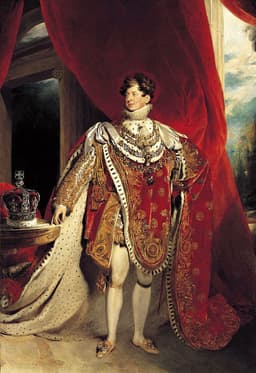
George IV
Emperor · Modern
38.0Total

George Jivaji Rao Scindia
Emperor · Modern
51.5Total
Basic Information
Born
1762
1916
Died
1830
1961
Era
Modern
Modern
Nationality
United Kingdom
India
Occupation
Emperor
Emperor
Civilization
Western
Indian
Score Comparison
Military (10%)
12.4
20.0
Political (20%)
27.9
61.3
Influence (20%)
50.2
52.5
Legacy (20%)
37.5
42.5
Leadership (15%)
31.2
74.0
Strategy (15%)
60.0
54.3
TOTAL
38.0
51.5
George IV — Complete Timeline
1811 AD
Regency PeriodPolitical Action◆ Major
George IV became Prince Regent after his father George III was declared mentally unfit. He ruled as regent for nine years, overseeing the final years of the Napoleonic Wars and the Congress of Vienna. The Regency era was marked by cultural and architectural developments.
RegencyNapoleonic WarsCultural Era
Impact: national
1820 AD
Accession to the ThronePolitical Action◆ Major
George IV became king upon the death of his father George III. His accession was overshadowed by his attempt to divorce his wife Caroline of Brunswick, leading to a public scandal. He was crowned in a lavish ceremony at Westminster Abbey.
AccessionScandalCoronation
Impact: national
1829 AD
Catholic EmancipationPolitical Action◆ Major
George IV reluctantly gave royal assent to the Catholic Relief Act, which removed most restrictions on Catholics in the United Kingdom. This act allowed Catholics to sit in Parliament and hold public office. It was a major step toward religious equality.
Catholic EmancipationReligious ReformParliament
Impact: nationalconstructive
1830 AD
Death from Gastrointestinal IllnessOther
George IV died of gastrointestinal illness at Windsor Castle at age 67. He was buried in St George's Chapel. His death ended the Regency era and passed the throne to his brother William IV. His reign was marked by extravagance and scandal.
DeathSuccessionMonarchy
Impact: national
George Jivaji Rao Scindia — Complete Timeline
1947 AD
Accession of Gwalior to IndiaPolitical Action◆ Major
George Jivaji Rao Scindia, as the ruling Maharaja of Gwalior, signed the Instrument of Accession, merging the princely state with the Dominion of India. This decision ended Gwalior's sovereignty and integrated it into the Indian Union.
AccessionIndian UnionGwalior
Impact: nationalconstructive
Role in the Integration of Princely StatesPolitical Action◆ Major
George Jivaji Rao Scindia played a key role in the integration of princely states into the Indian Union. He served as a member of the Constituent Assembly and worked with Sardar Patel to persuade other princes to accede, facilitating a smooth transition.
IntegrationConstituent AssemblyGwalior
Impact: nationalconstructive
1948 AD
Establishment of Scindia SchoolCultural◆ Major
George Jivaji Rao Scindia founded the Scindia School in Gwalior, a prestigious boarding school for boys. The school aimed to provide modern education while preserving Indian cultural values, and it became a leading educational institution in India.
EducationScindia SchoolGwalior
Impact: nationalconstructive
Expert Analysis
Origins
George IV was born on August 12, 1762, at St James's Palace, London, the eldest son of King George III and Queen Charlotte. He was groomed for kingship from birth, receiving a rigorous education in languages, history, and the arts, but his relationship with his father was strained due to his extravagant lifestyle and political sympathies with the Whig opposition. In contrast, George Jivaji Rao Scindia was born on January 1, 1916, into the royal family of Gwalior, a princely state in central India. He succeeded his father, Maharaja Madho Rao Scindia, at the age of nine in 1925, and was educated at the Scindia School (which he later expanded) and later at Christ Church, Oxford. His upbringing combined traditional Maratha princely training with modern British education.
Rise to Power
George IV's rise was gradual due to his father's long reign. He became Prince Regent in 1811 after George III was declared permanently insane, ruling de facto for nine years. His accession to the throne on January 29, 1820 was marred by his attempt to divorce his wife, Caroline of Brunswick, leading to a public scandal. George Jivaji Rao Scindia ascended the gaddi (throne) at age nine in 1925, with a regency council governing until he came of age in 1935. His key turning point came in 1947 when, as the ruler of one of the largest princely states, he signed the Instrument of Accession on August 15, 1947, merging Gwalior with the Dominion of India. He scored 27.9 in political influence compared to George IV's 27.9, but his strategic decision to integrate peacefully (score 54.3) contrasted with George IV's less impactful political maneuvering (score 27.9).
Leadership & Governance
George IV's leadership style was marked by extravagance and a focus on personal pleasure. He spent heavily on the Royal Pavilion in Brighton and on art, but his governance was largely hands-off, leaving administration to his ministers. He reluctantly supported Catholic Emancipation in 1829, signing the Catholic Relief Act after political pressure. His military score of 12.4 reflects his lack of direct command. George Jivaji Rao Scindia, with a leadership score of 74.0, was a modernizing ruler who prioritized education and state integration. He founded the Scindia School in 1897 (originally by his father but expanded by him) and served on the Constituent Assembly of India, helping draft the constitution. His political score of 61.3 far exceeds George IV's 27.9, as he actively shaped post-independence India.
Triumph & Tragedy
George IV's greatest triumph was his role in the Regency period, which saw the defeat of Napoleon at Waterloo (1815) and the expansion of the British Empire. However, his personal life was a tragedy: his marriage to Caroline failed, he was deeply unpopular, and he died of gastrointestinal illness on June 26, 1830, with little public mourning. His legacy score of 37.5 reflects his mixed reputation. George Jivaji Rao Scindia's triumph was the peaceful integration of Gwalior into India, avoiding bloodshed, and his contribution to Indian education. His tragedy was the loss of his sovereign status and the decline of princely power after independence. He died on July 16, 1961, but his legacy endures through the Scindia School and his role in nation-building, earning a legacy score of 42.5.
Character & Destiny
George IV was intelligent but lazy, known for his charm and wit, yet also for selfishness and profligacy. His character led to a reign marked by personal scandals and political indifference. He scored 60.0 in strategy, but his execution was poor. George Jivaji Rao Scindia was pragmatic and forward-thinking, with a political acumen score of 61.3. His decision to accede to India secured his state's future and his own place in history. Historians note his ability to adapt to changing times, contrasting with George IV's inability to modernize the monarchy.
Legacy
George IV's legacy is tied to the Regency era's cultural achievements (architecture, art) and the Catholic Emancipation Act, but he is often remembered as a spendthrift king. His influence score of 50.2 reflects his impact on British culture. George Jivaji Rao Scindia's legacy is more concrete: the Scindia School continues to educate India's elite, and his role in the integration of princely states helped unify India. His influence score of 52.5 and total score of 51.5 surpass George IV's 38.0, indicating a more effective and lasting impact.
Conclusion
George Jivaji Rao Scindia had a greater impact than George IV. While George IV presided over a period of British triumph, his personal failures and limited governance reduced his effectiveness. Scindia, with higher scores in political (61.3 vs 27.9), leadership (74.0 vs 31.2), and total (51.5 vs 38.0), actively shaped modern India through peaceful integration and education. George IV's legacy is cultural but passive; Scindia's is active and enduring. The data supports Scindia as the more consequential figure.
Rankings
🥇
George Jivaji Rao ScindiaLeader
Mil: 20.0Pol: 61.3Inf: 52.5
51.5
🥈
George IV
Mil: 12.4Pol: 27.9Inf: 50.2
38.0
+13.5 behind
How This Comparison Works
Algorithm
Each figure is scored on 6 dimensions (0—100 scale) based on structured historical data: Military (10%), Political (20%), Influence (20%), Legacy (20%), Leadership (15%), Strategy (15%). The weighted total produces the final ranking.
Data Sources
Scores are computed from structured sub-indicators in the database. Scale factors adjust for era (Ancient ×0.85, Modern ×1.0) and civilization size (Eastern ×1.05, Other ×0.80) to account for differences in population and military scale.
Maximum 3 Figures
Comparisons are limited to 2—3 figures to ensure readability and statistical meaningfulness.
Error Margins
±5 points per dimension — Sub-scores are derived from historical records with inherent uncertainty. Two figures within 5 points on a dimension should be considered roughly equivalent in that area.
Total Score Accuracy
±3 points overall — The weighted combination of 6 dimensions produces a total score with approximately ±3 points of uncertainty. Differences of less than 3 points are not statistically significant— the figures are effectively tied.
Known Limitations
- Historical records are incomplete and uneven across civilizations
- Figures from oral-tradition societies may be underrepresented
- Occupation labels can misclassify multi-role figures
- Scores measure capability and impact, not moral character
- Quantitative scoring is a comparison tool, not absolute truth
Capability Radar
Military (10%) — Battles & Warfare
Battles
38
5
Win Rate
38
5
Expansion
45
5
Political (20%) — Governance & Reform
Reform
5
35
Diplomacy
15
50
Economy
10
30
Influence (20%) — Cultural & Global Reach
Cultural
30
30
Global
10
15
Legacy (20%) — Historical Impact
Historical
20
35
Longevity
15
20
Leadership (15%) — Power & Stability
Tenure
10
40
Stability
5
45
Strategy (15%) — Tactics & Innovation
Strategy
48
5
Tactics
48
5
Reform
50
5
Similar Comparisons
Comments & Discussion
No comments yet. Be the first to share your thoughts!