Loading...
This comparison has not been analyzed yet.
One-time AI generation (~1 minute). Scores and timeline are already available below.
Ernst Udet vs Ivan Chernyakhovsky
Ivan Chernyakhovsky leads by 6.9 pts · 2 figures compared
…
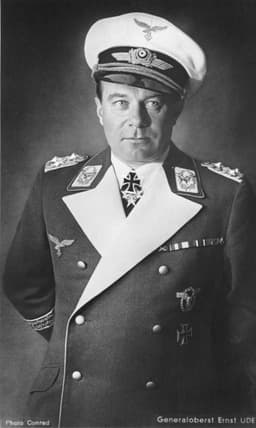
Ernst Udet
General · Modern
47.5Total
Ivan Chernyakhovsky
General · Modern
54.4Total
Basic Information
Born
1896
1906
Died
1941
1945
Era
Modern
Modern
Nationality
Germany
USSR
Occupation
General
General
Civilization
Western
Western
Score Comparison
Military (10%)
46.7
78.0
Political (20%)
30.8
35.1
Influence (20%)
58.0
58.0
Legacy (20%)
46.7
50.0
Leadership (15%)
40.4
50.7
Strategy (15%)
60.0
67.2
TOTAL
47.5
54.4
Ernst Udet — Complete Timeline
1918 AD
World War I Fighter AceWar◆ Major
Udet became the highest-scoring German fighter ace to survive World War I, with 62 confirmed victories. He flew with Jagdstaffel 11 and later commanded Jagdgeschwader 1. His aerial exploits made him a national hero and a celebrated figure in post-war Germany.
World War IAerial CombatFighter Ace
Impact: national
1936 AD
Appointment as Chief of the Luftwaffe's Technical OfficePolitical Action◆ Major
Udet was appointed head of the Technisches Amt (Technical Office) of the Luftwaffe, responsible for aircraft development and production. Despite his fame, he lacked administrative experience. His tenure was marked by mismanagement, delays in producing modern aircraft like the He 177 and Me 262, and a focus on dive-bombers.
LuftwaffeAircraft ProductionWorld War II
Impact: nationaldestructive
1941 AD
SuicideOther◆ Major
Udet committed suicide by gunshot after being blamed for the Luftwaffe's technical failures and production shortfalls during the Battle of Britain. His death was officially reported as a test flight accident. He was given a state funeral by Hermann G
SuicideLuftwaffeWorld War II
Impact: nationaltragic
Ivan Chernyakhovsky — Complete Timeline
1943 AD
Battle of KurskWar◆ Major
Chernyakhovsky commanded the 60th Army during the Battle of Kursk. His forces defended the northern face and later participated in the counteroffensive, liberating Kursk and advancing toward Ukraine.
World War IIKurskCounteroffensive
Impact: regional
1944 AD
Command of the 3rd Belorussian FrontWar◆ Major
Chernyakhovsky was appointed commander of the 3rd Belorussian Front at age 37, becoming the youngest front commander in the Soviet Army. He led the front in Operation Bagration and the liberation of Vilnius.
World War IIBelorussian FrontYoungest
Impact: regional
1945 AD
East Prussian OffensiveWar◆ Major
Chernyakhovsky commanded the 3rd Belorussian Front in the East Prussian Offensive. His forces advanced into East Prussia, capturing towns and encircling German forces in K
World War IIEast PrussiaOffensive
Impact: regional
Death in combat near MelzakWar◆ Major
Chernyakhovsky was killed by artillery shell fragments near Melzak (now Pieni
World War IIKilled in ActionEast Prussia
Impact: nationaltragic
This comparison has not been analyzed yet.
One-time AI generation (~1 minute). Scores and timeline are already available below.
Rankings
🥇
Ivan ChernyakhovskyLeader
Mil: 78.0Pol: 35.1Inf: 58.0
54.4
🥈
Ernst Udet
Mil: 46.7Pol: 30.8Inf: 58.0
47.5
+6.9 behind
How This Comparison Works
Algorithm
Each figure is scored on 6 dimensions (0—100 scale) based on structured historical data: Military (10%), Political (20%), Influence (20%), Legacy (20%), Leadership (15%), Strategy (15%). The weighted total produces the final ranking.
Data Sources
Scores are computed from structured sub-indicators in the database. Scale factors adjust for era (Ancient ×0.85, Modern ×1.0) and civilization size (Eastern ×1.05, Other ×0.80) to account for differences in population and military scale.
Maximum 3 Figures
Comparisons are limited to 2—3 figures to ensure readability and statistical meaningfulness.
Error Margins
±5 points per dimension — Sub-scores are derived from historical records with inherent uncertainty. Two figures within 5 points on a dimension should be considered roughly equivalent in that area.
Total Score Accuracy
±3 points overall — The weighted combination of 6 dimensions produces a total score with approximately ±3 points of uncertainty. Differences of less than 3 points are not statistically significant— the figures are effectively tied.
Known Limitations
- Historical records are incomplete and uneven across civilizations
- Figures from oral-tradition societies may be underrepresented
- Occupation labels can misclassify multi-role figures
- Scores measure capability and impact, not moral character
- Quantitative scoring is a comparison tool, not absolute truth
Capability Radar
Military (10%) — Battles & Warfare
Battles
30
75
Win Rate
35
80
Expansion
20
70
Political (20%) — Governance & Reform
Reform
15
20
Diplomacy
20
25
Economy
10
15
Influence (20%) — Cultural & Global Reach
Cultural
45
35
Global
35
45
Legacy (20%) — Historical Impact
Historical
40
55
Longevity
30
40
Leadership (15%) — Power & Stability
Tenure
30
30
Stability
5
20
Strategy (15%) — Tactics & Innovation
Strategy
25
78
Tactics
55
82
Reform
40
60
Similar Comparisons
Comments & Discussion
No comments yet. Be the first to share your thoughts!