Loading...
Ernst Udet vs Julius Caesar
Julius Caesar leads by 35.3 pts · 2 figures compared
…
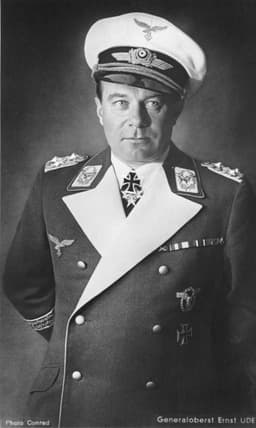
Ernst Udet
General · Modern
47.5Total

Julius Caesar
General · Ancient
82.8Total
Basic Information
Born
1896
-100
Died
1941
-44
Era
Modern
Ancient
Nationality
Germany
Roman Republic
Occupation
General
General
Civilization
Western
Western
Score Comparison
Military (10%)
46.7
88.0
Political (20%)
30.8
78.0
Influence (20%)
58.0
85.0
Legacy (20%)
46.7
82.0
Leadership (15%)
40.4
80.0
Strategy (15%)
60.0
85.0
TOTAL
47.5
82.8
Ernst Udet — Complete Timeline
1918 AD
World War I Fighter AceWar◆ Major
Udet became the highest-scoring German fighter ace to survive World War I, with 62 confirmed victories. He flew with Jagdstaffel 11 and later commanded Jagdgeschwader 1. His aerial exploits made him a national hero and a celebrated figure in post-war Germany.
World War IAerial CombatFighter Ace
Impact: national
1936 AD
Appointment as Chief of the Luftwaffe's Technical OfficePolitical Action◆ Major
Udet was appointed head of the Technisches Amt (Technical Office) of the Luftwaffe, responsible for aircraft development and production. Despite his fame, he lacked administrative experience. His tenure was marked by mismanagement, delays in producing modern aircraft like the He 177 and Me 262, and a focus on dive-bombers.
LuftwaffeAircraft ProductionWorld War II
Impact: nationaldestructive
1941 AD
SuicideOther◆ Major
Udet committed suicide by gunshot after being blamed for the Luftwaffe's technical failures and production shortfalls during the Battle of Britain. His death was officially reported as a test flight accident. He was given a state funeral by Hermann G
SuicideLuftwaffeWorld War II
Impact: nationaltragic
Julius Caesar — Complete Timeline
58 BC
Gallic WarsWar◆ Major
Caesar, as proconsul of Gaul, launched a series of campaigns that conquered all of Gaul (modern France, Belgium, and parts of Switzerland). He fought numerous battles, including against the Helvetii, the Belgae, and the Gallic chieftain Vercingetorix. The wars brought immense wealth and a loyal army to Caesar.
Gallic WarsConquestRoman Expansion
Impact: regional
49 BC
Crossing the RubiconPolitical Action◆ Major
Caesar led Legio XIII across the Rubicon River into Italy, defying the Roman Senate's order to disband his army. This act triggered a civil war against Pompey and the Optimates, ultimately leading to Caesar's dictatorship and the end of the Roman Republic.
Roman Civil WarEnd of RepublicPower Struggle
Impact: global
48 BC
Battle of PharsalusWar◆ Major
Caesar's outnumbered army defeated the larger forces of Pompey the Great at Pharsalus in Greece. Caesar's tactical use of a reserve line to counter Pompey's cavalry charge proved decisive. Pompey fled to Egypt, where he was assassinated, leaving Caesar as the undisputed master of the Roman world.
Roman Civil WarBattleDecisive Victory
Impact: regional
44 BC
Appointment as Dictator for LifePolitical Action◆ Major
The Roman Senate appointed Caesar dictator perpetuo (dictator for life), granting him unprecedented personal power. This move concentrated military, legislative, and judicial authority in one person, effectively ending the Roman Republic's traditional system of checks and balances and alarming many senators.
DictatorshipEnd of RepublicPower Consolidation
Impact: regionaldestructive
Assassination on the Ides of MarchPolitical Action◆ Major
A group of Roman senators, led by Marcus Junius Brutus and Gaius Cassius Longinus, stabbed Caesar to death at a meeting of the Senate in the Theatre of Pompey. The assassination was intended to restore the Republic, but instead triggered another civil war that led to the rise of the Roman Empire.
AssassinationRoman PoliticsEnd of Republic
Impact: globaldestructive
Expert Analysis
ernst-udet-vs-julius-caesar
# The General and the Ace: Two Paths Through the Storm of History
History has a way of pairing figures who, though separated by centuries, illuminate something essential about the nature of power, ambition, and the terrible price of leadership. Julius Caesar and Ernst Udet never shared a battlefield or a century, yet their stories intertwine like a tragic duet. Caesar, the architect of empires, crossed the Rubicon and remade Rome. Udet, the stunt pilot who became a Luftwaffe general, crossed the sky and found himself consumed by the very machine he helped build. One died by the daggers of senators, the other by his own hand. Both were men of extraordinary talent, yet their fates were shaped not only by their choices but by the eras that forged them.
Origins
Caesar was born in 100 BCE into the turbulent twilight of the Roman Republic. His family, the Julii, claimed descent from the goddess Venus, but their political influence had waned. From childhood, Caesar breathed the air of a republic in decay—a world where senatorial factions, military strongmen, and populist tribunes fought for control. His education in rhetoric, law, and military command was a preparation for a life of public competition. The young Caesar watched as Sulla marched on Rome, and he learned early that power was not granted but seized.
Ernst Udet entered the world in 1896, in Frankfurt, Germany, as the nineteenth century gave way to the twentieth. His father was an engineer, and the boy grew up fascinated by machines—particularly the fragile, fabric-covered airplanes that were just beginning to claw their way into the sky. The Great War, when it came in 1914, offered a generation of young men a terrible opportunity. Udet, barely old enough to shave, volunteered for the German air service. He was not a product of aristocratic tradition but of a new, technological age. Where Caesar learned to command legions, Udet learned to dance with death in a wooden crate held together by wire and canvas.
Rise to Power
Caesar’s ascent was a masterpiece of calculated risk. He served as a military tribune, then quaestor in Spain, where he wept before a statue of Alexander the Great—grieving that at the same age, Alexander had conquered the world while Caesar had done nothing. He forged alliances with the wealthy Crassus and the powerful Pompey, forming the First Triumvirate. His conquest of Gaul, from 58 to 50 BCE, was not merely a military campaign but a political engine: it gave him a loyal army, immense wealth, and a reputation that terrified his enemies in Rome. When the Senate ordered him to disband his legions, Caesar made his choice. On January 10, 49 BCE, he crossed the Rubicon River with a single legion, uttering the famous words, “*Alea iacta est*”—the die is cast.
Udet’s rise was less deliberate, more accidental. In World War I, he became a fighter ace with 62 confirmed victories, the highest-scoring German ace to survive the war. After the armistice, he found himself adrift in a Germany that had lost everything—its empire, its pride, its future. He turned to stunt flying, performing aerial acrobatics at air shows and even in movies. He was a celebrity, a daredevil, a man who seemed to live without fear. When the Nazis came to power, they needed heroes, and Udet was perfect. In 1936, he was appointed chief of the Luftwaffe’s Technical Office, responsible for aircraft development. He had no experience in administration, no talent for politics, and no understanding of industrial production. He was a pilot, not a manager—but the regime did not care.
Leadership & Governance
Caesar governed with a blend of ruthlessness and clemency that was revolutionary for its time. After defeating his enemies, he often pardoned them—a calculated mercy that won converts and disarmed opposition. He reformed the calendar, granted citizenship to provincials, initiated public works, and redistributed land to veterans. His military genius was absolute: at Alesia, he besieged a Gallic army while simultaneously defending against a relief force, a feat of logistics and tactics that still astounds. He led from the front, sharing the hardships of his soldiers, who adored him. But his political wisdom had limits. He centralized power, declared himself dictator for life, and began to behave like a king—an act that shattered the Republic’s fragile traditions and sealed his doom.
Udet’s leadership was a study in inadequacy. As head of the Technical Office, he was supposed to oversee the development of bombers, fighters, and engines that would give Germany air superiority. But Udet was a romantic, not a bureaucrat. He favored spectacular but impractical designs, like the Stuka dive bomber, and resisted the development of long-range strategic bombers and jet engines. He was plagued by indecision, overwhelmed by paperwork, and manipulated by more ruthless men like Hermann Göring and Erhard Milch. Production shortfalls mounted. The Luftwaffe, which had seemed invincible in 1940, began to falter over Britain and then over Russia. Udet was blamed—not entirely fairly, but not entirely wrongly either.
Triumph & Tragedy
Caesar’s greatest triumph was his conquest of Gaul, recorded in his own *Commentaries*—a work of propaganda so brilliant that it remains a masterpiece of Latin literature. He brought Roman civilization to a vast, barbarian land, and in doing so, he transformed himself into the most powerful man in the Mediterranean. His tragedy came on the Ides of March, 44 BCE, when a conspiracy of senators, led by Brutus and Cassius, stabbed him to death in the Senate chamber. He fell at the foot of a statue of Pompey, his old rival, bleeding from twenty-three wounds. His last words, according to legend, were “*Et tu, Brute?*”—“And you, Brutus?”
Udet’s triumph was the glory of his youth, the dogfights over the Western Front, the air shows that made him a legend. His tragedy unfolded slowly, in the corridors of the Air Ministry, in the failure of the Luftwaffe to match the Allies in production and technology. By 1941, the war was turning. The Battle of Britain had been lost. The invasion of the Soviet Union was bogging down. Göring, desperate to deflect blame, made Udet a scapegoat. The cheerful stunt pilot became a hollow-eyed alcoholic, tormented by guilt and pressure. On November 17, 1941, he put a pistol to his head and pulled the trigger. The Nazi regime reported his death as a testing accident.
Character & Destiny
Caesar’s character was a furnace of ambition, intelligence, and audacity. He believed in his own destiny, and he was not wrong. But his arrogance—his refusal to disguise his power, his contempt for republican forms—provoked the very violence that killed him. He could have been more cautious; he chose not to be. His destiny was to die at the moment of his greatest triumph, a martyr to the empire he unknowingly created.
Udet’s character was warmer, more human, and far more fragile. He was a man of the moment, not of strategy. He lived for the thrill of flight, not for the grind of administration. He was not evil, not a zealot—he was a man who drifted into a system that demanded more than he could give. His destiny was to be crushed between the machinery of total war and his own inadequacy.
Legacy
Caesar’s legacy is the Roman Empire itself. His assassination did not restore the Republic; it unleashed a civil war that ended with his adopted heir, Octavian, becoming Augustus, the first emperor. Caesar’s name became a title: Kaiser, Tsar. His reforms, his calendar, his model of military and political leadership shaped Western civilization for two millennia. He is remembered as a genius, a tyrant, a martyr, and a warning.
Udet’s legacy is more ambiguous. He is remembered, if at all, as a cautionary tale—a man whose skills as a pilot did not translate into the skills of a leader. The Luftwaffe’s failures in World War II were not his alone, but his name is attached to them. He left no empire, no enduring institution. He left a story—a story of a golden boy who flew too high and fell.
Conclusion
These two men, separated by two thousand years, share a common thread: they were both consumed by the forces they tried to master. Caesar remade the world and was destroyed by the world he remade. Udet served a regime that used him and discarded him. One was a genius of power; the other was a victim of it. Their stories remind us that leadership is not merely about talent or courage—it is about understanding the currents of history, and knowing when to cross the river, and when to turn back. For Caesar, the die was always cast. For Udet, the die was never his to throw.
Rankings
🥇
Julius CaesarLeader
Mil: 88.0Pol: 78.0Inf: 85.0
82.8
🥈
Ernst Udet
Mil: 46.7Pol: 30.8Inf: 58.0
47.5
+35.3 behind
How This Comparison Works
Algorithm
Each figure is scored on 6 dimensions (0—100 scale) based on structured historical data: Military (10%), Political (20%), Influence (20%), Legacy (20%), Leadership (15%), Strategy (15%). The weighted total produces the final ranking.
Data Sources
Scores are computed from structured sub-indicators in the database. Scale factors adjust for era (Ancient ×0.85, Modern ×1.0) and civilization size (Eastern ×1.05, Other ×0.80) to account for differences in population and military scale.
Maximum 3 Figures
Comparisons are limited to 2—3 figures to ensure readability and statistical meaningfulness.
Error Margins
±5 points per dimension — Sub-scores are derived from historical records with inherent uncertainty. Two figures within 5 points on a dimension should be considered roughly equivalent in that area.
Total Score Accuracy
±3 points overall — The weighted combination of 6 dimensions produces a total score with approximately ±3 points of uncertainty. Differences of less than 3 points are not statistically significant— the figures are effectively tied.
Known Limitations
- Historical records are incomplete and uneven across civilizations
- Figures from oral-tradition societies may be underrepresented
- Occupation labels can misclassify multi-role figures
- Scores measure capability and impact, not moral character
- Quantitative scoring is a comparison tool, not absolute truth
Capability Radar
Military (10%) — Battles & Warfare
Battles
30
95
Win Rate
35
92
Expansion
20
97
Political (20%) — Governance & Reform
Reform
15
90
Diplomacy
20
85
Economy
10
82
Influence (20%) — Cultural & Global Reach
Cultural
45
88
Global
35
94
Legacy (20%) — Historical Impact
Historical
40
95
Longevity
30
96
Leadership (15%) — Power & Stability
Tenure
30
75
Stability
5
60
Strategy (15%) — Tactics & Innovation
Strategy
25
94
Tactics
55
96
Reform
40
88
Similar Comparisons
Comments & Discussion
No comments yet. Be the first to share your thoughts!