Loading...
Ernst Udet vs Napoleon Bonaparte
Napoleon Bonaparte leads by 23.4 pts · 2 figures compared
…
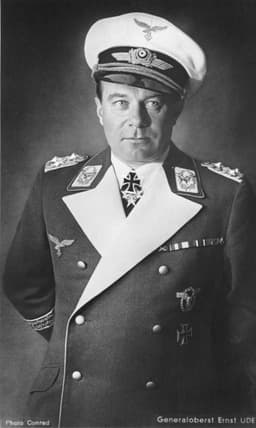
Ernst Udet
General · Modern
47.5Total

Napoleon Bonaparte
General · Modern
70.9Total
Basic Information
Born
1896
1769
Died
1941
1821
Era
Modern
Modern
Nationality
Germany
France
Occupation
General
General
Civilization
Western
Western
Score Comparison
Military (10%)
46.7
94.0
Political (20%)
30.8
72.0
Influence (20%)
58.0
40.0
Legacy (20%)
46.7
80.0
Leadership (15%)
40.4
78.0
Strategy (15%)
60.0
90.0
TOTAL
47.5
70.9
Ernst Udet — Complete Timeline
1918 AD
World War I Fighter AceWar◆ Major
Udet became the highest-scoring German fighter ace to survive World War I, with 62 confirmed victories. He flew with Jagdstaffel 11 and later commanded Jagdgeschwader 1. His aerial exploits made him a national hero and a celebrated figure in post-war Germany.
World War IAerial CombatFighter Ace
Impact: national
1936 AD
Appointment as Chief of the Luftwaffe's Technical OfficePolitical Action◆ Major
Udet was appointed head of the Technisches Amt (Technical Office) of the Luftwaffe, responsible for aircraft development and production. Despite his fame, he lacked administrative experience. His tenure was marked by mismanagement, delays in producing modern aircraft like the He 177 and Me 262, and a focus on dive-bombers.
LuftwaffeAircraft ProductionWorld War II
Impact: nationaldestructive
1941 AD
SuicideOther◆ Major
Udet committed suicide by gunshot after being blamed for the Luftwaffe's technical failures and production shortfalls during the Battle of Britain. His death was officially reported as a test flight accident. He was given a state funeral by Hermann G
SuicideLuftwaffeWorld War II
Impact: nationaltragic
Napoleon Bonaparte — Complete Timeline
1799 AD
Coup of 18 BrumaireOther◆ Major
Napoleon Bonaparte, with support from his brother Lucien and key political figures, overthrew the Directory in a bloodless coup. He established the Consulate with himself as First Consul, effectively becoming the ruler of France. This event ended the French Revolution's most unstable period.
French RevolutionCoupRise to Power
Impact: regional
1804 AD
Promulgation of the Napoleonic CodeOther◆ Major
Napoleon enacted the Civil Code of the French, known as the Napoleonic Code, a comprehensive set of laws that replaced the fragmented feudal legal systems. The code established legal equality, protected property rights, and secularized law. It became the basis for legal systems in many European and world countries.
Legal ReformNapoleonic CodeCivil Law
Impact: globalconstructive
1805 AD
Battle of AusterlitzWar◆ Major
Napoleon's Grande Arm
Napoleonic WarsBattleDecisive Victory
Impact: global
1812 AD
Invasion of RussiaWar◆ Major
Napoleon led the Grande Arm
Napoleonic WarsInvasionDisaster
Impact: globaldestructive
1815 AD
Battle of WaterlooWar◆ Major
Napoleon's French army was defeated by the combined forces of the Duke of Wellington's Anglo-Allied army and Gebhard Leberecht von Bl
Napoleonic WarsBattleFinal Defeat
Impact: globaldestructive
Expert Analysis
ernst-udet-vs-napoleon-bonaparte
### The Emperor and the Ace: Two Lives, One Century, Opposite Ends
On a spring morning in 1815, Napoleon Bonaparte stood before his Grande Armée, his grey coat immaculate, his hand resting on the hilt of his sword. He was about to march into Belgium, determined to crush the coalition that had exiled him. One hundred and twenty-six years later, in a pine forest near Berlin, General Ernst Udet, once the most celebrated pilot of the First World War, put a pistol to his head. He pulled the trigger because the aircraft he had promised his Führer were falling apart in the sky. Both men were military geniuses of their age. Both were destroyed by forces they had helped unleash. Why did one die in glory, the other in disgrace? The answer lies not in their victories, but in the vast distance between the worlds they were born into.
### Origins
Napoleon Bonaparte was born in 1769 on the island of Corsica, a land of fierce independence recently annexed by France. He was a child of the Enlightenment, raised on Plutarch’s heroes and the radical ideas of Rousseau. His family was minor nobility, poor but proud. From the start, he saw himself as an outsider—a Corsican who would conquer France, then remake Europe. The French Revolution shattered the old order, and Napoleon, a young artillery officer, seized the chaos. He was not born into power; he forged it from cannon fire and ambition.
Ernst Udet was born in 1896 in Frankfurt, Germany, into a comfortable middle-class family. His father was an engineer who died when Udet was young; his mother indulged his obsession with flying. Udet was a boy of the Industrial Age, fascinated by machines, not ideas. He learned to fly in 1913, before the Great War, and his world was the cockpit, not the parliament. He was a product of the German Empire’s technological pride, a daredevil who saw war as a sport. Where Napoleon studied strategy in books, Udet learned it in the air, alone, with only his instincts for company.
### Rise to Power
Napoleon’s rise was a masterpiece of political and military calculation. In 1796, at age 26, he took command of the starving Army of Italy and turned it into a legend. He crossed the Alps, won battles at Lodi and Arcole, and forced Austria to sue for peace. His coup of 18 Brumaire in 1799 made him First Consul, and by 1804 he crowned himself Emperor. He did not inherit his throne; he took it, step by bloody step, using victory as his legitimacy.
Udet’s rise was different—a matter of fame, not power. In the First World War, he became Germany’s highest-scoring fighter ace to survive, with 62 confirmed victories. He flew with Jasta 11, the “Flying Circus” of the Red Baron, Manfred von Richthofen, but Udet was no leader of men. He was a lone wolf, a stunt pilot who performed at airshows in the 1920s, earning a fortune and a reputation as a daredevil. When Hitler came to power in 1933, the Luftwaffe needed a hero, a face for propaganda. Udet was recruited, not by ambition, but by flattery. He was made Chief of the Luftwaffe’s Technical Office in 1936, responsible for aircraft development. He was a pilot, not an engineer or a manager. He was given a job he was never trained for.
### Leadership & Governance
Napoleon ruled with a blend of iron discipline and enlightened reform. He centralized the French state, created the Bank of France, and, most enduringly, codified the Napoleonic Code—a legal system that enshrined equality before the law, property rights, and secular governance. He was a master of strategy, winning battles like Austerlitz in 1805 by outthinking his enemies, not just outgunning them. He was also a political genius, marrying Marie Louise of Austria to cement alliances, and manipulating the press to control his image. His leadership was total: he commanded armies, wrote laws, and dictated the rhythm of an entire continent.
Udet’s leadership was a tragedy of mismatched skills. As head of the Technical Office, he was supposed to oversee the development of aircraft like the Messerschmitt Bf 109 and the Junkers Ju 87 Stuka. He was a brilliant test pilot who could make a plane dance, but he could not manage factories, budgets, or production schedules. He trusted Hermann Göring, who blamed him when the Luftwaffe fell behind the Royal Air Force in 1940. Udet’s strategy was reactive, not proactive. He approved designs based on instinct, not data. He was a good soldier in a bad role, a man who should have been flying, not administrating.
### Triumph & Tragedy
Napoleon’s greatest moment was the Battle of Austerlitz in 1805, where he crushed the combined armies of Austria and Russia. It was a triumph of deception, timing, and nerve. His greatest tragedy was the invasion of Russia in 1812. He marched 600,000 men into the snow and came back with fewer than 100,000. It was not a military defeat but a logistical catastrophe, born of overreach. He was exiled to Elba, returned for the Hundred Days, and met his final end at Waterloo in 1815, where his old enemy Wellington, aided by Prussian reinforcements, broke his army. He died in exile on Saint Helena in 1821, a prisoner of his own ambition.
Udet’s triumph was his youth. In 1918, he was a legend, a knight of the air. His tragedy was his middle age. By 1941, the Luftwaffe was losing the Battle of Britain, production was failing, and Göring needed a scapegoat. Udet was blamed for technical failures he could not control. He drank heavily, took pills, and grew depressed. On November 17, 1941, he shot himself in the head. The Nazi regime reported his death as a testing accident. He was 45.
### Character & Destiny
Napoleon was driven by an unshakable belief in his own destiny. He once said, “Impossible is a word to be found only in the dictionary of fools.” He was ruthless, brilliant, and relentless. His personality was his engine—and his flaw. He could not stop conquering. He could not delegate. He had to be the center of every story. That need for control ultimately destroyed him.
Udet was the opposite. He was charming, impulsive, and insecure. He was a man who lived for the moment, not the plan. He never wanted power; he wanted applause. When the applause stopped, and the responsibility became crushing, he had no inner fortress. He could not retreat, could not adapt. He chose the bullet over the shame.
### Legacy
Napoleon’s legacy is monumental. The Napoleonic Code still shapes law in Europe and beyond. His military tactics are studied at war colleges. He redrew the map of Europe and inspired nationalism across the continent. His score of 82.4 in total reflects a man who changed the world, for better and worse.
Udet’s legacy is smaller, sadder. He is remembered as a symbol of the Luftwaffe’s early failure, a cautionary tale of talent mismanaged. His score of 57.8 is a reminder that brilliance in one arena does not translate to another. He is a footnote in a war that consumed millions.
### Conclusion
One man conquered an empire; the other conquered the sky. Napoleon died in exile, but his ideas live on. Udet died in a forest, and his memory faded. The difference is not in their courage or their skill. It is in the shape of their ambition. Napoleon wanted to remake the world. Udet only wanted to fly. Both were consumed by the wars they served. But one wrote his story in stone, the other in smoke.
Rankings
🥇
Napoleon BonaparteLeader
Mil: 94.0Pol: 72.0Inf: 40.0
70.9
🥈
Ernst Udet
Mil: 46.7Pol: 30.8Inf: 58.0
47.5
+23.4 behind
How This Comparison Works
Algorithm
Each figure is scored on 6 dimensions (0—100 scale) based on structured historical data: Military (10%), Political (20%), Influence (20%), Legacy (20%), Leadership (15%), Strategy (15%). The weighted total produces the final ranking.
Data Sources
Scores are computed from structured sub-indicators in the database. Scale factors adjust for era (Ancient ×0.85, Modern ×1.0) and civilization size (Eastern ×1.05, Other ×0.80) to account for differences in population and military scale.
Maximum 3 Figures
Comparisons are limited to 2—3 figures to ensure readability and statistical meaningfulness.
Error Margins
±5 points per dimension — Sub-scores are derived from historical records with inherent uncertainty. Two figures within 5 points on a dimension should be considered roughly equivalent in that area.
Total Score Accuracy
±3 points overall — The weighted combination of 6 dimensions produces a total score with approximately ±3 points of uncertainty. Differences of less than 3 points are not statistically significant— the figures are effectively tied.
Known Limitations
- Historical records are incomplete and uneven across civilizations
- Figures from oral-tradition societies may be underrepresented
- Occupation labels can misclassify multi-role figures
- Scores measure capability and impact, not moral character
- Quantitative scoring is a comparison tool, not absolute truth
Capability Radar
Military (10%) — Battles & Warfare
Battles
30
95
Win Rate
35
90
Expansion
20
95
Political (20%) — Governance & Reform
Reform
15
95
Diplomacy
20
80
Economy
10
85
Influence (20%) — Cultural & Global Reach
Cultural
45
85
Global
35
90
Legacy (20%) — Historical Impact
Historical
40
95
Longevity
30
90
Leadership (15%) — Power & Stability
Tenure
30
85
Stability
5
70
Strategy (15%) — Tactics & Innovation
Strategy
25
95
Tactics
55
98
Reform
40
92
Similar Comparisons
Comments & Discussion
No comments yet. Be the first to share your thoughts!