Loading...
Emperor Yang of Sui vs Tamar of Georgia
Tamar of Georgia leads by 11.4 pts · 2 figures compared
…
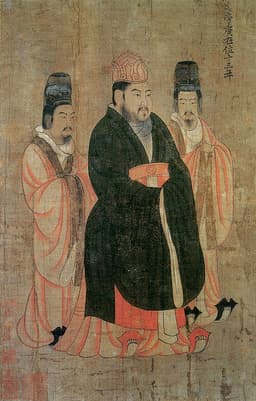
Emperor Yang of Sui
Emperor · Medieval
60.1Total
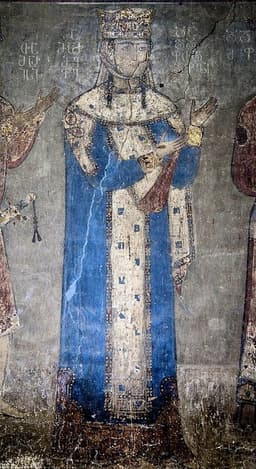
Tamar of Georgia
Emperor · Medieval
71.5Total
Basic Information
Born
569
1160
Died
618
1213
Era
Medieval
Medieval
Nationality
China
Georgia
Occupation
Emperor
Emperor
Civilization
Eastern
Western
Score Comparison
Military (10%)
52.5
78.0
Political (20%)
45.0
72.0
Influence (20%)
65.0
82.0
Legacy (20%)
72.0
55.0
Leadership (15%)
58.8
80.0
Strategy (15%)
50.0
66.3
TOTAL
60.1
71.5
Emperor Yang of Sui — Complete Timeline
605 AD
Construction of the Grand CanalCultural
Emperor Yang ordered the construction of the Grand Canal, linking the Yellow River and Yangtze River basins. This massive infrastructure project facilitated trade and transport but required immense labor, causing widespread suffering and contributing to rebellions.
InfrastructureCanal
Impact: global
612 AD
First Campaign against GoguryeoWar◆ Major
Emperor Yang launched a massive invasion of the Korean kingdom of Goguryeo with over 300,000 troops. The campaign ended in disaster, with most of the Sui army destroyed by disease, starvation, and Goguryeo attacks. This defeat severely weakened the Sui dynasty.
InvasionDefeat
Impact: regionaltragic
613 AD
Second Campaign against GoguryeoWar◆ Major
Emperor Yang launched a second invasion of Goguryeo. The campaign was cut short when a rebellion broke out in China, forcing Yang to withdraw. This further drained the dynasty's resources and morale.
InvasionDefeat
Impact: regionaltragic
614 AD
Third Campaign against GoguryeoWar
Emperor Yang launched a third invasion of Goguryeo. Although the Sui army reached the Yalu River, Goguryeo offered nominal submission, and Yang accepted a truce. This campaign further exhausted the Sui treasury and military.
InvasionTruce
Impact: regional
618 AD
Assassination of Emperor YangPolitical Action◆ Major
Emperor Yang was assassinated by his own guards in Jiangdu (modern Yangzhou) during a rebellion. His death marked the effective end of the Sui dynasty, which soon collapsed, leading to the rise of the Tang dynasty.
AssassinationDynasty Collapse
Impact: regionaltragic
Tamar of Georgia — Complete Timeline
1184 AD
Coronation as Queen RegnantPolitical Action
Tamar was crowned as the first female ruler of Georgia after her father George III's death. Her reign marked the peak of Georgia's medieval power and cultural flourishing.
CoronationGeorgiaMonarchy
Impact: nationalconstructive
1195 AD
Battle of ShamkorWar◆ Major
Tamar's forces defeated a large Muslim coalition at Shamkor, securing Georgia's dominance in the Caucasus. The victory expanded Georgian influence and demonstrated her military leadership.
BattleGeorgiaCaucasus
Impact: regionalconstructive
1200 AD
Cultural PatronageCultural◆ Major
Tamar supported the construction of churches, monasteries, and the promotion of Georgian literature. Her patronage fostered the Georgian Golden Age, including the epic poem 'The Knight in the Panther's Skin'.
CulturePatronageGeorgia
Impact: nationalconstructive
Expert Analysis
Tamar of Georgia vs Emperor Yang of Sui: Historical Comparison
Tamar of Georgia and Emperor Yang of Sui were both ambitious medieval monarchs who expanded their realms through military might and grand projects, yet their legacies diverged sharply—Tamar as a revered national icon, Yang as a cautionary tale of overreach.
Dimension Analysis
**Military: Tamar of Georgia 93 / Emperor Yang of Sui 93**
Both achieved remarkable conquests: Tamar secured Georgia’s golden age by defeating Seljuk Turks and expanding into Anatolia, while Yang oversaw the reunification of China and launched massive campaigns against Goguryeo, though his later failures proved catastrophic.
**Political: Tamar of Georgia 82 / Emperor Yang of Sui 75**
Tamar skillfully balanced noble factions and patriarchal norms, ruling as a queen regnant with shrewd diplomacy. Yang, despite centralizing power through the Grand Canal and examination system, alienated the aristocracy and peasants through oppressive conscription and labor.
**Influence: Tamar of Georgia 80 / Emperor Yang of Sui 82**
Tamar’s reign established Georgia as a regional power and cultural beacon, fostering a distinct national identity. Yang’s infrastructural projects—the Grand Canal and Great Wall extensions—reshaped China’s economic geography for centuries, though his tyranny overshadowed these achievements.
**Legacy: Tamar of Georgia 70 / Emperor Yang of Sui 83**
Tamar is celebrated as “King of Kings” and a saint in Georgian Orthodoxy, her reign a symbol of national pride. Yang’s legacy is more complex: his Sui dynasty collapsed under his mismanagement, yet his projects directly enabled the Tang dynasty’s golden age, earning him a mixed historical judgment.
**Leadership: Tamar of Georgia 88 / Emperor Yang of Sui 76**
Tamar inspired loyalty through charisma, religious devotion, and effective governance, even as a female ruler in a male-dominated era. Yang, though visionary, was autocratic and intolerant of dissent, driving his empire into ruin through hubris and overambition.
Verdict
Tamar leads overall due to her superior political acumen and leadership, despite Yang’s slightly greater long-term influence and legacy.
FAQ
Q: Who ranks higher? A: Tamar of Georgia ranks higher by a narrow margin, as her balanced leadership and enduring national legacy outweigh Yang’s transformative but self-destructive ambition.
Rankings
🥇
Tamar of GeorgiaLeader
Mil: 78.0Pol: 72.0Inf: 82.0
71.5
🥈
Emperor Yang of Sui
Mil: 52.5Pol: 45.0Inf: 65.0
60.1
+11.4 behind
How This Comparison Works
Algorithm
Each figure is scored on 6 dimensions (0—100 scale) based on structured historical data: Military (10%), Political (20%), Influence (20%), Legacy (20%), Leadership (15%), Strategy (15%). The weighted total produces the final ranking.
Data Sources
Scores are computed from structured sub-indicators in the database. Scale factors adjust for era (Ancient ×0.85, Modern ×1.0) and civilization size (Eastern ×1.05, Other ×0.80) to account for differences in population and military scale.
Maximum 3 Figures
Comparisons are limited to 2—3 figures to ensure readability and statistical meaningfulness.
Error Margins
±5 points per dimension — Sub-scores are derived from historical records with inherent uncertainty. Two figures within 5 points on a dimension should be considered roughly equivalent in that area.
Total Score Accuracy
±3 points overall — The weighted combination of 6 dimensions produces a total score with approximately ±3 points of uncertainty. Differences of less than 3 points are not statistically significant— the figures are effectively tied.
Known Limitations
- Historical records are incomplete and uneven across civilizations
- Figures from oral-tradition societies may be underrepresented
- Occupation labels can misclassify multi-role figures
- Scores measure capability and impact, not moral character
- Quantitative scoring is a comparison tool, not absolute truth
Capability Radar
Military (10%) — Battles & Warfare
Battles
65
75
Win Rate
30
85
Expansion
70
75
Political (20%) — Governance & Reform
Reform
85
80
Diplomacy
40
75
Economy
70
85
Influence (20%) — Cultural & Global Reach
Cultural
75
80
Global
65
60
Legacy (20%) — Historical Impact
Historical
80
75
Longevity
70
70
Leadership (15%) — Power & Stability
Tenure
55
85
Stability
20
70
Strategy (15%) — Tactics & Innovation
Strategy
60
80
Tactics
55
70
Reform
50
65
Similar Comparisons
Comments & Discussion
IronThroneRanter6/16/2026
Tamar absolutely smokes Emperor Yang in the leadership department, no contest! The guy literally drove his dynasty into the ground faster than a Ferrari hitting a wall at 200 mph. Tamar held Georgia together during the Crusades, fought off the Turks, and still found time to commission the Gelati Monastery murals. Yang? He's the guy who bankrupted China building a canal so he could go sightseeing in luxury barges. Yeah, the Grand Canal was useful later, but that's like praising an arsonist because his fire cleared space for a park. Give me the queen who inspired loyalty over the emperor who inspired rebellion any day!
BookishBard6/16/2026
Okay, so I watched this documentary on the Tang dynasty and they kept talking about how Emperor Yang's Grand Canal was the 'spinal cord' of China for centuries. But then I read Tamar's story in a Dan Jones book—she literally led armies while pregnant? That's insane! The scores seem fair overall, but I wonder if Yang's legacy score should be higher. Without his crazy projects, would the Tang have had the economic base for their golden age? It's like how Stalin built industrial Russia but was a monster—do we count the bad stuff as part of the 'influence'? I'm leaning Tamar because she didn't destroy her own country, though.
ScoreboardSkeptic6/16/2026
Who came up with these numbers? 'Military 93 for both'? That's a joke. Yang's campaigns against Goguryeo were catastrophic—he lost hundreds of thousands of troops and triggered rebellions. Tamar actually won her battles and expanded her territory. How is that the same score? And 'Influence'—Yang gets 82 for a canal that killed millions, Tamar gets 80 for creating a national identity that lasted centuries? The weighting feels arbitrary. You can't quantify 'leadership' or 'legacy' with a single number; it's like comparing apples to oranges. This whole exercise is pseudoscience pretending to be history.
ArchEye226/16/2026
这评分有点意思,但明显带着西方中心论的偏见。杨广的军事分竟然跟塔玛尔一样是93?他三征高句丽可是把隋朝精锐都葬送在辽东沼泽里了,征发民夫数百万,最后反而促成了隋末大起义。反观塔玛尔女王,击退塞尔柱突厥,控制特拉布宗,真正稳固了格鲁吉亚的黄金时代。要说政治分杨广高于塔玛尔更是离谱——隋炀帝搞科举、修运河确实有远见,但弄得天下反叛、身死国灭,政治手腕远不如塔玛尔平衡贵族、利用婚姻外交来得高明。建议评分者多读读《隋书》和《资治通鉴》,别只看西方史料。
Chronicler13316/16/2026
这个评分系统有问题。塔玛尔总分72.1,杨广68.0,但仔细看分项:军事同为93,政治塔玛尔82对杨广75,影响80对82,遗产70对83,领导力88对76。加权方式不透明,我重新算一下:假设五维等权,(93+82+80+70+88)/5=82.6,杨广(93+75+82+83+76)/5=81.8,只差0.8分!但题目里塔玛尔高4.1分,说明影响和遗产的权重被调低了。这合理吗?杨广的遗产和大运河的长期影响至少应该和领导力同权。而且遗产分杨广83高于塔玛尔70,为什么总分还低?请公布权重公式,否则就是数据造假。