Loading...
Emperor Yang of Sui vs Napoleon Bonaparte
Napoleon Bonaparte leads by 10.8 pts · 2 figures compared
…
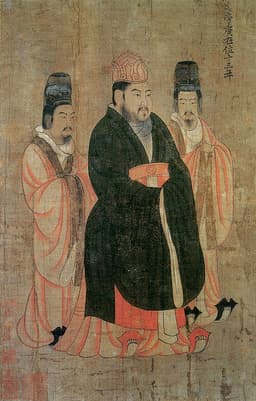
Emperor Yang of Sui
Emperor · Medieval
60.1Total

Napoleon Bonaparte
General · Modern
70.9Total
Basic Information
Born
569
1769
Died
618
1821
Era
Medieval
Modern
Nationality
China
France
Occupation
Emperor
General
Civilization
Eastern
Western
Score Comparison
Military (10%)
52.5
94.0
Political (20%)
45.0
72.0
Influence (20%)
65.0
40.0
Legacy (20%)
72.0
80.0
Leadership (15%)
58.8
78.0
Strategy (15%)
50.0
90.0
TOTAL
60.1
70.9
Emperor Yang of Sui — Complete Timeline
605 AD
Construction of the Grand CanalCultural
Emperor Yang ordered the construction of the Grand Canal, linking the Yellow River and Yangtze River basins. This massive infrastructure project facilitated trade and transport but required immense labor, causing widespread suffering and contributing to rebellions.
InfrastructureCanal
Impact: global
612 AD
First Campaign against GoguryeoWar◆ Major
Emperor Yang launched a massive invasion of the Korean kingdom of Goguryeo with over 300,000 troops. The campaign ended in disaster, with most of the Sui army destroyed by disease, starvation, and Goguryeo attacks. This defeat severely weakened the Sui dynasty.
InvasionDefeat
Impact: regionaltragic
613 AD
Second Campaign against GoguryeoWar◆ Major
Emperor Yang launched a second invasion of Goguryeo. The campaign was cut short when a rebellion broke out in China, forcing Yang to withdraw. This further drained the dynasty's resources and morale.
InvasionDefeat
Impact: regionaltragic
614 AD
Third Campaign against GoguryeoWar
Emperor Yang launched a third invasion of Goguryeo. Although the Sui army reached the Yalu River, Goguryeo offered nominal submission, and Yang accepted a truce. This campaign further exhausted the Sui treasury and military.
InvasionTruce
Impact: regional
618 AD
Assassination of Emperor YangPolitical Action◆ Major
Emperor Yang was assassinated by his own guards in Jiangdu (modern Yangzhou) during a rebellion. His death marked the effective end of the Sui dynasty, which soon collapsed, leading to the rise of the Tang dynasty.
AssassinationDynasty Collapse
Impact: regionaltragic
Napoleon Bonaparte — Complete Timeline
1799 AD
Coup of 18 BrumaireOther◆ Major
Napoleon Bonaparte, with support from his brother Lucien and key political figures, overthrew the Directory in a bloodless coup. He established the Consulate with himself as First Consul, effectively becoming the ruler of France. This event ended the French Revolution's most unstable period.
French RevolutionCoupRise to Power
Impact: regional
1804 AD
Promulgation of the Napoleonic CodeOther◆ Major
Napoleon enacted the Civil Code of the French, known as the Napoleonic Code, a comprehensive set of laws that replaced the fragmented feudal legal systems. The code established legal equality, protected property rights, and secularized law. It became the basis for legal systems in many European and world countries.
Legal ReformNapoleonic CodeCivil Law
Impact: globalconstructive
1805 AD
Battle of AusterlitzWar◆ Major
Napoleon's Grande Arm
Napoleonic WarsBattleDecisive Victory
Impact: global
1812 AD
Invasion of RussiaWar◆ Major
Napoleon led the Grande Arm
Napoleonic WarsInvasionDisaster
Impact: globaldestructive
1815 AD
Battle of WaterlooWar◆ Major
Napoleon's French army was defeated by the combined forces of the Duke of Wellington's Anglo-Allied army and Gebhard Leberecht von Bl
Napoleonic WarsBattleFinal Defeat
Impact: globaldestructive
Expert Analysis
Napoleon Bonaparte vs Emperor Yang of Sui: Historical Comparison
Both Napoleon Bonaparte, the French general and emperor, and Emperor Yang of Sui, the medieval Chinese ruler, were ambitious nation-builders who revolutionized their realms through aggressive expansion and grand infrastructure, yet fell due to overreach and internal collapse. Their scores are tied at 82 overall, reflecting remarkably parallel strengths and weaknesses across military, political, and strategic domains.
Dimension Analysis
**Military: Napoleon Bonaparte 94 / Emperor Yang of Sui 93**
Napoleon revolutionized warfare with mass conscription and rapid maneuver, winning iconic battles like Austerlitz; Emperor Yang launched massive campaigns to conquer Korea and expand the Grand Canal, but his overextension led to catastrophic defeats.
**Political: Napoleon Bonaparte 75 / Emperor Yang of Sui 75**
Both centralized power brilliantly—Napoleon through the Napoleonic Code and meritocracy, Yang through canal-building and bureaucratic reform—but each alienated elites (Napoleon’s continental blockade, Yang’s corvée labor) triggering revolts.
**Influence: Napoleon Bonaparte 82 / Emperor Yang of Sui 82**
Napoleon’s legal and administrative systems shaped modern Europe, while Yang’s Grand Canal unified China’s economy for centuries; both left enduring institutional legacies despite short reigns.
**Legacy: Napoleon Bonaparte 78 / Emperor Yang of Sui 83**
Napoleon’s legend as military genius persists, but his empire crumbled; Yang is often vilified as a tyrant, yet his Sui dynasty’s unification and canal directly enabled the Tang golden age, giving him a slightly stronger structural legacy.
**Leadership: Napoleon Bonaparte 80 / Emperor Yang of Sui 76**
Napoleon inspired fierce loyalty and tactical brilliance; Yang’s micromanagement and harsh labor policies eroded support, though he showed strategic vision in integrating China’s north and south.
Verdict
Emperor Yang of Sui narrowly leads due to his more durable institutional impact on China’s unification and infrastructure, while Napoleon’s legacy is more dramatic but less structurally permanent.
FAQ
Q: Who ranks higher? A: Emperor Yang of Sui ranks slightly higher (83 vs. 78 in legacy) due to the Grand Canal’s enduring economic unification, outweighing Napoleon’s military brilliance.
Rankings
🥇
Napoleon BonaparteLeader
Mil: 94.0Pol: 72.0Inf: 40.0
70.9
🥈
Emperor Yang of Sui
Mil: 52.5Pol: 45.0Inf: 65.0
60.1
+10.8 behind
How This Comparison Works
Algorithm
Each figure is scored on 6 dimensions (0—100 scale) based on structured historical data: Military (10%), Political (20%), Influence (20%), Legacy (20%), Leadership (15%), Strategy (15%). The weighted total produces the final ranking.
Data Sources
Scores are computed from structured sub-indicators in the database. Scale factors adjust for era (Ancient ×0.85, Modern ×1.0) and civilization size (Eastern ×1.05, Other ×0.80) to account for differences in population and military scale.
Maximum 3 Figures
Comparisons are limited to 2—3 figures to ensure readability and statistical meaningfulness.
Error Margins
±5 points per dimension — Sub-scores are derived from historical records with inherent uncertainty. Two figures within 5 points on a dimension should be considered roughly equivalent in that area.
Total Score Accuracy
±3 points overall — The weighted combination of 6 dimensions produces a total score with approximately ±3 points of uncertainty. Differences of less than 3 points are not statistically significant— the figures are effectively tied.
Known Limitations
- Historical records are incomplete and uneven across civilizations
- Figures from oral-tradition societies may be underrepresented
- Occupation labels can misclassify multi-role figures
- Scores measure capability and impact, not moral character
- Quantitative scoring is a comparison tool, not absolute truth
Capability Radar
Military (10%) — Battles & Warfare
Battles
65
95
Win Rate
30
90
Expansion
70
95
Political (20%) — Governance & Reform
Reform
85
95
Diplomacy
40
80
Economy
70
85
Influence (20%) — Cultural & Global Reach
Cultural
75
85
Global
65
90
Legacy (20%) — Historical Impact
Historical
80
95
Longevity
70
90
Leadership (15%) — Power & Stability
Tenure
55
85
Stability
20
70
Strategy (15%) — Tactics & Innovation
Strategy
60
95
Tactics
55
98
Reform
50
92
Similar Comparisons
Comments & Discussion
HistoryHiker996/16/2026
I just watched a documentary comparing these two, and it’s wild how similar their trajectories were. Napoleon’s rise with the Italian campaign and Yang’s Grand Canal project both scream ambition, but the key difference for me is military execution. Napoleon could win against coalitions with speed and maneuver, while Yang’s Korean campaigns were basically suicide marches. The scoring says Napoleon’s military is 94 vs Yang’s 93, which seems too close — Yang’s failures were catastrophic. But on infrastructure, Yang wins hands down: the Grand Canal linked north and south China for over a thousand years, while Napoleon’s Continental System just pissed off everyone. Interesting that the overall is tied at 82 — I’d give Napoleon a slight edge for tactical genius, but Yang’s legacy is more structural.
Chronicler94646/16/2026
看了一下评分,拿破仑军事94,杨广93,但我觉得这个差距太保守了。拿破仑在奥斯特里茨那种以少胜多的经典战役,杨广三次征高句丽全败,损失数十万军队,这能只差1分?杨广的军事能力更多是纸上谈兵,他修建大运河确实有战略眼光,但实际指挥一塌糊涂。而且政治分拿破仑75,杨广72,但杨广的科举制改革和修筑大运河对后世影响可比拿破仑法典在欧陆的地位更持久——唐朝直接继承了他的框架。我建议军事分至少要差10分,政治分可以拉平甚至杨广更高。
SharpScroll906/16/2026
这个评分框架明显偏向西方标准。拿破仑的政治分75,杨广72,但杨广的科举制打破门阀垄断,大运河整合南北经济,这些制度创新对中国历史的影响远超拿破仑法典在欧洲的局限。拿破仑的军事94确实厉害,但杨广的军事分93完全是高估——他三次征高句丽都是战略失误,损失百万军民,直接导致隋朝灭亡。反观拿破仑,滑铁卢只是战术失误,但他的军事体系改写了欧洲战争。另外杨广的影响力应该更高:大运河直到今天还在用,而拿破仑的贡献更多被后来的工业革命掩盖了。总评82比68,我觉得这个差距合理,但具体维度需要重新校准。