Loading...
Emperor Yang of Sui vs Pachacuti
Pachacuti leads by 9.3 pts · 2 figures compared
…
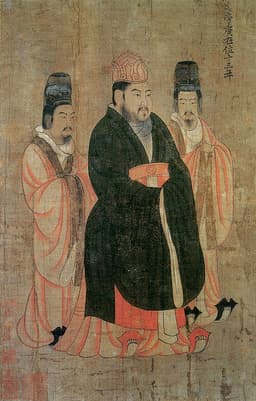
Emperor Yang of Sui
Emperor · Medieval
60.1Total
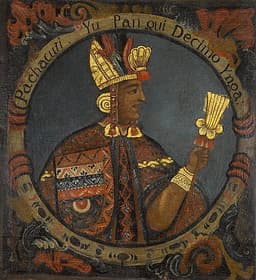
Pachacuti
Emperor · Medieval
69.4Total
Basic Information
Born
569
1418
Died
618
1472
Era
Medieval
Medieval
Nationality
China
Inca Empire
Occupation
Emperor
Emperor
Civilization
Eastern
Other
Score Comparison
Military (10%)
52.5
78.5
Political (20%)
45.0
58.1
Influence (20%)
65.0
65.0
Legacy (20%)
72.0
72.0
Leadership (15%)
58.8
78.0
Strategy (15%)
50.0
69.2
TOTAL
60.1
69.4
Emperor Yang of Sui — Complete Timeline
605 AD
Construction of the Grand CanalCultural
Emperor Yang ordered the construction of the Grand Canal, linking the Yellow River and Yangtze River basins. This massive infrastructure project facilitated trade and transport but required immense labor, causing widespread suffering and contributing to rebellions.
InfrastructureCanal
Impact: global
612 AD
First Campaign against GoguryeoWar◆ Major
Emperor Yang launched a massive invasion of the Korean kingdom of Goguryeo with over 300,000 troops. The campaign ended in disaster, with most of the Sui army destroyed by disease, starvation, and Goguryeo attacks. This defeat severely weakened the Sui dynasty.
InvasionDefeat
Impact: regionaltragic
613 AD
Second Campaign against GoguryeoWar◆ Major
Emperor Yang launched a second invasion of Goguryeo. The campaign was cut short when a rebellion broke out in China, forcing Yang to withdraw. This further drained the dynasty's resources and morale.
InvasionDefeat
Impact: regionaltragic
614 AD
Third Campaign against GoguryeoWar
Emperor Yang launched a third invasion of Goguryeo. Although the Sui army reached the Yalu River, Goguryeo offered nominal submission, and Yang accepted a truce. This campaign further exhausted the Sui treasury and military.
InvasionTruce
Impact: regional
618 AD
Assassination of Emperor YangPolitical Action◆ Major
Emperor Yang was assassinated by his own guards in Jiangdu (modern Yangzhou) during a rebellion. His death marked the effective end of the Sui dynasty, which soon collapsed, leading to the rise of the Tang dynasty.
AssassinationDynasty Collapse
Impact: regionaltragic
Pachacuti — Complete Timeline
1438 AD
Conquest of the Chanka KingdomWar
Pachacuti led the Inca army to defeat the Chanka, a powerful rival, in a decisive battle near Cusco. This victory secured his position as Sapa Inca and initiated a period of rapid expansion, transforming the Inca from a small kingdom into a vast empire.
ConquestInca ExpansionChanka
Impact: regional
1440 AD
Reconstruction of CuscoCultural◆ Major
Pachacuti rebuilt Cusco as the imperial capital, designing it in the shape of a puma and constructing massive stone structures like Sacsayhuam
Urban PlanningArchitectureInca Empire
Impact: regionalconstructive
1450 AD
Initiation of Machu Picchu's ConstructionCultural◆ Major
Pachacuti ordered the construction of Machu Picchu, a royal estate and ceremonial site high in the Andes. The complex featured sophisticated dry-stone masonry and terraced agriculture, serving as a symbol of Inca engineering and a retreat for the emperor.
ArchitectureRoyal EstateInca Engineering
Impact: regionalconstructive
Expert Analysis
Pachacuti vs Emperor Yang of Sui
# The Visionaries Who Built Empires and Lost Everything
In the high Andes of Peru, a city of stone rises from the clouds, its precise masonry defying both gravity and time. Half a world away and centuries earlier, a ribbon of water stretches across the Chinese plains, linking rivers that had never met. These monuments—Machu Picchu and the Grand Canal—are the fingerprints of two men who reshaped their worlds with ambition so vast it still echoes. Yet one is remembered as a founding father, the other as a tyrant who drove his dynasty to ruin. What separates the triumph of Pachacuti from the tragedy of Emperor Yang of Sui?
Origins
Pachacuti was born in 1418 into a world of small kingdoms competing for survival in the rugged Andes. The Incas were then merely one tribe among many, their capital Cusco a modest settlement. His father, Viracocha Inca, ruled but faced constant threats from powerful neighbors like the Chanka. Pachacuti grew up in the shadow of war, learning that existence itself was precarious.
Emperor Yang of Sui entered the world in 569, born into the aristocratic Yang family of northern China. The era was one of division—the Northern and Southern dynasties had kept China fractured for nearly three centuries. Yang’s father, Emperor Wen, would reunite China by force, founding the Sui dynasty in 581. Yang grew up in a palace, surrounded by scholars and generals, his path to power paved by his father’s conquests. Where Pachacuti learned to fight for survival, Yang learned to command from a throne already built.
Rise to Power
Pachacuti’s rise came through a single, desperate moment. In 1438, when the Chanka kingdom launched a massive assault on Cusco, his father fled the city in fear. Young Pachacuti refused to retreat. Rallying the remaining warriors, he led a counterattack that shattered the Chanka army. The victory was so complete that the Chanka never recovered, and Pachacuti—whose name means “he who remakes the world”—seized power from his disgraced father. His rise was forged in blood and courage.
Emperor Yang’s ascent was more calculated. His father had already unified China, but Yang maneuvered to become crown prince by outmaneuvering his elder brother, who was demoted and later forced to commit suicide. When Emperor Wen died in 604—rumored to have been murdered by Yang himself—the new emperor took the throne with a vision of grandeur. His path was not one of survival but of inheritance and intrigue.
Leadership & Governance
Pachacuti governed as a conqueror and an architect. After defeating the Chanka, he did not simply plunder—he reorganized. He divided the empire into four provinces, each with a governor, and imposed a system of roads, storehouses, and labor obligations that bound conquered peoples into a single state. He rebuilt Cusco as a puma-shaped capital with stone walls so precisely cut that no mortar was needed. And high above the Urubamba Valley, he ordered the construction of Machu Picchu around 1450—not a fortress, but a royal estate where the emperor could commune with the gods. His military genius was matched by his political wisdom: he often incorporated local leaders into his administration rather than destroying them.
Emperor Yang took a different approach. In 605, he initiated the Grand Canal, a 1,100-mile waterway linking the Yellow and Yangtze Rivers. It was an engineering marvel that would unify China’s economy for centuries. But Yang drove his people mercilessly: millions of laborers were conscripted, and tens of thousands died from exhaustion and disease. When he turned to foreign conquest, launching three massive campaigns against Goguryeo in Korea between 612 and 614, the results were catastrophic. The first invasion involved over 300,000 troops, but poor logistics and fierce Korean resistance left the Sui army shattered. The second and third campaigns fared no better, and each failure drained the treasury and inflamed rebellion.
Triumph & Tragedy
Pachacuti’s greatest moment was the transformation of a frightened tribe into an empire that stretched from modern Ecuador to Chile. Under his rule, the Inca domain expanded from a small kingdom into a civilization that would awe the Spanish a century later. His tragedy, if it can be called one, was that his empire would not survive the arrival of Europeans—but that was a century after his death.
Emperor Yang’s triumph was the Grand Canal, which would outlast him by over a millennium. His tragedy unfolded swiftly. By 613, rebellions erupted across China. The third Goguryeo campaign in 614 achieved only nominal submission from the Korean kingdom, but the cost was unbearable. In 618, his own guards, weary of his megalomania, assassinated him in Jiangdu. The Sui dynasty collapsed immediately, lasting only thirty-seven years—a brilliant but brief flame.
Character & Destiny
Pachacuti was ruthless but strategic. He executed enemies when necessary but preferred to win loyalty through generosity and shared glory. His vision was grand but grounded: he built an empire that could govern itself, with systems that outlasted him. He died in 1472, old and revered, having remade the world he inherited.
Emperor Yang was brilliant but impatient. He wanted everything at once—canals, conquests, glory. He lacked the patience to consolidate his gains or the empathy to spare his people. His ambition outpaced his resources, and his pride blinded him to the rebellions festering across his realm. He died alone, betrayed by the men he commanded.
Legacy
Pachacuti is remembered as the father of the Inca Empire, the greatest of the Sapa Incas. Machu Picchu stands as his eternal monument, and the road systems he built still trace the Andes. His legacy is one of creation.
Emperor Yang’s legacy is more ambiguous. The Grand Canal remains a vital artery of Chinese commerce, and his reunification of China paved the way for the Tang dynasty’s golden age. But his name is synonymous with tyranny and ruin. He built what others would perfect, and his failures taught future rulers what not to do.
Conclusion
Two visionaries, two empires, two fates. Pachacuti built slowly, on a foundation of survival and adaptability. Emperor Yang built fast, on a foundation of inheritance and impatience. One died in bed, the other by the sword. Their monuments remain—one a city in the sky, the other a river across a continent—but the difference lies not in what they built, but in how they built it. The stone endures; the water flows; but the memory of how power is used is what history never forgets.
Rankings
🥇
PachacutiLeader
Mil: 78.5Pol: 58.1Inf: 65.0
69.4
🥈
Emperor Yang of Sui
Mil: 52.5Pol: 45.0Inf: 65.0
60.1
+9.3 behind
How This Comparison Works
Algorithm
Each figure is scored on 6 dimensions (0—100 scale) based on structured historical data: Military (10%), Political (20%), Influence (20%), Legacy (20%), Leadership (15%), Strategy (15%). The weighted total produces the final ranking.
Data Sources
Scores are computed from structured sub-indicators in the database. Scale factors adjust for era (Ancient ×0.85, Modern ×1.0) and civilization size (Eastern ×1.05, Other ×0.80) to account for differences in population and military scale.
Maximum 3 Figures
Comparisons are limited to 2—3 figures to ensure readability and statistical meaningfulness.
Error Margins
±5 points per dimension — Sub-scores are derived from historical records with inherent uncertainty. Two figures within 5 points on a dimension should be considered roughly equivalent in that area.
Total Score Accuracy
±3 points overall — The weighted combination of 6 dimensions produces a total score with approximately ±3 points of uncertainty. Differences of less than 3 points are not statistically significant— the figures are effectively tied.
Known Limitations
- Historical records are incomplete and uneven across civilizations
- Figures from oral-tradition societies may be underrepresented
- Occupation labels can misclassify multi-role figures
- Scores measure capability and impact, not moral character
- Quantitative scoring is a comparison tool, not absolute truth
Capability Radar
Military (10%) — Battles & Warfare
Battles
65
85
Win Rate
30
90
Expansion
70
90
Political (20%) — Governance & Reform
Reform
85
92
Diplomacy
40
75
Economy
70
80
Influence (20%) — Cultural & Global Reach
Cultural
75
85
Global
65
65
Legacy (20%) — Historical Impact
Historical
80
80
Longevity
70
70
Leadership (15%) — Power & Stability
Tenure
55
85
Stability
20
82
Strategy (15%) — Tactics & Innovation
Strategy
60
88
Tactics
55
80
Reform
50
85
Similar Comparisons
Comments & Discussion
PachacutiFan4Life6/16/2026
Calling Emperor Yang a visionary is giving him way too much credit. The guy conscripted millions, bankrupted his dynasty, and left China starving for a canal that mainly served his egotistical tours to inspect lotus flowers. At least Pachacuti built Machu Picchu as a functional retreat using free labor that was culturally mandatory, not state-sanctioned slavery. One created a monument; the other created a body count. Not the same league, sorry.
数据侦探6/16/2026
别被“壮举”两个字骗了。隋炀帝修大运河,征发民夫五百多万,结果死了近一半人——这数字大到不像是真的,但《隋书》写得清清楚楚。帕查库蒂修马丘比丘,规模小得多,用的还是“米塔”劳役制,按月轮换,人累不死。把这两件事等量齐观,不是历史研究,是煽情文案。
ClassicsSkeptic6/16/2026
I'm tired of the "visionary vs tyrant" framing. Both men were autocrats with total power who mobilized their subjects for massive public works. The difference isn't moral—it's geological. Pachacuti's empire had mountains as natural barriers; Yang's China was a flat alluvial plain where canal labor could be tracked, counted, and exploited to death. Same ambition, different constraints. Stop romanticizing the one who got lucky with geography.
麦哲伦没到过的地方6/16/2026
帕查库蒂被神话得太厉害了。他打赢了昌卡战争后,把对手的头骨做成酒杯喝酒——这算哪门子“建设者”?隋炀帝再荒唐,也没把战俘当酒具。而且印加帝国没文字,留下马丘比丘就算“伟大”?大运河可是实实在在沟通了南北经济一千年。要论遗产,运河养活的人远比石头城多得多。
RevisionistHack6/16/2026
You're all missing the real story. Emperor Yang didn't fail because he was cruel—he failed because he was too ambitious too fast. The Grand Canal was a military logistics project to supply the northern frontier, not a pleasure cruise. Meanwhile Pachacuti conquered piecemeal over decades, giving his empire time to digest. Yang tried to do in 15 years what took others 150. That's not tyranny—that's strategic miscalculation. History punishes speed, not vision.