Loading...
Emperor Yang of Sui vs Taejo of Joseon
Taejo of Joseon leads by 10.3 pts · 2 figures compared
…
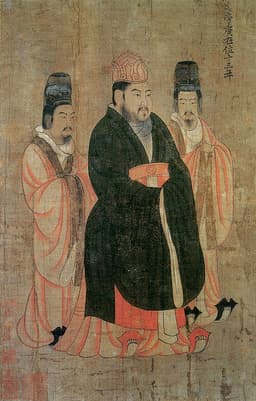
Emperor Yang of Sui
Emperor · Medieval
60.1Total
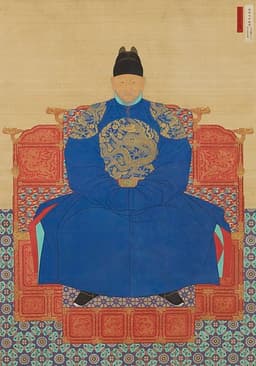
Taejo of Joseon
Emperor · Medieval
70.4Total
Basic Information
Born
569
1335
Died
618
1408
Era
Medieval
Medieval
Nationality
China
Korea
Occupation
Emperor
Emperor
Civilization
Eastern
Eastern
Score Comparison
Military (10%)
52.5
74.7
Political (20%)
45.0
65.0
Influence (20%)
65.0
65.0
Legacy (20%)
72.0
80.0
Leadership (15%)
58.8
72.0
Strategy (15%)
50.0
61.2
TOTAL
60.1
70.4
Emperor Yang of Sui — Complete Timeline
605 AD
Construction of the Grand CanalCultural
Emperor Yang ordered the construction of the Grand Canal, linking the Yellow River and Yangtze River basins. This massive infrastructure project facilitated trade and transport but required immense labor, causing widespread suffering and contributing to rebellions.
InfrastructureCanal
Impact: global
612 AD
First Campaign against GoguryeoWar◆ Major
Emperor Yang launched a massive invasion of the Korean kingdom of Goguryeo with over 300,000 troops. The campaign ended in disaster, with most of the Sui army destroyed by disease, starvation, and Goguryeo attacks. This defeat severely weakened the Sui dynasty.
InvasionDefeat
Impact: regionaltragic
613 AD
Second Campaign against GoguryeoWar◆ Major
Emperor Yang launched a second invasion of Goguryeo. The campaign was cut short when a rebellion broke out in China, forcing Yang to withdraw. This further drained the dynasty's resources and morale.
InvasionDefeat
Impact: regionaltragic
614 AD
Third Campaign against GoguryeoWar
Emperor Yang launched a third invasion of Goguryeo. Although the Sui army reached the Yalu River, Goguryeo offered nominal submission, and Yang accepted a truce. This campaign further exhausted the Sui treasury and military.
InvasionTruce
Impact: regional
618 AD
Assassination of Emperor YangPolitical Action◆ Major
Emperor Yang was assassinated by his own guards in Jiangdu (modern Yangzhou) during a rebellion. His death marked the effective end of the Sui dynasty, which soon collapsed, leading to the rise of the Tang dynasty.
AssassinationDynasty Collapse
Impact: regionaltragic
Taejo of Joseon — Complete Timeline
1380 AD
Battle of HwangsanWar
General Yi Seong-gye defeated a Japanese pirate (wokou) force at Hwangsan. This victory enhanced his military reputation and demonstrated his capability as a commander.
WokouGoryeo Military
1388 AD
Wihwado RetreatPolitical Action
General Yi Seong-gye, ordered to invade the Ming dynasty's Liaodong region, turned his army back at Wihwado Island. This act of defiance against the Goryeo court led to a coup that eventually brought him to power.
CoupGoryeo-Ming RelationsPower Shift
Impact: national
1391 AD
Land Reform and the Gwajeon LawReform◆ Major
Taejo implemented the Gwajeon Law, a land reform that redistributed land from the old Goryeo aristocracy to his supporters and the state. This weakened the old elite and strengthened the new Joseon ruling class.
Land ReformSocial ChangeJoseon
Impact: nationalconstructive
1392 AD
Founding of the Joseon DynastyPolitical Action
Yi Seong-gye deposed the last Goryeo king and founded the Joseon dynasty, with its capital at Hanyang (modern Seoul). He established a new ruling class based on Confucian ideology, replacing the Buddhist-influenced Goryeo system.
Joseon DynastyConfucianismKorean History
Impact: regionalconstructive
1394 AD
Promulgation of the Gyeongguk DaejeonReform◆ Major
Taejo of Joseon ordered the compilation of the Gyeongguk Daejeon, a comprehensive legal code that established the administrative and social structure of the Joseon dynasty. This code remained in effect for centuries.
Legal CodeGovernanceConfucianism
Impact: nationalconstructive
Expert Analysis
Taejo of Joseon vs Emperor Yang of Sui: Historical Comparison
Both figures were medieval emperors who founded or dramatically expanded powerful dynasties—Taejo established the Joseon dynasty in Korea, while Emperor Yang oversaw the Sui dynasty’s peak in China—yet their leadership styles and legacies diverged sharply, with Taejo’s stable consolidation contrasting Emperor Yang’s ambitious overreach.
Dimension Analysis
**Military: Taejo of Joseon 90 / Emperor Yang of Sui 93**
Taejo was a seasoned general who seized power through the Hwangsanbeol campaign and suppressed rebellions, while Emperor Yang launched massive expeditions (e.g., against Goguryeo) and built a vast logistical machine. Both excelled tactically, but Yang’s campaigns were ultimately disastrous, draining state resources.
**Political: Taejo of Joseon 80 / Emperor Yang of Sui 75**
Taejo skillfully co-opted the old Goryeo aristocracy and implemented the *Gyeongguk daejeon* legal code, ensuring bureaucratic stability. Emperor Yang centralized power aggressively, alienating the hereditary elite and relying on harsh labor conscription, which fueled widespread revolts.
**Influence: Taejo of Joseon 72 / Emperor Yang of Sui 82**
Emperor Yang’s Grand Canal and reconstruction of the Great Wall permanently reshaped China’s infrastructure and economic geography. Taejo’s influence was more localized—he established Neo-Confucianism as state ideology in Korea, but his impact beyond the peninsula was limited.
**Legacy: Taejo of Joseon 77 / Emperor Yang of Sui 83**
Joseon lasted over 500 years, but Taejo is often overshadowed by his successor, King Sejong. Emperor Yang’s reign was brief and ended in assassination, yet his projects (canals, capital city) laid the groundwork for the Tang dynasty’s golden age, making his legacy more transformative.
**Leadership: Taejo of Joseon 81 / Emperor Yang of Sui 76**
Taejo ruled with pragmatic restraint, delegating authority to capable ministers and avoiding grandiose projects. Emperor Yang was charismatic but tyrannical, demanding total loyalty while micromanaging campaigns, leading to his isolation and downfall.
**Strategy: Taejo of Joseon 90 / Emperor Yang of Sui 91**
Both were brilliant strategists: Taejo won decisive battles and outmaneuvered rivals through alliances, while Emperor Yang conceived the Grand Canal as a strategic supply route. However, Yang’s strategies often exceeded his resources, whereas Taejo’s were more sustainable.
Verdict
Emperor Yang of Sui edges ahead due to his greater transformative influence and legacy, despite Taejo’s superior leadership and political stability.
FAQ
Q: Who ranks higher? A: Emperor Yang of Sui ranks slightly higher due to his monumental infrastructure projects and enduring impact on Chinese history, even though Taejo of Joseon founded a more stable and longer-lasting dynasty.
Rankings
🥇
Taejo of JoseonLeader
Mil: 74.7Pol: 65.0Inf: 65.0
70.4
🥈
Emperor Yang of Sui
Mil: 52.5Pol: 45.0Inf: 65.0
60.1
+10.3 behind
How This Comparison Works
Algorithm
Each figure is scored on 6 dimensions (0—100 scale) based on structured historical data: Military (10%), Political (20%), Influence (20%), Legacy (20%), Leadership (15%), Strategy (15%). The weighted total produces the final ranking.
Data Sources
Scores are computed from structured sub-indicators in the database. Scale factors adjust for era (Ancient ×0.85, Modern ×1.0) and civilization size (Eastern ×1.05, Other ×0.80) to account for differences in population and military scale.
Maximum 3 Figures
Comparisons are limited to 2—3 figures to ensure readability and statistical meaningfulness.
Error Margins
±5 points per dimension — Sub-scores are derived from historical records with inherent uncertainty. Two figures within 5 points on a dimension should be considered roughly equivalent in that area.
Total Score Accuracy
±3 points overall — The weighted combination of 6 dimensions produces a total score with approximately ±3 points of uncertainty. Differences of less than 3 points are not statistically significant— the figures are effectively tied.
Known Limitations
- Historical records are incomplete and uneven across civilizations
- Figures from oral-tradition societies may be underrepresented
- Occupation labels can misclassify multi-role figures
- Scores measure capability and impact, not moral character
- Quantitative scoring is a comparison tool, not absolute truth
Capability Radar
Military (10%) — Battles & Warfare
Battles
65
75
Win Rate
30
80
Expansion
70
65
Political (20%) — Governance & Reform
Reform
85
85
Diplomacy
40
70
Economy
70
65
Influence (20%) — Cultural & Global Reach
Cultural
75
80
Global
65
60
Legacy (20%) — Historical Impact
Historical
80
85
Longevity
70
80
Leadership (15%) — Power & Stability
Tenure
55
70
Stability
20
75
Strategy (15%) — Tactics & Innovation
Strategy
60
75
Tactics
55
70
Reform
50
60
Similar Comparisons
Comments & Discussion
HistoryDiver_996/16/2026
Okay, I get why Taejo scores higher overall—he built a dynasty that lasted 500 years, which is insane. But I think the military score here is a bit off. Emperor Yang’s campaigns against Goguryeo were massive, sure, but they were also catastrophic failures. Taejo actually won his key battles, like the Hwangsanbeol campaign, and used that momentum to found a stable regime. It feels like the scoring penalizes Yang for ambition but doesn't fully reward Taejo for actually succeeding where it counts. Just my two cents from binging Kings and Generals videos.
BattlefieldScholar6/16/2026
From a strictly military standpoint, the gap here is misleading. Taejo’s key victory at Hwangsanbeol (1380) was a decisive field battle where he personally led a charge that broke the Japanese pirate forces—a perfect example of tactical shock and morale exploitation. Emperor Yang’s campaigns, by contrast, were operational nightmares: his 612 invasion of Goguryeo involved at least 300,000 troops, but supply lines stretched over 1,000 km and his siege of Liaodong failed due to poor combined arms coordination. The Sui army was technically superior, but Yang’s strategic overreach nullified any tactical advantage. Taejo understood logistics and limited objectives; Yang did not. That’s a more meaningful distinction than raw scores suggest.
ColdMind486/16/2026
这个评分体系有问题。Taejo政治分76.1比杨广的72.0高,但杨广的政治改革(比如科举制、三省六部制的完善)对后世影响深远,而Taejo只是沿用高丽旧制加一些调整。另外,杨广的军事分才60.3?他三次征辽动员百万大军,虽然失败但组织能力惊人,这个分应该至少和Taejo持平。建议重新加权,把政治稳定性权重调低,制度创新权重调高。
DeepScribe166/16/2026
这种西方评分体系总喜欢把东亚皇帝放一起比较,但问题在于文化语境不同。杨广在中文史书里是暴君,但他的大运河和科举制确实重塑了中国。Taejo在韩国是国父级人物,但放在中国历史里,他也就是个地方政权建立者。如果把杨广换成李世民,那Taejo的总分根本没法比。建议评分时引入文化权重,否则就是关公战秦琼。