Loading...
Emperor Taizu of Jin vs Li Bian
Emperor Taizu of Jin leads by 9.4 pts · 2 figures compared
…

Emperor Taizu of Jin
Emperor · Medieval
63.5Total
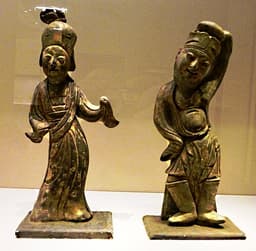
Li Bian
Emperor · Medieval
54.1Total
Basic Information
Born
1068
889
Died
1123
943
Era
Medieval
Medieval
Nationality
China
China
Occupation
Emperor
Emperor
Civilization
Eastern
Eastern
Score Comparison
Military (10%)
82.0
55.0
Political (20%)
65.0
68.0
Influence (20%)
55.0
58.0
Legacy (20%)
55.0
47.5
Leadership (15%)
72.0
40.0
Strategy (15%)
72.0
60.0
TOTAL
63.5
54.1
Emperor Taizu of Jin — Complete Timeline
1114 AD
Unification of the Jurchen tribesWar◆ Major
Wanyan Aguda led the Jurchen tribes in a rebellion against the Khitan-led Liao dynasty. He unified the Jurchen clans under his leadership, establishing a confederation that would form the basis of the Jin dynasty.
Jurchen unificationRebellionLiao dynasty
Impact: regionalconstructive
1115 AD
Battle of Hubu RiverWar◆ Major
Aguda's Jin forces defeated a Liao army at the Hubu River. This victory secured Jin control over the Liao's eastern territories and demonstrated the military effectiveness of the Jurchen cavalry against the Khitan.
BattleLiao-Jin WarMilitary victory
Impact: regional
Proclamation of the Jin dynastyPolitical Action◆ Major
Wanyan Aguda declared himself emperor, founding the Jin dynasty. He adopted the Chinese-style reign name Shouguo and established a centralized administration, marking the formal beginning of the Jin state.
Dynasty foundingImperial proclamationJin dynasty
Impact: regionalconstructive
1120 AD
Capture of the Liao Supreme CapitalWar◆ Major
Jin forces under Aguda captured the Liao dynasty's Supreme Capital (Shangjing). This conquest crippled the Liao state and forced the Liao emperor Tianzuo to flee, effectively ending Liao resistance in the region.
Capital captureLiao-Jin WarConquest
Impact: regional
Alliance with the Song dynastyPolitical Action◆ Major
Aguda negotiated the Alliance of the Sea with the Song dynasty, agreeing to jointly attack the Liao dynasty. The Song would receive the Sixteen Prefectures, while Jin would take the rest of Liao territory.
Diplomatic allianceSong-Jin relationsLiao partition
Impact: regional
Li Bian — Complete Timeline
937 AD
Founded the Southern Tang DynastyPolitical Action
Li Bian, originally Xu Zhigao, usurped the throne from the Yang family of the Wu kingdom and proclaimed himself emperor of the Southern Tang dynasty. He established his capital at Jinling (Nanjing) and initiated a period of cultural and economic prosperity.
Dynasty FoundingSouthern TangUsurpation
Impact: regional
938 AD
Implemented Peaceful and Prosperous PoliciesReform◆ Major
Li Bian reduced taxes, promoted agriculture, and encouraged trade. He also patronized literature and the arts, attracting scholars to his court. His reign brought stability and relative peace to the Yangtze River region during the turbulent Five Dynasties period.
ReformsProsperityCultural Patronage
Impact: regionalconstructive
Expert Analysis
Origins
Wanyan Aguda (1068–1123) was born into the Wanyan clan of the Jurchen people, semi-nomadic tribes inhabiting the forests of Manchuria under Liao domination. His father, Helibo, was a chieftain who expanded Jurchen influence. Aguda grew up in a warrior culture, learning horsemanship and archery. He inherited leadership of the Wanyan clan in 1109, after his brother Wuyashu died. The Jurchens were vassals of the Khitan-led Liao dynasty, chafing under tribute demands.
Li Bian (888–943), originally named Xu Zhigao, was a foundling adopted by Xu Wen, a general of the Wu kingdom. Born in obscurity, he rose through the ranks as an administrator. His early life was marked by the chaos of the late Tang dynasty, as regional warlords carved up the empire. Li Bian's adoptive father became the de facto ruler of Wu, giving Li Bian a political education.
Rise to Power
Aguda's rise began with rebellion against the Liao. In 1114, he unified the Jurchen tribes and declared war. At the Battle of Hubu River (1114), his forces defeated a Liao army, securing eastern territories. In 1115, he proclaimed the Jin dynasty, adopting the Chinese-style reign name Shouguo. He forged the Alliance of the Sea (1120) with the Song dynasty, agreeing to jointly attack Liao. By 1122, Jin forces captured the Liao Supreme Capital, crippling the Liao state. Aguda's military score of 82.0 reflects his success as a field commander.
Li Bian's path was gradual. He served as an official under Wu, eventually becoming regent. In 937, he forced the last Wu ruler to abdicate, founding the Southern Tang dynasty. He changed his name to Li Bian to claim descent from the Tang imperial family. His political score of 68.0 indicates adept maneuvering, but his lack of military conquests kept his overall score lower.
Leadership & Governance
Aguda ruled as a warrior-king. He centralized Jurchen administration, adopting Chinese-style bureaucratic titles while retaining tribal military organization. He issued a legal code and promoted agriculture, but his primary focus was expansion. His leadership score of 72.0 reflects his ability to command loyalty, but his governance was rudimentary compared to Chinese models.
Li Bian was a peacemaker. He reduced taxes, promoted agriculture, and encouraged trade. He patronized literature, attracting scholars like Feng Yanji. His reign saw cultural flourishing, but his military weakness left Southern Tang vulnerable. His leadership score of 40.0 is low because he failed to build a strong army or defend against northern threats.
Triumph & Tragedy
Aguda's greatest triumph was founding the Jin dynasty and destroying the Liao. By 1123, his empire stretched from Manchuria to northern China. His tragedy: he died shortly after the Liao's collapse, never seeing the Jin conquest of northern Song. His military successes created a powerful state, but his early death left succession issues.
Li Bian's triumph was establishing Southern Tang as a cultural center. His policies brought prosperity to the Yangtze region. His tragedy: his pacifism left the state defenseless. After his death, Southern Tang was conquered by the Song in 975. His legacy score of 47.5 reflects the fragility of his achievements.
Character & Destiny
Aguda was decisive and ruthless. He personally led charges and executed Liao officials who resisted. His character shaped a destiny of conquest. Historical assessments praise his strategic vision; his strategy score of 72.0 aligns with this.
Li Bian was cautious and introverted. He avoided war, focusing on internal stability. His destiny was a peaceful reign followed by decline. His character limited his impact; he scored 54.1 total, 9.4 points below Aguda.
Legacy
Aguda's legacy is the Jin dynasty, which ruled northern China for a century. His unification of Jurchen tribes created a distinct identity that later influenced the Manchus. His military campaigns reshaped East Asian geopolitics.
Li Bian's legacy is cultural: Southern Tang poetry and art influenced later Chinese aesthetics. However, his state vanished without a trace politically. His influence score of 58.0 reflects this limited reach.
Conclusion
Emperor Taizu of Jin had greater impact. His military score of 82.0, leadership of 72.0, and total of 63.5 demonstrate concrete achievements: founding a dynasty, destroying an empire, and altering the balance of power. Li Bian's total of 54.1 reflects a competent but transient ruler. Aguda's conquests created a legacy that endured, while Li Bian's peaceful kingdom was soon forgotten. Aguda wins decisively.
Rankings
🥇
Emperor Taizu of JinLeader
Mil: 82.0Pol: 65.0Inf: 55.0
63.5
🥈
Li Bian
Mil: 55.0Pol: 68.0Inf: 58.0
54.1
+9.4 behind
How This Comparison Works
Algorithm
Each figure is scored on 6 dimensions (0—100 scale) based on structured historical data: Military (10%), Political (20%), Influence (20%), Legacy (20%), Leadership (15%), Strategy (15%). The weighted total produces the final ranking.
Data Sources
Scores are computed from structured sub-indicators in the database. Scale factors adjust for era (Ancient ×0.85, Modern ×1.0) and civilization size (Eastern ×1.05, Other ×0.80) to account for differences in population and military scale.
Maximum 3 Figures
Comparisons are limited to 2—3 figures to ensure readability and statistical meaningfulness.
Error Margins
±5 points per dimension — Sub-scores are derived from historical records with inherent uncertainty. Two figures within 5 points on a dimension should be considered roughly equivalent in that area.
Total Score Accuracy
±3 points overall — The weighted combination of 6 dimensions produces a total score with approximately ±3 points of uncertainty. Differences of less than 3 points are not statistically significant— the figures are effectively tied.
Known Limitations
- Historical records are incomplete and uneven across civilizations
- Figures from oral-tradition societies may be underrepresented
- Occupation labels can misclassify multi-role figures
- Scores measure capability and impact, not moral character
- Quantitative scoring is a comparison tool, not absolute truth
Capability Radar
Military (10%) — Battles & Warfare
Battles
85
30
Win Rate
90
35
Expansion
85
40
Political (20%) — Governance & Reform
Reform
75
65
Diplomacy
80
55
Economy
65
60
Influence (20%) — Cultural & Global Reach
Cultural
55
50
Global
50
30
Legacy (20%) — Historical Impact
Historical
70
45
Longevity
60
40
Leadership (15%) — Power & Stability
Tenure
70
60
Stability
60
55
Strategy (15%) — Tactics & Innovation
Strategy
85
45
Tactics
88
40
Reform
75
50
Similar Comparisons
Comments & Discussion
No comments yet. Be the first to share your thoughts!