Loading...
Emperor Taizu of Jin vs Julius Caesar
Julius Caesar leads by 19.3 pts · 2 figures compared
…
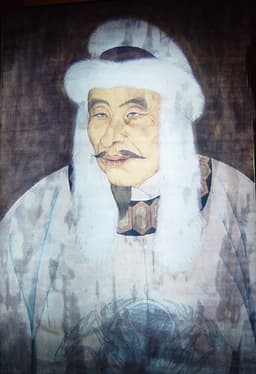
Emperor Taizu of Jin
Emperor · Medieval
63.5Total

Julius Caesar
General · Ancient
82.8Total
Basic Information
Born
1068
-100
Died
1123
-44
Era
Medieval
Ancient
Nationality
China
Roman Republic
Occupation
Emperor
General
Civilization
Eastern
Western
Score Comparison
Military (10%)
82.0
88.0
Political (20%)
65.0
78.0
Influence (20%)
55.0
85.0
Legacy (20%)
55.0
82.0
Leadership (15%)
72.0
80.0
Strategy (15%)
72.0
85.0
TOTAL
63.5
82.8
Emperor Taizu of Jin — Complete Timeline
1114 AD
Unification of the Jurchen tribesWar◆ Major
Wanyan Aguda led the Jurchen tribes in a rebellion against the Khitan-led Liao dynasty. He unified the Jurchen clans under his leadership, establishing a confederation that would form the basis of the Jin dynasty.
Jurchen unificationRebellionLiao dynasty
Impact: regionalconstructive
1115 AD
Battle of Hubu RiverWar◆ Major
Aguda's Jin forces defeated a Liao army at the Hubu River. This victory secured Jin control over the Liao's eastern territories and demonstrated the military effectiveness of the Jurchen cavalry against the Khitan.
BattleLiao-Jin WarMilitary victory
Impact: regional
Proclamation of the Jin dynastyPolitical Action◆ Major
Wanyan Aguda declared himself emperor, founding the Jin dynasty. He adopted the Chinese-style reign name Shouguo and established a centralized administration, marking the formal beginning of the Jin state.
Dynasty foundingImperial proclamationJin dynasty
Impact: regionalconstructive
1120 AD
Capture of the Liao Supreme CapitalWar◆ Major
Jin forces under Aguda captured the Liao dynasty's Supreme Capital (Shangjing). This conquest crippled the Liao state and forced the Liao emperor Tianzuo to flee, effectively ending Liao resistance in the region.
Capital captureLiao-Jin WarConquest
Impact: regional
Alliance with the Song dynastyPolitical Action◆ Major
Aguda negotiated the Alliance of the Sea with the Song dynasty, agreeing to jointly attack the Liao dynasty. The Song would receive the Sixteen Prefectures, while Jin would take the rest of Liao territory.
Diplomatic allianceSong-Jin relationsLiao partition
Impact: regional
Julius Caesar — Complete Timeline
58 BC
Gallic WarsWar◆ Major
Caesar, as proconsul of Gaul, launched a series of campaigns that conquered all of Gaul (modern France, Belgium, and parts of Switzerland). He fought numerous battles, including against the Helvetii, the Belgae, and the Gallic chieftain Vercingetorix. The wars brought immense wealth and a loyal army to Caesar.
Gallic WarsConquestRoman Expansion
Impact: regional
49 BC
Crossing the RubiconPolitical Action◆ Major
Caesar led Legio XIII across the Rubicon River into Italy, defying the Roman Senate's order to disband his army. This act triggered a civil war against Pompey and the Optimates, ultimately leading to Caesar's dictatorship and the end of the Roman Republic.
Roman Civil WarEnd of RepublicPower Struggle
Impact: global
48 BC
Battle of PharsalusWar◆ Major
Caesar's outnumbered army defeated the larger forces of Pompey the Great at Pharsalus in Greece. Caesar's tactical use of a reserve line to counter Pompey's cavalry charge proved decisive. Pompey fled to Egypt, where he was assassinated, leaving Caesar as the undisputed master of the Roman world.
Roman Civil WarBattleDecisive Victory
Impact: regional
44 BC
Appointment as Dictator for LifePolitical Action◆ Major
The Roman Senate appointed Caesar dictator perpetuo (dictator for life), granting him unprecedented personal power. This move concentrated military, legislative, and judicial authority in one person, effectively ending the Roman Republic's traditional system of checks and balances and alarming many senators.
DictatorshipEnd of RepublicPower Consolidation
Impact: regionaldestructive
Assassination on the Ides of MarchPolitical Action◆ Major
A group of Roman senators, led by Marcus Junius Brutus and Gaius Cassius Longinus, stabbed Caesar to death at a meeting of the Senate in the Theatre of Pompey. The assassination was intended to restore the Republic, but instead triggered another civil war that led to the rise of the Roman Empire.
AssassinationRoman PoliticsEnd of Republic
Impact: globaldestructive
Expert Analysis
emperor-taizu-of-jin-vs-julius-caesar
### The Conqueror and the Unifier
In the winter of 49 BCE, a Roman general stood at the banks of a small river in northern Italy, the Rubicon. To cross was to declare war on the Republic itself. Nearly twelve centuries later, on the frozen plains of what is now northeastern China, a Jurchen chieftain named Wanyan Aguda led his horsemen against an empire that had dominated his people for generations. Both men stood on the precipice of history, each about to shatter an old world and forge a new one. But while Julius Caesar’s crossing led to his apotheosis and then his bloody end in the Senate chamber, Aguda’s rebellion culminated in the founding of a dynasty that would rule northern China for a century. Why did one man’s ambition become a cautionary tale of overreach, while the other’s became a foundation stone of imperial continuity?
### Origins
Caesar was born into the chaos of the late Roman Republic, a world of senatorial intrigue, civil wars, and crumbling traditions. His family, the Julii, claimed descent from the goddess Venus, but they were not among the ruling elite. His father died when Caesar was sixteen, leaving him to navigate a treacherous political landscape where survival depended on alliances and audacity. The Republic was a machine of laws and customs, but it was also a battlefield of egos.
Wanyan Aguda emerged from a very different world. The Jurchen tribes were forest-dwellers in the northeast, living under the shadow of the Khitan Liao dynasty. Their society was tribal, bound by kinship and the harsh demands of hunting and warfare. Aguda grew up not in marble forums but in felt tents, learning to ride before he could walk. The Liao had long exploited the Jurchen, demanding tribute and playing one clan against another. Aguda’s father and brother had both led resistance, but it was Aguda who would finally unite the fractious tribes in 1114, declaring that the time for submission was over.
### Rise to Power
Caesar’s path to power was a masterclass in political calculation. He climbed the Roman ladder—quaestor, aedile, praetor—each step lubricated by borrowed money and strategic marriages. His military reputation was forged in Gaul, where over eight years he conquered a vast territory, wrote his own bestselling war commentaries, and built an army loyal to him, not the Senate. When the Senate ordered him to disband his legions, he instead crossed the Rubicon, sparking a civil war that ended with him as dictator.
Aguda’s rise was more direct, born of necessity rather than ambition. After unifying the Jurchen tribes, he proclaimed the Jin dynasty in 1115, adopting the Chinese-style reign name Shouguo. He was not a Roman senator scheming for power; he was a war chief who had to lead from the front. His great victory at the Battle of the Hubu River later that year shattered the Liao’s eastern defenses. By 1120, he had captured the Liao Supreme Capital. But Aguda knew he could not fight alone. He negotiated the Alliance of the Sea with the Song dynasty, a pact that promised mutual destruction of the Liao. It was a diplomatic masterstroke, but it would later prove a poisoned gift.
### Leadership & Governance
Caesar ruled as a reformer, not a revolutionary. He centralized authority, reformed the calendar, extended citizenship to provincials, and launched public works. But he never solved the Republic’s fundamental problems. He ruled by personal authority, not by building institutions. His clemency toward former enemies was legendary—and fatal. He pardoned men who would later stab him.
Aguda’s rule was simpler but more effective in its context. He did not try to remake Jurchen society; he adapted Chinese models of governance to his tribal base. He created a dual administration: Chinese-style bureaucracy for conquered lands, tribal councils for the Jurchen heartland. He was a unifier, not a centralizer. His military strategy was nimble—using cavalry mobility to outmaneuver the Liao’s larger armies—but his political vision was pragmatic. He knew that to rule China, one had to understand China.
### Triumph & Tragedy
Caesar’s greatest triumph was his conquest of Gaul, which doubled the size of Rome’s territory and filled its coffers. But his greatest tragedy was his success. By making himself dictator for life, he made the Republic’s survival impossible. His assassination on the Ides of March in 44 BCE was not a blow for liberty; it was a last gasp of a dying order. He died at fifty-five, leaving no clear successor and plunging Rome into another civil war.
Aguda’s triumph came in 1125, when Jin forces captured the last Liao emperor, Tianzuo, and destroyed the dynasty. But his tragedy was that he did not live to see it. He died in 1123 at age fifty-five, just as his empire was reaching its peak. His successors completed the conquest, but they also inherited a problem: the Song alliance collapsed, and the Jin soon turned on their former partners, sacking the Song capital of Kaifeng in 1127. Aguda’s dream of a stable northern kingdom gave way to endless war.
### Character & Destiny
Caesar was a gambler. He borrowed fortunes, risked civil war, and pardoned enemies because he believed in his own luck. His character was his destiny: his confidence made him great, but his refusal to fear the Senate’s daggers made him dead. He saw himself as a man above the law, and the law eventually caught up.
Aguda was a pragmatist. He did not seek glory for its own sake; he sought survival for his people. He accepted Chinese titles, made alliances with old enemies, and adopted foreign customs because they worked. His character was less dramatic than Caesar’s, but it was more suited to building something lasting. He understood that power is not about personal brilliance but about creating a system that outlasts its founder.
### Legacy
Caesar’s legacy is the Roman Empire. He did not found it—Augustus did—but he made it inevitable. His name became a title: Kaiser, Tsar. He is remembered as a genius, a tyrant, and a martyr.
Aguda’s legacy is the Jin dynasty, which ruled northern China for a century and laid the groundwork for the Mongol conquest that followed. He is honored in China as a unifier of the north, but his name is less known in the West. He did not conquer an empire; he built one from scratch, on horseback, out of snow and iron.
### Conclusion
Standing at the Rubicon, Caesar saw an empire. Standing on the frozen plains of Manchuria, Aguda saw a home. One man’s ambition destroyed a republic; the other’s necessity built a dynasty. Both died at fifty-five. One was stabbed by his peers; the other died in his tent, surrounded by his sons. The difference between them is the difference between a man who wanted to be a god and a man who wanted his people to be free. In the end, the gods are forgotten, but the people endure.
Rankings
🥇
Julius CaesarLeader
Mil: 88.0Pol: 78.0Inf: 85.0
82.8
🥈
Emperor Taizu of Jin
Mil: 82.0Pol: 65.0Inf: 55.0
63.5
+19.3 behind
How This Comparison Works
Algorithm
Each figure is scored on 6 dimensions (0—100 scale) based on structured historical data: Military (10%), Political (20%), Influence (20%), Legacy (20%), Leadership (15%), Strategy (15%). The weighted total produces the final ranking.
Data Sources
Scores are computed from structured sub-indicators in the database. Scale factors adjust for era (Ancient ×0.85, Modern ×1.0) and civilization size (Eastern ×1.05, Other ×0.80) to account for differences in population and military scale.
Maximum 3 Figures
Comparisons are limited to 2—3 figures to ensure readability and statistical meaningfulness.
Error Margins
±5 points per dimension — Sub-scores are derived from historical records with inherent uncertainty. Two figures within 5 points on a dimension should be considered roughly equivalent in that area.
Total Score Accuracy
±3 points overall — The weighted combination of 6 dimensions produces a total score with approximately ±3 points of uncertainty. Differences of less than 3 points are not statistically significant— the figures are effectively tied.
Known Limitations
- Historical records are incomplete and uneven across civilizations
- Figures from oral-tradition societies may be underrepresented
- Occupation labels can misclassify multi-role figures
- Scores measure capability and impact, not moral character
- Quantitative scoring is a comparison tool, not absolute truth
Capability Radar
Military (10%) — Battles & Warfare
Battles
85
95
Win Rate
90
92
Expansion
85
97
Political (20%) — Governance & Reform
Reform
75
90
Diplomacy
80
85
Economy
65
82
Influence (20%) — Cultural & Global Reach
Cultural
55
88
Global
50
94
Legacy (20%) — Historical Impact
Historical
70
95
Longevity
60
96
Leadership (15%) — Power & Stability
Tenure
70
75
Stability
60
60
Strategy (15%) — Tactics & Innovation
Strategy
85
94
Tactics
88
96
Reform
75
88
Similar Comparisons
Comments & Discussion
No comments yet. Be the first to share your thoughts!