Loading...
Emperor Sujin vs Parakramabahu I
Parakramabahu I leads by 14.5 pts · 2 figures compared
…
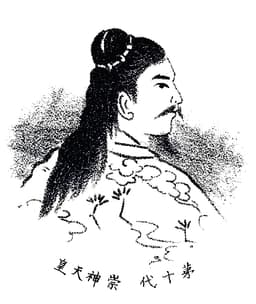
Emperor Sujin
Emperor · Ancient
51.6Total
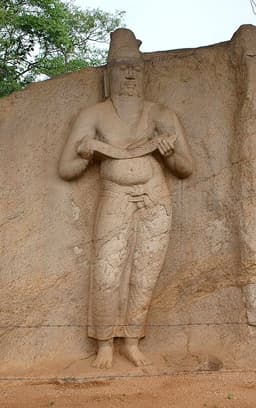
Parakramabahu I
Emperor · Medieval
66.1Total
Basic Information
Born
-148
1123
Died
-30
1186
Era
Ancient
Medieval
Nationality
Japan
Sri Lanka
Occupation
Emperor
Emperor
Civilization
Eastern
Indian
Score Comparison
Military (10%)
50.0
82.0
Political (20%)
68.0
72.0
Influence (20%)
47.1
61.0
Legacy (20%)
43.3
52.0
Leadership (15%)
72.0
82.0
Strategy (15%)
30.3
65.4
TOTAL
51.6
66.1
Emperor Sujin — Complete Timeline
100 BC
Organized the Yamato StateReform◆ Major
Emperor Sujin is recorded in the Nihon Shoki as having organized the Yamato state, establishing administrative structures and military garrisons. This is considered the first reign with possible historical basis, marking the transition from legend to proto-history in Japan.
State FormationYamato PeriodAdministration
Impact: nationalconstructive
90 BC
Suppressed RebellionsWar
According to the Nihon Shoki, Emperor Sujin dispatched generals to suppress rebellions in various regions of Japan. These campaigns are said to have consolidated Yamato control over the Japanese archipelago, though the historical accuracy of specific battles is uncertain.
Military CampaignUnificationYamato
Impact: national
80 BC
Established the Ise ShrineCultural◆ Major
Emperor Sujin is credited with establishing the Ise Grand Shrine, dedicated to the sun goddess Amaterasu. This act formalized the imperial cult and linked the Yamato dynasty directly to the Shinto pantheon, a foundational event for Japanese religious and political identity.
ShintoImperial CultReligion
Impact: nationalconstructive
Parakramabahu I — Complete Timeline
1153 AD
Unification of Sri LankaWar
Parakramabahu I unified the entire island of Sri Lanka under his rule after a series of military campaigns. He defeated the rulers of Ruhuna and other regional kingdoms, ending a period of fragmentation.
Impact: national
1160 AD
Construction of Parakrama SamudraOther◆ Major
Parakramabahu I constructed the Parakrama Samudra, a massive man-made sea of interconnected tanks and canals near Polonnaruwa. This irrigation system, covering over 5,000 acres, was a major engineering achievement.
Impact: regionalconstructive
1165 AD
Invasion of BurmaWar◆ Major
Parakramabahu I launched a naval invasion of Burma (Pagan Kingdom) in retaliation for a trade dispute. The Sinhalese fleet captured the port of Kusumiya and sacked the city, demonstrating Sri Lanka's naval power.
Impact: regional
Reform of the Buddhist SanghaReform◆ Major
Parakramabahu I convened a council to purify the Buddhist Sangha. He expelled corrupt monks and re-established discipline, strengthening Theravada Buddhism in Sri Lanka.
Impact: nationalconstructive
1170 AD
Construction of Polonnaruwa VatadageCultural◆ Major
Parakramabahu I built the Polonnaruwa Vatadage, a circular relic house for the Tooth Relic of the Buddha. This structure is considered a masterpiece of Sinhalese architecture.
Impact: nationalconstructive
Expert Analysis
Emperor Sujin vs Parakramabahu I
# The Unifier and the Founder: Parakramabahu I and Emperor Sujin
In the heart of Sri Lanka, a colossal reservoir called Parakrama Samudra still holds water after eight centuries, a testament to one king’s vision. Half a world away, in the forests of Japan, the Ise Grand Shrine has been rebuilt every twenty years for over two thousand years, a tradition tracing back to another ruler. One built in stone and water; the other in ritual and lineage. Both were founders of a kind—but their worlds, their methods, and their legacies could not be more different.
Origins
Parakramabahu I was born in 1123 into a fractured Sri Lanka. The island’s golden age of Anuradhapura had long passed, and regional chieftains fought for scraps of power. He grew up in the court of his uncle, King Gajabahu II, but ambition simmered early. Medieval Sri Lanka was a world of warring kingdoms, Buddhist monasteries wielding political influence, and constant threat from South Indian empires. Parakramabahu learned that survival meant conquest.
Emperor Sujin, by contrast, emerged from the mists of legend. Born around 148 BCE, he is the first Japanese emperor with plausible historicity—the tenth in the traditional line, but the first whose deeds, recorded centuries later in the *Nihon Shoki*, suggest a real ruler. Ancient Japan was a patchwork of clans, with the Yamato court struggling to assert control. Sujin’s world was not one of grand armies but of ritual authority, where the emperor’s power came from the gods as much as from swords.
Rise to Power
Parakramabahu seized the throne in 1153 after a brutal civil war. He defeated his uncle and rival claimants, unifying the island under a single crown. His path was paved with blood and strategy—he understood that to rule, one must first conquer. The turning point came when he crushed the last rebel stronghold, then turned his army southward to secure the coasts. For him, power was a prize taken by force.
Sujin’s rise was quieter. He inherited a position that was more priest-king than warlord. According to the *Nihon Shoki*, he organized the Yamato state around 100 BCE, establishing administrative structures and dispatching generals to suppress rebellions in the regions. His power came not from personal military brilliance—his strategy score of 46.8 reflects a ruler who delegated warfare—but from his ability to weave the clans into a coherent whole. He was a consolidator, not a conqueror.
Leadership & Governance
Parakramabahu ruled with iron ambition. He reformed the Buddhist Sangha in 1165, expelling corrupt monks and restoring discipline—a move that strengthened his moral authority. But his greatest achievement was irrigation. The Parakrama Samudra, a man-made sea of interconnected tanks and canals, still irrigates Sri Lanka’s dry zone today. He built roads, hospitals, and the Polonnaruwa Vatadage, a circular relic house for the Tooth Relic of the Buddha. His leadership score of 66.5 reflects a king who governed through grand projects and military might.
Sujin governed through tradition. He established the Ise Grand Shrine around 80 BCE, dedicating it to Amaterasu, the sun goddess and mythical ancestor of the imperial line. This act formalized the emperor’s role as high priest of the nation’s religion. His political score of 69.4, higher than his military score, reveals a ruler who understood that in ancient Japan, legitimacy came from ritual, not war. He did not build vast reservoirs; he built the spiritual foundation of a dynasty that would last into the modern age.
Triumph & Tragedy
Parakramabahu’s greatest triumph was the 1165 invasion of Burma, a naval campaign launched to avenge a trade dispute. His fleet crossed the Bay of Bengal, raided the Pagan Kingdom, and returned laden with tribute. It was a stunning projection of power—but also a warning. He stretched his resources thin, and his empire, though glorious, did not long outlast him. After his death in 1186, the kingdom fragmented. The tragedy of Parakramabahu is that his ambition built a peak that could not sustain itself.
Sujin’s triumphs were quieter but more enduring. He suppressed rebellions, organized the state, and established a shrine that still stands today. Yet his tragedy is one of obscurity. He left no monumental buildings, no epic inscriptions. His legacy is so woven into the fabric of Japanese tradition that it is almost invisible—he is a name in ancient chronicles, remembered more for being the first “real” emperor than for any specific deed.
Character & Destiny
Parakramabahu was a builder, a warrior, a reformer. His total score of 69.0 reflects a balanced but aggressive ruler—someone who believed that a king’s duty was to expand, construct, and purify. He was driven by a vision of Sri Lanka as a unified, powerful state. His character was that of a lion: proud, fierce, and ultimately alone.
Sujin, with a total score of 62.5, was more cautious. His leadership score of 86.6—the highest among all his metrics—suggests a man who led not by force but by consensus and ritual. He was a weaver of alliances, a founder of institutions. His destiny was to lay the foundation, not to build the palace.
Legacy
Parakramabahu is remembered as the greatest king of medieval Sri Lanka. His name is synonymous with irrigation and Buddhist revival. The Parakrama Samudra still bears his name, and his capital, Polonnaruwa, is a UNESCO World Heritage site. But his empire crumbled. His legacy is monumental, but fragile.
Emperor Sujin’s legacy is the opposite: fragile in detail, monumental in effect. The Ise Shrine still stands. The imperial line he helped legitimize continues. His organization of the Yamato state set the course for Japanese civilization. He is not a name on monuments but a shadow in the DNA of a nation.
Conclusion
Two kings, two islands, two different definitions of greatness. Parakramabahu built a kingdom that shouted from the hilltops; Sujin built a dynasty that whispered through centuries. One conquered water and men; the other conquered time. Perhaps the deepest difference is this: Parakramabahu’s Sri Lanka was a civilization at its zenith, burning bright and fast. Sujin’s Japan was a civilization at its dawn, laying foundations that would outlast stone. Both succeeded. But only one built something that could be rebuilt, again and again, like the Ise Shrine itself—eternal because it was never meant to be permanent.
Rankings
🥇
Parakramabahu ILeader
Mil: 82.0Pol: 72.0Inf: 61.0
66.1
🥈
Emperor Sujin
Mil: 50.0Pol: 68.0Inf: 47.1
51.6
+14.5 behind
How This Comparison Works
Algorithm
Each figure is scored on 6 dimensions (0—100 scale) based on structured historical data: Military (10%), Political (20%), Influence (20%), Legacy (20%), Leadership (15%), Strategy (15%). The weighted total produces the final ranking.
Data Sources
Scores are computed from structured sub-indicators in the database. Scale factors adjust for era (Ancient ×0.85, Modern ×1.0) and civilization size (Eastern ×1.05, Other ×0.80) to account for differences in population and military scale.
Maximum 3 Figures
Comparisons are limited to 2—3 figures to ensure readability and statistical meaningfulness.
Error Margins
±5 points per dimension — Sub-scores are derived from historical records with inherent uncertainty. Two figures within 5 points on a dimension should be considered roughly equivalent in that area.
Total Score Accuracy
±3 points overall — The weighted combination of 6 dimensions produces a total score with approximately ±3 points of uncertainty. Differences of less than 3 points are not statistically significant— the figures are effectively tied.
Known Limitations
- Historical records are incomplete and uneven across civilizations
- Figures from oral-tradition societies may be underrepresented
- Occupation labels can misclassify multi-role figures
- Scores measure capability and impact, not moral character
- Quantitative scoring is a comparison tool, not absolute truth
Capability Radar
Military (10%) — Battles & Warfare
Battles
10
75
Win Rate
10
80
Expansion
20
70
Political (20%) — Governance & Reform
Reform
50
80
Diplomacy
30
70
Economy
30
75
Influence (20%) — Cultural & Global Reach
Cultural
30
65
Global
10
40
Legacy (20%) — Historical Impact
Historical
40
70
Longevity
30
60
Leadership (15%) — Power & Stability
Tenure
40
85
Stability
40
80
Strategy (15%) — Tactics & Innovation
Strategy
10
75
Tactics
10
70
Reform
20
65
Similar Comparisons
Comments & Discussion
MASTER_OF_RESERVOIRS6/16/2026
Parakramabahu I wins hands down. Parakrama Samudra still irrigates 12,000 acres today - that's not symbolism, that's engineering immortality. Sujin's shrine rebuilding is just expensive theater. Sri Lankan king built something that moves water; Japanese emperor built something that moves priests. Show me Sujin's hydrological monuments that still function, then we'll talk about legacy.
数据侦探6/16/2026
Sujin的“可考性”就是个笑话。日本史书把他吹成公元前148年的人物,但《日本书纪》是公元720年才写的,将近900年的空白谁敢信?相比之下,Parakramabahu同时代的铜板刻字和寺庙碑文多了去了。数据不会说谎:一个活在录音带时代,一个活在口述传说里。
PILLAR_OF_SINHALA6/16/2026
Parakramabahu didn't just build tanks - he unified a fractured nation through force. The Polonnaruwa period saw him defeat regional lords like Parakrama Pandya and even raid South Indian mainland. Sujin's claim to unification? He moved a mirror and a sword. I'd rather have a king who subjugated rebels than one who performed rituals with sacred furniture.
古典学人6/16/2026
把Sujin和Parakramabahu相提并论本身就是对历史的侮辱。斯里兰卡国王有确凿的公元12世纪铭文记录他的军事行动、水利工程和宗教捐赠,而Sujin的“十陵”连考古学家都找不到。一个是有血有肉的历史人物,另一个是神话缝合体。这就好比拿亚历山大大帝去比罗慕路斯——不在一个量级。
REVISIONIST_FURY6/16/2026
The entire Sujin narrative is a Yamato propaganda tool from the 8th century. They fabricated a continuous imperial line to legitimize their rule over competing clans. Parakramabahu at least has contemporary accounts from foreign travelers - Chinese texts mention Sri Lanka's irrigation systems. Japanese "history" before the Kofun period is creative fiction. Let's call Sujin what he probably was: a regional chieftain with good PR.