Loading...
Emperor Sujin vs Moctezuma I
Moctezuma I leads by 7.3 pts · 2 figures compared
…
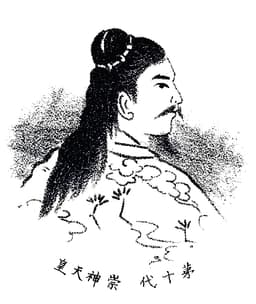
Emperor Sujin
Emperor · Ancient
51.6Total

Moctezuma I
Emperor · Medieval
58.9Total
Basic Information
Born
-148
1398
Died
-30
1469
Era
Ancient
Medieval
Nationality
Japan
Aztec Empire
Occupation
Emperor
Emperor
Civilization
Eastern
Other
Score Comparison
Military (10%)
50.0
82.0
Political (20%)
68.0
45.0
Influence (20%)
47.1
58.3
Legacy (20%)
43.3
56.0
Leadership (15%)
72.0
66.0
Strategy (15%)
30.3
55.0
TOTAL
51.6
58.9
Emperor Sujin — Complete Timeline
100 BC
Organized the Yamato StateReform◆ Major
Emperor Sujin is recorded in the Nihon Shoki as having organized the Yamato state, establishing administrative structures and military garrisons. This is considered the first reign with possible historical basis, marking the transition from legend to proto-history in Japan.
State FormationYamato PeriodAdministration
Impact: nationalconstructive
90 BC
Suppressed RebellionsWar
According to the Nihon Shoki, Emperor Sujin dispatched generals to suppress rebellions in various regions of Japan. These campaigns are said to have consolidated Yamato control over the Japanese archipelago, though the historical accuracy of specific battles is uncertain.
Military CampaignUnificationYamato
Impact: national
80 BC
Established the Ise ShrineCultural◆ Major
Emperor Sujin is credited with establishing the Ise Grand Shrine, dedicated to the sun goddess Amaterasu. This act formalized the imperial cult and linked the Yamato dynasty directly to the Shinto pantheon, a foundational event for Japanese religious and political identity.
ShintoImperial CultReligion
Impact: nationalconstructive
Moctezuma I — Complete Timeline
1428 AD
Conquest of the TepanecsWar◆ Major
Itzcoatl led the Triple Alliance forces in a war against the Tepanecs of Azcapotzalco, the dominant power in the region. The victory broke Tepanec hegemony and established Tenochtitlan as the leading city-state in central Mexico.
WarTepanec WarAztec Expansion
Impact: regional
Formed the Triple AlliancePolitical Action
Itzcoatl, as tlatoani of Tenochtitlan, formed the Triple Alliance with Texcoco and Tlacopan. This military and political pact created the Aztec Empire, enabling coordinated conquests and the subjugation of neighboring city-states in the Valley of Mexico.
Aztec EmpireAlliancePolitical Foundation
Impact: regional
1430 AD
Burned Historical CodicesCultural◆ Major
Itzcoatl ordered the burning of historical codices from conquered peoples, rewriting Aztec history to legitimize his rule and the empire's divine origins. This act destroyed pre-Aztec records and reshaped Mesoamerican historical memory.
Cultural DestructionHistorical RevisionAztec Ideology
Impact: regionaldestructive
Expert Analysis
Emperor Sujin vs Moctezuma I
### The Emperor and the Reformer: Moctezuma I and Emperor Sujin
In the highlands of central Mexico, a young prince watched as his uncle, Itzcoatl, led a coalition of city-states into battle against the Tepanecs of Azcapotzalco. The year was 1428, and the air was thick with the smoke of burning temples and the cries of warriors. Across the Pacific, on the island chain of Japan, a figure shrouded in myth, Emperor Sujin, was said to have dispatched generals to quell rebellions in a land still emerging from the prehistoric haze. One man’s story is etched in stone, blood, and the bones of conquered cities. The other’s is whispered in ancient chronicles, a blend of legend and the faintest echo of statecraft. What drives a ruler to build an empire through conquest, and another to organize a state through ritual and reform? The answers lie in the starkly different worlds of Moctezuma I and Emperor Sujin.
**Origins**
Moctezuma I, born in 1398, was a prince of the Aztec city-state of Tenochtitlan, a rising power in the Valley of Mexico. His world was one of constant warfare, where gods demanded human hearts and political survival depended on military might. He was a product of a culture that measured glory in tribute and territory. His uncle, Itzcoatl, was the architect of the Triple Alliance, a military pact formed in 1428 with Texcoco and Tlacopan that shattered the old Tepanec order. Moctezuma learned warfare and politics at his uncle’s side, inheriting a machine built for expansion.
Emperor Sujin, whose traditional dates place him between 148 BCE and 30 BCE, inhabited a Japan that was still coalescing. The *Nihon Shoki*, the 8th-century chronicle that records his reign, presents him as the tenth emperor, the first whose existence might be grounded in historical fact. His Japan was a patchwork of clans, bound by loose allegiance to the Yamato court. There were no great empires to conquer, only a need to impose order on a fragmented land. His upbringing is a blank, but his actions suggest a ruler focused on internal consolidation, not external glory.
**Rise to Power**
Moctezuma’s path to power was paved with blood. As a prince, he fought alongside Itzcoatl in the war against the Tepanecs. He witnessed the burning of historical codices in 1430, a deliberate act by Itzcoatl to rewrite history and legitimize Aztec dominance. When Itzcoatl died in 1440, Moctezuma was chosen as tlatoani—the speaker—of Tenochtitlan. His rise was not a peaceful inheritance but a continuation of a violent, political ascent.
Emperor Sujin’s rise is far more enigmatic. According to the *Nihon Shoki*, he ascended the throne after a period of turmoil, possibly following a plague or a succession crisis. His authority was not based on conquest but on his role as a sacred figure, a descendant of the sun goddess Amaterasu. He did not fight his way to power; he inherited a mantle of religious and symbolic authority.
**Leadership & Governance**
Moctezuma I was a warrior-emperor. He expanded the Aztec Empire through relentless military campaigns, pushing its borders to the Gulf of Mexico and the Pacific. His military genius, though scored a modest 73.2, was practical and brutal. He did not just conquer; he extracted tribute—gold, cacao, cotton, and captives for sacrifice. His political wisdom, scored 85.7, was evident in how he maintained the Triple Alliance, balancing the interests of Tenochtitlan, Texcoco, and Tlacopan. He was a reformer of a kind, but his reforms were about centralizing power and tribute collection, not building a bureaucratic state.
Emperor Sujin’s leadership, scored an extraordinary 86.6, was of a different kind. He is credited with organizing the Yamato state, establishing administrative structures that would last for centuries. He did not lead armies into battle; he dispatched generals to suppress rebellions, as recorded in the *Nihon Shoki* around 90 BCE. His most lasting act was the establishment of the Ise Grand Shrine around 80 BCE, dedicated to Amaterasu. This was not a military conquest but a cultural and religious foundation that unified the clans under a common divine ancestor. His political score of 69.4 reflects a ruler who built not an empire, but a state.
**Triumph & Tragedy**
Moctezuma’s greatest triumph was the consolidation of the Aztec Empire. He turned a coalition of city-states into a tribute-collecting machine. His tragedy was that he laid the groundwork for the empire’s ultimate destruction. The very system of conquest and tribute he perfected created enemies who would later ally with the Spanish. He died in 1469, unaware of the doom that was coming.
Emperor Sujin’s triumph was the creation of a stable state. His tragedy is that we know so little of him. His legacy is a shadow, a name in a chronicle, a shrine that still stands. He did not fail; he simply faded into the mists of legend.
**Character & Destiny**
Moctezuma was a man of his time: ruthless, ambitious, and devout in his worship of the gods. His character was forged in a crucible of constant war. His destiny was to build an empire that would be destroyed by forces he could not imagine.
Emperor Sujin was a figure of order and ritual. His character, as far as we can guess, was that of a consolidator, a builder of institutions. His destiny was to create a foundation for a civilization that would endure for over two thousand years.
**Legacy**
Moctezuma I is remembered as the great expander of the Aztec Empire, a name carved into the history of a lost civilization. His legacy is one of conquest and tribute, but also of a system that was unsustainable. Emperor Sujin is remembered as the first historical emperor of Japan, the organizer of the Yamato state, and the founder of the Ise Shrine. His legacy is one of endurance, of a state that would evolve into the Japan we know today.
**Conclusion**
One built an empire of blood and gold; the other built a state of ritual and order. Moctezuma I’s story is a warning about the limits of power built on conquest. Emperor Sujin’s story is a testament to the power of institutions and symbols. In the end, both were products of their worlds—the Aztec emperor, a warrior in a universe of war; the Japanese emperor, a priest-king in a land of clans. Their differences are not just about personal character but about the very nature of the civilizations they led. And in that difference, we see the vast, varied tapestry of human leadership.
Rankings
🥇
Moctezuma ILeader
Mil: 82.0Pol: 45.0Inf: 58.3
58.9
🥈
Emperor Sujin
Mil: 50.0Pol: 68.0Inf: 47.1
51.6
+7.3 behind
How This Comparison Works
Algorithm
Each figure is scored on 6 dimensions (0—100 scale) based on structured historical data: Military (10%), Political (20%), Influence (20%), Legacy (20%), Leadership (15%), Strategy (15%). The weighted total produces the final ranking.
Data Sources
Scores are computed from structured sub-indicators in the database. Scale factors adjust for era (Ancient ×0.85, Modern ×1.0) and civilization size (Eastern ×1.05, Other ×0.80) to account for differences in population and military scale.
Maximum 3 Figures
Comparisons are limited to 2—3 figures to ensure readability and statistical meaningfulness.
Error Margins
±5 points per dimension — Sub-scores are derived from historical records with inherent uncertainty. Two figures within 5 points on a dimension should be considered roughly equivalent in that area.
Total Score Accuracy
±3 points overall — The weighted combination of 6 dimensions produces a total score with approximately ±3 points of uncertainty. Differences of less than 3 points are not statistically significant— the figures are effectively tied.
Known Limitations
- Historical records are incomplete and uneven across civilizations
- Figures from oral-tradition societies may be underrepresented
- Occupation labels can misclassify multi-role figures
- Scores measure capability and impact, not moral character
- Quantitative scoring is a comparison tool, not absolute truth
Capability Radar
Military (10%) — Battles & Warfare
Battles
10
65
Win Rate
10
70
Expansion
20
80
Political (20%) — Governance & Reform
Reform
50
60
Diplomacy
30
65
Economy
30
70
Influence (20%) — Cultural & Global Reach
Cultural
30
60
Global
10
50
Legacy (20%) — Historical Impact
Historical
40
65
Longevity
30
55
Leadership (15%) — Power & Stability
Tenure
40
70
Stability
40
65
Strategy (15%) — Tactics & Innovation
Strategy
10
75
Tactics
10
60
Reform
20
55
Similar Comparisons
Comments & Discussion
EmperorSkeptic6/16/2026
Let's be real: comparing Sujin to Moctezuma I is like comparing a campfire story to a history textbook. Sujin is so wrapped in myth that we can't even confirm he existed beyond a name in the Nihon Shoki. Moctezuma, by contrast, has codices, tribute records, and the conquest of over 33 cities. One is the foundation of a nation; the other is the blueprint for an empire. Give me the guy who left bones and stone, not whispers.
神武不太神6/16/2026
说真的,拿崇神天皇和蒙特祖玛一世比,就像拿童话书对比军事档案。崇神的存在全靠《日本书纪》里的几段传说撑场面,连考古证据都模棱两可。而蒙特祖玛一世留下了实实在在的贡赋清单和33座被征服城市的记录。一个靠神话说大话,一个靠铁血留真迹,这还用选?我站墨西哥那位实干家。