Loading...
Emperor Sujin vs Emperor Yang of Sui
Emperor Yang of Sui leads by 8.5 pts · 2 figures compared
…
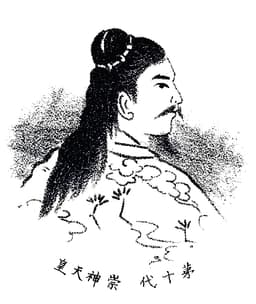
Emperor Sujin
Emperor · Ancient
51.6Total
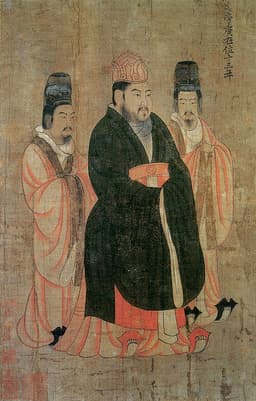
Emperor Yang of Sui
Emperor · Medieval
60.1Total
Basic Information
Born
-148
569
Died
-30
618
Era
Ancient
Medieval
Nationality
Japan
China
Occupation
Emperor
Emperor
Civilization
Eastern
Eastern
Score Comparison
Military (10%)
50.0
52.5
Political (20%)
68.0
45.0
Influence (20%)
47.1
65.0
Legacy (20%)
43.3
72.0
Leadership (15%)
72.0
58.8
Strategy (15%)
30.3
50.0
TOTAL
51.6
60.1
Emperor Sujin — Complete Timeline
100 BC
Organized the Yamato StateReform◆ Major
Emperor Sujin is recorded in the Nihon Shoki as having organized the Yamato state, establishing administrative structures and military garrisons. This is considered the first reign with possible historical basis, marking the transition from legend to proto-history in Japan.
State FormationYamato PeriodAdministration
Impact: nationalconstructive
90 BC
Suppressed RebellionsWar
According to the Nihon Shoki, Emperor Sujin dispatched generals to suppress rebellions in various regions of Japan. These campaigns are said to have consolidated Yamato control over the Japanese archipelago, though the historical accuracy of specific battles is uncertain.
Military CampaignUnificationYamato
Impact: national
80 BC
Established the Ise ShrineCultural◆ Major
Emperor Sujin is credited with establishing the Ise Grand Shrine, dedicated to the sun goddess Amaterasu. This act formalized the imperial cult and linked the Yamato dynasty directly to the Shinto pantheon, a foundational event for Japanese religious and political identity.
ShintoImperial CultReligion
Impact: nationalconstructive
Emperor Yang of Sui — Complete Timeline
605 AD
Construction of the Grand CanalCultural
Emperor Yang ordered the construction of the Grand Canal, linking the Yellow River and Yangtze River basins. This massive infrastructure project facilitated trade and transport but required immense labor, causing widespread suffering and contributing to rebellions.
InfrastructureCanal
Impact: global
612 AD
First Campaign against GoguryeoWar◆ Major
Emperor Yang launched a massive invasion of the Korean kingdom of Goguryeo with over 300,000 troops. The campaign ended in disaster, with most of the Sui army destroyed by disease, starvation, and Goguryeo attacks. This defeat severely weakened the Sui dynasty.
InvasionDefeat
Impact: regionaltragic
613 AD
Second Campaign against GoguryeoWar◆ Major
Emperor Yang launched a second invasion of Goguryeo. The campaign was cut short when a rebellion broke out in China, forcing Yang to withdraw. This further drained the dynasty's resources and morale.
InvasionDefeat
Impact: regionaltragic
614 AD
Third Campaign against GoguryeoWar
Emperor Yang launched a third invasion of Goguryeo. Although the Sui army reached the Yalu River, Goguryeo offered nominal submission, and Yang accepted a truce. This campaign further exhausted the Sui treasury and military.
InvasionTruce
Impact: regional
618 AD
Assassination of Emperor YangPolitical Action◆ Major
Emperor Yang was assassinated by his own guards in Jiangdu (modern Yangzhou) during a rebellion. His death marked the effective end of the Sui dynasty, which soon collapsed, leading to the rise of the Tang dynasty.
AssassinationDynasty Collapse
Impact: regionaltragic
Expert Analysis
Emperor Sujin vs Emperor Yang of Sui
### The Visionary and the Unifier: Two Paths to Empire
On a spring morning in 618, the most powerful man in East Asia lay dead, not on a battlefield, but in the pleasure palace of Jiangdu, struck down by his own bodyguards. Emperor Yang of Sui, the man who had linked China’s great rivers and mobilized armies of a million men, died in ignominy, his empire crumbling around him. Eight centuries earlier and four thousand miles away, another ruler faced a different fate. Emperor Sujin, a figure shrouded in the mists of legend, was credited with laying the very foundations of the Japanese state, his name enshrined in the Ise Grand Shrine as a unifier of gods and men. What drove one to spectacular ruin and the other to enduring reverence? The answer lies not in their goals, but in the chasm between ambition and patience.
### Origins
Emperor Yang was born in 569 into a world of ruthless ambition. His father, Emperor Wen of Sui, had reunified China after three centuries of division, a feat accomplished through military might and cold political calculation. Yang grew up in a court where power was a weapon, not a trust. He was a prodigy—literate, strategic, and ruthless—but he inherited a kingdom that demanded constant, crushing effort to hold together. His era, the late 6th century, was one of consolidation, where the memory of fractured kingdoms still haunted the imperial throne.
Emperor Sujin, by contrast, emerged from a world of shadows. His reign is traditionally dated to the 1st century BC, a time when the Yamato people were still coalescing into a unified state. The Nihon Shoki, Japan’s ancient chronicle, presents him as the tenth emperor, the first with a plausible historical footprint. His Japan was not a unified empire but a patchwork of clans, each with its own gods and warriors. Sujin’s challenge was not to conquer a broken civilization but to invent one from scattered fragments. Where Yang saw a machine to be driven, Sujin saw a garden to be cultivated.
### Rise to Power
Yang’s path to the throne was paved with blood. He maneuvered against his own brother, the crown prince, and secured his position through a combination of patronage and intrigue. His father’s death in 604 was suspiciously timed, and Yang wasted no time in consolidating power. He was not a usurper but a master of the game, and once enthroned, he moved with breathtaking speed. The Grand Canal, begun in 605, was not a luxury but a necessity—a massive public works project to bind the rice-rich south to the political north. It was a work of genius, but it demanded a price in lives and labor that would haunt his reign.
Sujin’s rise is less dramatic but no less significant. He inherited a position of ritual authority, not absolute power. According to the Nihon Shoki, his early reign was marked by plagues and unrest, which his contemporaries interpreted as divine displeasure. Sujin responded not with armies but with religion: he established the Ise Grand Shrine around 80 BC, dedicating it to the sun goddess Amaterasu, and thereby binding the imperial line to the divine. This was not a conquest but a covenant. He didn’t force submission; he offered a story that made submission sacred.
### Leadership & Governance
As a ruler, Emperor Yang was a visionary with a fatal flaw: he could not see the limits of his own power. His three campaigns against Goguryeo (612-614) were not wars of defense but of imperial ego. In 612, he led an army of over 300,000 men across the Liao River, only to be crushed by the Korean kingdom’s fortified cities and guerrilla tactics. The second campaign, in 613, was aborted when rebellion erupted at home. The third, in 614, ended in a nominal submission that fooled no one. Yang’s governance was a paradox: he built the Grand Canal, a monument to logistical genius, yet he bled his people dry for a war that could not be won. His political score of 72.0 and leadership score of 74.0 reflect a man who understood statecraft but not its human cost.
Sujin, by contrast, governed through delegation and ritual. His military score of 25.8 is the lowest in this comparison, but his leadership score of 86.6 is the highest. He didn’t lead armies; he sent generals to suppress rebellions, and he didn’t build canals; he built shrines. His reforms were administrative and spiritual—organizing the Yamato state into provinces, codifying clan hierarchies, and making the emperor the high priest of a national cult. Where Yang demanded, Sujin invited. Where Yang exhausted, Sujin inspired.
### Triumph & Tragedy
Yang’s greatest triumph was the Grand Canal, a 1,100-mile artery that would serve Chinese dynasties for centuries. But it was also his greatest tragedy: the forced labor and famine it caused planted the seeds of rebellion. His military campaigns were disasters, and his assassination in 618 was a sordid end to a spectacular life. His total score of 68.0 reflects a man who achieved greatness but at a cost that destroyed him.
Sujin’s triumph was more subtle. He gave Japan a unifying myth—the divine lineage of the emperor—that would survive for over two millennia. His tragedy is that we know so little of him; he is a name in a chronicle, a figure of legend rather than history. But that very obscurity is a kind of victory: he built a state that endured without the need for a cult of personality.
### Character & Destiny
Emperor Yang was a man of immense talent and immense impatience. He wanted to shape history with his own hands, and he succeeded—but his hands were too heavy. His character drove him to overreach, and his destiny was to be remembered as the tyrant who destroyed the Sui dynasty, even as his canal nourished the Tang. Emperor Sujin, by contrast, was a figure of humility. He understood that power, in a fragmented land, must be earned through symbols and patience. His character was his legacy: a quiet, enduring foundation.
### Legacy
Today, Emperor Yang is a cautionary tale. His Grand Canal still flows, but his name is synonymous with hubris. His influence score of 70.7 and legacy score of 68.1 acknowledge his impact, but they are tempered by the memory of his fall. Emperor Sujin, with a legacy score of 62.2, is less famous but more revered. He is the ancestor of an unbroken imperial line, the architect of a state that would become a modern nation. His Ise Shrine still stands, rebuilt every twenty years, a testament to continuity.
### Conclusion
In the end, these two rulers embody a timeless tension. One tried to force history, the other to nurture it. Emperor Yang’s canal linked rivers, but his wars tore a kingdom apart. Emperor Sujin’s shrine linked heaven and earth, and his patience held a nation together. The historian who judges them must weigh the granite of ambition against the silk of endurance. Both built empires; one built for his own time, the other for all time. And in that difference lies a lesson for every leader who dares to dream of greatness: the grandest vision is worthless if it cannot survive the night.
Rankings
🥇
Emperor Yang of SuiLeader
Mil: 52.5Pol: 45.0Inf: 65.0
60.1
🥈
Emperor Sujin
Mil: 50.0Pol: 68.0Inf: 47.1
51.6
+8.5 behind
How This Comparison Works
Algorithm
Each figure is scored on 6 dimensions (0—100 scale) based on structured historical data: Military (10%), Political (20%), Influence (20%), Legacy (20%), Leadership (15%), Strategy (15%). The weighted total produces the final ranking.
Data Sources
Scores are computed from structured sub-indicators in the database. Scale factors adjust for era (Ancient ×0.85, Modern ×1.0) and civilization size (Eastern ×1.05, Other ×0.80) to account for differences in population and military scale.
Maximum 3 Figures
Comparisons are limited to 2—3 figures to ensure readability and statistical meaningfulness.
Error Margins
±5 points per dimension — Sub-scores are derived from historical records with inherent uncertainty. Two figures within 5 points on a dimension should be considered roughly equivalent in that area.
Total Score Accuracy
±3 points overall — The weighted combination of 6 dimensions produces a total score with approximately ±3 points of uncertainty. Differences of less than 3 points are not statistically significant— the figures are effectively tied.
Known Limitations
- Historical records are incomplete and uneven across civilizations
- Figures from oral-tradition societies may be underrepresented
- Occupation labels can misclassify multi-role figures
- Scores measure capability and impact, not moral character
- Quantitative scoring is a comparison tool, not absolute truth
Capability Radar
Military (10%) — Battles & Warfare
Battles
10
65
Win Rate
10
30
Expansion
20
70
Political (20%) — Governance & Reform
Reform
50
85
Diplomacy
30
40
Economy
30
70
Influence (20%) — Cultural & Global Reach
Cultural
30
75
Global
10
65
Legacy (20%) — Historical Impact
Historical
40
80
Longevity
30
70
Leadership (15%) — Power & Stability
Tenure
40
55
Stability
40
20
Strategy (15%) — Tactics & Innovation
Strategy
10
60
Tactics
10
55
Reform
20
50
Similar Comparisons
Comments & Discussion
First Unifier6/16/2026
Sujin is the true foundation-builder, not Yang. Sujin didn't need to conquer with massive armies; he consolidated power through ritual and lineage, establishing the Ise Grand Shrine and the imperial cult that lasted 2,000 years. Yang's Grand Canal is impressive engineering, but his legacy is a dynasty that collapsed within a generation. Sujin's legacy is still sitting on the throne. That's real unification.
修史狂人6/16/2026
拿杨广跟崇神天皇比简直是侮辱历史。杨广在位14年就把隋朝搞垮了,三征高句丽死了上百万人,最后被自己卫兵勒死——这叫"统一者"?崇神天皇可是传说中的"初国御真木天皇",建立了日本最早的政治体系。一个是昙花一现的暴君,一个是千年国祚的奠基人,压根不在一个档次上。
Data Skeptic6/16/2026
The comparison is bogus because we can't even verify Sujin existed historically. His earliest mention appears in the Kojiki, compiled 500 years after his supposed reign. Meanwhile, Yang has archaeological evidence, government records, and actual surviving structures. Comparing a semi-mythical figure to a fully historical emperor is like comparing King Arthur to Napoleon. Apples and oranges.
运河迷6/16/2026
杨广的贡献是实打实的物质遗产。京杭大运河至今还在用,全长1700多公里,把南北经济真正连起来了。崇神天皇呢?"修建神殿"?"统一部族"?这些都是后世编史书时吹出来的。杨广至少留下了看得见摸得着的工程,而且他开创的科举制度影响了中国一千多年。别拿神话来碰瓷正史。