Loading...
Emperor Pedro I of Brazil vs Napoleon Bonaparte
Napoleon Bonaparte leads by 15.4 pts · 2 figures compared
…
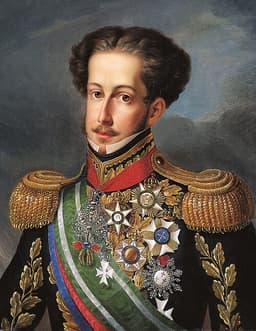
Emperor Pedro I of Brazil
Emperor · Modern
55.5Total

Napoleon Bonaparte
General · Modern
70.9Total
Basic Information
Born
1798
1769
Died
1834
1821
Era
Modern
Modern
Nationality
Brazil
France
Occupation
Emperor
General
Civilization
Western
Western
Score Comparison
Military (10%)
55.0
94.0
Political (20%)
62.7
72.0
Influence (20%)
59.0
40.0
Legacy (20%)
50.0
80.0
Leadership (15%)
65.0
78.0
Strategy (15%)
35.7
90.0
TOTAL
55.5
70.9
Emperor Pedro I of Brazil — Complete Timeline
1822 AD
Declaration of Brazilian IndependencePolitical Action
Dom Pedro declared Brazil's independence from Portugal on September 7, 1822, at the Ipiranga River. He was acclaimed Emperor Pedro I of Brazil, establishing a constitutional monarchy separate from Portugal.
IndependenceFounding
Impact: globalprogressive
Coronation as Emperor of BrazilPolitical Action◆ Major
Pedro I was crowned Emperor of Brazil on December 1, 1822, in Rio de Janeiro. The coronation formalized his rule over the newly independent nation, with a constitution promulgated in 1824.
CoronationMonarchy
Impact: national
1825 AD
Cisplatine WarWar◆ Major
Brazil went to war with the United Provinces of the R
WarTerritorial Loss
Impact: regionaldestructive
1831 AD
Abdication of the Brazilian ThronePolitical Action
Facing political crisis and military unrest, Pedro I abdicated the Brazilian throne on April 7, 1831, in favor of his five-year-old son Pedro II. He then returned to Portugal to claim the Portuguese throne.
AbdicationPolitical Crisis
Impact: nationaltragic
Napoleon Bonaparte — Complete Timeline
1799 AD
Coup of 18 BrumaireOther◆ Major
Napoleon Bonaparte, with support from his brother Lucien and key political figures, overthrew the Directory in a bloodless coup. He established the Consulate with himself as First Consul, effectively becoming the ruler of France. This event ended the French Revolution's most unstable period.
French RevolutionCoupRise to Power
Impact: regional
1804 AD
Promulgation of the Napoleonic CodeOther◆ Major
Napoleon enacted the Civil Code of the French, known as the Napoleonic Code, a comprehensive set of laws that replaced the fragmented feudal legal systems. The code established legal equality, protected property rights, and secularized law. It became the basis for legal systems in many European and world countries.
Legal ReformNapoleonic CodeCivil Law
Impact: globalconstructive
1805 AD
Battle of AusterlitzWar◆ Major
Napoleon's Grande Arm
Napoleonic WarsBattleDecisive Victory
Impact: global
1812 AD
Invasion of RussiaWar◆ Major
Napoleon led the Grande Arm
Napoleonic WarsInvasionDisaster
Impact: globaldestructive
1815 AD
Battle of WaterlooWar◆ Major
Napoleon's French army was defeated by the combined forces of the Duke of Wellington's Anglo-Allied army and Gebhard Leberecht von Bl
Napoleonic WarsBattleFinal Defeat
Impact: globaldestructive
Expert Analysis
emperor-pedro-i-of-brazil-vs-napoleon-bonaparte
### The Emperor and the Exile
On a sweltering September afternoon in 1822, a prince on horseback stood at the banks of the Ipiranga River in São Paulo. Surrounded by an honor guard, he tore the Portuguese blue-and-white cockade from his hat, drew his sword, and shouted a cry that would echo through the Americas: “Independence or death!” Half a world away, on a barren island in the South Atlantic, another man—once the master of Europe—paced the damp floors of a stone cottage, dictating his memoirs to a loyal companion. One was a young prince, Pedro de Alcântara, soon to be crowned Emperor of Brazil. The other was Napoleon Bonaparte, fallen emperor of the French, waiting for an end that would never come quickly enough. Their lives, separated by a generation, are bound by a single question: why did one build an empire that crumbled into legend, while the other built a nation that endured?
### Origins: The Corsican and the Royal
Napoleon was born in 1769 on the rugged island of Corsica, a land only recently annexed by France. His family was minor nobility, struggling and resentful. From the start, he was an outsider—a Corsican in a French world, short of stature and quick of temper. The French Revolution, which erupted when he was twenty, shattered the old order and opened a path for talent over birth. Napoleon seized it with the ferocity of a man who had nothing to lose.
Pedro I, by contrast, was born into the very heart of monarchy. His father was Prince Regent João of Portugal, and in 1807, when Napoleon’s armies invaded Portugal, the entire Braganza court fled to Brazil—a flight that turned Rio de Janeiro into the capital of the Portuguese Empire. Young Pedro grew up not in a palace of powdered wigs and ancient protocol, but in a tropical court where the scent of coffee and sugarcane mingled with the smoke of gunpowder. He was a prince, but a prince in exile, raised in a land that would one day need him to choose between his father’s kingdom and his people’s freedom.
### Rise to Power: The Artilleryman and the Heir
Napoleon’s ascent was a masterpiece of will. By 1793, at just twenty-four, he was a captain of artillery who crushed a royalist uprising in Toulon—a feat that earned him a general’s star at twenty-four. He then swept through Italy, humiliating the Austrians, and later led a doomed but dazzling campaign in Egypt. In 1799, he returned to a France mired in corruption and chaos, and in a coup d’état, he made himself First Consul. By 1804, he crowned himself Emperor, placing the crown on his own head in a gesture of supreme self-belief.
Pedro’s path was quieter but no less decisive. In 1821, his father King João VI returned to Portugal, leaving Pedro as regent of Brazil. Portuguese courts demanded that the prince return to Lisbon, effectively demoting Brazil to a colony again. The Brazilian elite, fearing a return to subjugation, urged Pedro to stay. On January 9, 1822, he famously declared, “I will stay”—the *Dia do Fico*. Eight months later came the cry at Ipiranga. He was not a general who conquered his way to a throne; he was a prince who chose a nation over a dynasty.
### Leadership & Governance: Code and Crown
Napoleon’s genius was in organization. He reformed French law into the Napoleonic Code, which enshrined equality before the law, property rights, and secular administration. He built roads, standardized education, and created a centralized state that outlasted his reign. But his rule was also a military dictatorship. He suppressed dissent, censored the press, and placed his brothers on thrones across Europe. His governance was a paradox: a liberator who brought modern reforms, and a tyrant who crushed the liberty of others.
Pedro I had neither the time nor the temperament for such deep reform. His Brazil was a sprawling, slave-owning empire, held together by regional elites and the threat of force. He drafted a constitution in 1824 that established a constitutional monarchy, but it was a fragile compromise. He fought the Cisplatine War (1825–1828) against Argentina over control of Uruguay—a costly, inconclusive conflict that drained Brazil’s treasury and his own popularity. Where Napoleon commanded armies of hundreds of thousands, Pedro struggled to hold together a fractious cabinet. His political score of 60.2 reflects a leader who could declare independence but could not govern a nation in peace.
### Triumph & Tragedy: Waterloo and the Abdication
Napoleon’s greatest moment was Austerlitz in 1805, where he crushed the combined armies of Russia and Austria in a single day of tactical brilliance. His worst was Waterloo in 1815, where a combination of Prussian reinforcements and his own misjudgments ended his hundred-day return. He died in exile on Saint Helena in 1821, a prisoner of the British.
Pedro’s triumph was September 7, 1822—a single cry that created a nation. His tragedy came nine years later. By 1831, Brazil was in chaos: the Cisplatine War had failed, his ministers were corrupt, and his affair with the Marchioness of Santos had scandalized the court. On April 7, 1831, facing military revolt, he abdicated the throne in favor of his five-year-old son, Pedro II. He sailed back to Portugal, where he died of tuberculosis in 1834 at just thirty-five. He had been emperor of two nations, but master of none.
### Character & Destiny: Ambition and Impulse
Napoleon was a man of iron will and cold calculation. He once said, “Impossible is a word to be found only in the dictionary of fools.” He believed he was destiny’s instrument, and his ambition was as vast as his ego. That ambition drove him to conquer Europe—and to overreach, invading Russia in 1812, where his Grand Army was destroyed by winter and attrition.
Pedro was impulsive, romantic, and mercurial. He was a man who could weep at the opera and rage at his ministers. He loved Brazil, but he was not a builder of institutions. His abdication was not a defeat—it was a surrender. He lacked Napoleon’s ruthless patience. Pedro’s leadership score of 75.2 suggests a man who could inspire loyalty but could not sustain it through crisis. Napoleon, with his 80.0 leadership score, could command armies, but his inability to share power led to his downfall.
### Legacy: Legend and Nation
Napoleon left a legend. His name is synonymous with military genius, ambition, and the reshaping of Europe. The Napoleonic Code influenced legal systems from Latin America to Japan. He is remembered as a titan, a figure of both awe and caution.
Pedro I left a nation. Brazil did not fracture into warring republics like Spanish America; it remained a unified empire for nearly seventy years, thanks in large part to his son, Pedro II, who ruled for half a century. Pedro I is remembered as the “Liberator,” but his legacy is more subtle: he gave Brazil its independence, but he could not give it stability. His influence score of 72.3 and legacy of 70.0 reflect a founder, not a builder.
### Conclusion: The Cry and the Silence
Standing at the Ipiranga River, Pedro I shouted for independence. Napoleon, on Saint Helena, whispered only to his memoirs. One man’s cry created a country; the other’s silence left a legend. The difference between them is not in talent, but in timing and temperament. Napoleon was a comet—blazing, brilliant, and brief. Pedro was a bridge—unsteady, fragile, but crucial. Both were exiles in the end. But one exile built a world that remembered him; the other built a world that outgrew him. In the final accounting, Napoleon conquered Europe, but Pedro I gave Brazil to itself.
Rankings
🥇
Napoleon BonaparteLeader
Mil: 94.0Pol: 72.0Inf: 40.0
70.9
🥈
Emperor Pedro I of Brazil
Mil: 55.0Pol: 62.7Inf: 59.0
55.5
+15.4 behind
How This Comparison Works
Algorithm
Each figure is scored on 6 dimensions (0—100 scale) based on structured historical data: Military (10%), Political (20%), Influence (20%), Legacy (20%), Leadership (15%), Strategy (15%). The weighted total produces the final ranking.
Data Sources
Scores are computed from structured sub-indicators in the database. Scale factors adjust for era (Ancient ×0.85, Modern ×1.0) and civilization size (Eastern ×1.05, Other ×0.80) to account for differences in population and military scale.
Maximum 3 Figures
Comparisons are limited to 2—3 figures to ensure readability and statistical meaningfulness.
Error Margins
±5 points per dimension — Sub-scores are derived from historical records with inherent uncertainty. Two figures within 5 points on a dimension should be considered roughly equivalent in that area.
Total Score Accuracy
±3 points overall — The weighted combination of 6 dimensions produces a total score with approximately ±3 points of uncertainty. Differences of less than 3 points are not statistically significant— the figures are effectively tied.
Known Limitations
- Historical records are incomplete and uneven across civilizations
- Figures from oral-tradition societies may be underrepresented
- Occupation labels can misclassify multi-role figures
- Scores measure capability and impact, not moral character
- Quantitative scoring is a comparison tool, not absolute truth
Capability Radar
Military (10%) — Battles & Warfare
Battles
25
95
Win Rate
30
90
Expansion
35
95
Political (20%) — Governance & Reform
Reform
50
95
Diplomacy
45
80
Economy
30
85
Influence (20%) — Cultural & Global Reach
Cultural
45
85
Global
40
90
Legacy (20%) — Historical Impact
Historical
55
95
Longevity
50
90
Leadership (15%) — Power & Stability
Tenure
40
85
Stability
20
70
Strategy (15%) — Tactics & Innovation
Strategy
25
95
Tactics
20
98
Reform
15
92
Similar Comparisons
Comments & Discussion
Emperor's Last March6/17/2026
Pedro I didn't even command a single major land battle personally, unlike Napoleon who led from the front at Austerlitz and Borodino. Pedro's "military" success was basically a diplomatic handshake with British-backed Portuguese forces. He relied on his son's regent later while Napoleon fought through six coalitions. Call Pedro a "Liberator Emperor" but he's a Napoleon Lite at best—decorative cavalry charges in Rio don't match Napoleonic warfare.
数据侦探6/17/2026
把佩德罗一世和拿破仑比?拿破仑统治期间法国人口约2800万,军队曾达60万;而巴西当时人口才500万左右,佩德罗的军队连3万都不到。一个靠个人野心崛起,一个靠继承王位。数据不会撒谎:拿破仑的帝国横跨欧洲,佩德罗的"帝国"差点在自己手里分裂。根本不是一个量级。
Reformist Critic6/17/2026
Everyone romanticizes Pedro's 7 September cry but ignores his botched Constituent Assembly dissolution in 1823. Napoleon centralized France through the Napoleonic Code and Bank of France—institutional legacies. Pedro's Brazil had no lasting legal code from him; he wrote a constitution but then tore it up. One built systems; the other just shouted at a river. Give me the Corsican's bureaucracy over the Brazilian's bravado any day.
古典学究6/17/2026
从古典政治哲学看,拿破仑是马基雅维利式的"新君主",靠武力和谋略夺取权力;佩德罗一世则更像柏拉图理想中的"哲人王"——生于王权却选择解放。但有趣的是,拿破仑失败的滑铁卢(1815)与佩德罗成功的独立(1822)相差仅七年。拿破仑让欧洲颤抖,佩德罗让美洲沉默地走向未来。一个史诗悲剧,一个现实主义喜剧。
Coffee Rebel6/17/2026
Pedro I abdicated in 1831 over a local scandal involving his mistress and a Portuguese minister, leaving his 5-year-old son to rule. Napoleon died in exile plotting comebacks. Pedro's legacy is basically "gave Brazil a start then quit" while Napoleon's is "gave Europe a system then lost it all." I'd rather have the Little Corporal's hubris than a monarch who couldn't handle a domestic drama.