Loading...
Emperor Pedro I of Brazil vs Julius Caesar
Julius Caesar leads by 27.3 pts · 2 figures compared
…
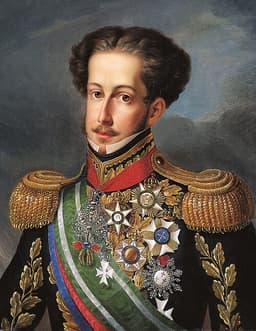
Emperor Pedro I of Brazil
Emperor · Modern
55.5Total

Julius Caesar
General · Ancient
82.8Total
Basic Information
Born
1798
-100
Died
1834
-44
Era
Modern
Ancient
Nationality
Brazil
Roman Republic
Occupation
Emperor
General
Civilization
Western
Western
Score Comparison
Military (10%)
55.0
88.0
Political (20%)
62.7
78.0
Influence (20%)
59.0
85.0
Legacy (20%)
50.0
82.0
Leadership (15%)
65.0
80.0
Strategy (15%)
35.7
85.0
TOTAL
55.5
82.8
Emperor Pedro I of Brazil — Complete Timeline
1822 AD
Declaration of Brazilian IndependencePolitical Action
Dom Pedro declared Brazil's independence from Portugal on September 7, 1822, at the Ipiranga River. He was acclaimed Emperor Pedro I of Brazil, establishing a constitutional monarchy separate from Portugal.
IndependenceFounding
Impact: globalprogressive
Coronation as Emperor of BrazilPolitical Action◆ Major
Pedro I was crowned Emperor of Brazil on December 1, 1822, in Rio de Janeiro. The coronation formalized his rule over the newly independent nation, with a constitution promulgated in 1824.
CoronationMonarchy
Impact: national
1825 AD
Cisplatine WarWar◆ Major
Brazil went to war with the United Provinces of the R
WarTerritorial Loss
Impact: regionaldestructive
1831 AD
Abdication of the Brazilian ThronePolitical Action
Facing political crisis and military unrest, Pedro I abdicated the Brazilian throne on April 7, 1831, in favor of his five-year-old son Pedro II. He then returned to Portugal to claim the Portuguese throne.
AbdicationPolitical Crisis
Impact: nationaltragic
Julius Caesar — Complete Timeline
58 BC
Gallic WarsWar◆ Major
Caesar, as proconsul of Gaul, launched a series of campaigns that conquered all of Gaul (modern France, Belgium, and parts of Switzerland). He fought numerous battles, including against the Helvetii, the Belgae, and the Gallic chieftain Vercingetorix. The wars brought immense wealth and a loyal army to Caesar.
Gallic WarsConquestRoman Expansion
Impact: regional
49 BC
Crossing the RubiconPolitical Action◆ Major
Caesar led Legio XIII across the Rubicon River into Italy, defying the Roman Senate's order to disband his army. This act triggered a civil war against Pompey and the Optimates, ultimately leading to Caesar's dictatorship and the end of the Roman Republic.
Roman Civil WarEnd of RepublicPower Struggle
Impact: global
48 BC
Battle of PharsalusWar◆ Major
Caesar's outnumbered army defeated the larger forces of Pompey the Great at Pharsalus in Greece. Caesar's tactical use of a reserve line to counter Pompey's cavalry charge proved decisive. Pompey fled to Egypt, where he was assassinated, leaving Caesar as the undisputed master of the Roman world.
Roman Civil WarBattleDecisive Victory
Impact: regional
44 BC
Appointment as Dictator for LifePolitical Action◆ Major
The Roman Senate appointed Caesar dictator perpetuo (dictator for life), granting him unprecedented personal power. This move concentrated military, legislative, and judicial authority in one person, effectively ending the Roman Republic's traditional system of checks and balances and alarming many senators.
DictatorshipEnd of RepublicPower Consolidation
Impact: regionaldestructive
Assassination on the Ides of MarchPolitical Action◆ Major
A group of Roman senators, led by Marcus Junius Brutus and Gaius Cassius Longinus, stabbed Caesar to death at a meeting of the Senate in the Theatre of Pompey. The assassination was intended to restore the Republic, but instead triggered another civil war that led to the rise of the Roman Empire.
AssassinationRoman PoliticsEnd of Republic
Impact: globaldestructive
Expert Analysis
emperor-pedro-i-of-brazil-vs-julius-caesar
# The Eagle and the Emperor
On a September morning in 1822, a young prince stood at the banks of the Ipiranga River in São Paulo, tore the Portuguese insignia from his uniform, and shouted, “Independência ou Morte!” It was a moment of theatrical courage that would define a nation. Eighteen centuries earlier, another man had stood at the Rubicon River in northern Italy, paused, and then crossed with his army, uttering, “The die is cast.” One created an empire from a colony; the other destroyed a republic to build one. Both were men of ambition, born to lead, yet their paths diverged into radically different destinies. Why did Julius Caesar, a general of the ancient world, leave a legacy that still shapes Western civilization, while Pedro I of Brazil, a modern emperor, faded into a footnote of history? The answer lies not in their eras alone, but in the nature of their power, their wars, and their souls.
Origins
Julius Caesar was born into a patrician family in 100 BCE, a time when the Roman Republic was already cracking under the weight of its own conquests. His uncle Marius had been a populist reformer; his father died when Caesar was sixteen. The young Roman grew up in a world of civil strife, debt, and political vendettas—a forge that tempered his cunning. He learned early that survival meant mastering both the sword and the senate.
Pedro I was born in 1798 in the Queluz Palace near Lisbon, the son of King John VI of Portugal and Carlota Joaquina of Spain. His childhood was one of royal privilege but also chaos: the Napoleonic Wars forced the Portuguese court to flee to Brazil in 1807, making Rio de Janeiro the capital of the Portuguese Empire. Pedro grew up in a tropical Versailles, surrounded by courtiers, slaves, and the simmering tensions between European colonizers and American colonists. Unlike Caesar, who had to claw his way upward, Pedro was handed a crown—but it was a crown that sat uneasily on a young man’s head.
Rise to Power
Caesar’s ascent was a masterclass in patience and audacity. He climbed the Roman political ladder step by step: military tribune, quaestor, aedile, praetor, and finally consul in 59 BCE. Along the way, he forged the First Triumvirate with Pompey and Crassus, bought influence with borrowed money, and won a command in Gaul. The Gallic Wars (58–50 BCE) were his true launching pad. He conquered a vast territory, built a loyal army, and wrote his own propaganda—the *Commentaries*—to shape his image for Rome.
Pedro’s rise was swifter and more accidental. When his father returned to Portugal in 1821, leaving Pedro as regent in Brazil, the Brazilian elites pressured him to stay. On January 9, 1822, he famously declared, “I will stay,” defying orders from Lisbon. Then came the Ipiranga River. Within months, he was crowned emperor. His path to power was less a conquest than a negotiation—a marriage of convenience between a prince and a colony seeking independence.
Leadership & Governance
Caesar governed as a revolutionary traditionalist. As dictator, he reformed the calendar (the Julian calendar), granted citizenship to provincials, redistributed land to veterans, and centralized the bureaucracy. But his military genius was his cornerstone: at Alesia (52 BCE), he besieged a Gallic army while simultaneously repelling a relief force, a feat of logistics and nerve. His strategy was aggressive, his tactics innovative, and his soldiers worshipped him. Yet his political wisdom was flawed. He pardoned enemies who would later kill him, and he alienated the Senate by accepting a lifetime dictatorship.
Pedro’s governance was a struggle against entropy. He wrote a liberal constitution for Brazil in 1824, establishing a parliamentary system, but he also maintained the institution of slavery and faced constant rebellions. The Cisplatine War (1825–1828) against Argentina was a costly stalemate that drained Brazil’s treasury and his popularity. Unlike Caesar, who led his armies in person, Pedro remained in Rio while his generals fought. His military score of 32.8 reflects this distance: he was no battlefield commander. His political score of 60.2 shows a man who could inspire a nation’s birth but could not sustain its growth.
Triumph & Tragedy
Caesar’s greatest triumph was his conquest of Gaul, which added a province larger than Italy to the Roman world. His most devastating failure was his assassination on the Ides of March, 44 BCE. He died at the foot of a statue of Pompey, stabbed by senators he had pardoned. His tragedy was that he saw the Republic’s flaws but could not fix them without destroying it.
Pedro’s triumph was Brazil’s independence, a bloodless revolution compared to the wars in Spanish America. His tragedy came later. In 1826, he briefly became King Pedro IV of Portugal, but he abdicated within two months to focus on Brazil. The strain of ruling two empires, coupled with his authoritarian tendencies and a scandalous personal life, eroded his support. On April 7, 1831, facing military unrest and political crisis, he abdicated the Brazilian throne in favor of his five-year-old son, Pedro II. He sailed back to Europe, a monarch without a kingdom.
Character & Destiny
Caesar was a gambler who calculated every risk. He was charismatic, ruthless, and intellectually voracious—he wrote poetry, studied astronomy, and seduced the most powerful women in Rome. His personality drove him to seek absolute power, but it also blinded him to the hatred he inspired. His destiny was to die at the peak of his ambition, becoming a martyr for the empire he never saw.
Pedro was impulsive and passionate, a man of grand gestures but short attention spans. He loved music, women, and the spotlight, but he lacked the discipline to rule effectively. His character was shaped by his upbringing: a prince who never had to fight for his throne until he had to keep it. His destiny was to be a founder, not a builder—the man who lit the torch but could not carry it.
Legacy
Caesar’s legacy is immense. His name became a title—Kaiser, Tsar—and his reforms laid the foundation for the Roman Empire. He is remembered as a military genius, a writer, and a cautionary tale about ambition. His total score of 83.3 reflects his enduring influence.
Pedro I’s legacy is more modest. He is honored as Brazil’s liberator, but his reign is often seen as a prelude to his son’s more stable rule. His score of 64.0 captures a leader who achieved a great beginning but could not finish the work. In Brazil, he is a national symbol; in Portugal, a brief footnote.
Conclusion
What separates Caesar from Pedro is not time or talent, but the scale of their ambition and the depth of their commitment. Caesar remade the world because he was willing to destroy it first. Pedro inherited a world and tried to hold it together. One was a conqueror who became a legend; the other was a prince who became a memory. Both crossed their Rubicons—Caesar’s was a river in Italy, Pedro’s a river in Brazil. But only one understood that to change history, you must be willing to drown in it.
Rankings
🥇
Julius CaesarLeader
Mil: 88.0Pol: 78.0Inf: 85.0
82.8
🥈
Emperor Pedro I of Brazil
Mil: 55.0Pol: 62.7Inf: 59.0
55.5
+27.3 behind
How This Comparison Works
Algorithm
Each figure is scored on 6 dimensions (0—100 scale) based on structured historical data: Military (10%), Political (20%), Influence (20%), Legacy (20%), Leadership (15%), Strategy (15%). The weighted total produces the final ranking.
Data Sources
Scores are computed from structured sub-indicators in the database. Scale factors adjust for era (Ancient ×0.85, Modern ×1.0) and civilization size (Eastern ×1.05, Other ×0.80) to account for differences in population and military scale.
Maximum 3 Figures
Comparisons are limited to 2—3 figures to ensure readability and statistical meaningfulness.
Error Margins
±5 points per dimension — Sub-scores are derived from historical records with inherent uncertainty. Two figures within 5 points on a dimension should be considered roughly equivalent in that area.
Total Score Accuracy
±3 points overall — The weighted combination of 6 dimensions produces a total score with approximately ±3 points of uncertainty. Differences of less than 3 points are not statistically significant— the figures are effectively tied.
Known Limitations
- Historical records are incomplete and uneven across civilizations
- Figures from oral-tradition societies may be underrepresented
- Occupation labels can misclassify multi-role figures
- Scores measure capability and impact, not moral character
- Quantitative scoring is a comparison tool, not absolute truth
Capability Radar
Military (10%) — Battles & Warfare
Battles
25
95
Win Rate
30
92
Expansion
35
97
Political (20%) — Governance & Reform
Reform
50
90
Diplomacy
45
85
Economy
30
82
Influence (20%) — Cultural & Global Reach
Cultural
45
88
Global
40
94
Legacy (20%) — Historical Impact
Historical
55
95
Longevity
50
96
Leadership (15%) — Power & Stability
Tenure
40
75
Stability
20
60
Strategy (15%) — Tactics & Innovation
Strategy
25
94
Tactics
20
96
Reform
15
88
Similar Comparisons
Comments & Discussion
RubiconRambler6/17/2026
Caesar’s crossing of the Rubicon was a deliberate act of treason against a republic that still functioned—Pedro’s "Independência ou Morte" was just a slogan for a bloodless coup by the elite. One destroyed a functional system; the other founded a dysfunctional one. Don’t romanticize the emperor who bankrupted Brazil with pointless wars in Cisplatina while Caesar at least left Gaul as a province that paid for itself.
佩德罗之墓6/17/2026
说佩德罗一世是“现代版凯撒”?别开玩笑了。他统治巴西不到十年就仓促退位,把烂摊子丢给五岁的儿子;凯撒在4年内改组了整个罗马世界。事实是:佩德罗挥霍无度,光为1819年的葡萄牙公主婚礼就花了帝国半年预算,而凯撒即使被刺杀前还在规划道路和税改。论治国,前者就是个穿着皇帝新衣的浪子。
GaulishGaucho6/17/2026
I’ll take the general who actually won his empire. Caesar conquered Gaul in eight years with 60,000 men, defeating over two million tribesmen—figures from his own commentaries, sure, but archeology backs the scale. Pedro’s big military “triumph”? Putting down a few thousand rebels in Bahia with Portuguese troops he bribed. That’s not a Caesar; that’s a colonial cop with a crown.
数字拆解者6/17/2026
别迷信光辉叙事。凯撒的高卢战记自称屠杀百万敌人——现代学者估计实际数字不到一半。佩德罗的军事记录确实平庸,但他治国时推行了巴西第一部宪法,限制奴隶制扩展,而凯撒的“仁慈”只针对贵族,对高卢部落他搞种族灭绝。要选血腥还是进步?我站一个真正试图打破枷锁的人,哪怕他失败了。
ClassicistCritic6/17/2026
Caesar’s legacy endures because he wrote it himself. His *Commentarii* are a masterpiece of propaganda: third-person narration that turned civil war into epic. Pedro left no comparable text—just letters and a hastily composed anthem. Compare their deaths: Caesar’s assassination became a world-historical drama; Pedro died of tuberculosis in a Lisbon palace, aged 35, and Portugal printed his obituary on one page. Genius needs a scribe, not just a sword.