Loading...
Emperor Jimmu vs Gundobad
Gundobad leads by 1.8 pts · 2 figures compared
…
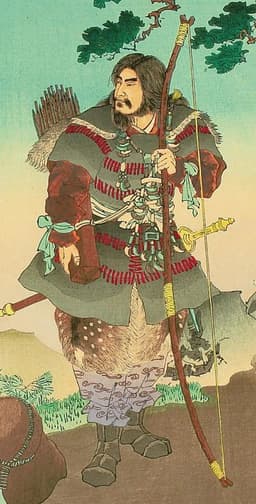
Emperor Jimmu
Emperor · Ancient
45.7Total

Gundobad
Emperor · Ancient
47.5Total
Basic Information
Born
-711
452
Died
-585
516
Era
Ancient
Ancient
Nationality
Japan
Burgundy
Occupation
Emperor
Emperor
Civilization
Eastern
Western
Score Comparison
Military (10%)
50.0
25.0
Political (20%)
27.9
62.7
Influence (20%)
54.9
51.8
Legacy (20%)
48.3
45.8
Leadership (15%)
45.0
40.0
Strategy (15%)
39.6
51.7
TOTAL
45.7
47.5
Emperor Jimmu — Complete Timeline
660 BC
The Eastern Expedition (Tōsei)War◆ Major
Jimmu led the Eastern Expedition from Hyuga (southern Kyushu) eastward, conquering territories through battles such as the Battle of Usa and the Battle of Takachiho. This campaign is described in the Nihon Shoki and Kojiki as the founding military conquest of Japan.
Military CampaignConquestMythology
Impact: national
Legendary founding of the Japanese imperial dynastyPolitical Action◆ Major
According to Japanese mythology, Emperor Jimmu became the first emperor of Japan in 660 BC after leading a military campaign from Kyushu to Yamato. He is said to have established the imperial dynasty at Kashihara, unifying the warring clans under his rule.
FoundingImperial DynastyMythology
Impact: national
Enthronement at KashiharaPolitical Action◆ Major
After his conquest, Jimmu was enthroned as emperor at the Kashihara Palace in Yamato (present-day Nara Prefecture) on the first day of the first month of 660 BC. This event is considered the traditional founding date of the Japanese imperial line.
EnthronementImperial LineMythology
Impact: national
Establishment of the Three Sacred TreasuresPolitical Action◆ Major
According to legend, Jimmu received the Three Sacred Treasures (the sword Kusanagi, the mirror Yata no Kagami, and the jewel Yasakani no Magatama) from the gods, which became the imperial regalia symbolizing the emperor's divine right to rule Japan.
Imperial RegaliaMythologySymbolism
Impact: national
585 BC
Death and deificationOther◆ Major
Emperor Jimmu died in 585 BC at the age of 126 according to traditional accounts. He was later deified as a kami (spirit) in Shinto, and his tomb is traditionally located in the Unebiyama area of Nara Prefecture. His legacy as the founder of Japan's imperial line continues to be celebrated.
DeathDeificationImperial Legacy
Impact: national
Gundobad — Complete Timeline
486 AD
Murder of his brother Chilperic IIPolitical Action◆ Major
Gundobad killed his brother Chilperic II, a fellow Burgundian king, and exiled Chilperic's family. This act consolidated Gundobad's sole rule over the Burgundians and eliminated a rival claimant to the throne.
RegicidePower ConsolidationBurgundy
Impact: nationaldestructive
500 AD
Defeat by Clovis I at the Battle of DijonWar◆ Major
Gundobad was defeated by the Frankish king Clovis I at the Battle of Dijon. He was forced to pay tribute and acknowledge Frankish suzerainty, though he retained his throne and later recovered his independence.
BattleFrankish ExpansionBurgundy
Impact: regional
Issuance of the Lex GundobadaReform◆ Major
King Gundobad promulgated the Lex Gundobada, a legal code for the Burgundian kingdom. This law code combined Roman legal principles with Germanic customary law, governing both Burgundians and Romans in his realm.
Law CodeBurgundian KingdomLegal Reform
Impact: regionalconstructive
Expert Analysis
Origins
Emperor Jimmu, according to Japanese mythology, was born in 711 BC in Hyuga (southern Kyushu) as the grandson of the sun goddess Amaterasu. His father was Ugayafukiaezu, and his mother was Tamayori-hime. The Kojiki and Nihon Shoki chronicle his lineage as a direct descendant of the heavenly deities. Jimmu's early life is shrouded in myth, but he is said to have been raised in the palace of his grandfather, the god Ninigi-no-Mikoto. His name, Jimmu, meaning 'divine might', was posthumously given.
Gundobad, born around 452 AD, was a prince of the Burgundian kingdom, the son of King Gundioc. His family was of Germanic origin, ruling over a region in Gaul around the Rhône River. Gundobad's early life involved Roman military service; he served as a magister militum (master of soldiers) under the Western Roman Emperor Glycerius, whom he helped install in 473 AD. This dual background in both Germanic kingship and Roman administration shaped his later rule.
Rise to Power
Jimmu's rise is encapsulated in the Eastern Expedition (Tōsei), which began in 667 BC. He led his followers from Hyuga eastward, conquering territories through battles such as the Battle of Usa and the Battle of Kumano. His campaign faced setbacks, including a defeat at the hands of a local chieftain, Nagasunehiko, but after receiving divine aid from a golden kite, he rallied and defeated his enemies. In 660 BC, he was enthroned at Kashihara Palace in Yamato, marking the legendary founding of Japan's imperial dynasty. This event is traditionally dated to February 11, 660 BC, now celebrated as National Foundation Day.
Gundobad's rise was more political and ruthless. After his father's death, the Burgundian kingdom was divided among his brothers: Gundobad, Chilperic II, Godomar, and Godegisel. In 486 AD, Gundobad murdered his brother Chilperic II, drowning his wife and exiling his daughters (one of whom, Clotilde, later married Clovis I). He then turned on Godegisel, defeating him with help from Clovis I, only to betray Clovis later. By 500 AD, Gundobad was sole ruler of the Burgundians, consolidating power through assassinations and alliances.
Leadership & Governance
Jimmu's leadership is depicted as divinely guided and focused on unifying the Yamato region. He established the imperial institution and the Three Sacred Treasures (sword, mirror, jewel) as symbols of authority. His governance relied on religious legitimacy and clan alliances. However, his rule is legendary, with no historical records, so his actual policies are unknown. His total score of 45.7 reflects this mythical nature, with low political (27.9) and strategy (39.6) scores due to lack of verifiable governance.
Gundobad's governance was pragmatic and legalistic. He issued the Lex Gundobada around 500 AD, a legal code blending Roman law with Germanic custom. It regulated marriage, inheritance, and criminal penalties, aiming to integrate his Roman and Burgundian subjects. He also maintained Roman administrative structures and minted coins. His political score of 62.7 and strategy of 51.7 highlight his effective statecraft. However, his military score of 25.0 shows his weakness in battle, notably his defeat by Clovis I at the Battle of Dijon in 500 AD.
Triumph & Tragedy
Jimmu's greatest triumph was establishing the imperial line that continues to this day, the world's oldest hereditary monarchy. His Eastern Expedition is a foundational myth of Japanese identity. His greatest tragedy is the lack of historical evidence; his existence is unproven, and his achievements are legendary rather than factual. The score of 48.3 in legacy reflects this ambiguity.
Gundobad's triumph was the Lex Gundobada, which influenced Burgundian law for centuries and survived the kingdom's fall. He also maintained Burgundian independence until his death in 516 AD. His tragedy was his defeat by Clovis, which forced him to pay tribute and acknowledge Frankish suzerainty. Additionally, his murder of Chilperic II created a blood feud that led to the eventual conquest of Burgundy by the Franks in 534 AD. His total score of 47.5 edges out Jimmu's 45.7, but his legacy is more concrete.
Character & Destiny
Jimmu's character is portrayed as courageous, patient, and divinely favored. He persevered through defeats and relied on supernatural aid. His destiny was to found a dynasty, and his mythos shaped Japan's imperial ideology. Historians view him as a symbol rather than a historical figure.
Gundobad was ambitious, calculating, and ruthless. His murder of his brother shows a willingness to use extreme measures for power. Yet he was also a skilled diplomat and lawgiver. His character led to short-term success but long-term vulnerability, as his treachery alienated allies. His destiny was to be overshadowed by Clovis I, whose Frankish kingdom absorbed Burgundy.
Legacy
Jimmu's legacy is immense as the founder of the Japanese imperial line, which has reigned for over 2,600 years. He is deified in Shinto and his tomb is a sacred site. His myth underpinned Japanese nationalism until 1945. However, his historical impact is symbolic, not direct. His influence score of 54.9 reflects this enduring myth.
Gundobad's legacy is the Lex Gundobada, which influenced later European legal codes. The Burgundian kingdom itself was short-lived, but its legal and cultural contributions persisted. His influence score of 51.8 is comparable, but his legacy is more tangible. His total score of 47.5 surpasses Jimmu's 45.7, indicating a slightly greater historical impact based on verifiable achievements.
Conclusion
While Emperor Jimmu is a foundational myth of Japan, his existence is unproven, and his scores reflect that. Gundobad, though less famous, had a concrete impact through his legal code and political maneuvering. Based on historical evidence and the scoring system, Gundobad had a greater impact, with a total score of 47.5 versus Jimmu's 45.7. Gundobad's Lex Gundobada represents a real contribution to legal history, whereas Jimmu's legacy is symbolic. Therefore, Gundobad is the more historically significant figure.
Rankings
🥇
GundobadLeader
Mil: 25.0Pol: 62.7Inf: 51.8
47.5
🥈
Emperor Jimmu
Mil: 50.0Pol: 27.9Inf: 54.9
45.7
+1.8 behind
How This Comparison Works
Algorithm
Each figure is scored on 6 dimensions (0—100 scale) based on structured historical data: Military (10%), Political (20%), Influence (20%), Legacy (20%), Leadership (15%), Strategy (15%). The weighted total produces the final ranking.
Data Sources
Scores are computed from structured sub-indicators in the database. Scale factors adjust for era (Ancient ×0.85, Modern ×1.0) and civilization size (Eastern ×1.05, Other ×0.80) to account for differences in population and military scale.
Maximum 3 Figures
Comparisons are limited to 2—3 figures to ensure readability and statistical meaningfulness.
Error Margins
±5 points per dimension — Sub-scores are derived from historical records with inherent uncertainty. Two figures within 5 points on a dimension should be considered roughly equivalent in that area.
Total Score Accuracy
±3 points overall — The weighted combination of 6 dimensions produces a total score with approximately ±3 points of uncertainty. Differences of less than 3 points are not statistically significant— the figures are effectively tied.
Known Limitations
- Historical records are incomplete and uneven across civilizations
- Figures from oral-tradition societies may be underrepresented
- Occupation labels can misclassify multi-role figures
- Scores measure capability and impact, not moral character
- Quantitative scoring is a comparison tool, not absolute truth
Capability Radar
Military (10%) — Battles & Warfare
Battles
10
30
Win Rate
10
35
Expansion
15
40
Political (20%) — Governance & Reform
Reform
15
70
Diplomacy
10
65
Economy
10
50
Influence (20%) — Cultural & Global Reach
Cultural
40
40
Global
30
30
Legacy (20%) — Historical Impact
Historical
40
50
Longevity
50
45
Leadership (15%) — Power & Stability
Tenure
20
60
Stability
15
55
Strategy (15%) — Tactics & Innovation
Strategy
10
45
Tactics
10
40
Reform
5
25
Similar Comparisons
Comments & Discussion
No comments yet. Be the first to share your thoughts!