Loading...
Edward III vs John of Denmark
Edward III leads by 18.2 pts · 2 figures compared
…
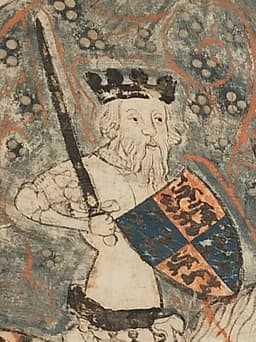
Edward III
Emperor · Medieval
62.3Total

John of Denmark
Emperor · Medieval
44.1Total
Basic Information
Born
1312
1455
Died
1377
1513
Era
Medieval
Medieval
Nationality
England
Denmark
Occupation
Emperor
Emperor
Civilization
Western
Western
Score Comparison
Military (10%)
72.0
45.0
Political (20%)
59.3
36.5
Influence (20%)
68.0
50.2
Legacy (20%)
40.0
41.7
Leadership (15%)
80.0
48.4
Strategy (15%)
72.0
38.6
TOTAL
62.3
44.1
Edward III — Complete Timeline
1337 AD
Claimed the French ThronePolitical Action
Edward III formally claimed the French crown through his mother Isabella, daughter of Philip IV of France, rejecting the Salic law that barred female succession. This claim initiated the Hundred Years' War between England and France.
Hundred Years' WarSuccession CrisisDynastic Claim
Impact: regional
1346 AD
Battle of CrécyWar◆ Major
Edward III's English army defeated a larger French force at Cr
Hundred Years' WarBattleLongbow
Impact: regional
1347 AD
Siege of CalaisWar◆ Major
Edward III besieged the French port of Calais for nearly a year, forcing its surrender. The city became an English enclave for over two centuries, serving as a strategic base for English operations in France.
Hundred Years' WarSiegeCalais
Impact: regional
1356 AD
Battle of PoitiersWar◆ Major
Edward III's son, Edward the Black Prince, led English forces to victory at Poitiers, capturing King John II of France. This triumph followed Cr
Hundred Years' WarBattleCapture of King John
Impact: regional
1360 AD
Treaty of BrétignyPolitical Action◆ Major
Edward III signed the Treaty of Br
TreatyHundred Years' WarTerritorial Gains
Impact: regional
John of Denmark — Complete Timeline
1397 AD
Union of Kalmar TreatyPolitical Action◆ Major
John of Denmark became king of the Kalmar Union, which united Denmark, Norway, and Sweden under a single monarch. The union was already weakened by internal conflicts. John's reign saw continued tensions with Swedish nobility who resisted central authority, leading to periodic rebellions.
Kalmar UnionMonarchyScandinavia
Impact: regional
1471 AD
Battle of BrunkebergWar◆ Major
John of Denmark led Danish forces against Swedish regent Sten Sture the Elder at Brunkeberg near Stockholm. The Danish army was defeated, and John failed to reclaim the Swedish throne. This battle solidified Swedish resistance to the Kalmar Union and delayed Danish control over Sweden.
BattleKalmar UnionSwedish Rebellion
Impact: regionaldestructive
1509 AD
Treaty of CopenhagenPolitical Action
John of Denmark signed the Treaty of Copenhagen with the Hanseatic League, ending a trade war. The treaty granted the Hanseatic League favorable trading rights in the Baltic, weakening Danish economic control. This agreement reflected John's inability to assert Danish dominance over the powerful league.
TreatyHanseatic LeagueTrade
Impact: regional
Expert Analysis
Origins
**Edward III** was born on 13 November 1312 at Windsor Castle, the son of King Edward II and Isabella of France. His father's reign was marked by conflict with the barons and a disastrous military record, culminating in Edward II's deposition in 1327. Edward III was crowned at age 14, with his mother and her lover Roger Mortimer acting as regents. He received a knightly education, learning martial skills and statecraft, but his early years were overshadowed by the power struggles of the regency.
**John of Denmark** was born on 2 February 1455 at Aalborg Castle, the son of King Christian I of Denmark, Norway, and Sweden and Dorothea of Brandenburg. He was raised in the court of the Kalmar Union, a personal union of the three Scandinavian kingdoms. John's education emphasized diplomacy and administration, as the union required constant negotiation with fractious nobles. He became heir apparent after his older brother's death and inherited a throne already weakened by internal dissent.
Rise to Power
**Edward III** took control of his own government in 1330 when he executed Mortimer and forced his mother into retirement. He immediately asserted English sovereignty, launching campaigns against Scotland to restore English influence. In 1337, he claimed the French throne through his mother Isabella, daughter of Philip IV, rejecting the Salic law. This claim sparked the Hundred Years' War. Edward secured alliances with the Holy Roman Empire and the Low Countries, but early campaigns were inconclusive. The turning point came in 1340 with the naval victory at Sluys, giving England control of the English Channel.
**John of Denmark** ascended the throne in 1481 upon his father's death. He faced immediate challenges: the Kalmar Union was fraying, with Sweden asserting independence under regent Sten Sture the Elder. John attempted to reassert Danish authority by military force, leading an invasion of Sweden in 1483. However, his campaign culminated in the Battle of Brunkeberg (10 October 1483), where his forces were defeated. John failed to capture Stockholm, and the Swedish nobility remained defiant. He also had to contend with the powerful Hanseatic League, which controlled Baltic trade.
Leadership & Governance
**Edward III** was a hands-on military leader who personally led campaigns and inspired loyalty among his knights. He reformed the English army, emphasizing the use of longbowmen and combining infantry with dismounted knights. His governance was marked by the development of Parliament, which he summoned frequently to grant taxes for war. Edward also fostered chivalric culture, founding the Order of the Garter in 1348. However, his later years saw declining health and the rise of factionalism at court, with his son John of Gaunt becoming increasingly powerful.
**John of Denmark** ruled through a council of nobles and relied on diplomacy to manage the union. His political score of 36.5 reflects his inability to centralize power. He granted the Hanseatic League favorable trade terms in the Treaty of Copenhagen (1494), which weakened Danish commerce. His military score of 45.0 indicates limited success; after Brunkeberg, he avoided major battles. He focused on consolidating control over Norway and Denmark, but his leadership style was reactive rather than proactive.
Triumph & Tragedy
**Edward III**'s greatest triumph was the Battle of Crécy (26 August 1346), where his army of about 12,000 defeated a French force of 30,000-40,000. The English longbowmen decimated French knights, and Edward's tactical use of terrain and dismounted men-at-arms set a new standard. The subsequent Siege of Calais (1346-1347) gave England a strategic foothold in France. His son's victory at Poitiers (1356) and the Treaty of Brétigny (1360) secured vast territories, including Aquitaine. However, his later years were tragic: the war resumed in 1369 due to French reconquests, and Edward's health declined. He died in 1377, leaving a kingdom drained by war and a succession crisis.
**John of Denmark**'s triumph was the Treaty of Copenhagen (1494), which ended a costly trade war with the Hanseatic League, though on unfavorable terms. He also secured the recognition of his son Christian as heir to the union. However, his tragedy was the Battle of Brunkeberg, where his defeat cemented Swedish independence in all but name. The Kalmar Union effectively collapsed, and John's reign saw the loss of Danish influence in Scandinavia. He died in 1513, leaving a fragmented union.
Character & Destiny
**Edward III** was ambitious, chivalric, and pragmatic. He cultivated the image of a warrior king, personally leading charges and sharing hardships with his soldiers. His decision to claim the French throne was driven by dynastic pride and a desire to restore English honor. However, his later years showed a decline in judgment, as he allowed favorites to dominate court. Historians note that his leadership score of 80.0 reflects his ability to inspire, but his strategy score of 72.0 indicates some overreach.
**John of Denmark** was cautious and diplomatic, but lacked the military acumen to enforce his will. He was more comfortable with negotiation than battle, which suited the complex politics of the Kalmar Union. However, his indecisiveness alienated allies, and his concessions to the Hanseatic League weakened the Danish economy. His character was shaped by the constraints of a union that required consensus, but he failed to adapt to the rising nationalism in Sweden.
Legacy
**Edward III** transformed England into a major military power and laid the foundation for the Hundred Years' War, which defined Anglo-French relations for centuries. His military innovations, particularly the use of the longbow, influenced European warfare. The Order of the Garter remains a prestigious British institution. However, his wars also led to heavy taxation and social strain, contributing to the Peasants' Revolt of 1381. His legacy score of 40.0 reflects the mixed outcomes: territorial gains were lost, but his reign is seen as a golden age of chivalry.
**John of Denmark**'s legacy is the decline of the Kalmar Union. His inability to hold Sweden led to the union's dissolution in 1523 under his son. The Treaty of Copenhagen set a precedent for Hanseatic influence in Scandinavia. He is remembered as a weak king who failed to adapt to changing times. His legacy score of 41.7 is slightly higher than Edward's due to the long-term impact of the union's collapse, but his overall impact is negative.
Conclusion
Edward III had a greater impact on European history than John of Denmark. His military score of 72.0 and leadership score of 80.0 dwarf John's 45.0 and 48.4. Edward's actions initiated the Hundred Years' War, a conflict that reshaped the balance of power in Europe, while John's reign accelerated the fragmentation of the Kalmar Union. Though Edward's gains were temporary, his military innovations and chivalric legacy endure. John, by contrast, is a footnote in the history of a failed union. The score gap of 18.2 points reflects Edward's superior achievements and lasting influence.
Rankings
🥇
Edward IIILeader
Mil: 72.0Pol: 59.3Inf: 68.0
62.3
🥈
John of Denmark
Mil: 45.0Pol: 36.5Inf: 50.2
44.1
+18.2 behind
How This Comparison Works
Algorithm
Each figure is scored on 6 dimensions (0—100 scale) based on structured historical data: Military (10%), Political (20%), Influence (20%), Legacy (20%), Leadership (15%), Strategy (15%). The weighted total produces the final ranking.
Data Sources
Scores are computed from structured sub-indicators in the database. Scale factors adjust for era (Ancient ×0.85, Modern ×1.0) and civilization size (Eastern ×1.05, Other ×0.80) to account for differences in population and military scale.
Maximum 3 Figures
Comparisons are limited to 2—3 figures to ensure readability and statistical meaningfulness.
Error Margins
±5 points per dimension — Sub-scores are derived from historical records with inherent uncertainty. Two figures within 5 points on a dimension should be considered roughly equivalent in that area.
Total Score Accuracy
±3 points overall — The weighted combination of 6 dimensions produces a total score with approximately ±3 points of uncertainty. Differences of less than 3 points are not statistically significant— the figures are effectively tied.
Known Limitations
- Historical records are incomplete and uneven across civilizations
- Figures from oral-tradition societies may be underrepresented
- Occupation labels can misclassify multi-role figures
- Scores measure capability and impact, not moral character
- Quantitative scoring is a comparison tool, not absolute truth
Capability Radar
Military (10%) — Battles & Warfare
Battles
85
25
Win Rate
80
30
Expansion
85
20
Political (20%) — Governance & Reform
Reform
70
30
Diplomacy
75
35
Economy
80
30
Influence (20%) — Cultural & Global Reach
Cultural
65
25
Global
70
15
Legacy (20%) — Historical Impact
Historical
80
30
Longevity
75
20
Leadership (15%) — Power & Stability
Tenure
85
40
Stability
70
20
Strategy (15%) — Tactics & Innovation
Strategy
90
25
Tactics
85
20
Reform
75
15
Similar Comparisons
Comments & Discussion
No comments yet. Be the first to share your thoughts!