Loading...
Edward III vs Julius Caesar
Julius Caesar leads by 20.5 pts · 2 figures compared
…
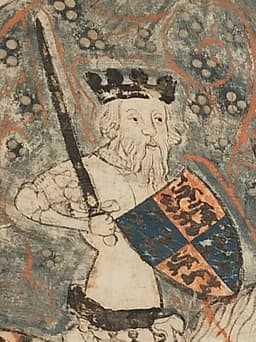
Edward III
Emperor · Medieval
62.3Total

Julius Caesar
General · Ancient
82.8Total
Basic Information
Born
1312
-100
Died
1377
-44
Era
Medieval
Ancient
Nationality
England
Roman Republic
Occupation
Emperor
General
Civilization
Western
Western
Score Comparison
Military (10%)
72.0
88.0
Political (20%)
59.3
78.0
Influence (20%)
68.0
85.0
Legacy (20%)
40.0
82.0
Leadership (15%)
80.0
80.0
Strategy (15%)
72.0
85.0
TOTAL
62.3
82.8
Edward III — Complete Timeline
1337 AD
Claimed the French ThronePolitical Action
Edward III formally claimed the French crown through his mother Isabella, daughter of Philip IV of France, rejecting the Salic law that barred female succession. This claim initiated the Hundred Years' War between England and France.
Hundred Years' WarSuccession CrisisDynastic Claim
Impact: regional
1346 AD
Battle of CrécyWar◆ Major
Edward III's English army defeated a larger French force at Cr
Hundred Years' WarBattleLongbow
Impact: regional
1347 AD
Siege of CalaisWar◆ Major
Edward III besieged the French port of Calais for nearly a year, forcing its surrender. The city became an English enclave for over two centuries, serving as a strategic base for English operations in France.
Hundred Years' WarSiegeCalais
Impact: regional
1356 AD
Battle of PoitiersWar◆ Major
Edward III's son, Edward the Black Prince, led English forces to victory at Poitiers, capturing King John II of France. This triumph followed Cr
Hundred Years' WarBattleCapture of King John
Impact: regional
1360 AD
Treaty of BrétignyPolitical Action◆ Major
Edward III signed the Treaty of Br
TreatyHundred Years' WarTerritorial Gains
Impact: regional
Julius Caesar — Complete Timeline
58 BC
Gallic WarsWar◆ Major
Caesar, as proconsul of Gaul, launched a series of campaigns that conquered all of Gaul (modern France, Belgium, and parts of Switzerland). He fought numerous battles, including against the Helvetii, the Belgae, and the Gallic chieftain Vercingetorix. The wars brought immense wealth and a loyal army to Caesar.
Gallic WarsConquestRoman Expansion
Impact: regional
49 BC
Crossing the RubiconPolitical Action◆ Major
Caesar led Legio XIII across the Rubicon River into Italy, defying the Roman Senate's order to disband his army. This act triggered a civil war against Pompey and the Optimates, ultimately leading to Caesar's dictatorship and the end of the Roman Republic.
Roman Civil WarEnd of RepublicPower Struggle
Impact: global
48 BC
Battle of PharsalusWar◆ Major
Caesar's outnumbered army defeated the larger forces of Pompey the Great at Pharsalus in Greece. Caesar's tactical use of a reserve line to counter Pompey's cavalry charge proved decisive. Pompey fled to Egypt, where he was assassinated, leaving Caesar as the undisputed master of the Roman world.
Roman Civil WarBattleDecisive Victory
Impact: regional
44 BC
Appointment as Dictator for LifePolitical Action◆ Major
The Roman Senate appointed Caesar dictator perpetuo (dictator for life), granting him unprecedented personal power. This move concentrated military, legislative, and judicial authority in one person, effectively ending the Roman Republic's traditional system of checks and balances and alarming many senators.
DictatorshipEnd of RepublicPower Consolidation
Impact: regionaldestructive
Assassination on the Ides of MarchPolitical Action◆ Major
A group of Roman senators, led by Marcus Junius Brutus and Gaius Cassius Longinus, stabbed Caesar to death at a meeting of the Senate in the Theatre of Pompey. The assassination was intended to restore the Republic, but instead triggered another civil war that led to the rise of the Roman Empire.
AssassinationRoman PoliticsEnd of Republic
Impact: globaldestructive
Expert Analysis
edward-iii-vs-julius-caesar
The Crossing and the Claim
On a January day in 49 BCE, Julius Caesar stood at the banks of the Rubicon, a small river that marked the boundary of his legal command. To cross with his army was treason, a declaration of civil war. He paused, then uttered, "The die is cast," and plunged into history. More than thirteen centuries later, in 1337, another king made a claim that would also change the world. Edward III of England, in the grand hall of Westminster, declared himself the rightful King of France, igniting a conflict that would smolder for over a hundred years. Both men gambled everything on a single decision. But while Caesar’s ambition ended in a bloody Senate chamber, Edward’s war carved a new identity for England. Why did one man’s rise lead to empire, and the other’s to a stalemate? The answer lies not just in their swords, but in the worlds they inherited.
Origins
Caesar was born into the chaos of the late Roman Republic, a world of crumbling traditions and ruthless political feuds. His family, the Julii, was ancient but not wealthy. He learned early that survival meant forging alliances, outmaneuvering rivals, and never showing weakness. His uncle by marriage, Gaius Marius, had been a populist reformer; his enemy, Sulla, a dictator. Caesar watched both, absorbing the lesson that power was a prize for the bold.
Edward III was born in 1312 into a more stable, but no less dangerous, medieval world. England was a kingdom still recovering from the weak rule of his father, Edward II, who had been deposed and murdered. Young Edward ascended the throne at fourteen, his power initially held by a regency. His England was feudal, pious, and obsessed with honor and lineage. Where Caesar saw a republic to be mastered, Edward saw a kingdom to be defended and a throne in France that, he believed, was his by blood.
Rise to Power
Caesar’s path was a masterclass in calculated risk. He climbed the political ladder—quaestor, aedile, pontifex maximus—spending fortunes he did not have on games and bribes. In 60 BCE, he formed the First Triumvirate with Pompey and Crassus, an informal alliance that gave him command of Gaul. His nine-year conquest of Gaul (58–50 BCE) was not just a war; it was a personal empire-building project, turning barbarian gold into Roman loyalty. When the Senate ordered him to disband his army, he chose the Rubicon.
Edward III’s rise was more straightforward, but no less decisive. He seized power from his mother’s lover, Roger Mortimer, in a 1330 coup at Nottingham Castle. He was eighteen. Unlike Caesar, Edward did not need to create a new system; he needed to restore the old one. He revived the chivalric order, founded the Order of the Garter, and wrapped his ambitions in the language of knightly duty. His claim to the French throne in 1337 was a legal maneuver, but it was also a rallying cry. He was not rebelling against his own government; he was challenging a rival king.
Leadership & Governance
Caesar governed like a revolutionary. As dictator, he reformed the calendar, granted citizenship to provincials, initiated public works, and centralized authority. His military genius—victories at Alesia, Pharsalus, and Alexandria—was matched by a political ruthlessness that pardoned enemies but never forgot them. He ruled through personal charisma and fear, bypassing the Senate entirely. His reforms were brilliant, but they destroyed the Republic’s delicate balance.
Edward III governed like a feudal lord writ large. He was a warrior-king who led his armies in person, most famously at the Battle of Crécy in 1346, where English longbowmen shattered French knights. He understood that medieval kingship was about personal presence and patronage. His son, the Black Prince, was his greatest general. Edward’s political wisdom lay in working with Parliament, granting concessions to secure war funds. He was no reformer; he was a manager of a system that already worked—for the nobility. His governance was effective, but it lacked Caesar’s transformative ambition.
Triumph & Tragedy
Caesar’s greatest triumph was the conquest of Gaul, a campaign that made him fabulously wealthy and gave him a veteran army loyal to him alone. His tragedy was the Ides of March, 44 BCE, when sixty senators stabbed him to death. He had centralized power so completely that his survival became impossible. He died not as a king, but as a tyrant in the eyes of his killers.
Edward III’s triumph was the Treaty of Brétigny in 1360, which gave England vast territories in France and a huge ransom for the captured King John II. It was the high point of the Hundred Years’ War. His tragedy was the slow unraveling of that victory. The Black Prince died before him, the French recovered under Charles V, and by Edward’s death in 1377, most of the gains were lost. He outlived his own success, watching his life’s work crumble.
Character & Destiny
Caesar was driven by a relentless need for glory. He wrote his own commentaries, controlled his own narrative, and believed that the Republic was a hollow shell. His arrogance—refusing the crown but accepting the title “dictator for life”—sealed his fate. He saw himself as a god in the making, and the senators saw him as a mortal who had forgotten his place.
Edward III was driven by a more conventional ambition: honor, dynasty, and the claim of his mother. He was a man of his age, believing in chivalry, divine right, and the justice of his cause. He was less a revolutionary than a restorer. His character was shaped by the medieval world’s certainties, not the Roman world’s cynicism. He died in his bed, a king still, but a disappointed one.
Legacy
Caesar’s legacy is the Roman Empire itself. His adopted heir, Octavian, became Augustus, and the Republic became a monarchy. His name became a title—Kaiser, Tsar. He is remembered as a military genius, a political master, and a warning about ambition. His assassination did not save the Republic; it ensured its death.
Edward III’s legacy is more subtle. He did not conquer France, but he created an English national identity forged in war. The longbow, the Order of the Garter, the English language in court—all owe something to his reign. He is remembered as a chivalric ideal, a king who embodied his age. But his war also drained England’s treasury and led to the chaos of the Wars of the Roses.
Conclusion
Caesar and Edward III both crossed lines that could not be uncrossed. Caesar crossed a river and ended a republic. Edward crossed the Channel and began a war. One sought to remake the world in his image; the other sought to reclaim a throne he believed was his. Their different outcomes were not just a matter of luck. They were shaped by the very different worlds they inhabited—one a dying republic where personal ambition could topple a state, the other a feudal order where kingship was still a sacred trust. In the end, Caesar’s tragedy was that he succeeded too completely. Edward’s was that he did not succeed enough. Both men remind us that history is not made by the bold alone, but by the times that shape their boldness.
Rankings
🥇
Julius CaesarLeader
Mil: 88.0Pol: 78.0Inf: 85.0
82.8
🥈
Edward III
Mil: 72.0Pol: 59.3Inf: 68.0
62.3
+20.5 behind
How This Comparison Works
Algorithm
Each figure is scored on 6 dimensions (0—100 scale) based on structured historical data: Military (10%), Political (20%), Influence (20%), Legacy (20%), Leadership (15%), Strategy (15%). The weighted total produces the final ranking.
Data Sources
Scores are computed from structured sub-indicators in the database. Scale factors adjust for era (Ancient ×0.85, Modern ×1.0) and civilization size (Eastern ×1.05, Other ×0.80) to account for differences in population and military scale.
Maximum 3 Figures
Comparisons are limited to 2—3 figures to ensure readability and statistical meaningfulness.
Error Margins
±5 points per dimension — Sub-scores are derived from historical records with inherent uncertainty. Two figures within 5 points on a dimension should be considered roughly equivalent in that area.
Total Score Accuracy
±3 points overall — The weighted combination of 6 dimensions produces a total score with approximately ±3 points of uncertainty. Differences of less than 3 points are not statistically significant— the figures are effectively tied.
Known Limitations
- Historical records are incomplete and uneven across civilizations
- Figures from oral-tradition societies may be underrepresented
- Occupation labels can misclassify multi-role figures
- Scores measure capability and impact, not moral character
- Quantitative scoring is a comparison tool, not absolute truth
Capability Radar
Military (10%) — Battles & Warfare
Battles
85
95
Win Rate
80
92
Expansion
85
97
Political (20%) — Governance & Reform
Reform
70
90
Diplomacy
75
85
Economy
80
82
Influence (20%) — Cultural & Global Reach
Cultural
65
88
Global
70
94
Legacy (20%) — Historical Impact
Historical
80
95
Longevity
75
96
Leadership (15%) — Power & Stability
Tenure
85
75
Stability
70
60
Strategy (15%) — Tactics & Innovation
Strategy
90
94
Tactics
85
96
Reform
75
88
Similar Comparisons
Comments & Discussion
No comments yet. Be the first to share your thoughts!