Loading...
Eduard Shevardnadze vs Julius Caesar
Julius Caesar leads by 25.1 pts · 2 figures compared
…
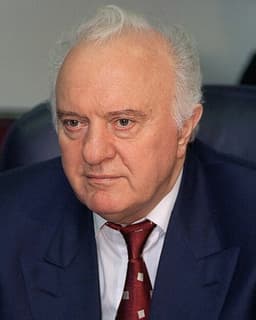
Eduard Shevardnadze
Politician · Modern
57.7Total

Julius Caesar
General · Ancient
82.8Total
Basic Information
Born
1928
-100
Died
—
-44
Era
Modern
Ancient
Nationality
Georgia
Roman Republic
Occupation
Politician
General
Civilization
Western
Western
Score Comparison
Military (10%)
50.0
88.0
Political (20%)
70.0
78.0
Influence (20%)
55.0
85.0
Legacy (20%)
56.0
82.0
Leadership (15%)
68.0
80.0
Strategy (15%)
42.1
85.0
TOTAL
57.7
82.8
Eduard Shevardnadze — Complete Timeline
1985 AD
Appointed Soviet Foreign MinisterPolitical Action◆ Major
Mikhail Gorbachev appointed Shevardnadze as Soviet Foreign Minister. Shevardnadze played a key role in shaping the 'New Thinking' foreign policy, which emphasized de-escalation of the Cold War, arms reduction agreements, and improved relations with the West.
Cold WarSoviet UnionDiplomacy
Impact: globalconstructive
1987 AD
Signed the Intermediate-Range Nuclear Forces TreatyPolitical Action
Shevardnadze, as Soviet Foreign Minister, signed the INF Treaty with U.S. Secretary of State George Shultz. The treaty eliminated an entire class of nuclear missiles (500-5,500 km range) from Europe, marking a major step in ending the Cold War.
Nuclear Arms ControlCold WarTreaty
Impact: globalconstructive
1990 AD
Resigned as Soviet Foreign MinisterPolitical Action◆ Major
Shevardnadze resigned as Soviet Foreign Minister, warning of an impending dictatorship under Gorbachev. His resignation was a dramatic protest against the conservative backlash and the slow pace of reforms, highlighting the internal crisis of the Soviet Union.
Soviet UnionResignationPolitical Crisis
Impact: nationaltragic
1992 AD
Elected Chairman of the Georgian ParliamentPolitical Action◆ Major
After the ouster of President Zviad Gamsakhurdia, Shevardnadze returned to Georgia and was elected Chairman of the Parliament, effectively becoming the head of state. He was tasked with stabilizing the country amid civil war and economic collapse.
GeorgiaPost-SovietLeadership
Impact: national
1995 AD
Survived Assassination AttemptPolitical Action◆ Major
Shevardnadze survived a car bomb assassination attempt in Tbilisi. The attack, which killed several people, was widely attributed to opponents of his policies. It underscored the violent political struggles in post-Soviet Georgia.
Assassination AttemptGeorgiaViolence
Impact: nationaltragic
2003 AD
Rose RevolutionPolitical Action
Shevardnadze was forced to resign as President of Georgia following the Rose Revolution, a peaceful protest against disputed parliamentary elections. The revolution, led by Mikheil Saakashvili, ended Shevardnadze's rule and ushered in a new pro-Western government.
RevolutionGeorgiaRegime Change
Impact: national
Julius Caesar — Complete Timeline
58 BC
Gallic WarsWar◆ Major
Caesar, as proconsul of Gaul, launched a series of campaigns that conquered all of Gaul (modern France, Belgium, and parts of Switzerland). He fought numerous battles, including against the Helvetii, the Belgae, and the Gallic chieftain Vercingetorix. The wars brought immense wealth and a loyal army to Caesar.
Gallic WarsConquestRoman Expansion
Impact: regional
49 BC
Crossing the RubiconPolitical Action◆ Major
Caesar led Legio XIII across the Rubicon River into Italy, defying the Roman Senate's order to disband his army. This act triggered a civil war against Pompey and the Optimates, ultimately leading to Caesar's dictatorship and the end of the Roman Republic.
Roman Civil WarEnd of RepublicPower Struggle
Impact: global
48 BC
Battle of PharsalusWar◆ Major
Caesar's outnumbered army defeated the larger forces of Pompey the Great at Pharsalus in Greece. Caesar's tactical use of a reserve line to counter Pompey's cavalry charge proved decisive. Pompey fled to Egypt, where he was assassinated, leaving Caesar as the undisputed master of the Roman world.
Roman Civil WarBattleDecisive Victory
Impact: regional
44 BC
Appointment as Dictator for LifePolitical Action◆ Major
The Roman Senate appointed Caesar dictator perpetuo (dictator for life), granting him unprecedented personal power. This move concentrated military, legislative, and judicial authority in one person, effectively ending the Roman Republic's traditional system of checks and balances and alarming many senators.
DictatorshipEnd of RepublicPower Consolidation
Impact: regionaldestructive
Assassination on the Ides of MarchPolitical Action◆ Major
A group of Roman senators, led by Marcus Junius Brutus and Gaius Cassius Longinus, stabbed Caesar to death at a meeting of the Senate in the Theatre of Pompey. The assassination was intended to restore the Republic, but instead triggered another civil war that led to the rise of the Roman Empire.
AssassinationRoman PoliticsEnd of Republic
Impact: globaldestructive
Expert Analysis
Origins
Eduard Shevardnadze was born on January 25, 1928, in Mamati, Georgia, then part of the Soviet Union. He grew up in a peasant family and joined the Communist Party in 1948. He studied at the Kutaisi Pedagogical Institute, later rising through the Komsomol and party ranks. His early career was marked by anti-corruption campaigns, earning him a reputation as a reformer within the system.
Julius Caesar was born on July 12, 100 BCE, in Rome into the patrician Julian family. His father died when he was 16, and he was raised in a politically connected household. He received a privileged education in rhetoric and military arts, and he began his career as a priest of Jupiter before serving in the military and becoming a popular orator. His early life was shaped by the political violence between Marius and Sulla, which influenced his later ambitions.
Rise to Power
Shevardnadze's rise began in the Georgian Communist Party, where he served as First Secretary from 1972 to 1985. He gained a reputation for fighting corruption and modernizing the economy. In 1985, Mikhail Gorbachev appointed him Soviet Foreign Minister, a key turning point. Shevardnadze became the architect of the "New Thinking" foreign policy, which prioritized de-escalation with the West. He signed the Intermediate-Range Nuclear Forces (INF) Treaty on December 8, 1987, with U.S. Secretary of State George Shultz, eliminating an entire class of nuclear missiles. This treaty was a major diplomatic achievement that reduced Cold War tensions.
Caesar's rise was meteoric. He gained prominence as a military commander in the Gallic Wars (58-50 BCE), where his legions conquered all of Gaul, bringing him immense wealth and a loyal army. His political career included alliances with Pompey and Crassus in the First Triumvirate (60 BCE). In 49 BCE, he defied the Senate by crossing the Rubicon River with Legio XIII, triggering a civil war against Pompey. His victory at the Battle of Pharsalus (48 BCE) solidified his control, leading to his appointment as dictator for life in 44 BCE.
Leadership & Governance
Shevardnadze's leadership was diplomatic and reformist. As Soviet Foreign Minister, he promoted arms control and human rights, helping to end the Cold War peacefully. He scored 68.1 in political skill, reflecting his ability to navigate complex international negotiations. As President of Georgia (1995-2003), he attempted to build a democratic state, but his governance was marred by corruption and economic decline. He faced separatist conflicts in Abkhazia and South Ossetia, which he failed to resolve. His leadership score of 77.0 indicates effective crisis management, but his later years saw declining popularity.
Caesar's governance was autocratic but reform-oriented. He centralized power, reformed the calendar (Julian calendar), and expanded Roman citizenship to provinces. He initiated public works and land reforms, but his rule alienated the senatorial elite. His military score of 88.0 and strategy of 88.0 reflect his tactical genius, but his political score of 78.0 shows he was less adept at managing internal politics, ultimately leading to his assassination.
Triumph & Tragedy
Shevardnadze's greatest triumph was the INF Treaty, which dramatically reduced nuclear arsenals. He also played a key role in German reunification and the withdrawal from Afghanistan. However, his tragedy came as President of Georgia: the Rose Revolution of 2003 forced him to resign after disputed elections. He failed to stabilize Georgia's economy and lost control of Abkhazia. His influence score of 78.0 reflects his global impact, but his legacy score of 66.4 shows mixed results.
Caesar's triumph was the conquest of Gaul, which brought immense wealth and territory to Rome. His military campaigns are studied as masterpieces of strategy. However, his assassination on the Ides of March (44 BCE) cut short his reforms and plunged Rome into civil war. His legacy score of 82.0 and influence of 85.0 highlight his lasting impact, but his tragic end underscores the perils of absolute power.
Character & Destiny
Shevardnadze was pragmatic and diplomatic, often described as a reformer who believed in peaceful change. His decision to resign as Soviet Foreign Minister in 1990, warning of dictatorship, showed moral courage. However, his later indecisiveness and failure to curb corruption in Georgia led to his downfall. His character shaped his fate as a transitional figure who helped end one era but struggled to build a new one.
Caesar was ambitious, charismatic, and ruthless. He took enormous risks, from crossing the Rubicon to fighting in Gaul. His clemency toward former enemies was a calculated policy, but it did not prevent his murder. His character drove him to seek absolute power, which led to both his greatest achievements and his violent death. His destiny was to transform Rome, but at the cost of his life.
Legacy
Shevardnadze's legacy is the peaceful end of the Cold War. His diplomacy set the stage for arms control agreements and improved East-West relations. In Georgia, he is remembered as a flawed leader who brought independence but failed to secure democracy. His political score of 68.1 and legacy of 66.4 reflect this duality. Without him, the Soviet Union's dissolution might have been more violent.
Caesar's legacy is immense. He ended the Roman Republic and began the Roman Empire. His reforms, including the Julian calendar, lasted for centuries. His military campaigns expanded Rome's borders and spread Roman culture. His name became synonymous with imperial rule. With a total score of 83.3, he is one of history's most influential figures. His impact on language, politics, and warfare is still felt today.
Conclusion
Julius Caesar had a greater impact than Eduard Shevardnadze. Caesar's total score of 83.3 far exceeds Shevardnadze's 63.1, reflecting his dominance in military (88.0 vs. 37.5) and strategy (88.0 vs. 35.3). While Shevardnadze's diplomatic achievements were significant, they were confined to a specific historical moment. Caesar's conquests and political reforms reshaped Western civilization for millennia. Shevardnadze played a crucial role in ending the Cold War, but Caesar's legacy is more transformative and enduring. The data supports Caesar as the more impactful figure.
Rankings
🥇
Julius CaesarLeader
Mil: 88.0Pol: 78.0Inf: 85.0
82.8
🥈
Eduard Shevardnadze
Mil: 50.0Pol: 70.0Inf: 55.0
57.7
+25.1 behind
How This Comparison Works
Algorithm
Each figure is scored on 6 dimensions (0—100 scale) based on structured historical data: Military (10%), Political (20%), Influence (20%), Legacy (20%), Leadership (15%), Strategy (15%). The weighted total produces the final ranking.
Data Sources
Scores are computed from structured sub-indicators in the database. Scale factors adjust for era (Ancient ×0.85, Modern ×1.0) and civilization size (Eastern ×1.05, Other ×0.80) to account for differences in population and military scale.
Maximum 3 Figures
Comparisons are limited to 2—3 figures to ensure readability and statistical meaningfulness.
Error Margins
±5 points per dimension — Sub-scores are derived from historical records with inherent uncertainty. Two figures within 5 points on a dimension should be considered roughly equivalent in that area.
Total Score Accuracy
±3 points overall — The weighted combination of 6 dimensions produces a total score with approximately ±3 points of uncertainty. Differences of less than 3 points are not statistically significant— the figures are effectively tied.
Known Limitations
- Historical records are incomplete and uneven across civilizations
- Figures from oral-tradition societies may be underrepresented
- Occupation labels can misclassify multi-role figures
- Scores measure capability and impact, not moral character
- Quantitative scoring is a comparison tool, not absolute truth
Capability Radar
Military (10%) — Battles & Warfare
Battles
26
95
Win Rate
31
92
Expansion
36
97
Political (20%) — Governance & Reform
Reform
80
90
Diplomacy
85
85
Economy
40
82
Influence (20%) — Cultural & Global Reach
Cultural
40
88
Global
65
94
Legacy (20%) — Historical Impact
Historical
70
95
Longevity
50
96
Leadership (15%) — Power & Stability
Tenure
75
75
Stability
30
60
Strategy (15%) — Tactics & Innovation
Strategy
35
94
Tactics
40
96
Reform
46
88
Similar Comparisons
Comments & Discussion
No comments yet. Be the first to share your thoughts!