Loading...
Douglas MacArthur vs Godfrey of Bouillon
Douglas MacArthur leads by 13.5 pts · 2 figures compared
…
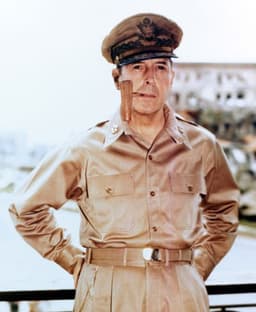
Douglas MacArthur
General · Modern
65.7Total
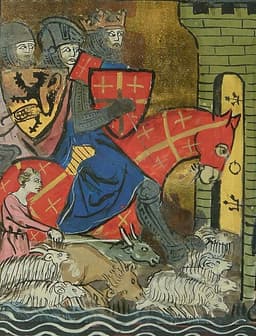
Godfrey of Bouillon
General · Medieval
52.2Total
Basic Information
Born
1880
1060
Died
1964
1100
Era
Modern
Medieval
Nationality
United States
Jerusalem
Occupation
General
General
Civilization
Western
Western
Score Comparison
Military (10%)
85.0
60.0
Political (20%)
78.0
37.9
Influence (20%)
68.0
55.7
Legacy (20%)
40.0
47.5
Leadership (15%)
78.0
54.2
Strategy (15%)
68.0
66.3
TOTAL
65.7
52.2
Douglas MacArthur — Complete Timeline
1942 AD
Battle of Bataan and CorregidorWar◆ Major
MacArthur commanded US and Filipino forces defending the Bataan Peninsula and Corregidor Island against Japanese invasion. After months of resistance, he was ordered to evacuate to Australia, leaving his troops who later surrendered and endured the Bataan Death March.
World War IIPacific TheaterDefeat
Impact: regionaltragic
1944 AD
Return to the PhilippinesWar◆ Major
MacArthur led the Allied invasion of Leyte Gulf, fulfilling his promise 'I shall return.' The campaign liberated the Philippines from Japanese occupation, a major strategic victory in the Pacific War.
World War IIPacific TheaterVictory
Impact: regionalconstructive
1945 AD
Surrender of JapanWar
MacArthur, as Supreme Commander for the Allied Powers, accepted Japan's formal surrender aboard USS Missouri in Tokyo Bay. This ended World War II and began the Allied occupation of Japan under his leadership.
World War IIJapanOccupation
Impact: globalconstructive
Occupation of Japan ReformsReform◆ Major
MacArthur oversaw the Allied occupation of Japan, implementing sweeping reforms including a new constitution, land redistribution, women's suffrage, and demilitarization. These changes transformed Japan into a democratic and pacifist state.
JapanPost-WarDemocratization
Impact: globalprogressive
1950 AD
Inchon LandingWar◆ Major
MacArthur planned and executed a bold amphibious assault at Inchon, South Korea, behind North Korean lines. The operation cut North Korean supply lines and recaptured Seoul, turning the tide of the Korean War.
Korean WarAmphibious AssaultVictory
Impact: regionalconstructive
1951 AD
Dismissal by President TrumanPolitical Action◆ Major
President Harry S. Truman relieved MacArthur of command for insubordination after MacArthur publicly advocated for expanding the Korean War into China. The dismissal sparked a political controversy in the US and ended MacArthur's military career.
Korean WarCivil-Military RelationsDismissal
Impact: nationaldestructive
Godfrey of Bouillon — Complete Timeline
1096 AD
Leadership of the First CrusadeWar◆ Major
Godfrey of Bouillon was a key leader of the First Crusade, commanding an army from Lorraine. He participated in the Siege of Nicaea, the Battle of Dorylaeum, and the Siege of Antioch, and was instrumental in the capture of Jerusalem in 1099.
CrusadeFirst CrusadeJerusalem
Impact: global
1099 AD
Capture of JerusalemWar
Godfrey led the successful assault on Jerusalem on July 15, 1099, ending Muslim rule. The capture was followed by a massacre of the city's Jewish and Muslim inhabitants. Godfrey was elected as the first ruler of the Kingdom of Jerusalem.
CrusadeJerusalemMassacre
Impact: globaldestructive
Battle of AscalonWar◆ Major
Godfrey led the Crusader army to victory against a Fatimid Egyptian force at Ascalon, securing the new kingdom's southern border. The victory prevented an immediate Muslim reconquest of Jerusalem.
BattleCrusader KingdomFatimids
Impact: regional
Election as Advocate of the Holy SepulchrePolitical Action◆ Major
After the capture of Jerusalem, Godfrey was elected as the ruler of the kingdom, but he refused the title of king, instead taking the title Advocatus Sancti Sepulchri (Advocate of the Holy Sepulchre). This established the Crusader state.
Crusader KingdomJerusalemTitle
Impact: regional
1100 AD
Death and SuccessionPolitical Action◆ Major
Godfrey died in 1100, possibly from illness or a wound. His brother Baldwin I succeeded him as the first king of Jerusalem. Godfrey's death left the kingdom in a precarious position, but Baldwin's leadership expanded it.
DeathSuccessionCrusader Kingdom
Impact: regionaltragic
Expert Analysis
Douglas MacArthur vs Godfrey of Bouillon
# The General and the Crusader
On September 15, 1950, Douglas MacArthur stood on the deck of the USS *Mount McKinley* off the coast of Korea, watching his forces storm the beaches of Inchon. The tide had risen exactly as he had predicted, and the North Korean army, caught completely off guard, was collapsing. Nearly nine centuries earlier, on July 15, 1099, Godfrey of Bouillon led his Crusaders over the walls of Jerusalem, ending four centuries of Muslim rule. Both men achieved the impossible, yet their paths could not have diverged more sharply. One would be fired by his own president; the other would die in possession of a kingdom he refused to crown himself. What explains the difference?
Origins
Douglas MacArthur was born into the American military aristocracy. His father, Arthur MacArthur, had won the Medal of Honor at Missionary Ridge during the Civil War. Young Douglas grew up on army posts, absorbing the rituals of command as naturally as other boys learned to read. He entered West Point in 1899, graduating first in his class—a feat he would later describe as the proudest moment of his life. The United States was emerging as a world power, and MacArthur would ride that wave.
Godfrey of Bouillon came from a world where power was personal and precarious. Born around 1060 in the fragmented lands of Lorraine, he inherited the duchy of Lower Lorraine from his uncle. The Holy Roman Empire was a patchwork of feuding nobles, and the Church was calling for holy war. Godfrey was a product of feudal Europe—a world where piety and violence were inseparable, and where a man's word was his bond, even unto death.
Rise to Power
MacArthur's ascent was methodical. He served in the Philippines, helped suppress the Bonus Army in Washington, and became Army Chief of Staff in 1930. His career seemed to peak when he retired in 1937 to serve as military advisor to the Philippines. But World War II thrust him back onto the world stage. When Japan invaded the Philippines in 1941, MacArthur was forced to retreat to Corregidor, then escape to Australia under orders from President Roosevelt. His famous promise—“I shall return”—was not just a military pledge; it was a personal declaration that defined his legacy.
Godfrey's rise was more chaotic. When Pope Urban II called for the First Crusade in 1095, Godfrey sold his estates to raise an army. He was not the most powerful noble to join the crusade—that was Raymond of Toulouse—nor the most charismatic, like Bohemond of Taranto. But Godfrey was steady, devout, and determined. He led his army across Europe, through the treacherous mountains of Anatolia, and finally to the walls of Antioch, where the Crusaders barely survived a brutal siege before capturing the city in 1098.
Leadership & Governance
MacArthur ruled by presence. Tall, imperious, often wearing sunglasses and a corncob pipe, he cultivated an image of invincibility. As Supreme Commander for the Allied Powers in Japan from 1945 to 1950, he was effectively a proconsul, drafting a new constitution, redistributing land, and transforming Japanese society. His reforms were sweeping and largely successful. Yet his military genius was matched by a towering ego. The Inchon landing was a masterpiece of strategy, but his subsequent advance into North Korea ignored Chinese warnings, leading to disaster when hundreds of thousands of Chinese troops crossed the Yalu River in November 1950.
Godfrey governed by humility—or at least by the appearance of it. When the Crusaders captured Jerusalem, the nobles offered him the crown. He refused, saying he would not wear a crown of gold where Christ had worn a crown of thorns. Instead, he took the title “Advocate of the Holy Sepulchre.” This was not mere piety; it was political wisdom. By refusing the kingship, he avoided alienating the Church and other nobles. He then consolidated his rule by defeating a Fatimid Egyptian army at the Battle of Ascalon in 1099, securing the kingdom's southern border.
Triumph & Tragedy
MacArthur's greatest triumph was the occupation of Japan. In just five years, he transformed a militaristic empire into a peaceful democracy. His greatest tragedy was the Korean War. After Inchon, he seemed unstoppable. But his public calls to bomb China and use nuclear weapons directly challenged civilian authority. On April 11, 1951, President Truman fired him. “I am closing my 52 years of military service,” MacArthur told Congress. “Old soldiers never die; they just fade away.” But he did not fade—he was bitter to the end.
Godfrey's triumph was Jerusalem itself. The capture of the Holy City on July 15, 1099, was the climax of centuries of Christian longing. Yet his tragedy was that he could not enjoy it. He died just one year later, in July 1100, possibly from typhoid or a battle wound. His brother Baldwin succeeded him, becoming the first crowned King of Jerusalem. Godfrey's refusal to take the crown became his defining legend, but it also left his kingdom vulnerable to the succession disputes that would plague it for generations.
Character & Destiny
MacArthur was a man of immense talent and immense pride. He believed he was destined for greatness, and he was right—yet that belief also destroyed him. He could not accept that a politician like Truman could overrule a general. His dismissal was not just a clash of personalities; it was a constitutional crisis that reaffirmed civilian control of the military in the United States.
Godfrey was a man of faith and pragmatism. He knew that a crown in Jerusalem was a poisoned gift. By refusing it, he preserved his soul and his reputation. His character was suited to a world where honor mattered more than power. He died before his legend could be tarnished.
Legacy
MacArthur is remembered as one of America's greatest generals, but also as a cautionary tale. His statue stands at West Point, and his name adorns a major highway in Virginia. Yet his dismissal overshadows his achievements. In Japan, he is still revered as the architect of modern democracy. In Korea, he is a controversial figure—a liberator who nearly started World War III.
Godfrey of Bouillon became a medieval hero. Dante placed him in Paradise. Tasso made him the hero of *Jerusalem Delivered*. Crusader castles were named after him. Yet his kingdom lasted only until 1187, when Saladin recaptured Jerusalem. Godfrey's legacy is not military conquest but the ideal of the Christian knight—devout, selfless, and doomed.
Conclusion
MacArthur and Godfrey both achieved the impossible. One conquered Japan without firing a shot; the other captured Jerusalem with a sword. But the differences between them are not just about time and place. MacArthur lived in an age of nations, constitutions, and civilian authority. Godfrey lived in an age of faith, feudalism, and personal loyalty. MacArthur's tragedy was that he could not accept his limits. Godfrey's tragedy was that he never had the chance to exceed his. One was fired; the other died. In the end, both remind us that even the greatest leaders are shaped by forces they cannot control—and that history judges not only what we achieve, but how we bear the weight of our own success.
Rankings
🥇
Douglas MacArthurLeader
Mil: 85.0Pol: 78.0Inf: 68.0
65.7
🥈
Godfrey of Bouillon
Mil: 60.0Pol: 37.9Inf: 55.7
52.2
+13.5 behind
How This Comparison Works
Algorithm
Each figure is scored on 6 dimensions (0—100 scale) based on structured historical data: Military (10%), Political (20%), Influence (20%), Legacy (20%), Leadership (15%), Strategy (15%). The weighted total produces the final ranking.
Data Sources
Scores are computed from structured sub-indicators in the database. Scale factors adjust for era (Ancient ×0.85, Modern ×1.0) and civilization size (Eastern ×1.05, Other ×0.80) to account for differences in population and military scale.
Maximum 3 Figures
Comparisons are limited to 2—3 figures to ensure readability and statistical meaningfulness.
Error Margins
±5 points per dimension — Sub-scores are derived from historical records with inherent uncertainty. Two figures within 5 points on a dimension should be considered roughly equivalent in that area.
Total Score Accuracy
±3 points overall — The weighted combination of 6 dimensions produces a total score with approximately ±3 points of uncertainty. Differences of less than 3 points are not statistically significant— the figures are effectively tied.
Known Limitations
- Historical records are incomplete and uneven across civilizations
- Figures from oral-tradition societies may be underrepresented
- Occupation labels can misclassify multi-role figures
- Scores measure capability and impact, not moral character
- Quantitative scoring is a comparison tool, not absolute truth
Capability Radar
Military (10%) — Battles & Warfare
Battles
85
65
Win Rate
75
60
Expansion
85
55
Political (20%) — Governance & Reform
Reform
85
25
Diplomacy
75
40
Economy
70
20
Influence (20%) — Cultural & Global Reach
Cultural
70
55
Global
80
50
Legacy (20%) — Historical Impact
Historical
85
60
Longevity
70
55
Leadership (15%) — Power & Stability
Tenure
80
30
Stability
65
25
Strategy (15%) — Tactics & Innovation
Strategy
90
60
Tactics
80
55
Reform
70
30
Similar Comparisons
Comments & Discussion
MACARTHUR'S GHOST6/16/2026
Comparing Inchon to Jerusalem is like comparing a Vegas magic trick to a miracle. MacArthur's "brilliant" landing relied on tides and charts that any competent naval commander could read. Godfrey's men had no intelligence, no air cover, and were outnumbered—yet they built siege towers from scraps and took the walls through sheer grit. One gambled with American industrial might; the other bet with faith and desperation. Who's the real genius here?
统计忍者6/16/2026
数据不会说谎:仁川登陆时美军拥有260艘舰艇和绝对制空权,而戈弗雷的十字军连配剑都不够发。麦克阿瑟的"天才"建立在20世纪的后勤碾压上,戈弗雷却要靠断粮的士兵徒手爬墙。把麦克阿瑟扔回1099年,他连安条克都守不住。历史给胜利者镀金,但胜利从不平等。
Crusader or Cipher6/16/2026
Godfrey's refusal to wear Jerusalem's crown wasn't humility—it was a political masterstroke. He knew the barons would tear each other apart for the title, so he let Baldwin take the throne and kept his own legend untarnished. MacArthur, by contrast, couldn't resist the spotlight: he wanted the presidency, wanted to cross the Yalu, wanted to be Caesar. Both seized cities, but only one understood that power sometimes means not grasping.
教皇与五角大楼6/16/2026
麦克阿瑟被解职是因为他忘了自己是仆从,而戈弗雷牢记自己是棋子。艾森豪威尔不是教皇乌尔班二世——前者有原子弹和宪法,后者只有信仰和恐惧。麦克阿瑟威胁要轰炸中国时,他越过了文官统治的红线;戈弗雷跪吻圣墓地板,恰恰巩固了教廷对他的需要。所有将军幻想不朽,但只有懂得何时跪下的人才能永生。
Revisionist's Razor6/16/2026
Let's cut the "Great Man" nonsense. Inchon was a tactical win but a strategic disaster—it lured MacArthur into a war with China that killed hundreds of thousands. Jerusalem was a bloodbath that sparked centuries of holy war. Both men are remembered for style, not substance. Godfrey can't claim he "liberated" a city that was then sacked; MacArthur can't claim he "saved" Korea when he nearly lost it. History loves a showman, but results don't lie.