Loading...
Doris Leuthard vs Julius Caesar
Julius Caesar leads by 27.6 pts · 2 figures compared
…
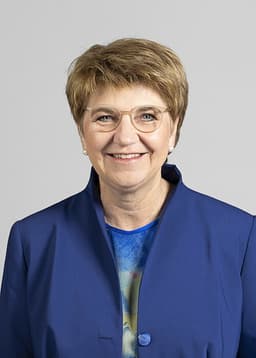
Doris Leuthard
Politician · Modern
55.2Total

Julius Caesar
General · Ancient
82.8Total
Basic Information
Born
1963
-100
Died
—
-44
Era
Modern
Ancient
Nationality
Switzerland
Roman Republic
Occupation
Politician
General
Civilization
Western
Western
Score Comparison
Military (10%)
50.0
88.0
Political (20%)
61.0
78.0
Influence (20%)
54.9
85.0
Legacy (20%)
44.2
82.0
Leadership (15%)
80.0
80.0
Strategy (15%)
42.3
85.0
TOTAL
55.2
82.8
Doris Leuthard — Complete Timeline
2010 AD
Elected President of the Swiss ConfederationPolitical Action◆ Major
Leuthard was elected President of the Swiss Confederation for 2010, focusing on energy policy and sustainable development. She was the second woman to hold the office, following Micheline Calmy-Rey.
PresidencyEnergy PolicyGender Equality
Impact: nationalprogressive
Led the Federal Department of Environment, Transport, Energy and CommunicationsPolitical Action◆ Major
Leuthard was elected to the Federal Council and headed the Federal Department of Environment, Transport, Energy and Communications from 2010 to 2018. She oversaw policies on climate change, infrastructure, and digitalization.
Federal CouncilEnvironmentTransport
Impact: nationalconstructive
2011 AD
Championed the Energy Strategy 2050Reform
Leuthard spearheaded the Energy Strategy 2050, a comprehensive plan to transition Switzerland away from nuclear power and fossil fuels toward renewable energy. The strategy included measures to increase energy efficiency and promote solar, wind, and hydroelectric power.
Energy TransitionRenewable EnergyNuclear Phase-out
Impact: nationalprogressive
2016 AD
Advocated for Digitalization and InnovationReform
Leuthard promoted digitalization in Switzerland, including the development of e-government services and support for digital startups. She emphasized the importance of innovation for Switzerland's economic competitiveness.
DigitalizationInnovationE-Government
Impact: nationalconstructive
2017 AD
Re-elected President of the Swiss ConfederationPolitical Action
Leuthard was re-elected as President of the Swiss Confederation for 2017, a rare second term. She continued her work on energy transition and digitalization, advocating for a sustainable and innovative Switzerland.
PresidencyRe-electionSustainability
Impact: nationalconstructive
2018 AD
Resigned from the Federal CouncilPolitical Action
Leuthard announced her resignation from the Federal Council, effective at the end of 2018. She cited a desire to step down after eight years in office. Her legacy includes the Energy Strategy 2050 and digitalization efforts.
ResignationFederal CouncilLegacy
Impact: national
Julius Caesar — Complete Timeline
58 BC
Gallic WarsWar◆ Major
Caesar, as proconsul of Gaul, launched a series of campaigns that conquered all of Gaul (modern France, Belgium, and parts of Switzerland). He fought numerous battles, including against the Helvetii, the Belgae, and the Gallic chieftain Vercingetorix. The wars brought immense wealth and a loyal army to Caesar.
Gallic WarsConquestRoman Expansion
Impact: regional
49 BC
Crossing the RubiconPolitical Action◆ Major
Caesar led Legio XIII across the Rubicon River into Italy, defying the Roman Senate's order to disband his army. This act triggered a civil war against Pompey and the Optimates, ultimately leading to Caesar's dictatorship and the end of the Roman Republic.
Roman Civil WarEnd of RepublicPower Struggle
Impact: global
48 BC
Battle of PharsalusWar◆ Major
Caesar's outnumbered army defeated the larger forces of Pompey the Great at Pharsalus in Greece. Caesar's tactical use of a reserve line to counter Pompey's cavalry charge proved decisive. Pompey fled to Egypt, where he was assassinated, leaving Caesar as the undisputed master of the Roman world.
Roman Civil WarBattleDecisive Victory
Impact: regional
44 BC
Appointment as Dictator for LifePolitical Action◆ Major
The Roman Senate appointed Caesar dictator perpetuo (dictator for life), granting him unprecedented personal power. This move concentrated military, legislative, and judicial authority in one person, effectively ending the Roman Republic's traditional system of checks and balances and alarming many senators.
DictatorshipEnd of RepublicPower Consolidation
Impact: regionaldestructive
Assassination on the Ides of MarchPolitical Action◆ Major
A group of Roman senators, led by Marcus Junius Brutus and Gaius Cassius Longinus, stabbed Caesar to death at a meeting of the Senate in the Theatre of Pompey. The assassination was intended to restore the Republic, but instead triggered another civil war that led to the rise of the Roman Empire.
AssassinationRoman PoliticsEnd of Republic
Impact: globaldestructive
Expert Analysis
doris-leuthard-vs-julius-caesar
# The Dictator and the Democrat
On a March morning in 44 BCE, the most powerful man in the Roman world fell beneath the daggers of his closest allies, his blood pooling on the floor of the Senate chamber. Two thousand years later, in December 2018, a Swiss woman named Doris Leuthard quietly packed up her office in Bern, shook hands with her colleagues, and walked out of the Federal Palace into a peaceful retirement. No assassins. No civil war. No empire collapsing in her wake. These two figures, separated by two millennia, both held supreme power in their respective worlds. Yet their stories could hardly be more different. Why?
Origins
Julius Caesar was born into the twilight of the Roman Republic, a world of violent ambition where noble families clawed for supremacy. His aunt had married Gaius Marius, the great general who had saved Rome from Germanic invasion, and his father’s family claimed descent from the goddess Venus itself. But the Rome of 100 BCE was no place for the faint-hearted. The Republic was bleeding from decades of civil strife, with populists and aristocrats locked in a death struggle. Caesar learned early that survival meant seizing glory.
Doris Leuthard, born in 1963 in the small town of Merenschwand, Switzerland, entered a world that had already solved its fundamental political questions. Switzerland had not fought a war in generations. Its democracy was stable, its banks were full, and its citizens voted on everything from highway construction to immigration quotas. She grew up in a country where compromise was not a weakness but a national religion. Her father was a farmer, her mother a teacher. No divine ancestry. No military glory. Just the quiet certainties of Alpine prosperity.
Rise to Power
Caesar’s path to power was a masterpiece of calculated risk. He borrowed fortunes he could never repay to fund public games, bought allies with land and money, and served as governor of a province he had no right to govern. His conquest of Gaul between 58 and 50 BCE was not merely a military campaign—it was a personal empire built on the blood of a million dead Gauls. When the Senate ordered him to disband his army, he crossed the Rubicon River with a single legion, gambling everything on civil war. He won.
Leuthard’s rise was quieter but no less remarkable. She entered politics in the 1990s, serving in the Swiss parliament before being elected to the Federal Council in 2010—Switzerland’s seven-member executive body. There was no crossing of rivers, no declaration of war. She simply worked harder than her peers, mastered the arcane details of Swiss energy policy, and earned the trust of her colleagues. When she was elected President of the Swiss Confederation in 2010 and again in 2017, it was a rare honor—but Swiss presidents are not dictators. They are first among equals, serving one-year terms.
Leadership & Governance
Caesar governed as he fought: decisively, ruthlessly, and with an eye toward eternity. As dictator, he reformed the calendar, granted citizenship to Gauls, launched public works projects that employed the poor, and centralized power in his own hands. His military genius was unquestionable—he had conquered Gaul, defeated his rival Pompey, and pacified Egypt. But his political wisdom was more ambiguous. He pardoned his enemies, only to be killed by them. He centralized power, only to create a system that would destroy the Republic he claimed to save.
Leuthard governed through consensus. Her signature achievement, the Energy Strategy 2050, was a comprehensive plan to phase out nuclear power and transition Switzerland to renewable energy. It required years of negotiation, referendums, and compromise with cantons, industries, and environmental groups. Where Caesar issued decrees, Leuthard built coalitions. Where Caesar commanded legions, she chaired committees. Her leadership score of 84.3 reflects this—not the charisma of a conqueror, but the steady hand of a manager.
Triumph & Tragedy
Caesar’s greatest triumph was his conquest of Gaul, a campaign that added a vast territory to the Roman sphere and made him the richest man in the Republic. His greatest tragedy was his own success: the power he accumulated made him a target. On the Ides of March, 44 BCE, sixty senators stabbed him to death, believing they were saving the Republic. Instead, they triggered another civil war, and the Republic died anyway.
Leuthard’s triumph was the passage of the Energy Strategy 2050 in 2011, a turning point for Swiss environmental policy. Her tragedy? There is none. She left office voluntarily, with her reputation intact, her policies in place, and her country at peace. The contrast is almost absurd: one man died for his ambition, the other retired to a quiet life.
Character & Destiny
Caesar was driven by an insatiable hunger for glory. He once remarked that he would rather be first in a village than second in Rome. His personality—bold, generous, calculating, and utterly convinced of his own destiny—shaped every decision he made. He could not stop. He could not compromise. He could not share power. And so he died.
Leuthard, by contrast, embodied the Swiss virtue of *Konkordanz*—the art of finding common ground. She did not seek personal glory. She did not build a cult of personality. She served her terms, passed her reforms, and stepped aside. Her personality reflected her nation: pragmatic, patient, and profoundly unromantic.
Legacy
Caesar’s legacy is written in stone and blood. The Roman Empire, the Latin language, the Western calendar, the very concept of a dictator—all bear his mark. His name became synonymous with imperial power: Kaiser in German, Tsar in Russian. He is remembered as a genius, a tyrant, and a martyr, depending on who tells the story.
Leuthard’s legacy is quieter but no less real. Switzerland’s energy transition, its digitalization initiatives, its stable governance—these bear her fingerprints. She is remembered as competent, honest, and effective. Not a conqueror. Not a legend. But perhaps, in the long run, more successful than Caesar. After all, she got to go home.
Conclusion
What drove the different outcomes? The answer lies not in the individuals but in the worlds they inhabited. Caesar lived in a system that rewarded violence and punished restraint. Leuthard lived in one that rewarded patience and punished ambition. One was a shark in a sea of sharks; the other was a farmer tending a well-watered garden. The tragedy of Caesar is that he could not imagine a world where he did not need to conquer. The wisdom of Leuthard is that she knew exactly when to stop.
Rankings
🥇
Julius CaesarLeader
Mil: 88.0Pol: 78.0Inf: 85.0
82.8
🥈
Doris Leuthard
Mil: 50.0Pol: 61.0Inf: 54.9
55.2
+27.6 behind
How This Comparison Works
Algorithm
Each figure is scored on 6 dimensions (0—100 scale) based on structured historical data: Military (10%), Political (20%), Influence (20%), Legacy (20%), Leadership (15%), Strategy (15%). The weighted total produces the final ranking.
Data Sources
Scores are computed from structured sub-indicators in the database. Scale factors adjust for era (Ancient ×0.85, Modern ×1.0) and civilization size (Eastern ×1.05, Other ×0.80) to account for differences in population and military scale.
Maximum 3 Figures
Comparisons are limited to 2—3 figures to ensure readability and statistical meaningfulness.
Error Margins
±5 points per dimension — Sub-scores are derived from historical records with inherent uncertainty. Two figures within 5 points on a dimension should be considered roughly equivalent in that area.
Total Score Accuracy
±3 points overall — The weighted combination of 6 dimensions produces a total score with approximately ±3 points of uncertainty. Differences of less than 3 points are not statistically significant— the figures are effectively tied.
Known Limitations
- Historical records are incomplete and uneven across civilizations
- Figures from oral-tradition societies may be underrepresented
- Occupation labels can misclassify multi-role figures
- Scores measure capability and impact, not moral character
- Quantitative scoring is a comparison tool, not absolute truth
Capability Radar
Military (10%) — Battles & Warfare
Battles
26
95
Win Rate
31
92
Expansion
38
97
Political (20%) — Governance & Reform
Reform
70
90
Diplomacy
68
85
Economy
65
82
Influence (20%) — Cultural & Global Reach
Cultural
30
88
Global
40
94
Legacy (20%) — Historical Impact
Historical
35
95
Longevity
30
96
Leadership (15%) — Power & Stability
Tenure
65
75
Stability
70
60
Strategy (15%) — Tactics & Innovation
Strategy
37
94
Tactics
38
96
Reform
46
88
Similar Comparisons
Comments & Discussion
No comments yet. Be the first to share your thoughts!