Loading...
Dmitry Peskov vs Tage Erlander
Tage Erlander leads by 17.4 pts · 2 figures compared
…
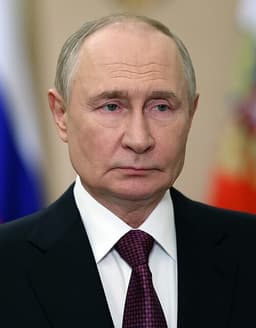
Dmitry Peskov
Politician · Modern
44.9Total

Tage Erlander
Politician · Modern
62.3Total
Basic Information
Born
1967
1901
Died
—
1985
Era
Modern
Modern
Nationality
Russia
Sweden
Occupation
Politician
Politician
Civilization
Western
Western
Score Comparison
Military (10%)
50.0
48.3
Political (20%)
35.1
82.0
Influence (20%)
51.8
62.0
Legacy (20%)
38.3
52.0
Leadership (15%)
53.2
83.3
Strategy (15%)
41.0
42.1
TOTAL
44.9
62.3
Dmitry Peskov — Complete Timeline
1999 AD
Appointed Deputy Press Secretary of the PresidentPolitical Action
Peskov was appointed Deputy Press Secretary for President Boris Yeltsin in 1999, later serving under Putin. He worked under Press Secretary Alexei Gromov before taking over the role.
Presidential AdministrationMedia
Impact: national
2000 AD
Appointed Press Secretary of the President of RussiaPolitical Action◆ Major
Dmitry Peskov was appointed Press Secretary for President Vladimir Putin in 2000, serving as the official spokesperson. He has been the primary conduit for Kremlin communications, handling media relations and public statements.
Presidential AdministrationMedia
Impact: national
2012 AD
Served as Deputy Chief of the Presidential AdministrationPolitical Action◆ Major
Peskov was appointed Deputy Chief of the Presidential Administration in 2012, while retaining his role as Press Secretary. He gained broader responsibilities in managing Kremlin communications and policy coordination.
Presidential AdministrationLeadership
Impact: national
2014 AD
Managed communication during the annexation of CrimeaPolitical Action◆ Major
Peskov was the Kremlin's chief spokesperson during the annexation of Crimea in 2014, presenting the Russian government's narrative. He denied Russian military involvement initially, later acknowledging it, and defended the annexation as a legitimate act.
CrimeaMedia
Impact: global
Tage Erlander — Complete Timeline
1946 AD
Appointment as Prime MinisterPolitical Action◆ Major
Tage Erlander became Prime Minister of Sweden after the death of Per Albin Hansson. He led the Social Democratic Party and began a period of continuous governance that lasted until 1969.
Prime MinisterSocial DemocratsSuccession
Impact: national
1950 AD
Expansion of the welfare stateReform◆ Major
Erlander oversaw the expansion of Sweden's welfare state, including universal healthcare, child allowances, and a comprehensive pension system. These reforms were part of the 'Swedish Model' of social democracy.
Welfare StateSocial ReformSwedish Model
Impact: nationalprogressive
1960 AD
Nuclear energy policyPolitical Action◆ Major
Erlander's government decided to invest heavily in nuclear power, building several reactors to meet Sweden's energy needs. This policy was controversial but provided cheap electricity for decades.
EnergyNuclear PowerInfrastructure
Impact: national
1969 AD
Resignation as Prime MinisterPolitical Action◆ Major
Erlander resigned after 23 years as Prime Minister, the longest tenure in Swedish history. He was succeeded by Olof Palme, marking a peaceful transition of power within the Social Democratic Party.
ResignationSuccessionSocial Democrats
Impact: national
Expert Analysis
Origins
Dmitry Peskov was born in 1967 in Moscow, Russia, into a diplomatic family. His father, Sergei Peskov, was a Soviet diplomat, which influenced Dmitry's career path. He studied at the Moscow State Institute of International Relations (MGIMO), graduating in 1989. He began his career in the Soviet Ministry of Foreign Affairs, serving in Turkey in the early 1990s. His early work involved diplomatic and translation roles.
Tage Erlander was born in 1901 in Ransäter, Sweden, into a middle-class family. His father was a schoolteacher. Erlander studied political science and economics at Lund University, graduating in 1928. He joined the Social Democratic Party and became active in local politics. He worked as a journalist and later as a civil servant in the Ministry of Social Affairs.
Rise to Power
Peskov rose to prominence in 1999 when he was appointed Deputy Press Secretary for President Boris Yeltsin. He quickly gained the trust of Vladimir Putin, who became president in 2000. Peskov was named Press Secretary for the President, becoming the official spokesperson. His role expanded in 2012 when he became Deputy Chief of the Presidential Administration, while retaining his press secretary duties. He managed communications during key events like the 2014 annexation of Crimea.
Erlander became Prime Minister in 1946 after the sudden death of Per Albin Hansson. He was initially seen as a compromise candidate but quickly established himself. He led the Social Democratic Party and formed a government. His rise was marked by his ability to build consensus and maintain party unity. He won multiple elections, serving from 1946 to 1969.
Leadership & Governance
Peskov's leadership is defined by his role as a spokesperson and communications strategist. He has a score of 53.2 in Leadership, reflecting his ability to manage the Kremlin's message. He controls information flow, often using propaganda and disinformation. For example, during the 2014 Crimea crisis, he denied Russian military involvement despite evidence. His governance is opaque, with limited accountability.
Erlander scored 83.3 in Leadership, indicating effective democratic governance. He oversaw the expansion of Sweden's welfare state, including universal healthcare, child allowances, and a comprehensive pension system. He pursued a policy of neutrality during the Cold War and invested in nuclear energy to reduce oil dependence. His leadership style was consensual and coalition-building.
Triumph & Tragedy
Peskov's greatest triumph is his longevity and influence as the Kremlin's voice. He successfully managed communications for Putin for over two decades. His greatest failure is the erosion of trust in Russian media and his role in spreading misinformation. The 2014 Crimea annexation and the 2022 invasion of Ukraine damaged Russia's international reputation, and Peskov's statements were often contradictory.
Erlander's greatest triumph is the expansion of the Swedish welfare state, which improved living standards. He also guided Sweden through post-war reconstruction. His greatest failure is the controversial nuclear energy policy, which faced public opposition and safety concerns. Additionally, his government's high taxes and bureaucracy faced criticism.
Character & Destiny
Peskov is known for his loyalty to Putin and his ability to deliver the Kremlin's message without deviation. He is disciplined and strategic, but his character is tied to an authoritarian regime. His destiny is to be remembered as a mouthpiece for a system that suppresses dissent. Historical assessments view him as a skilled propagandist.
Erlander was pragmatic and consensus-oriented. He was known for his humility and ability to listen. His character shaped a stable, democratic Sweden. His destiny was to lead a period of unprecedented prosperity and social reform. Historians regard him as one of Sweden's greatest prime ministers.
Legacy
Peskov's legacy is tied to Putin's era. He scored 38.3 in Legacy, reflecting limited independent impact. His communication techniques have influenced modern propaganda but are unlikely to endure beyond the current regime. His role in undermining democratic norms is a negative legacy.
Erlander scored 52.0 in Legacy, but his impact on Swedish society is profound. The welfare state he built remains a model. His peaceful transition of power to Olof Palme set a precedent. His policies shaped Sweden for decades.
Conclusion
Tage Erlander had greater impact than Dmitry Peskov. Erlander's scores are higher in Political (82.0 vs 35.1), Leadership (83.3 vs 53.2), and Influence (62.0 vs 51.8). While Peskov's role is significant in the context of Russian propaganda, Erlander's reforms improved millions of lives. Erlander's total score of 62.3 exceeds Peskov's 44.9 by 17.4 points. Erlander's legacy is positive and enduring, while Peskov's is tied to a regime that may not last.
Rankings
🥇
Tage ErlanderLeader
Mil: 48.3Pol: 82.0Inf: 62.0
62.3
🥈
Dmitry Peskov
Mil: 50.0Pol: 35.1Inf: 51.8
44.9
+17.4 behind
How This Comparison Works
Algorithm
Each figure is scored on 6 dimensions (0—100 scale) based on structured historical data: Military (10%), Political (20%), Influence (20%), Legacy (20%), Leadership (15%), Strategy (15%). The weighted total produces the final ranking.
Data Sources
Scores are computed from structured sub-indicators in the database. Scale factors adjust for era (Ancient ×0.85, Modern ×1.0) and civilization size (Eastern ×1.05, Other ×0.80) to account for differences in population and military scale.
Maximum 3 Figures
Comparisons are limited to 2—3 figures to ensure readability and statistical meaningfulness.
Error Margins
±5 points per dimension — Sub-scores are derived from historical records with inherent uncertainty. Two figures within 5 points on a dimension should be considered roughly equivalent in that area.
Total Score Accuracy
±3 points overall — The weighted combination of 6 dimensions produces a total score with approximately ±3 points of uncertainty. Differences of less than 3 points are not statistically significant— the figures are effectively tied.
Known Limitations
- Historical records are incomplete and uneven across civilizations
- Figures from oral-tradition societies may be underrepresented
- Occupation labels can misclassify multi-role figures
- Scores measure capability and impact, not moral character
- Quantitative scoring is a comparison tool, not absolute truth
Capability Radar
Military (10%) — Battles & Warfare
Battles
27
31
Win Rate
33
34
Expansion
34
33
Political (20%) — Governance & Reform
Reform
10
85
Diplomacy
55
80
Economy
10
85
Influence (20%) — Cultural & Global Reach
Cultural
10
55
Global
40
55
Legacy (20%) — Historical Impact
Historical
20
65
Longevity
10
70
Leadership (15%) — Power & Stability
Tenure
70
95
Stability
30
90
Strategy (15%) — Tactics & Innovation
Strategy
37
36
Tactics
40
42
Reform
42
43
Similar Comparisons
Comments & Discussion
No comments yet. Be the first to share your thoughts!