Loading...
Dmitry Peskov vs Julius Caesar
Julius Caesar leads by 37.9 pts · 2 figures compared
…
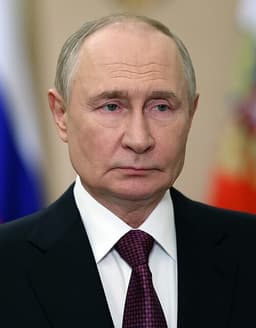
Dmitry Peskov
Politician · Modern
44.9Total

Julius Caesar
General · Ancient
82.8Total
Basic Information
Born
1967
-100
Died
—
-44
Era
Modern
Ancient
Nationality
Russia
Roman Republic
Occupation
Politician
General
Civilization
Western
Western
Score Comparison
Military (10%)
50.0
88.0
Political (20%)
35.1
78.0
Influence (20%)
51.8
85.0
Legacy (20%)
38.3
82.0
Leadership (15%)
53.2
80.0
Strategy (15%)
41.0
85.0
TOTAL
44.9
82.8
Dmitry Peskov — Complete Timeline
1999 AD
Appointed Deputy Press Secretary of the PresidentPolitical Action
Peskov was appointed Deputy Press Secretary for President Boris Yeltsin in 1999, later serving under Putin. He worked under Press Secretary Alexei Gromov before taking over the role.
Presidential AdministrationMedia
Impact: national
2000 AD
Appointed Press Secretary of the President of RussiaPolitical Action◆ Major
Dmitry Peskov was appointed Press Secretary for President Vladimir Putin in 2000, serving as the official spokesperson. He has been the primary conduit for Kremlin communications, handling media relations and public statements.
Presidential AdministrationMedia
Impact: national
2012 AD
Served as Deputy Chief of the Presidential AdministrationPolitical Action◆ Major
Peskov was appointed Deputy Chief of the Presidential Administration in 2012, while retaining his role as Press Secretary. He gained broader responsibilities in managing Kremlin communications and policy coordination.
Presidential AdministrationLeadership
Impact: national
2014 AD
Managed communication during the annexation of CrimeaPolitical Action◆ Major
Peskov was the Kremlin's chief spokesperson during the annexation of Crimea in 2014, presenting the Russian government's narrative. He denied Russian military involvement initially, later acknowledging it, and defended the annexation as a legitimate act.
CrimeaMedia
Impact: global
Julius Caesar — Complete Timeline
58 BC
Gallic WarsWar◆ Major
Caesar, as proconsul of Gaul, launched a series of campaigns that conquered all of Gaul (modern France, Belgium, and parts of Switzerland). He fought numerous battles, including against the Helvetii, the Belgae, and the Gallic chieftain Vercingetorix. The wars brought immense wealth and a loyal army to Caesar.
Gallic WarsConquestRoman Expansion
Impact: regional
49 BC
Crossing the RubiconPolitical Action◆ Major
Caesar led Legio XIII across the Rubicon River into Italy, defying the Roman Senate's order to disband his army. This act triggered a civil war against Pompey and the Optimates, ultimately leading to Caesar's dictatorship and the end of the Roman Republic.
Roman Civil WarEnd of RepublicPower Struggle
Impact: global
48 BC
Battle of PharsalusWar◆ Major
Caesar's outnumbered army defeated the larger forces of Pompey the Great at Pharsalus in Greece. Caesar's tactical use of a reserve line to counter Pompey's cavalry charge proved decisive. Pompey fled to Egypt, where he was assassinated, leaving Caesar as the undisputed master of the Roman world.
Roman Civil WarBattleDecisive Victory
Impact: regional
44 BC
Appointment as Dictator for LifePolitical Action◆ Major
The Roman Senate appointed Caesar dictator perpetuo (dictator for life), granting him unprecedented personal power. This move concentrated military, legislative, and judicial authority in one person, effectively ending the Roman Republic's traditional system of checks and balances and alarming many senators.
DictatorshipEnd of RepublicPower Consolidation
Impact: regionaldestructive
Assassination on the Ides of MarchPolitical Action◆ Major
A group of Roman senators, led by Marcus Junius Brutus and Gaius Cassius Longinus, stabbed Caesar to death at a meeting of the Senate in the Theatre of Pompey. The assassination was intended to restore the Republic, but instead triggered another civil war that led to the rise of the Roman Empire.
AssassinationRoman PoliticsEnd of Republic
Impact: globaldestructive
Expert Analysis
dmitry-peskov-vs-julius-caesar
# The Spokesman and the Sword: What Separates a Man Who Speaks for Power from a Man Who Seizes It
On the Ides of March, 44 BCE, a Roman dictator bled out on the Senate floor, stabbed twenty-three times by men he had once called friends. Two thousand years later, in a Kremlin press room, a soft-spoken spokesman fields questions about a war, his words calibrated to deflect, to delay, to deny. One man conquered Gaul, crossed the Rubicon, and changed the course of Western history. The other has never commanded a legion, never led a charge, never held a sword in anger. Yet both stood at the epicenter of power. What, then, separates a man who shapes history with his hand from one who shapes it with his voice?
Origins
Julius Caesar was born into a patrician family that had fallen from political grace. His father died when he was sixteen, leaving him to navigate a Rome torn between populists and aristocrats. He learned early that in a republic rotting from within, survival required audacity. He fled the dictator Sulla's proscriptions, borrowed money he could never repay, and cultivated an image of reckless charm—a man who could lose everything and still smile. His era was one of civil war, where ambition was the only currency that mattered.
Dmitry Peskov was born in 1967 in Moscow, the son of a diplomat. His childhood was the late Soviet Union—a system already cracking, yet still rigid with ideology. He studied Oriental languages at Moscow State University, became a translator, and entered the foreign service. His path was not one of conquest but of proximity. In the Soviet system, as in Putin's Russia, loyalty was the ladder, and Peskov climbed it by never saying the wrong thing. His era was one of empire's slow decay and sudden rebirth—a time when the state needed a voice more than it needed a general.
Rise to Power
Caesar's rise was a spectacle. At thirty-seven, he formed the First Triumvirate with Pompey and Crassus, a backroom deal that let him become consul and then governor of Gaul. Over eight years, he conquered a territory larger than Italy itself, writing his own propaganda—the *Commentaries*—as he went. The Senate grew terrified; the Rubicon River became a line he crossed with a single legion and a famous phrase: *Alea iacta est*—the die is cast. He marched on Rome not as a rebel but as a man who had made himself indispensable.
Peskov's rise was quieter. In 1999, he became Deputy Press Secretary for President Boris Yeltsin, a dying man in a dying regime. Then Vladimir Putin arrived. In 2000, Peskov was appointed Press Secretary to the new president. He did not conquer Gaul; he learned to read a room. In 2012, he became Deputy Chief of the Presidential Administration while retaining his spokesman role—a man who had mastered the art of saying nothing while saying everything. His turning point was 2014, when he managed Kremlin communication during the annexation of Crimea. He did not cross a river; he spun a narrative.
Leadership & Governance
Caesar governed as a military genius and a political reformer. He reorganized the calendar, granted citizenship to provincials, and launched massive infrastructure projects. His leadership was personal: he led from the front, shared his soldiers' rations, and pardoned enemies who surrendered. But his wisdom was flawed. He centralized power, declared himself dictator for life, and ignored the republican traditions that had held Rome together. His reforms were brilliant; his arrogance was fatal.
Peskov governs as a voice, not a hand. His military score of 37.5 reflects a man who has never commanded troops. His political score of 54.1 suggests a bureaucrat, not a strategist. Yet his influence score of 71.5 reveals the truth: in a system where the leader's word is law, the man who shapes that word wields power. Peskov's leadership is defensive—managing crises, controlling narratives, deflecting blame. He does not reform; he preserves. In 2014, he presented the annexation of Crimea as a liberation, not an invasion. His genius is not in conquest but in camouflage.
Triumph & Tragedy
Caesar's greatest moment came in 52 BCE at the Siege of Alesia, where he surrounded a Gallic army that outnumbered him three to one, built a ring of fortifications around the besieged and another ring facing outward against a relief force, and crushed both. It was a tactical masterpiece. His tragedy was the Ides of March—a death he had been warned of but dismissed. "The die is cast" became "Et tu, Brute?"—a betrayal that ended not just a life but a republic.
Peskov's triumph was 2014, when he helped sell the Crimea annexation to a domestic audience and a skeptical world. His tragedy is that he remains a functionary, not a figure. He will never have a statue, never be remembered by name beyond his lifetime. His legacy score of 52.4 reflects a man who serves power but does not define it. His greatest failure is not a defeat in battle but the absence of any personal mark on history.
Character & Destiny
Caesar's character was audacity itself. He was vain, ambitious, and ruthless, yet also generous, forgiving, and charismatic. He believed in his own star. That star led him to the Senate floor and the knives of his friends. His destiny was to be a pivot point—the man who ended the Republic and began the Empire. His personality shaped his decisions: he could have restored republican rule but chose dictatorship because he believed only he could save Rome.
Peskov's character is caution. He is a survivor in a system that devours the careless. He has never made a grand gesture, never risked everything on a single throw. His destiny is to be a footnote—a man who spoke for a leader who will be remembered, while he himself fades. His personality shaped his path: he chose proximity over glory, influence over fame. In a world of swords, he chose the microphone.
Legacy
Caesar's legacy is everywhere: the word "kaiser," the month of July, the calendar we use, the model of military genius that Napoleon and Churchill studied. His scores—Military 88, Political 78, Influence 85, Legacy 82, Leadership 82, Strategy 88—paint a portrait of a titan. He transformed the world, then died for it. He is remembered as a founder, a tyrant, a martyr, and a warning.
Peskov's legacy is thin. His scores—Military 37.5, Political 54.1, Influence 71.5, Legacy 52.4, Leadership 76.7, Strategy 35.3—reveal a man of influence but not impact. He will be remembered only as a name in the footnotes of Putin's biography. In a hundred years, schoolchildren will study Caesar. In a thousand, Peskov will be dust and data.
Conclusion
The difference between these two men is not talent or opportunity but the nature of power itself. Caesar lived in an age when power was seized by force, when a man could rewrite the world with a sword and a pen. Peskov lives in an age when power is managed by messages, when the most dangerous man in the room is not the one with a weapon but the one with a script. One was the storm; the other is the weather report. Both stood close to the throne. Only one sat on it. And that, perhaps, is the deepest truth: history remembers those who take power, not those who speak for it.
Rankings
🥇
Julius CaesarLeader
Mil: 88.0Pol: 78.0Inf: 85.0
82.8
🥈
Dmitry Peskov
Mil: 50.0Pol: 35.1Inf: 51.8
44.9
+37.9 behind
How This Comparison Works
Algorithm
Each figure is scored on 6 dimensions (0—100 scale) based on structured historical data: Military (10%), Political (20%), Influence (20%), Legacy (20%), Leadership (15%), Strategy (15%). The weighted total produces the final ranking.
Data Sources
Scores are computed from structured sub-indicators in the database. Scale factors adjust for era (Ancient ×0.85, Modern ×1.0) and civilization size (Eastern ×1.05, Other ×0.80) to account for differences in population and military scale.
Maximum 3 Figures
Comparisons are limited to 2—3 figures to ensure readability and statistical meaningfulness.
Error Margins
±5 points per dimension — Sub-scores are derived from historical records with inherent uncertainty. Two figures within 5 points on a dimension should be considered roughly equivalent in that area.
Total Score Accuracy
±3 points overall — The weighted combination of 6 dimensions produces a total score with approximately ±3 points of uncertainty. Differences of less than 3 points are not statistically significant— the figures are effectively tied.
Known Limitations
- Historical records are incomplete and uneven across civilizations
- Figures from oral-tradition societies may be underrepresented
- Occupation labels can misclassify multi-role figures
- Scores measure capability and impact, not moral character
- Quantitative scoring is a comparison tool, not absolute truth
Capability Radar
Military (10%) — Battles & Warfare
Battles
27
95
Win Rate
33
92
Expansion
34
97
Political (20%) — Governance & Reform
Reform
10
90
Diplomacy
55
85
Economy
10
82
Influence (20%) — Cultural & Global Reach
Cultural
10
88
Global
40
94
Legacy (20%) — Historical Impact
Historical
20
95
Longevity
10
96
Leadership (15%) — Power & Stability
Tenure
70
75
Stability
30
60
Strategy (15%) — Tactics & Innovation
Strategy
37
94
Tactics
40
96
Reform
42
88
Similar Comparisons
Comments & Discussion
No comments yet. Be the first to share your thoughts!