Loading...
Dmitry Peskov vs Napoleon Bonaparte
Napoleon Bonaparte leads by 26.0 pts · 2 figures compared
…
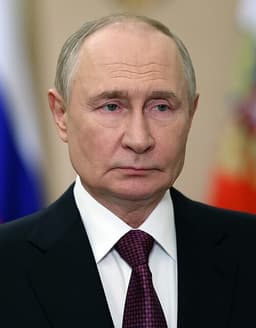
Dmitry Peskov
Politician · Modern
44.9Total

Napoleon Bonaparte
General · Modern
70.9Total
Basic Information
Born
1967
1769
Died
—
1821
Era
Modern
Modern
Nationality
Russia
France
Occupation
Politician
General
Civilization
Western
Western
Score Comparison
Military (10%)
50.0
94.0
Political (20%)
35.1
72.0
Influence (20%)
51.8
40.0
Legacy (20%)
38.3
80.0
Leadership (15%)
53.2
78.0
Strategy (15%)
41.0
90.0
TOTAL
44.9
70.9
Dmitry Peskov — Complete Timeline
1999 AD
Appointed Deputy Press Secretary of the PresidentPolitical Action
Peskov was appointed Deputy Press Secretary for President Boris Yeltsin in 1999, later serving under Putin. He worked under Press Secretary Alexei Gromov before taking over the role.
Presidential AdministrationMedia
Impact: national
2000 AD
Appointed Press Secretary of the President of RussiaPolitical Action◆ Major
Dmitry Peskov was appointed Press Secretary for President Vladimir Putin in 2000, serving as the official spokesperson. He has been the primary conduit for Kremlin communications, handling media relations and public statements.
Presidential AdministrationMedia
Impact: national
2012 AD
Served as Deputy Chief of the Presidential AdministrationPolitical Action◆ Major
Peskov was appointed Deputy Chief of the Presidential Administration in 2012, while retaining his role as Press Secretary. He gained broader responsibilities in managing Kremlin communications and policy coordination.
Presidential AdministrationLeadership
Impact: national
2014 AD
Managed communication during the annexation of CrimeaPolitical Action◆ Major
Peskov was the Kremlin's chief spokesperson during the annexation of Crimea in 2014, presenting the Russian government's narrative. He denied Russian military involvement initially, later acknowledging it, and defended the annexation as a legitimate act.
CrimeaMedia
Impact: global
Napoleon Bonaparte — Complete Timeline
1799 AD
Coup of 18 BrumaireOther◆ Major
Napoleon Bonaparte, with support from his brother Lucien and key political figures, overthrew the Directory in a bloodless coup. He established the Consulate with himself as First Consul, effectively becoming the ruler of France. This event ended the French Revolution's most unstable period.
French RevolutionCoupRise to Power
Impact: regional
1804 AD
Promulgation of the Napoleonic CodeOther◆ Major
Napoleon enacted the Civil Code of the French, known as the Napoleonic Code, a comprehensive set of laws that replaced the fragmented feudal legal systems. The code established legal equality, protected property rights, and secularized law. It became the basis for legal systems in many European and world countries.
Legal ReformNapoleonic CodeCivil Law
Impact: globalconstructive
1805 AD
Battle of AusterlitzWar◆ Major
Napoleon's Grande Arm
Napoleonic WarsBattleDecisive Victory
Impact: global
1812 AD
Invasion of RussiaWar◆ Major
Napoleon led the Grande Arm
Napoleonic WarsInvasionDisaster
Impact: globaldestructive
1815 AD
Battle of WaterlooWar◆ Major
Napoleon's French army was defeated by the combined forces of the Duke of Wellington's Anglo-Allied army and Gebhard Leberecht von Bl
Napoleonic WarsBattleFinal Defeat
Impact: globaldestructive
Expert Analysis
dmitry-peskov-vs-napoleon-bonaparte
# The Spokesman and the Emperor
In the summer of 1815, as the Duke of Wellington’s cannons fell silent at Waterloo, Napoleon Bonaparte stood on the deck of the *Bellerophon*, a prisoner of his own ambition. Two centuries later, in a marble-lined Kremlin corridor, Dmitry Peskov faced a very different kind of battle: a scrum of journalists, each demanding an explanation for a war that would reshape Europe. One man commanded armies; the other commands words. Yet both were architects of power in their own age. How did a Corsican artillery officer and a Soviet-born diplomat come to define the relationship between authority and communication? The answer lies not in their shared era—both lived in modernity—but in the chasm between the sword and the microphone.
Origins
Napoleon Bonaparte was born in 1769 on the island of Corsica, a rocky Mediterranean outpost that had only recently become French. His family was minor nobility, but his education at the military academy of Brienne was anything but aristocratic—he was mocked for his accent and his poverty. This outsider’s hunger drove him. He devoured history and military strategy, and by the time he was a young officer, he had absorbed the Enlightenment ideals of meritocracy and rational law. The French Revolution, which erupted when he was twenty, shattered the old order and opened a path for a man of talent.
Dmitry Peskov was born in 1967 in Moscow, the heart of a Soviet Union that seemed eternal. His father was a diplomat, and young Dmitry grew up in the world of official communiqués and state secrets. He studied at the Moscow State Institute of International Relations, the training ground for the Soviet elite. When the USSR collapsed in 1991, Peskov was thirty-four—old enough to remember the old system, young enough to adapt. He did not inherit a revolution; he inherited a wreckage. Where Napoleon seized a world in flames, Peskov slipped into a world of shadows.
Rise to Power
Napoleon’s ascent was a series of explosions. In 1793, at the age of twenty-four, he drove the British out of Toulon with a brilliant artillery plan. By 1796, he commanded the Army of Italy, where he won six victories in as many months. He was not merely a general; he was a phenomenon. He understood that in the chaos of revolution, a man who could deliver victory could also deliver legitimacy. In 1799, he staged a coup and made himself First Consul. By 1804, he crowned himself Emperor in Notre-Dame, snatching the crown from the Pope’s hands.
Peskov’s rise was quieter, a slow climb through the bureaucracy. In 1999, he was appointed Deputy Press Secretary for President Boris Yeltsin, a role that required managing a chaotic and often drunk leader’s public image. When Vladimir Putin took power in 2000, Peskov was made Press Secretary. He did not conquer; he adapted. He learned to speak in the language of control—careful, precise, never revealing more than necessary. In 2012, he became Deputy Chief of the Presidential Administration, a position that gave him influence over the entire state apparatus. His power was not the power to command armies, but to shape what the world knew.
Leadership & Governance
Napoleon governed like he fought: with speed, clarity, and overwhelming force. He reformed French law through the Napoleonic Code, a system that enshrined equality before the law, property rights, and secular governance. He reorganized education, built roads, and stabilized the currency. His military genius—rated 93 in strategy—was matched by a political mind that understood the value of propaganda. He controlled the press, staged grand ceremonies, and used bulletins from the battlefield to create a myth of invincibility.
Peskov’s governance is the governance of the mask. He does not write laws or lead armies; he manages the narrative. His military score is 37.5, his political score 54.1—mediocre by the standards of a ruler, but irrelevant for a spokesman. His genius lies in his 76.7 leadership score: the ability to stand before a room of hostile journalists and answer every question with a deflection, a denial, or a counter-accusation. During the annexation of Crimea in 2014, Peskov was the voice of the Kremlin, presenting the seizure as a humanitarian mission. He did not need to win battles; he needed to win the argument.
Triumph & Tragedy
Napoleon’s greatest triumph was Austerlitz in 1805, where he crushed the combined armies of Austria and Russia. His greatest tragedy was the invasion of Russia in 1812. He marched 600,000 men into the snow; fewer than 100,000 returned. It was not a single defeat but a slow, grinding collapse—a lesson in overreach. He was exiled to Elba, returned for a hundred days, and then met his final ruin at Waterloo in 1815.
Peskov’s triumphs are harder to measure. He has survived every purge, every scandal, every shift in the Kremlin’s line. His tragedy may be that he will never be remembered for anything but his words. In 2022, as Russia launched its full-scale invasion of Ukraine, Peskov stood at the podium and called it a “special military operation.” He became the face of a war that would isolate Russia and kill hundreds of thousands. His triumph is survival; his tragedy is complicity.
Character & Destiny
Napoleon was a man of immense will, convinced that he was the instrument of destiny. “Impossible is a word to be found only in the dictionary of fools,” he once said. His personality—ambitious, restless, brilliant—drove him to conquer Europe, but also to destroy himself. He could not stop. He believed that the world was a stage and he was its star.
Peskov is the opposite. He is the voice without a face. His personality is submerged in the institution he serves. He does not speak for himself; he speaks for Putin. His destiny is to be forgotten—or remembered only as a footnote. Where Napoleon left a code, a legend, and a tomb at Les Invalides, Peskov will leave transcripts of press briefings and a reputation for obfuscation.
Legacy
Napoleon’s legacy is vast. The Napoleonic Code influenced legal systems across Europe and the world. He reshaped borders, toppled monarchies, and inspired nationalism. His military tactics are still studied. He is a figure of both admiration and revulsion, a man who liberated and enslaved in equal measure.
Peskov’s legacy is narrower. He is a symbol of the modern information war, where the battle is not for territory but for truth. He represents the power of the spokesperson—the person who can make a lie sound like a fact, a crime sound like a necessity. His legacy score of 52.4 reflects this: not greatness, but effectiveness.
Conclusion
Napoleon and Peskov are separated by two centuries, but they share a single truth: power must be communicated. Napoleon used the bullet and the bulletin; Peskov uses the microphone and the denial. One conquered with armies, the other with words. But both understood that the real battle is for the minds of men. Napoleon’s tragedy was that he believed he could conquer the world. Peskov’s tragedy is that he knows he can only defend it. In the end, the emperor and the spokesman are both prisoners of the stories they tell.
Rankings
🥇
Napoleon BonaparteLeader
Mil: 94.0Pol: 72.0Inf: 40.0
70.9
🥈
Dmitry Peskov
Mil: 50.0Pol: 35.1Inf: 51.8
44.9
+26.0 behind
How This Comparison Works
Algorithm
Each figure is scored on 6 dimensions (0—100 scale) based on structured historical data: Military (10%), Political (20%), Influence (20%), Legacy (20%), Leadership (15%), Strategy (15%). The weighted total produces the final ranking.
Data Sources
Scores are computed from structured sub-indicators in the database. Scale factors adjust for era (Ancient ×0.85, Modern ×1.0) and civilization size (Eastern ×1.05, Other ×0.80) to account for differences in population and military scale.
Maximum 3 Figures
Comparisons are limited to 2—3 figures to ensure readability and statistical meaningfulness.
Error Margins
±5 points per dimension — Sub-scores are derived from historical records with inherent uncertainty. Two figures within 5 points on a dimension should be considered roughly equivalent in that area.
Total Score Accuracy
±3 points overall — The weighted combination of 6 dimensions produces a total score with approximately ±3 points of uncertainty. Differences of less than 3 points are not statistically significant— the figures are effectively tied.
Known Limitations
- Historical records are incomplete and uneven across civilizations
- Figures from oral-tradition societies may be underrepresented
- Occupation labels can misclassify multi-role figures
- Scores measure capability and impact, not moral character
- Quantitative scoring is a comparison tool, not absolute truth
Capability Radar
Military (10%) — Battles & Warfare
Battles
27
95
Win Rate
33
90
Expansion
34
95
Political (20%) — Governance & Reform
Reform
10
95
Diplomacy
55
80
Economy
10
85
Influence (20%) — Cultural & Global Reach
Cultural
10
85
Global
40
90
Legacy (20%) — Historical Impact
Historical
20
95
Longevity
10
90
Leadership (15%) — Power & Stability
Tenure
70
85
Stability
30
70
Strategy (15%) — Tactics & Innovation
Strategy
37
95
Tactics
40
98
Reform
42
92
Similar Comparisons
Comments & Discussion
GRENADIER'S GHOST6/17/2026
"Napoleon conquered Europe with cannons and cavalry; Peskov conquers press conferences with obfuscation and deflection. The Corsican's bulletins from Austerlitz were propaganda, yes, but he'd ridden through grapeshot to earn that right. Peskov parses semantics from a Moscow office while men die in Ukraine. One risked the battlefield; the other risks only his syntax. That's the difference between an emperor who walked among his dead and a spokesman who tweets from behind blast walls."
克里姆林译者6/17/2026
"把外交官佩斯科夫和拿破仑放在一起比较,不是一般的历史类比,而是一种系统性曲解。拿破仑活着的时候是真正的独裁者,他亲手签署处决令、重构欧洲版图。佩斯科夫呢?他是个官僚,一个传声筒,只是个工具人。把一个传达指令的人和一个创造历史的人相提并论,就像把打字机和文学混为一谈。这是现代媒体对权力本质的肤浅理解,让它看起来比实际更浪漫。"
SKEPSIS REVIVED6/17/2026
"Let's be real: one man rewrote civil law, reorganized German states, and marched armies from Madrid to Moscow. The other parses questions about gas pipelines. The data doesn't support this comparison. Napoleon's diplomatic correspondence was a tool of conquest—ultimatums backed by bayonets. Peskov's statements are damage control for an energy war. Conflating a grand strategist with a mid-level media manager cheapens our understanding of power. This is clickbait historiography, not analysis."
双头鹰观察者6/17/2026
"两人唯一的共同点就是都在为宏大叙事服务。拿破仑的圣赫勒拿回忆录是在塑造自己的历史形象;而佩斯科夫每天的简报同样是克里姆林宫版本的历史书写。区别在于:拿破仑知道自己在编故事,而且他编得很精彩;佩斯科夫只是照本宣科,连他自己的声音都听不见了。一个是操控过去的天才,一个是操控当代的传声筒。说白了,一个史诗一个公关。"
CANNONFODDER'S COUSIN6/17/2026
"Hold up—both men faced an impossible strategic situation and chose doubling down over backing down. Napoleon refused diplomacy at Leipzig when he had 200,000 men; Peskov denies reality while Russia burns through its tank fleet. Neither admits error. Napoleon at his peak could lose 30,000 men at Eylau and call it victory; Peskov calls a missile strike on a shopping mall 'a response to provocation.' Pattern recognition: power intoxicates, and these two are drunk on the same poison."