Loading...
Dmitry Peskov vs Franklin Pierce
Franklin Pierce leads by 1.3 pts · 2 figures compared
…
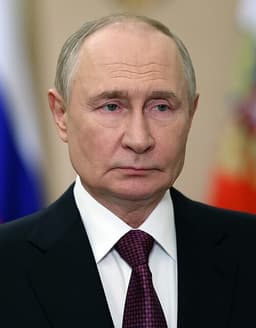
Dmitry Peskov
Politician · Modern
44.9Total

Franklin Pierce
Politician · Modern
46.2Total
Basic Information
Born
1967
1804
Died
—
1869
Era
Modern
Modern
Nationality
Russia
United States
Occupation
Politician
Politician
Civilization
Western
Western
Score Comparison
Military (10%)
50.0
50.0
Political (20%)
35.1
30.8
Influence (20%)
51.8
48.6
Legacy (20%)
38.3
41.7
Leadership (15%)
53.2
65.7
Strategy (15%)
41.0
41.6
TOTAL
44.9
46.2
Dmitry Peskov — Complete Timeline
1999 AD
Appointed Deputy Press Secretary of the PresidentPolitical Action
Peskov was appointed Deputy Press Secretary for President Boris Yeltsin in 1999, later serving under Putin. He worked under Press Secretary Alexei Gromov before taking over the role.
Presidential AdministrationMedia
Impact: national
2000 AD
Appointed Press Secretary of the President of RussiaPolitical Action◆ Major
Dmitry Peskov was appointed Press Secretary for President Vladimir Putin in 2000, serving as the official spokesperson. He has been the primary conduit for Kremlin communications, handling media relations and public statements.
Presidential AdministrationMedia
Impact: national
2012 AD
Served as Deputy Chief of the Presidential AdministrationPolitical Action◆ Major
Peskov was appointed Deputy Chief of the Presidential Administration in 2012, while retaining his role as Press Secretary. He gained broader responsibilities in managing Kremlin communications and policy coordination.
Presidential AdministrationLeadership
Impact: national
2014 AD
Managed communication during the annexation of CrimeaPolitical Action◆ Major
Peskov was the Kremlin's chief spokesperson during the annexation of Crimea in 2014, presenting the Russian government's narrative. He denied Russian military involvement initially, later acknowledging it, and defended the annexation as a legitimate act.
CrimeaMedia
Impact: global
Franklin Pierce — Complete Timeline
1852 AD
Elected President of the United StatesPolitical Action◆ Major
Pierce won the 1852 presidential election as a dark horse Democratic candidate, defeating Whig Winfield Scott. He carried all but four states, benefiting from the Whig Party's collapse.
PresidencyElectionDemocratic Party
Impact: national
1853 AD
Gadsden PurchasePolitical Action
Pierce authorized the Gadsden Purchase, acquiring 29,670 square miles from Mexico for $10 million. The land in present-day Arizona and New Mexico was intended for a southern transcontinental railroad route.
Territorial ExpansionGadsden PurchaseRailroad
Impact: regional
1854 AD
Signed the Kansas-Nebraska ActPolitical Action◆ Major
Pierce signed the Kansas-Nebraska Act, which repealed the Missouri Compromise and allowed popular sovereignty on slavery in Kansas and Nebraska. This led to violent conflict in 'Bleeding Kansas'.
Kansas-Nebraska ActSlaveryBleeding Kansas
Impact: nationaldestructive
Ostend ManifestoPolitical Action
Pierce's administration supported the Ostend Manifesto, a secret document advocating U.S. acquisition of Cuba by force if Spain refused to sell. The leak caused a diplomatic scandal and damaged Pierce's reputation.
CubaImperialismScandal
Impact: nationaldestructive
1856 AD
Lost 1856 Democratic NominationPolitical Action◆ Major
Pierce sought the Democratic nomination for a second term but was defeated by James Buchanan. His support for the Kansas-Nebraska Act and the resulting violence made him unelectable.
ElectionDemocratic PartyKansas-Nebraska Act
Impact: nationaltragic
Expert Analysis
Origins
Dmitry Peskov was born in 1967 in Moscow, Russia. He graduated from the Moscow State Institute of International Relations (MGIMO) in 1989, specializing in Oriental studies. He began his career in the Soviet Ministry of Foreign Affairs, serving in Turkey. Franklin Pierce was born in 1804 in Hillsborough, New Hampshire. He graduated from Bowdoin College and studied law. He served in the New Hampshire legislature and as a U.S. Representative and Senator before the presidency.
Rise to Power
Peskov rose through the ranks of the Russian government. He served as Deputy Press Secretary for President Boris Yeltsin in 1999. In 2000, he was appointed Press Secretary for President Vladimir Putin, becoming the Kremlin's primary spokesperson. His role expanded in 2012 when he became Deputy Chief of the Presidential Administration. Pierce rose to prominence as a Democrat. He was nominated as a dark horse candidate in 1852 and won the presidency, carrying all but four states. His election was aided by his support for the Compromise of 1850.
Leadership & Governance
Peskov's leadership is defined by his role as a spokesperson, not a policymaker. He manages the Kremlin's media strategy, often presenting controversial narratives, such as during the annexation of Crimea in 2014. His political score is 35.1, reflecting limited autonomous power. Pierce's leadership was marked by his signing of the Kansas-Nebraska Act in 1854, which repealed the Missouri Compromise and allowed popular sovereignty on slavery. This deepened North-South divisions. His leadership score is 65.7, indicating a more direct impact on governance.
Triumph & Tragedy
Peskov's successes include effectively managing communication for Putin, maintaining a consistent narrative. His failures include being implicated in propaganda efforts that have been criticized internationally. Pierce's greatest success was the Gadsden Purchase in 1853, acquiring land for a southern transcontinental railroad. His greatest failure was the Kansas-Nebraska Act, which led to "Bleeding Kansas" and the collapse of the Whig Party. He also supported the Ostend Manifesto, which advocated seizing Cuba.
Character & Destiny
Peskov is known for his loyalty to Putin and his skill in deflecting criticism. His character shaped his fate as a long-serving spokesperson. Pierce was known for his charm and indecisiveness. His character led him to compromise on slavery, which ultimately ruined his political career. He lost the 1856 Democratic nomination due to the fallout from the Kansas-Nebraska Act.
Legacy
Peskov's legacy is tied to Putin's regime. He will be remembered as a key propagandist. His influence score is 51.8. Pierce's legacy is negative; he is often ranked among the worst US presidents. His actions accelerated the Civil War. His legacy score is 41.7.
Conclusion
Franklin Pierce had a greater historical impact, scoring 46.2 total versus Peskov's 44.9. Pierce's decisions directly affected the course of US history, while Peskov's role is secondary. Despite lower leadership scores, Pierce's presidency had more far-reaching consequences.
Rankings
🥇
Franklin PierceLeader
Mil: 50.0Pol: 30.8Inf: 48.6
46.2
🥈
Dmitry Peskov
Mil: 50.0Pol: 35.1Inf: 51.8
44.9
+1.3 behind
How This Comparison Works
Algorithm
Each figure is scored on 6 dimensions (0—100 scale) based on structured historical data: Military (10%), Political (20%), Influence (20%), Legacy (20%), Leadership (15%), Strategy (15%). The weighted total produces the final ranking.
Data Sources
Scores are computed from structured sub-indicators in the database. Scale factors adjust for era (Ancient ×0.85, Modern ×1.0) and civilization size (Eastern ×1.05, Other ×0.80) to account for differences in population and military scale.
Maximum 3 Figures
Comparisons are limited to 2—3 figures to ensure readability and statistical meaningfulness.
Error Margins
±5 points per dimension — Sub-scores are derived from historical records with inherent uncertainty. Two figures within 5 points on a dimension should be considered roughly equivalent in that area.
Total Score Accuracy
±3 points overall — The weighted combination of 6 dimensions produces a total score with approximately ±3 points of uncertainty. Differences of less than 3 points are not statistically significant— the figures are effectively tied.
Known Limitations
- Historical records are incomplete and uneven across civilizations
- Figures from oral-tradition societies may be underrepresented
- Occupation labels can misclassify multi-role figures
- Scores measure capability and impact, not moral character
- Quantitative scoring is a comparison tool, not absolute truth
Capability Radar
Military (10%) — Battles & Warfare
Battles
27
28
Win Rate
33
32
Expansion
34
33
Political (20%) — Governance & Reform
Reform
10
10
Diplomacy
55
20
Economy
10
15
Influence (20%) — Cultural & Global Reach
Cultural
10
10
Global
40
10
Legacy (20%) — Historical Impact
Historical
20
30
Longevity
10
20
Leadership (15%) — Power & Stability
Tenure
70
60
Stability
30
5
Strategy (15%) — Tactics & Innovation
Strategy
37
39
Tactics
40
40
Reform
42
41
Similar Comparisons
Comments & Discussion
No comments yet. Be the first to share your thoughts!